
Meta and Apple have given local AI an unusually persuasive sales pitch: a large open-weight model running across two desktop computers, capable of working on code and understanding images, video and audio.
If your team has been waiting for a credible alternative to sending every AI request to a hosted model, this release deserves attention. It also deserves a closer look before someone orders the hardware.
The model is available through an access process. The specific high-memory Mac configuration is still coming. And running an agent locally leaves you responsible for its permissions, operating costs and mistakes.
Why this matters
Meta has released Muse Spark Open, an 816-billion-parameter mixture-of-experts model with 42 billion active parameters and a one-million-token context window. Meta calls it the most capable U.S. open-weight model to date. That is the company’s assessment, not an independently established winner for every workload.
The practical development is a documented path to running a quantized version across two 512GB M5 Ultra Mac Studios using Apple’s MLX framework. Apple’s published measurements make that more concrete than a stage demonstration, but they do not establish performance at the model’s full context limit or under a team’s concurrent workload.
My recommendation: evaluate one real assignment before making a hardware commitment. Decide what local execution would improve, then test whether the quality and operating cost justify it.
What Meta released
The Muse Spark Open model card describes text, image, video and audio inputs, with text output. “Natively multimodal” does not mean it generates finished videos or speaks back in audio.
Meta has published BF16 and NVFP4 repositories with weight files listed on Hugging Face. Access is manually gated and requires accepting the terms; this is not an unrestricted anonymous download. Meta also lists hosted inference partners, including Together AI, Fireworks, Baseten, Modal and OpenRouter. Those are alternative access routes, not evidence that each service offers identical features or pricing.
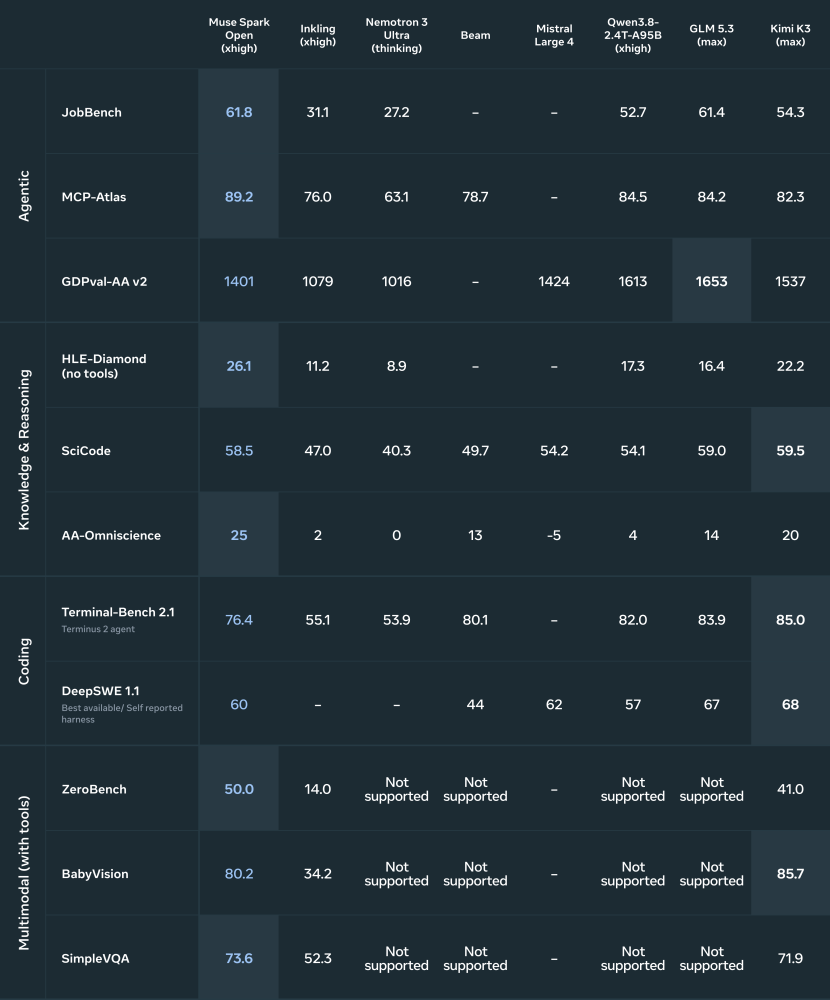
Developers have several deployment options. Meta lists SGLang, vLLM, TensorRT-LLM, Hugging Face Transformers, MLX, llama.cpp and Unsloth, with optimizations spanning AMD, Apple, Intel and NVIDIA hardware. It also points to PyTorch and TorchTitan for customization. For an implementation, check the exact checkpoint, precision, engine version and supported modalities rather than treating that list as a universal compatibility guarantee.
The parameter distinction matters. “42 billion active” describes the portion activated during computation; it does not turn the release into a model with only 42 billion parameters to store. Apple’s memory discussion is based on the full model footprint.
What two Mac Studios can actually do
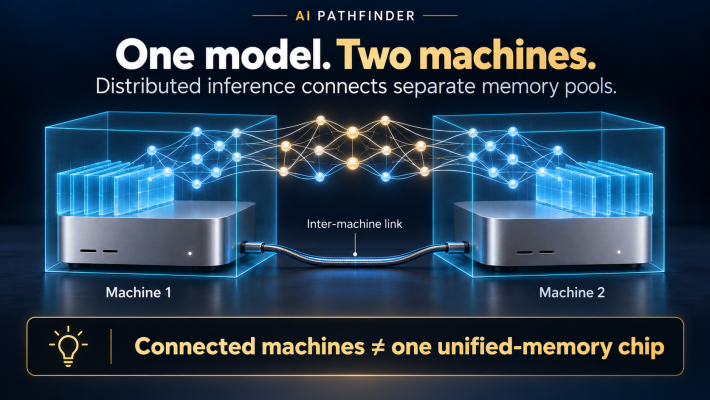
Apple’s distributed-inference research describes an NVFP4, four-bit version with a model footprint of about 493GB. The native BF16 weights alone require more than 1.6TB. In Apple’s tested setup, inference overhead makes the quantized model too large for a single 512GB Mac, so the work is distributed across machines.
This is two Macs with 512GB of unified memory each, connected for distributed inference. It is not one physically unified-memory chip, and the inter-machine connection should not be confused with the chip’s local memory bandwidth.
Apple reports the following two-machine results using tensor parallelism:
- At an 8,192-token context: 24.99 generated tokens per second, with 8.2 seconds to the first token.
- At a 65,536-token context: 23.84 generated tokens per second, with 70.3 seconds to the first token.
Those are Apple-published NVFP4 measurements, with batch size one and decoding measured over 128 generated tokens. They are not results from my own deployment. Nor are they a benchmark of a million-token prompt, multiple simultaneous developers or an agent completing an entire software change.
That first-token delay is worth noticing. A model can generate at a respectable pace once it starts and still make someone wait while it processes a large input. For an interactive coding assistant, both numbers affect the experience.
There is also a procurement caveat. Apple’s Mac Studio announcement says the 512GB configuration is coming in late October. The October 15 model release should not be read as immediate shipment of the demonstrated hardware configuration. A base-model Mac Studio price would also be the wrong basis for costing this setup.
Apple and Meta are cooperating. Your architecture still needs boundaries.
The partnership is an entertaining part of the story. “We’re excited for mommy and daddy to be playing nice again,” Alexandr Wang told Axios in its reporting on the Apple–Meta collaboration.
For buyers, the useful outcome is a model and a local runtime being developed together. This announcement does not establish a Muse integration into Apple Intelligence.
Meta says it tested local agentic workflows using Muse Code powered by Spark Open, including changes to the Ice Cubes iOS app and work inside DaVinci Resolve. These are vendor-reported examples, not independent proof that an arbitrary repository or editing project will work equally well.
A model is one component of that experience. The agent application supplies the tools, instructions and execution environment. Downloading the weights does not automatically reproduce Muse Code’s workflow or controls.
The same distinction applies to privacy. Local inference can keep model computation on your machines. An agent that then calls a hosted search service, sends telemetry, uploads a file or uses a cloud connector may still move data outside your environment. Before calling a workflow “fully local,” inspect its network behavior and dependencies.
Open-weight does not mean unrestricted commercial use
The Muse Model License permits substantial use, modification and distribution, subject to its conditions. It is a custom license, not a blanket promise of unrestricted open-source rights.
Its commercial trigger is specific. If a licensee or its affiliates provides model-as-a-service access, and their aggregate gross revenue exceeds US$20 million during any consecutive twelve months, they must notify Meta and enter a separate written agreement before offering the software or derivatives as part of that business.
That is not a general revenue ceiling on every company using the model. Internal use and non-model-as-a-service product features are expressly excluded from that particular restriction. Other obligations still apply, including “Built with Muse Spark Open” attribution and the usage policy.
Teams planning fine-tuning or synthetic-data training should also read the derivatives definition. It extends to models improved using the software’s outputs, not just direct edits to the weights. Have counsel review your intended use rather than relying on the phrase “free for many developers.”
Your AI Pathfinder Action Plan
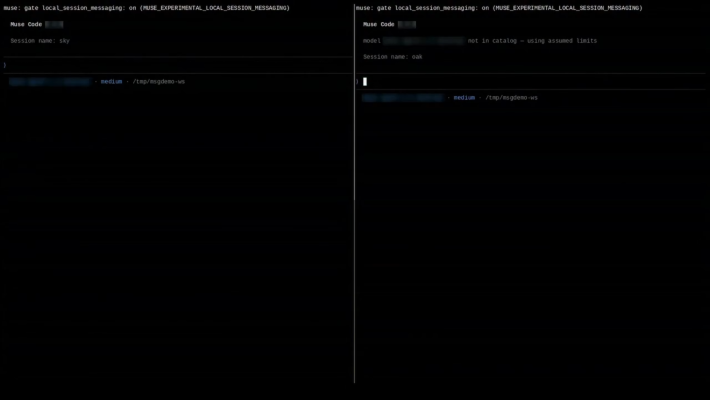
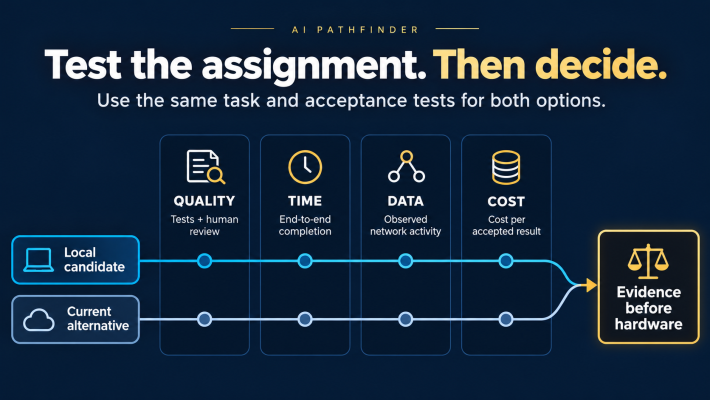
I would start with a contained software-maintenance task: reproduce a bug in a non-sensitive test repository, make a change, run the tests and produce a reviewable diff. No production credentials, automatic merge or deployment permission.
Use the same task specification and acceptance tests for the local candidate and your current alternative. Record the application, model precision, context settings and tools so a change in the surrounding system does not get mistaken for a model improvement.
Before the trial, agree on what would justify switching:
- Does the change pass the tests and survive human review? Record missed requirements and regressions, not just whether the agent says it finished.
- How long does the whole assignment take? Include prompt processing, retries, tool execution and reviewer correction time.
- What leaves the machine? Inspect network access and logs rather than relying on where the weights are stored.
- What does the accepted result cost? Include hardware over its useful life, electricity, software, administration and idle capacity alongside any API charges.
If hardware is not yet available, a hosted trial can help assess task quality. It cannot establish local latency, local privacy or the cost of operating the two-Mac configuration. Keep those as separate tests.
For occasional use or a team without someone to maintain the deployment, hosted inference may remain the simpler choice. A sustained workload with a clear control requirement is a stronger reason to investigate self-hosting. Neither conclusion follows from a benchmark ranking alone.
Frequently Asked Questions (FAQs)
Can I run Muse Spark Open on an ordinary Mac?
The documented configuration discussed here uses two M5 Ultra Mac Studios with 512GB of memory each and NVFP4 weights. Do not translate that into a claim that the full model fits on a typical laptop or base Mac Studio.
Does a million-token context guarantee reliable long-task memory?
No. It specifies capacity. Test whether the model finds the relevant information, follows changed requirements and avoids reviving an obsolete decision. Apple’s cited Mac measurements use shorter contexts.
Does “most capable” mean it will beat my current coding assistant?
Not necessarily. Meta’s evaluation methodology combines internal runs, external leaderboard results and provider reports, with differences in harnesses and sampling. Evaluate the complete application on your own tasks before replacing it.
The Bottom Line

Muse Spark Open gives developers more choice about where a capable model runs and how it can be adapted. The Apple work adds a concrete desktop deployment route, with published measurements and clear configuration requirements.
For a business, the next step is a workload decision. Choose the assignment you want to bring local, identify why it belongs there, and gather enough evidence to decide whether the hardware and operating responsibility are worth taking on.
The companion AI Pathfinder analysis of Muse Wonder looks at a related question: whether an agent can finish a revised assignment without crossing its authority boundaries. Spark Open makes deployment location a more interesting choice; it does not remove that test.
About Jason Fleagle
Jason Fleagle is Head of AI for Netsync and writes AI Pathfinder to help leaders make practical decisions about AI strategy, governance and implementation. You can learn more at thejasonfleagle.com and netsync.com.