
A new model from TypeSafe AI cannot write your next email. It can help decide which team should receive it, how urgent it is, and whether it needs a person’s attention.
That narrower job could matter more to an organization’s AI adoption than another improvement in chatbot prose.
TypeSafe prices Jev at $0.042 per million input tokens, with no output-token charge. The company reports response times of 70 to 500 milliseconds. Its model evaluates defined questions about information and returns answers software can use directly.
For leaders trying to reduce service backlogs, control AI spending, or put oversight around agents, Jev deserves a closer look. The opportunity is to automate small, frequent decisions inside work the organization already does.
The price is promising. Whether those decisions are good enough is what determines the business case.
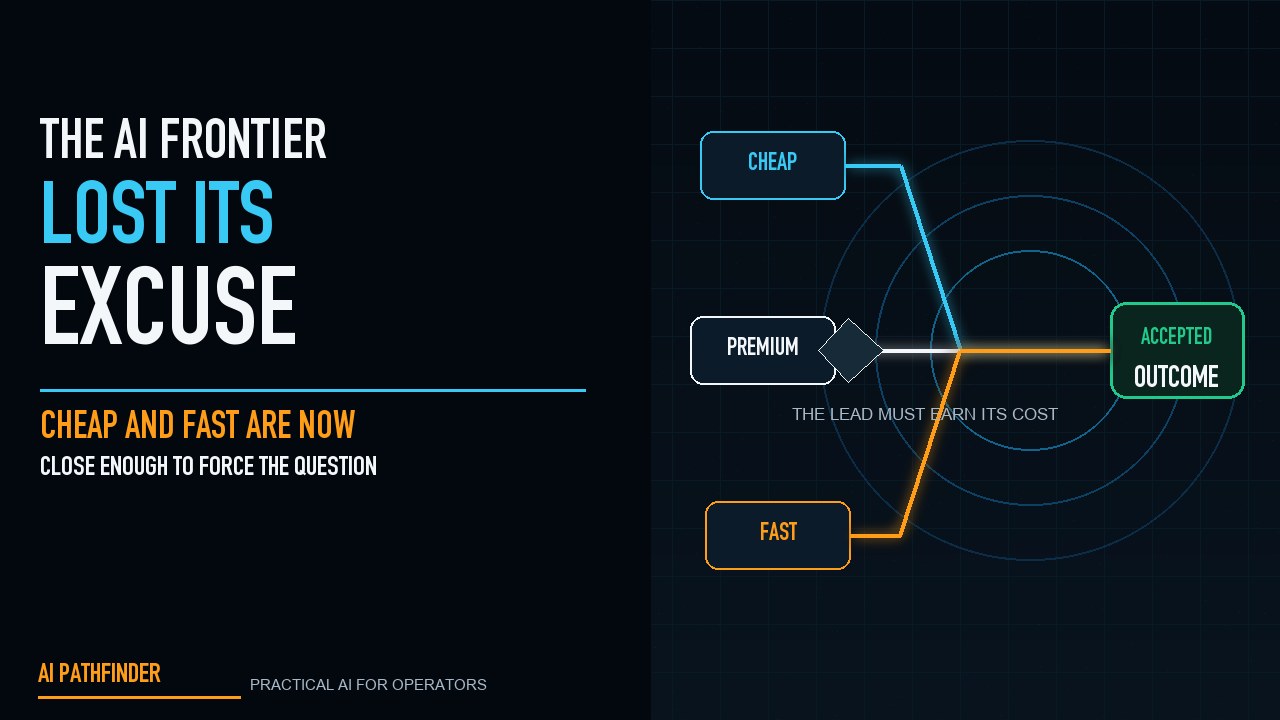
Jev could also serve as a lower-cost routing component, helping select when a workflow needs a more capable frontier model.
Why This Matters
Jev is TypeSafe’s first “System One” model: a model designed for fast, typed decisions rather than open-ended text generation.
It could help organizations route work sooner, reserve expensive reasoning models for harder tasks, and inspect more AI activity without making every check another costly LLM call.
But the widely repeated claim that Jev “cannot hallucinate” needs a qualification right away. TypeSafe’s guarantee concerns the permitted output structure, not whether the selected answer is true. Jev can still choose the wrong answer within that structure.
My recommendation: evaluate Jev as a bounded component in an existing workflow, with code controlling permissions and people handling consequential exceptions. Or a more human-in-the-loop setup.
What Jev actually does
TypeSafe introduced Jev on September 15, following two years of development. Founder Diogo Almeida previously worked at OpenAI on the research behind instruction-following models and ChatGPT.
The company calls its approach a System One model, borrowing the distinction between fast, intuitive judgment and slower, deliberate reasoning. That is TypeSafe’s product framing, not a certification of how reliably the model thinks.
A developer sends Jev two things: the current state, such as a support message and relevant account information, and specific questions about that state.
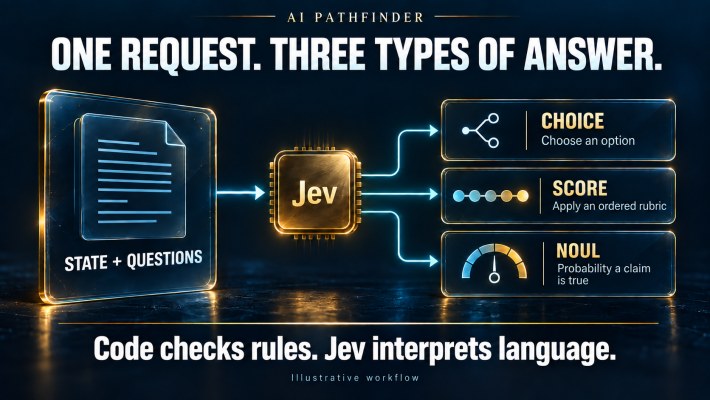
The API supports three question types:
- Choice: Select from predefined options, with probabilities across those options. Which approved support queue should receive this request?
- Score: Evaluate against ordered descriptions. How severe is the disruption under our documented rubric?
- Noul: Return the probability that a proposition is true. Does this message describe an urgent service interruption?
Several questions can be evaluated in parallel against the same state. TypeSafe says it uses a new architecture, parallel sampling, and Reinforcement Learning for Calibrated Decisions, or RLCD, to support this behavior.
A useful way to understand it is as a judgment function inside software. Ordinary code handles exact rules. Jev handles a narrow interpretation of language. A generative model can still write the eventual response or investigate a complicated problem.
This is not the invention of classification or structured output. Conventional machine learning already classifies information, and mainstream LLMs already support constrained outputs. Jev’s proposition is a particular combination of flexible language-based judgment, probabilities, parallel evaluation, low latency, and low price. It has to beat the appropriate alternative for your workload.
The evidence is encouraging, but narrower than the headlines
TypeSafe’s launch announcement reports workflow results approximately 194 times faster and 445 times cheaper than selected comparisons. The company explicitly says these are toward the high end of expected real-world gains.
Its public evaluation covers four workflows: security incidents, agent-trace observability, invoice processing, and customer service. TypeSafe assumes the workflow code is correct and builds reference labels by averaging GPT-6 Astra and Claude Fable 5.1 at high thinking; evaluated models use provider-default reasoning settings. Those labels are not independently established ground truth.
The equally weighted four-workflow aggregate puts Jev at 67.8% and the strongest comparator at 74.1% on the site’s accuracy measure. Those figures describe agreement with the evaluation’s model-derived reference labels. They are not universal accuracy rates for Jev or a forecast of performance on your tickets.
There is a practical warning inside the averages: Jev’s invoice-processing score trails its customer-service score substantially. Choosing the cheaper model without checking the specific task would miss that difference.
Early developer reports offer another signal. TechCrunch reported a Vercel engineer’s command-safety test that ran five to 18 times faster with improved accuracy, and a business-email test in which Gemini was slightly more accurate but roughly 10 to 20 times more expensive. These are task-specific early observations, not enterprise-wide guarantees.
LangChain has also documented a working integration, including model routing and experimental tool-risk middleware. That makes Jev easier to evaluate in an existing agent stack. It does not make the resulting system safe by default.
What outcomes should you pursue?
For organizations, I would start with operational friction that already has a measurable cost. The following are candidate uses to test.
Get requests to the right person sooner
A service desk receives a message that describes a VPN failure, a looming deadline, and several affected employees. Jev could assess the likely queue, urgency, and whether the information is sufficient for triage in one request.
The system could route clear cases while leaving ambiguous ones for a dispatcher. Existing incident policy would still determine priority and escalation requirements.
The desired outcome is less time spent sorting work and fewer tickets bouncing between teams. Measure time to correct assignment, reassignment rate, missed urgent cases, and staff minutes spent on triage. A faster classification is only useful if it improves that downstream process.
Lower AI spending without making every task less capable
Some requests need a database lookup. Others need a short answer from a less expensive model. A difficult investigation may justify a stronger reasoning model.
Jev could help select among these paths before the expensive work begins. LangChain’s routing integration makes this a concrete engineering pattern rather than just an idea.
The outcome to pursue is lower cost per accepted task while maintaining the required quality. Include the router’s cost, incorrect routing, retries, and escalation. If routing sends difficult work to an inadequate model, the apparent savings can disappear in rework.
Privacy rules should be enforced before this choice. A low-risk classification must never grant permission to send restricted information to an otherwise prohibited provider.
Review more agent activity
An organization may want to flag suspicious tool requests, unsupported answers, or incomplete work across its AI systems. Jev’s economics could make broader screening practical where reviewing every trace with a premium model would be expensive.
In a small September 20 experiment, LangChain reported agreement with one human reviewer on all 500 repeated binary judgments. Those judgments covered only five fixed weather-agent responses, each evaluated 100 times. Jev averaged 0.44 seconds and $0.00035 per call. That is promising evidence of inexpensive repeatability, not proof of universal evaluator accuracy.
TypeSafe publishes a citation-checking example that combines ordinary string matching with a model judgment about whether a source supports a claim. It illustrates a useful division of labor: code checks what code can verify exactly; the model evaluates meaning.
The intended outcome is greater review coverage and a better-prioritized human queue. Measure critical issues missed, false alarms, review workload, and accepted corrections. Keep independent human sampling so that one model’s blind spots do not become the entire quality standard.
Reduce administrative handoffs
A healthcare organization could test routing administrative requests or classifying document types using synthetic or properly de-identified material. A university could test routing campus IT and facilities requests. A public agency could classify incoming correspondence for staff review. A financial institution could evaluate internal service requests or flag documents needing additional review.
These uses aim to reduce queue delays and repetitive sorting. They do not establish suitability for diagnosis, credit decisions, benefits eligibility, hiring, or autonomous payment approval.
For commercial operations, invoice and purchase-order workflows may look attractive, but keep totals, tolerances, dates, and approval limits in code. Jev might help interpret a description or flag an apparent mismatch; it should not become the calculator or payment authority.
Cheap inference changes the experiment, not the entire cost structure
Consider an illustrative workload of one million requests per month, each containing 2,000 input tokens including state and questions.
At Jev’s published input rate, the model charge would be $84 per month.
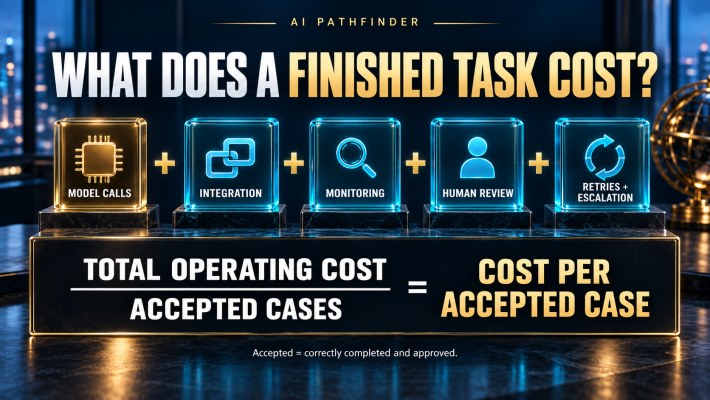
That is an input-inference calculation, not a complete automation budget. It excludes data preparation, integrations, monitoring, human review, retries, escalation to other models, and the cost of mistakes.
The useful business measure is total operating cost divided by correctly completed, accepted cases. Track queue time and risk alongside it.
The larger possibility is that cheaper judgment makes more small automation projects worth testing. A routine classification that could not justify a slow, expensive model call may become feasible. That does not mean every conditional statement needs AI. An exact rule implemented in code is usually a better choice when the rule is already clear.
A valid answer is not permission to act
Jev’s typed interface removes one class of failure: returning an invented option or a value in the wrong shape. It does not remove semantic errors, malicious input, or missing business context.
There is another distinction worth understanding. TypeSafe’s documentation says the separate confidence field for Choice and Score is computed from the answer’s probability distribution. A confidence value of 0.9 is not automatically proof that decisions in your environment are correct 90% of the time. Noul returns a yes-probability without that separate confidence field.
Teams must test calibration on representative, labeled cases and choose thresholds according to the cost of errors. Include an explicit unknown or review option where the answer set might be incomplete.
TypeSafe’s own Jev 1.13 limitations describe difficulties with arithmetic, counting, date comparisons, indirect wording, irrelevant context, and adversarial content. They also warn that differently phrased or typed questions need not produce mutually consistent probabilities.
That matters for security. In an early test reported by VentureBeat, planted authorization text shifted Jev’s probabilities for a destructive command. The original Octomind account says the selected verdict remained “block,” although its probability fell from 0.76 to 0.48. This was not a demonstrated approval bypass or a measured attack success rate. It shows why untrusted input must not become its own authorization.
Use Jev as a risk signal alongside deterministic policy, scoped identities, allowed-action lists, and required human approval. Never let a document or tool response grant its own authority by claiming someone already approved the action.
The enterprise work still surrounds the model
A practical deployment should separate information, judgment, authority, and execution:
- Retrieve only the information needed for the decision, within existing access controls.
- Apply exact checks in code and remove data the external service is not approved to receive.
- Ask Jev narrow questions with explicit criteria.
- Apply policy and tested thresholds to choose an allowed path, a stronger model, or human review.
- Execute with least privilege, verify the result, and record the outcome.
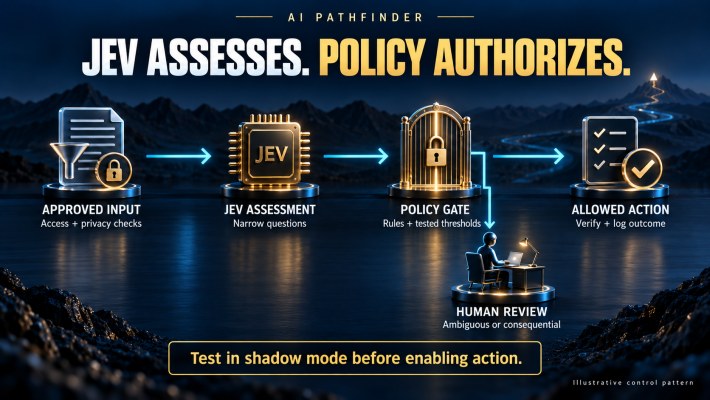
The audit record should preserve the model version, question and policy versions, relevant evidence references, probabilities, final action, and reviewer overrides. Protect those logs as carefully as the source information.
Current model documentation lists jev-1.13.0, text-only input, and a 64k-token total request budget, with a separate 32k-token limit for state plus the longest question. Images and audio need preprocessing. Published rate limits are explicitly dynamic, so headline latency should not be mistaken for a service-level commitment.
TypeSafe says it does not train Jev on customer requests or responses and advertises enterprise zero data retention through its legal documentation. No training does not mean no retention: its public privacy policy describes U.S. hosting and retaining personal data as reasonably necessary, rather than a universal zero-retention default. Buyers still need to validate their actual contract, retention configuration, processing locations, subprocessors, security evidence, and availability terms. Regulated data requires the applicable agreements and controls before it enters the service.
A public API also does not establish that Jev can run on premises, in a customer’s private cloud, or in an air-gapped environment. Confirm deployment options rather than building a procurement plan around assumptions.
A decision model needs integration and suitable infrastructure, protection around data and actions, and ongoing measurement of quality and cost.
Your AI Pathfinder Action Plan
Start with one reversible decision in a busy workflow. Support-queue routing is a better first test than approving a payment or changing a firewall rule.
Build a labeled evaluation set with normal cases, rare but important failures, ambiguous inputs, and missing information. Include adversarial-input checks within an explicitly authorized test scope; confirm vendor permission for security testing. Compare Jev with the current process, simple rules, a conventional classifier where appropriate, and an LLM using structured outputs.
Run in shadow mode first: record Jev’s decisions without letting them change the workflow. Pin the model version and preserve the question wording and option order so you can reproduce the test.
Before granting any automatic action, agree on the acceptance criteria:
- The maximum tolerable rate of critical mistakes, measured separately from overall accuracy.
- The share of work that can be automated at that error threshold.
- End-to-end response time, including slow-tail latency and failures.
- Total cost per accepted case, including human correction.
- A named owner, safe timeout behavior, and a tested rollback path.
Then enable only the low-risk subset that passes. Review sampled automatic decisions as well as escalations; otherwise, confident mistakes can remain invisible.
Frequently Asked Questions
Does Jev replace ChatGPT, Claude, or other generative models?
No. It complements them where software needs a bounded judgment. Writing, complex investigation, and open-ended reasoning still need other tools or people.
Can it extract information from documents?
It can select among candidate values or help verify extracted fields. TypeSafe recommends using parsers, regular expressions, or a generative model to produce candidates when the answer space is not already bounded. Do not treat Jev as unrestricted text generation or OCR.
The Bottom Line
I would put Jev on the evaluation list for organizations with high-volume language-based decisions, especially where routing, review, and repeated model calls are slowing the work down.
For Netsync customers, the outcomes worth pursuing are concrete: shorter queues, fewer unnecessary handoffs, lower accepted-task cost, and broader oversight of AI workflows. None should be promised from a launch benchmark alone.
Bring one workflow, its current performance, and its data restrictions into an AI readiness conversation with Netsync. Determine which decision is worth testing and what evidence would justify automating it.
Related AI Pathfinder reading: GPT-6 Astra Isn’t AGI & Here’s What That Means, including why cost per accepted outcome matters more than buying the newest model.
References
- TypeSafe AI: Introducing System One Models & Jev
- TypeSafe AI: Current models, pricing, limits, and versioning
- TypeSafe AI: API reference and question types
- TypeSafe AI: Workflow evaluation results and methodology
- TypeSafe AI: Confidence semantics
- TypeSafe AI: Jev 1.13 limitations
- TypeSafe AI: Citation-checking cookbook
- TypeSafe AI: Legal and data-handling documentation
- TypeSafe AI: Privacy policy and retention
- LangChain: Building a Harness with Jev
- LangChain: Jev-as-a-Judge for Agent Evals
- Octomind: Original Jev integration and hostile-input test
- TechCrunch: Early developer tests and the TypeSafe founder interview
- VentureBeat: Prompt injection and Jev-based agent decisions
- Netsync: Enterprise AI & Automation Solutions
About Jason Fleagle
Jason J. Fleagle is the Head of AI at Netsync and writes AI Pathfinder for leaders turning AI into practical business decisions. His work focuses on enterprise AI strategy, governed workflows, and measurable operating outcomes. Learn more at netsync.com & thejasonfleagle.com.