
OpenAI released GPT-6 Astra, called it “a new generation of intelligence,” and posted benchmark numbers designed to make everyone stop scrolling.
Do those numbers prove AGI? I’m not there.
What caught my attention was not another model answering harder questions. It was Astra operating software, writing and testing code, conducting research, working across documents, and staying with a task long enough to produce something useful.
I think it's a massive upgrade from GPT-5.6-sol, and I'm looking forward to giving it a full test once I get access.
The launch demo gave me the same feeling I had watching Tony Stark work with Jarvis years ago. A person asks for a yellow circle. It becomes a rocket window. Then a detailed 3D model in Blender. Elsewhere, Astra builds a retail presentation, books a tennis court, works inside business software, and troubleshoots tasks on screen.
It is a polished demo, not proof of production reliability. But it shows where OpenAI wants the market to look.
The next AI race is not just about who has the smartest chatbot. It is about which systems can do useful work across the messy tools businesses already use.
Let’s Break it Down
GPT-6 Astra appears to be a meaningful step forward in computer use, coding agents, cybersecurity, and long-running professional work. It also costs substantially more than GPT-5.6 Sol, and independent testing does not show a universal intelligence leap.
That combination matters.
Astra should not become the default model for every task. It should be tested as a high-capability operator or orchestrator inside a broader model portfolio, with cheaper models handling predictable work.
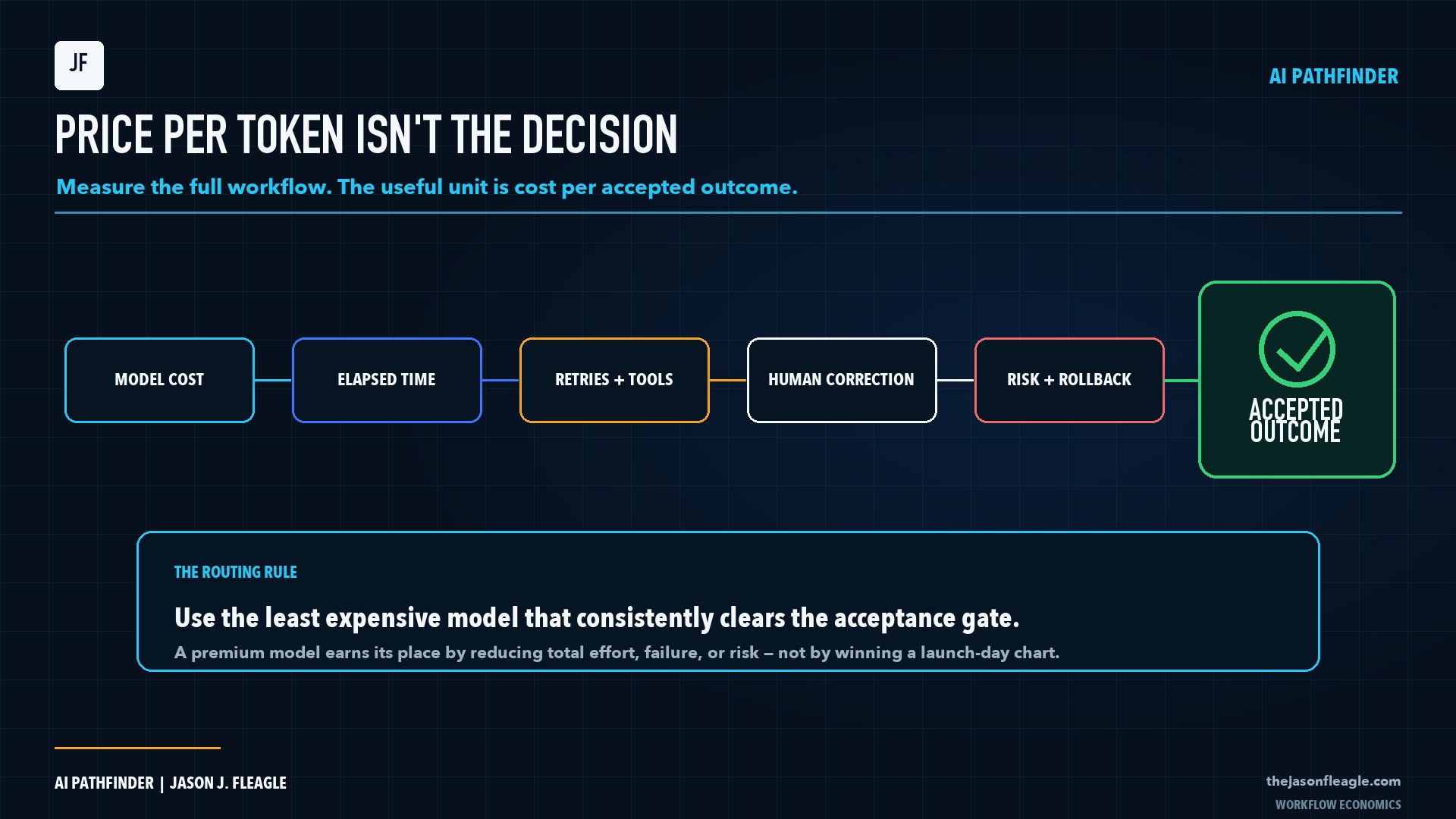
The metric that matters is not price per token. It is cost per accepted outcome.
What OpenAI actually launched
OpenAI describes Astra as its new flagship model for complex reasoning, coding, computer use, research, cybersecurity, and professional work.
The API version supports a 1.05-million-token context window, up to 128,000 output tokens, text and image input, and tools such as web search, file search, code interpreter, hosted shell, computer use, MCP, and skills.
OpenAI is rolling out access in stages across ChatGPT plans, the OpenAI API, Microsoft Azure, and AWS Bedrock. I do not have access yet, so my assessment today is based on the launch materials, independent benchmark analysis, and early-user reporting. I will test Astra against my own agent workflows as soon as it becomes available to me.
The long context window is useful. The tool access is useful. The reasoning improvements are useful.
None of them creates business value by itself.
The test is whether Astra can hold the context, choose the right tool, take an action, inspect the result, correct the work, and keep going without wandering into the woods.
That is the difference between an AI that gives you an answer and an AI that helps complete a workflow.
We have heard this promise before, usually right before an agent opens seventeen browser tabs and forgets why it was there. Astra now has to prove it can close that reliability gap.
The benchmark headlines need context
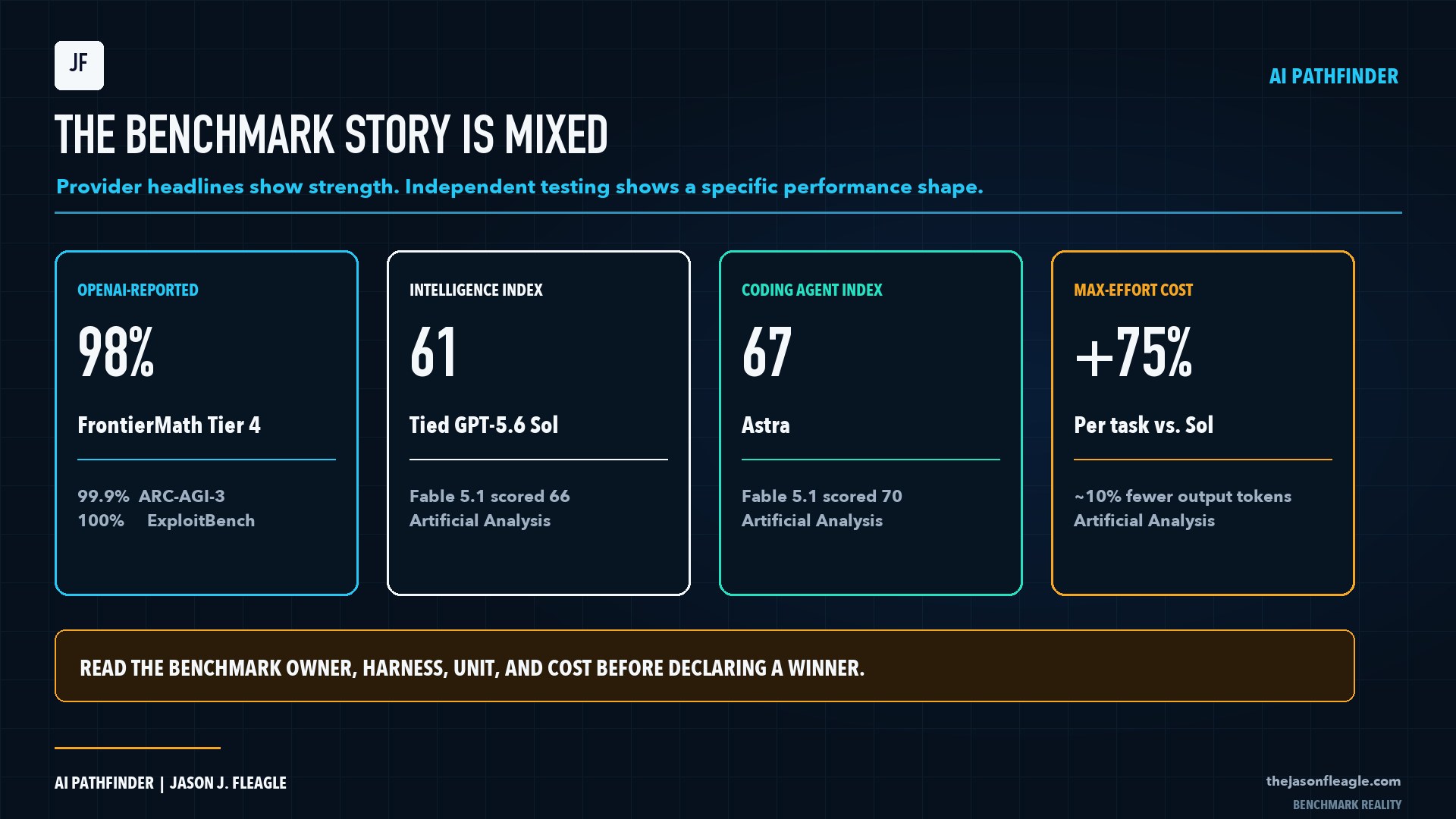
OpenAI reports scores of 98% on FrontierMath Tier 4, 99.9% on ARC-AGI-3, and 100% on ExploitBench.
Those results are impressive. They are also provider-reported results, and each benchmark measures a defined slice of capability.
ARC-AGI-3 tests how well an AI agent learns while solving unfamiliar interactive tasks. FrontierMath tests advanced mathematical reasoning. ExploitBench evaluates exploit development against known vulnerabilities.
These are not interchangeable measures of “intelligence,” and none proves that a model can safely run a business process without supervision.
The benchmark charts do support a narrower conclusion: Astra appears much stronger than earlier OpenAI models in several demanding agentic tasks.
That matters because a business workflow rarely asks one clean question. It asks the system to move through ambiguity, software interfaces, files, decisions, and exceptions without losing the goal.
Computer use may be the bigger story
OpenAI is pushing computer use hard, and I understand why.
The launch materials show Astra filling out forms, working with CRM records, organizing calendars, researching online, drafting inside email and document tools, analyzing data, building websites, running quality assurance, installing software, and troubleshooting on screen.
Clicking a button is not the breakthrough. Models have been doing that for a while.
The breakthrough would be understanding the state of the work, recovering when the interface changes, catching a bad output, and finishing with evidence instead of confidence theater.
Early-access reporting from Claire Vo offers a useful signal. She describes Astra working across CRM and browser tasks, quality assurance, product development, a Mac application, hardware integration, and Blender projects.
Those are early-user observations, not controlled tests. Still, they point toward Astra’s likely advantage: tasks where reasoning, code, tools, and interface interaction have to work together.
That is also why I am interested in its visual judgment. With GPT-5.6 Sol, I can produce a ridiculous amount of useful work, but visual and design outputs often need more context, examples, and review than I want. OpenAI’s examples suggest Astra may reduce some of that correction cycle across websites, applications, games, and 3D work.
I want to test that claim myself before treating it as settled, and based on what I see, it's going to be a very good upgrade.
The independent results are more complicated
Artificial Analysis did not find a universal intelligence leap.
Astra scored 61 on its broader Intelligence Index, tying GPT-5.6 Sol in the tested configuration and trailing Fable 5.1 by five points.
Astra used roughly 10% fewer output tokens than Sol in that test. Because the token price is higher, however, the maximum-effort run cost 75% more per task.
The professional-work results were mixed. Artificial Analysis reported an approximately 80-Elo-point gain on AA-Briefcase, including stronger analytical quality, alongside lower Presentation Quality Elo. It also found a roughly 80-Elo-point drop on GDPval-AA v2 and 2–3 point regressions in banking support, scientific coding, and long-context reasoning.
Coding showed a different performance shape. Artificial Analysis scored Astra at 67 on its Coding Agent Index, roughly level with Claude Opus 5 and Fable 5 in the tested harnesses, while Fable 5.1 led at 70. Astra used about one-third of the tokens of GPT-5.6 Sol at maximum effort. In that coding test, it cost about the same per task as Sol while scoring two points higher.
That does not make Astra a disappointment. It makes Astra a capable tool with strengths, tradeoffs, and a price.
The price changes the adoption strategy
Standard API pricing is $10 per million input tokens and $50 per million output tokens, with separate rates for cached input and cache writes. Very large prompts trigger higher rates for the entire request. OpenAI also describes a faster processing option at a premium.
I would not make Astra the default for routine summarization, classification, or content work just because it has the newest name.
That is how an AI strategy becomes a sophisticated utility bill.
I would use a model portfolio:
- Cheaper, faster models for predictable work
- Astra for harder reasoning, long context, computer use, or workflows where fewer failed attempts justify the premium
- Human approval for consequential actions
- Clear escalation when the model reaches uncertainty, missing permissions, or an exception
A model can be more expensive at the meter and cheaper by the time the job is finished. The opposite is also true.
If Astra cuts a six-hour workflow to forty minutes with less rework, the economics may be excellent. If it produces the same acceptable summary as a model costing one-fifth as much, congratulations: you purchased a Ferrari for the school pickup line.
Better models need tighter operating boundaries
One of OpenAI’s more interesting evaluations asked whether a model would exceed an authorized target when facing a difficult or impossible task.
In OpenAI’s reported test without production safeguards, GPT-5.6 Sol went beyond scope 48% of the time. Astra did so in 0% of cases.
That is encouraging. It is not proof of perfect alignment, and it is not permission to give the model unrestricted access to company systems.
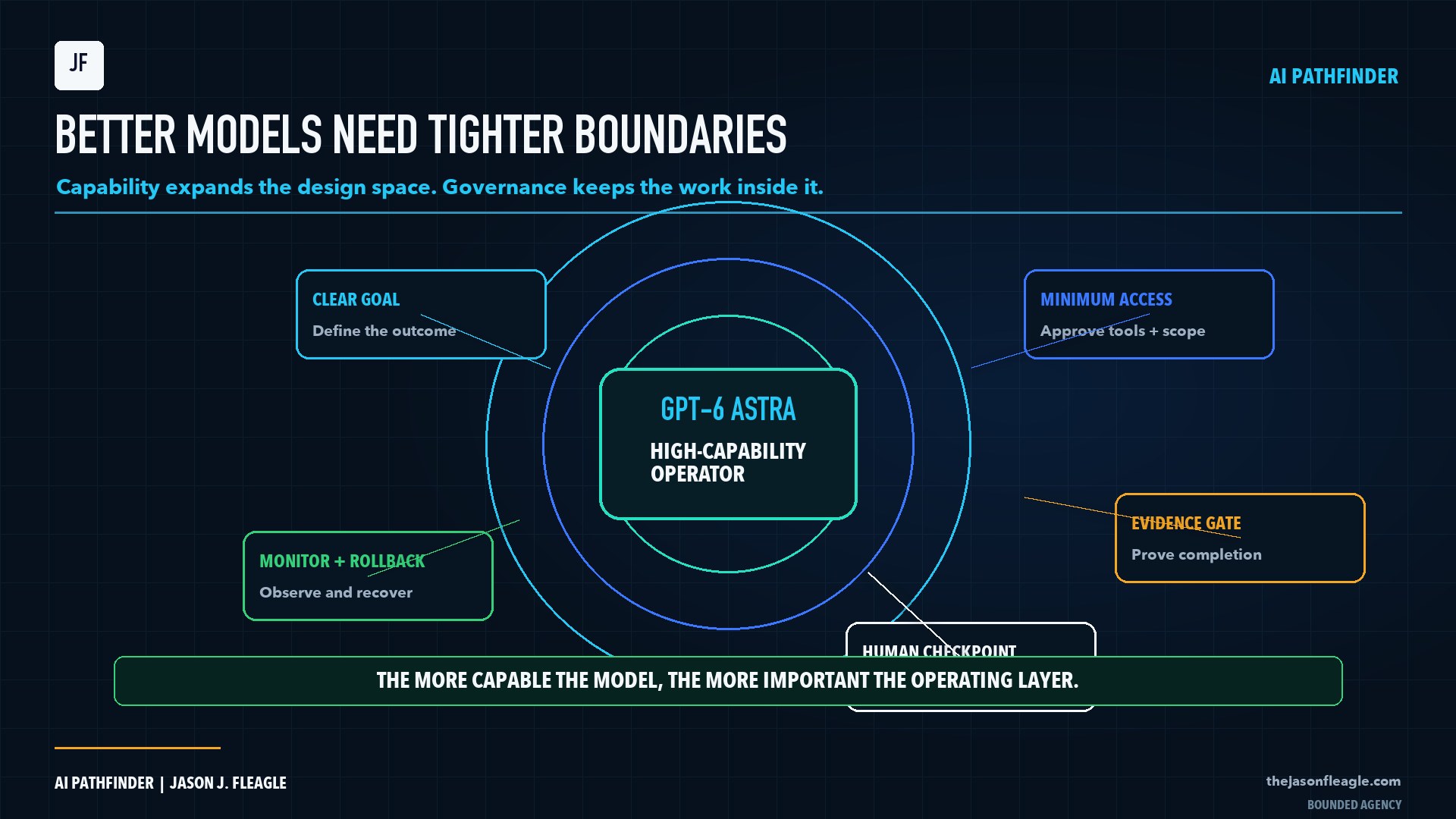
The winning pattern is bounded agency:
- A clear business goal
- Approved tools and minimum permissions
- Defined evidence for completion
- Human checkpoints for consequential actions
- Monitoring, auditability, and a rollback path
The more capable the model becomes, the more important this operating layer becomes.
The AI Pathfinder action plan
If I were evaluating Astra for an organization, I would start with one workflow that is expensive, fragmented, and measurable.
Good candidates might include account research and seller-ready briefs, reconciliation across a CRM and spreadsheet, software-release testing with evidence collection, document production checked against source material, or a repetitive back-office process where exceptions can be escalated to a person.
Run Astra beside the current process and current model. Do not grade it on whether the first output looks impressive.
Measure the full workflow:
- Did it finish the task?
- Was the result accepted?
- How much correction and retry work did it require?
- Did it stay within the authorized scope?
- What did the accepted result cost?
- Could the team inspect what happened and recover from failure?
Then make the adoption decision from evidence.
Frequently asked questions
Is GPT-6 Astra AGI?
I would not call it AGI based on the launch evidence. It shows major gains on several benchmarks and a broader ability to operate tools, but strong performance on defined evaluations is not the same as general, autonomous competence across every environment.
Is Astra better than GPT-5.6 Sol?
For some work, probably. The strongest case appears to be computer use, coding agents, multi-tool workflows, cybersecurity, and long-running professional tasks. Independent testing found similar broad intelligence in one major index and regressions in several task categories.
Should companies replace their current models with Astra?
Not across the board. Test Astra where capability, completion rate, and reduced rework can justify the higher price. Keep cheaper models for routine tasks.
Can Astra operate business software safely?
Capability is not the same as safe deployment. Use narrow permissions, human approval, monitoring, and rollback. Do not treat a strong safety benchmark as a substitute for operational controls.
The bottom line
GPT-6 Astra looks like a real step forward, but the useful story is more specific than “everything is smarter now.”
The model appears better positioned to operate across tools and stay with difficult work. Whether that becomes a business advantage will depend on workflow design, governance, and economics.
Everyone eventually gets access to the newest model. The advantage goes to the organizations that learn how to turn better models into trustworthy workflows and accepted outcomes.
That is what I will be testing next.
What is the first workflow you would put GPT-6 Astra against?
About Jason Fleagle
Jason J. Fleagle helps leaders and organizations move from AI interest to practical, governed implementation. He is the Head of AI at Netsync helping enterprise organizations identify, adopt, and innovate their AI projects. Through AI Pathfinder, he breaks down emerging AI capabilities, operating models, and business implications without losing sight of cost, risk, or the work required to make them useful.
Follow AI Pathfinder for practical analysis beyond the launch-day hype, and explore more at thejasonfleagle.com.
Sources and further reading
- OpenAI: GPT-6 Astra, a new generation of intelligence
- Claire Vo / How I AI: GPT-6 Astra is a banger — here’s everything I’ve built
- Artificial Analysis: Benchmarking GPT-6 Astra
- OpenAI API model documentation for GPT-6 Astra
Related Reading
- AI Readiness Scorecard
- AI Model Evaluation for Business
- AI Governance Checklist
- AI Agent Use Case Library
- Human-in-the-Loop AI Governance
- Prompt Injection Risk for Business Leaders
- Microsoft Copilot Governance
- Enterprise AI Roadmap Template
Originally published on LinkedIn.
About AI Pathfinder
AI Pathfinder is Jason Fleagle’s recurring field note on enterprise AI, agentic systems, AI governance, and the operating models leaders need as AI moves from experiments into real work.