
The new system can run synthetic product research at population scale. Its own results show why leaders should use it as a preflight tool, not a substitute for customers.
Imagine testing a new price, chatbot, website, or mobile workflow against thousands of users before recruiting a single participant.
You could compare reactions across age groups, income levels, technical backgrounds, trust profiles, and accessibility needs. You could rerun the same study after every product change. Initial results could arrive in hours rather than weeks.
That is the promise behind MatrAIx, an open-source simulated-user evaluation system organized by researchers at Harvard and MIT with contributors from a much broader academic team.[1][2]
The headline is irresistible: 8.3 billion persona agents.
The more useful description is narrower.
MatrAIx contains roughly 8.3 billion persona records. Those records are not digital twins of 8.3 billion identifiable people, and the researchers did not run eight billion agents at once. A record becomes an agent only when it is paired with a language model, an interface, and a task. The public release is a quality-filtered coreset of about one million personas.[1][3]
That distinction matters because MatrAIx is not a machine for asking humanity what it thinks.
It is a machine for generating hypotheses about how different kinds of people might respond.
That can be extremely useful. It can also create unjustified confidence if teams mistake simulation output for evidence about real people.
Why This Matters
MatrAIx combines three pieces:
- Persona 8B, a population-scale dataset represented through 1,290 categorical dimensions.
- A playground where persona agents can complete surveys, talk with chatbots, browse websites, and operate applications.
- A task library containing 1,010 evaluation recipes across more than 25 domains, including commerce, software, finance, and healthcare.[1]
The research team executed 18,189 trials across eight representative tasks. Most survey, chatbot, and web studies used cohorts of roughly 1,000 personas per model. Native application tests were much smaller because they were more expensive to run.[1]
The personas were powered by three different language models: Claude Opus 4.8, GPT 5.5, and Claude Haiku 4.5.[1]
That last detail is the center of the story.
The model is not merely running the experiment. It is also playing the user.
What the 8.3 billion figure really means
Persona 8B uses two construction methods.
Synthetic records are generated from a dependency graph intended to preserve relationships among attributes. A person’s region can affect likely language. Education can affect profession. Income, family structure, technical experience, risk tolerance, and other traits can condition downstream attributes.
Human-grounded records draw from sources including Wikipedia biographies, Amazon review histories, the Stack Overflow Developer Survey, the General Social Survey, PRISM profiles, and a small set of consented self-reports. The team maps those sources into a shared schema, removes direct identifiers, checks contradictions, and deduplicates records.[1]
The released coreset contains 599,847 human-grounded records and 400,000 synthetic ones.[1]
That still does not make it a representative sample of humanity.
The paper is explicit about this. Its human-grounded sources are not population-representative. The combined coreset is calibrated toward four demographic marginals: age bracket, region, gender identity, and urbanicity. It is not representative joint coverage across all 1,290 dimensions.[1]
So the 8.3 billion number describes corpus scale. It does not confer democratic legitimacy, predictive validity, or one-to-one coverage of the world’s living population.
A billion simulated respondents do not become real customers through multiplication.
The system is useful before it is right
MatrAIx does not need to predict humanity perfectly to create value.
A product team could use it to probe questions that are currently easy to skip:
- Which cohorts abandon a chatbot after it hallucinates?
- Who struggles to find a privacy setting?
- How do different trust profiles react to a financial assistant?
- Which users become more price-sensitive after a change?
- Where does a redesigned workflow create new friction?
This is where the system looks most practical: pre-deployment screening.
Instead of asking a generic model to “act like a user,” teams can define a cohort, hold the product and task constant, and inspect how outcomes vary across persona attributes. The system stores interaction traces, product state, verifier results, and other evidence from each trial.[1]
That can expose brittle assumptions before a real user pays the price. It can also help teams decide where scarce human-research time should go.
The mistake would be treating synthetic feedback as customer truth.
The model is part of the measurement instrument
The paper’s most important result is not the size of Persona 8B. It is the instability across the models playing those personas.
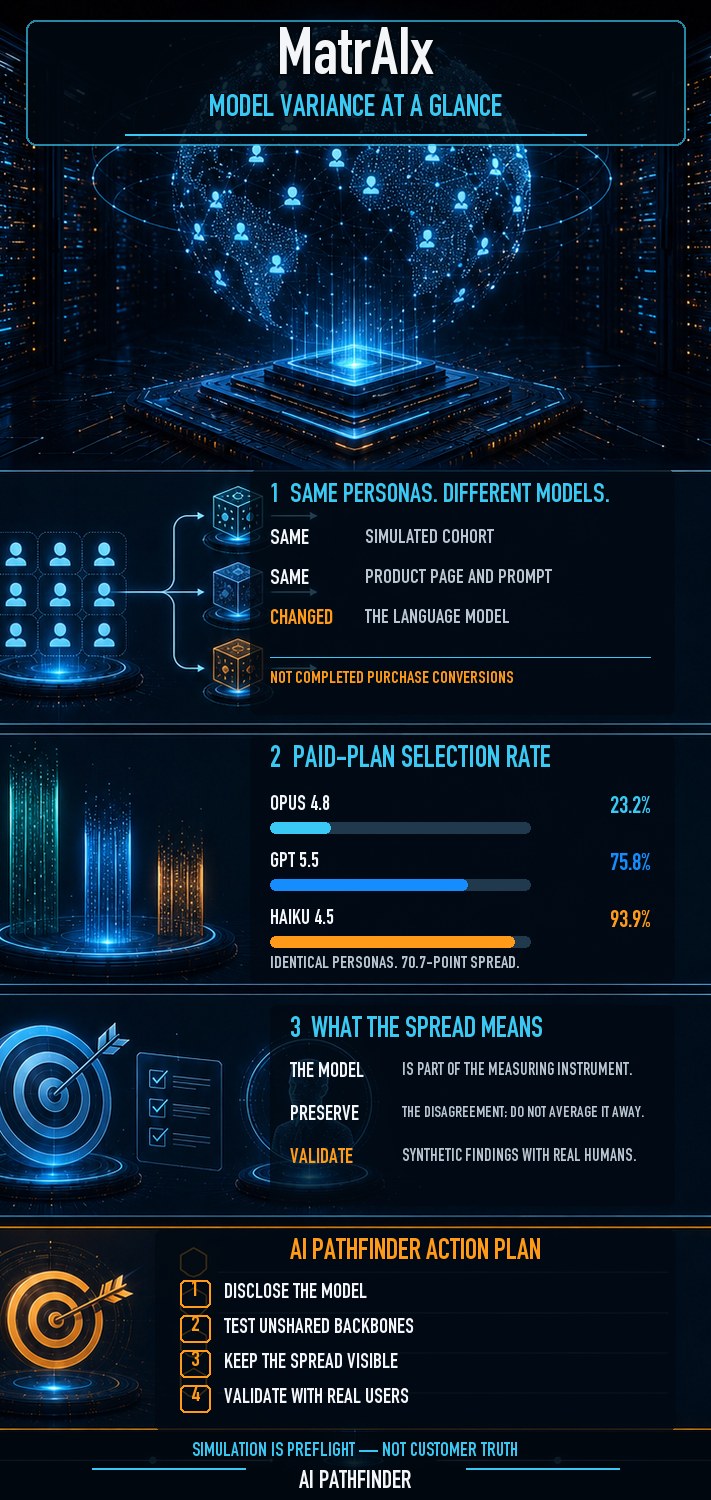
In a web task involving Notion plans, identical cohorts saw the same product page and made a paid-plan decision. The share selecting a paid plan was:
- 23.2% with Claude Opus 4.8 playing the users
- 75.8% with GPT 5.5
- 93.9% with Claude Haiku 4.5[1]
That is not a rounding error. It is three radically different readings of the same product page.
The underlying persona records did not explain that spread. The acting model did.
Across 88 joinable persona-fidelity fields, median pairwise agreement between the three models was approximately zero after chance correction. The paper describes the persona model as a “first-order factor rather than an implementation detail.”[1]
This changes how leaders should read synthetic user research.
A result from MatrAIx is not simply:
This persona chose this option.
It is closer to:
This language model, conditioned on this persona record, responded this way inside this task and interface.
The result belongs to the whole configuration.
Change the model and you may change the market.
Do not average the disagreement away
The tempting response is to run several models and average the result.
That may produce a cleaner number. It does not prove the number is closer to human behavior.
Model disagreement is useful information. It tells you the simulated conclusion is sensitive to the backbone acting as the user. Averaging 23%, 76%, and 94% produces a precise-looking answer while hiding the fact that the measurement instrument is unstable.
The authors recommend something more defensible: report the persona model, test important findings with more than one model, use at least one model that does not share a backbone with the system under evaluation, inspect the underlying interactions, and validate consequential conclusions with real people.[1]
This is a triangulation problem, not an averaging problem.
If three simulated cohorts agree on the direction of a problem, you have a stronger hypothesis to investigate. If they disagree sharply, that uncertainty should survive into the report.
Do not let a dashboard turn disagreement into certainty.
Watch for synthetic self-preference
There is another failure mode hiding in the architecture.
Suppose the model playing the persona shares a backbone with the AI product being tested. A favorable result becomes ambiguous. Did the simulated user genuinely respond well to the product, or did one model recognize and prefer the style of another version of itself?
The paper does not claim to have isolated this effect. It warns that shared-backbone agreement should be treated as a hypothesis, not a result.[1]
This matters for any company using AI to evaluate AI.
If the judge, user, assistant, and report writer all come from the same model family, you have not built an independent evaluation system. You have built a room of mirrors.
At minimum, separate the roles:
- Use different model families for the system under test and the simulated user.
- Keep objective verifiers outside both models where possible.
- Preserve trial-level traces instead of accepting only a summary score.
- Add human review when the conclusion affects pricing, access, safety, health, employment, or financial decisions.
The closer the decision gets to a real consequence, the less acceptable synthetic agreement becomes as final evidence.
The validation result is promising, but narrower than it sounds
MatrAIx reports 91.5% adherence in a 400-trial controlled study. Persona agents expressed, or correctly suppressed, ten assigned behavioral traits across survey, chatbot, web, and application environments in 366 trials.[1]
That is a useful infrastructure result. It suggests the system can condition agent behavior in observable ways.
It does not establish that the resulting agents behave like real people in the wild.
The paper says exactly that in its limitations. The current work does not show that personas withhold context, push back, correct the system, or abandon a task the way people do. It calls for stronger validation against real interaction logs and longitudinal human data.[1]
Persona adherence answers:
Did the agent follow the persona instruction?
Predictive validity asks:
Would people with those characteristics actually behave this way?
Those are different questions. A system can perform well on the first and remain unproven on the second.
AI Pathfinder Action Plan
Use synthetic users as a preflight layer in your research process.
1. Start with decisions, not personas
Choose a specific product decision: pricing, onboarding, feature discovery, support recovery, trust, accessibility, or retention. Define what evidence would change the decision before running the simulation.
2. Treat the cohort as designed, not representative
Document how personas were selected, which attributes matter, what population claims are out of scope, and which real users remain missing.
3. Run multiple persona models
Use at least two model families. Keep the task, interface, and cohort fixed. Report the spread instead of publishing one blended number.
4. Separate AI roles
Avoid using the same backbone as the simulated user, product under test, evaluator, and summarizer. Independent checks matter more when AI is evaluating AI.
5. Preserve the evidence
Keep prompts, actions, screenshots, final states, verifier outputs, failures, and subgroup results. A synthetic paid-plan selection rate without its interaction traces is difficult to trust.
6. Use disagreement to allocate human research
Large cross-model variance should trigger investigation. Stable patterns can help prioritize what to validate. Neither should eliminate contact with real users.
7. Put humans back into consequential decisions
Synthetic research can shape a hypothesis or screen a design. It should not determine access, pricing, medical guidance, hiring, credit, insurance, or public policy without direct human evidence and appropriate governance.
Frequently Asked Questions
What does the 8.3 billion figure prove, and can this replace user research?
The figure describes constructed persona records, not digital twins or 8.3 billion executed agents. The paper reports 18,189 trials, and the public artifact is a one-million-persona coreset. Synthetic cohorts can support screening and stress testing, but conclusions about real populations still require human validation—especially when changing the persona model can move a paid-plan selection rate from 23.2% to 93.9%.[1]
Is MatrAIx available publicly?
The project website and code repository are public, and the repository describes the work as open-source evaluation infrastructure. The released dataset is the quality-filtered Persona 1M coreset rather than the full internal population.[2][3]
The Bottom Line
MatrAIx makes synthetic user research far more operational. Teams can test products across designed cohorts, repeat studies after each change, and inspect failure patterns before exposing real users to them.
That is valuable.
But the system’s own evidence sets the boundary. The persona model can move a product conclusion from 23% to 94% on identical cohorts. The records are not a representative sample of humanity. Persona adherence is not proof of human prediction.
Use MatrAIx to ask better questions earlier.
Then invite real people into the room before you trust the answer.
What would you test with synthetic users first, and what decision would you refuse to make without hearing from actual customers?
Sources
[1] https://arxiv.org/html/2608.04205v1 — MatrAIx: Simulating the World with 8.3 Billion Persona Agents [2] https://matraix.ai — MatrAIx — Simulate Before Reality [3] https://github.com/MatrAIx-ai/MatrAIx-Persona-8B — MatrAIx Persona 8B GitHub repositoryAbout Jason Fleagle
Jason J. Fleagle helps business and public-sector leaders turn AI uncertainty into practical strategy, governance, architecture, and measurable operating outcomes. He leads AI strategy at Netsync Network Solutions and writes AI Pathfinder for leaders trying to adopt AI without losing control of risk, cost, or execution.
Learn more at thejasonfleagle.com and Netsync.
Related AI Pathfinder Reading
- AI Model Evaluation for Business
- Human-in-the-Loop AI Governance
- AI Governance Checklist
- AI Readiness Scorecard
Originally published in AI Pathfinder on LinkedIn.