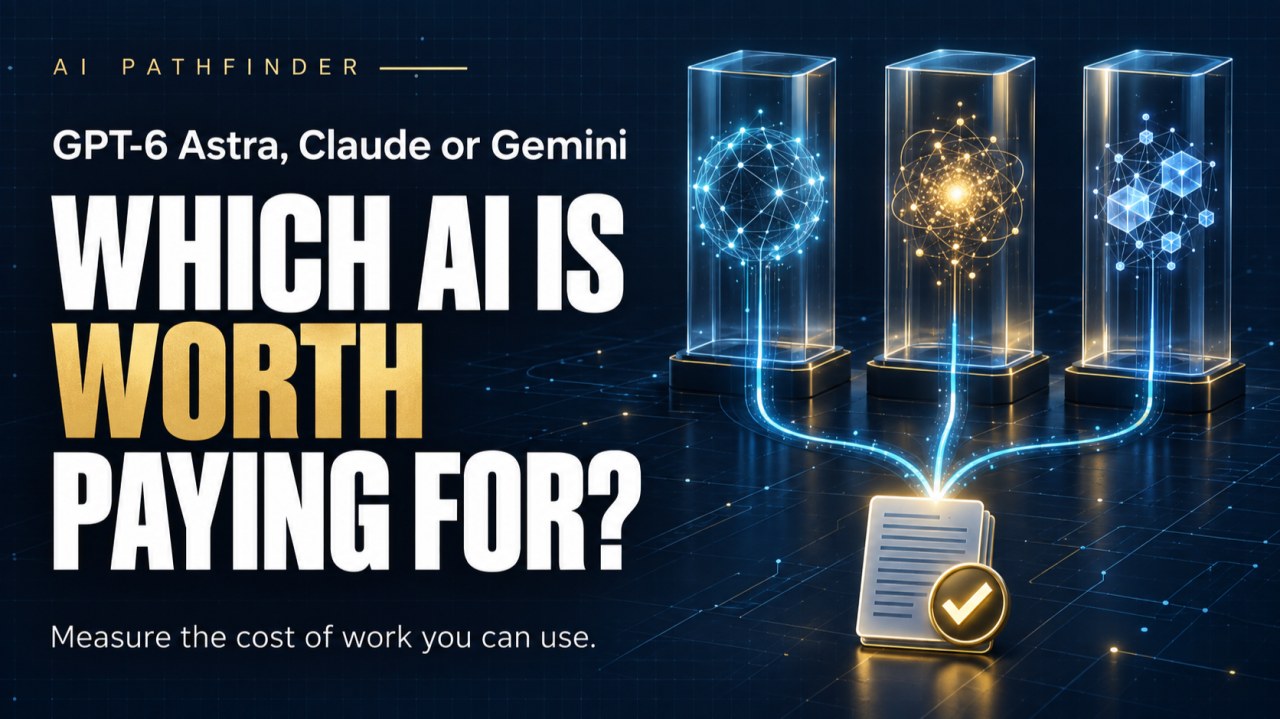
GPT-6 Astra and Claude Fable 5.1 earned the same rounded score on Artificial Analysis’ Intelligence Index. Yet the measured cost per benchmark task was $3.26 for Astra and $7.63 for Fable.
If you’re choosing AI for your team, that difference deserves more attention than another impressive demo.
It doesn’t prove Astra will cut your bill. It gives you a specific question to test: are you paying more for work that a less expensive configuration could complete just as well?
Google’s Gemini 3.8 updates add another option for lower-cost work and a separate set of models for voice. Reports of Fable 5.2 testing make the decision noisier, but they don’t yet provide a verified benchmark comparison.
Here’s how to use the evidence to build your shortlist before you change subscriptions, integrations or team workflows.
Why This Matters
Test Astra against Fable 5.1 for demanding coding and professional work. Test Gemini 3.8 Flash for frequent, bounded tasks where cost matters. Evaluate Gemini Live separately if you’re building a voice experience.
Keep Fable 5.2 on your watchlist until its version, access and results can be verified.
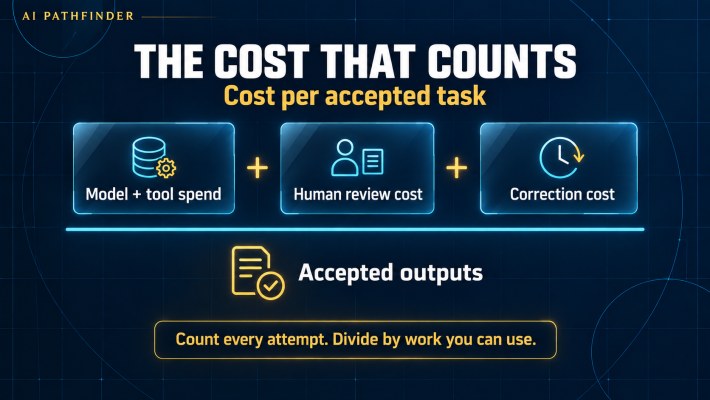
Your buying criterion should be cost per accepted task: what you spend to produce work your team can actually use, including failed attempts and human correction.
Start with what the same benchmark actually costs
These results come from Artificial Analysis model pages retrieved September 22, all using Intelligence Index v4.3.2:
- GPT-6 Astra, max effort: 53 points; $3.26 weighted average cost per benchmark task.
- Claude Fable 5.1, max effort with default fallback: 53 points; $7.63 per benchmark task.
- Gemini 3.8 Flash, high effort: 41 points; $1.24 per benchmark task.
Sources: Astra, Fable 5.1, Gemini 3.8 Flash.
Those are rounded index points, not percentages or predicted success rates for your business. The reasoning settings differ, and Fable’s tested configuration includes fallback behavior. The costs exclude your organization’s integration, human review and recovery expenses.
Even with those limits, the decision is concrete. Astra deserves a side-by-side test with Fable when you need premium capability. Gemini deserves a test when the work is narrow enough that its lower composite score may not matter.
Don’t average everything into one winner. A model that handles document classification well may still struggle with the software change sitting next to it in your backlog.
Paying for coding? Test Astra before assuming Claude is worth the premium
Artificial Analysis’ September 9 report gives Astra in Codex and Fable 5.1 in Claude Code the same rounded Coding Agent Index score of 62.
Astra cost $7.09 per task, approximately 40% less than Fable 5.1 at the cited settings. These are comparisons of models inside different agent harnesses, not a test of model weights alone.
That makes Astra a credible candidate for expensive engineering work. It doesn’t make Fable the wrong choice for your codebase.
Run both against the same kind of change your team routinely ships. Check whether tests pass, whether the change follows repository conventions, and how much a developer has to repair before accepting it. A cheaper run that leaves more cleanup can erase the saving.
Astra isn’t a universal upgrade, either. The same September 9 report found lower GDPval-AA v2 performance than GPT-5.6 Sol and weaker presentation quality on AA-Briefcase, despite stronger analytical results. If polished documents are the deliverable, inspect the documents.
Gemini 3.8 Flash: pay less per token, then check the finished work
Google announced Gemini 3.8 Flash and Flash Cyber on September 2.
Flash’s introductory API rates are $0.75 per million input tokens and $3.75 per million output tokens. Google’s published chart says regular pricing becomes $1.50 and $7.50 on January 1, 2027. Build that change into your budget rather than treating launch pricing as permanent.
Google reports 73.7% on DeepSWE v1.1, compared with 65.3% for Gemini 3.7 Flash, and 54.9% on HLE-Verified. But the same chart reports 19.1% on Terminal-Bench 4.0. These benchmarks test different work; a strong coding result doesn’t establish broad superiority.
The DeepSWE methodology also matters: Google’s result uses a mini-swe agent at high thinking, while competitor figures come from the public leaderboard. This is not a controlled head-to-head under identical configurations.
My recommendation: test Flash on a repeatable workload with clear acceptance criteria before assigning it open-ended work. Track retries and token use. Google warns that higher effort can use more tokens, so the posted token rate is only part of your bill.
Security teams need a separate access decision
Flash Cyber is available to trusted defenders through Google’s Fairwind program. Google’s reported 47.2% pass@1 on CWE-Bench measures vulnerability patching. It is not directly comparable with Astra’s exploit-development scores.
If you’re evaluating security work, confirm the access program and permitted tasks first. Don’t base a purchase on capabilities your deployment cannot use.
Building a voice agent? Measure resolution, not how good it sounds
Google introduced Gemini 3.8 Live and Live Extended Thinking on September 15.
Live supports visual context, language transitions and background tool calls while the conversation continues. Extended Thinking adds deeper reasoning while speaking. Google describes developer access through the Gemini API and AI Studio, with the enterprise offering in private preview.
For Live Extended Thinking, Google’s announcement reports:
- 82.6 on Artificial Analysis’ Speech-to-Speech Quality Index.
- 68.6% on τ-Voice.
- 35.1% on τ-Voice-banking.
- 97.7% on Big Bench Audio.
These are vendor-reported figures from different voice evaluations. They cannot be ranked against the general Intelligence Index or treated as a forecast for your contact center.
The practical test is whether the agent completes the request correctly. Include interruptions, failed tool calls, ambiguous instructions and handoff to a person. Require confirmation before consequential actions. A fluent conversation that ends with the wrong account change is a failed workflow.
What about Fable 5.2?
TestingCatalog reports apparent Fable 5.2 testing, including visual-coding demonstrations and claims of requests being routed to a newer model. Its coverage says Anthropic had not commented on the reported A/B test.
I could not verify an official Fable 5.2 launch, model card or independent benchmark result in the sources reviewed for this edition. Anthropic’s documented release is Fable 5.1, which is generally available; Mythos 5.1 has different safeguards and restricted access.
That leaves Fable 5.2 unscored here. Early demonstrations may justify watching it closely. They don’t justify borrowing 5.1’s scores or declaring a winner against Astra.
AI Pathfinder Action Plan: make the next model earn the switch
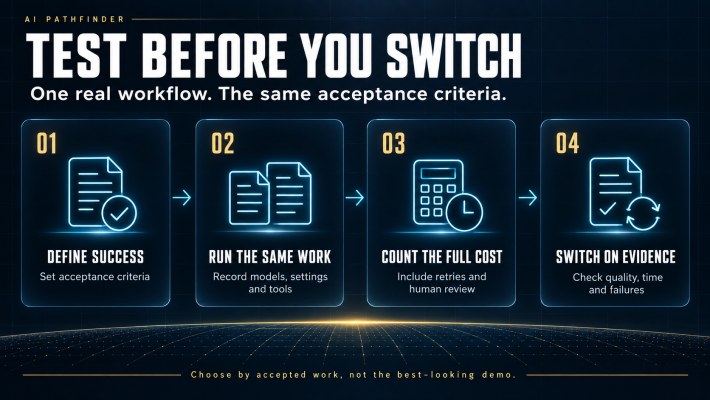
Choose one workflow your team already performs. Use a code change with existing tests, a document checked against supplied records, or another task with a clear definition of acceptable work.
- Define acceptance before running the models. Write down what must be correct, what evidence is required and what actions need human approval.
- Keep the comparison repeatable. Use the same tasks and source material. Record each model ID, effort setting, tools and agent harness. Repeat difficult cases instead of picking the best-looking attempt.
- Count the full cost. Include model and tool spend across every attempt, plus human review and correction time valued consistently. Divide total cost by the number of accepted outputs. If none pass, report the failure rather than a misleading cost figure.
- Switch only after the result holds up. Check quality, elapsed time and failure handling alongside cost. Keep permissions bounded and a rollback path available.
The next step is small enough to do before a migration: pick the workflow, write the acceptance criteria and compare your current setup with one challenger.
Frequently Asked Questions
Should I move everything to the cheapest model?
No. Test the work you want it to do. Lower benchmark cost is useful evidence, but extra retries or human correction can make a cheap model expensive to operate.
Should I wait for Fable 5.2?
You don’t need to postpone a bounded test of available models. Keep the test reusable so a documented 5.2 release can face the same acceptance criteria when you can access it.
The Bottom Line
Astra has a credible cost case against Fable 5.1 in the independent results reviewed here. Gemini 3.8 Flash offers a less expensive configuration to test on bounded work, while Gemini Live needs its own voice-workflow evaluation.
Before paying for the next upgrade, make it finish a task your team cares about. Then compare what you spent to get an acceptable result.
References
- Anthropic: Introducing Claude Fable 5.1 and Claude Mythos 5.1
- TestingCatalog: Reports of Fable 5.2 and Opus 5.5 testing
- Google: Gemini 3.8 Flash and Flash Cyber
- Google DeepMind: Gemini 3.8 Flash evaluation methodology
- Google: Gemini 3.8 Live and Live Extended Thinking
- OpenAI: GPT-6 Astra announcement
- Artificial Analysis: Benchmarking GPT-6 Astra
- Artificial Analysis: GPT-6 Astra model results
- Artificial Analysis: Claude Fable 5.1 model results
- Artificial Analysis: Gemini 3.8 Flash model results
About Jason Fleagle
Jason Fleagle is Head of AI at Netsync and writes AI Pathfinder for leaders putting AI to work. Explore his work at netsync.com and thejasonfleagle.com and follow AI Pathfinder for practical analysis of AI systems, adoption and governance.
Originally published on LinkedIn.
Table of content
Related articles
September 23, 2026