Meta Launches Muse Image: Why Agentic Image Generation Is Moving Into the Feed
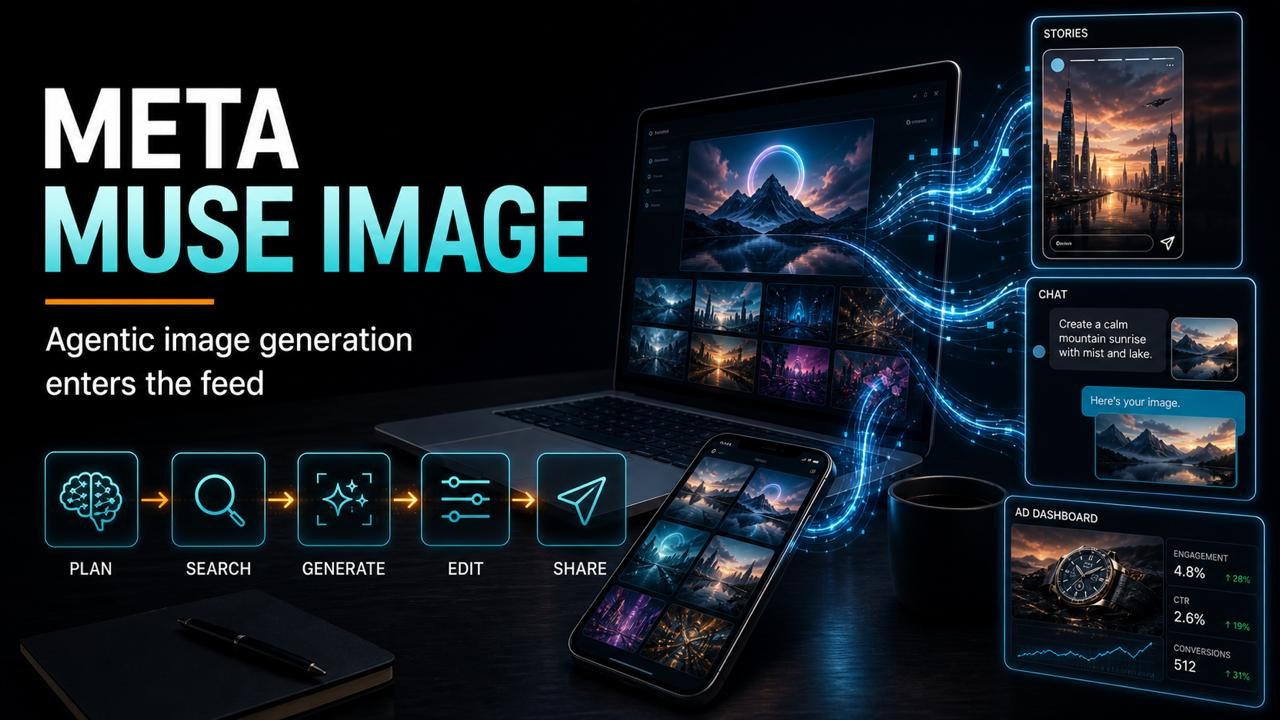
Quick answer: Meta Muse Image is not just another image model. It is Meta’s move to make AI image generation native to the places people already create, chat, share, and advertise: Meta AI, WhatsApp, Instagram Stories, Facebook, Messenger, and Advantage+ creative.
What Meta announced
On July 7, 2026, Meta introduced Muse Image, the first image-generation model from Meta Superintelligence Labs. Meta says Muse Image is available in the Meta AI app and is rolling into WhatsApp, Instagram Stories, Facebook, Messenger, and eventually Meta advertising workflows through Advantage+ creative.
That is the product headline. The strategic point is bigger: Meta is trying to make AI image generation native to social distribution, not just better inside a standalone demo tool.
The agentic creative loop
Most image tools still live in a separate workflow: open a model, write a prompt, download the image, edit it somewhere else, then post it somewhere else. Meta wants to collapse that loop into the feed itself.
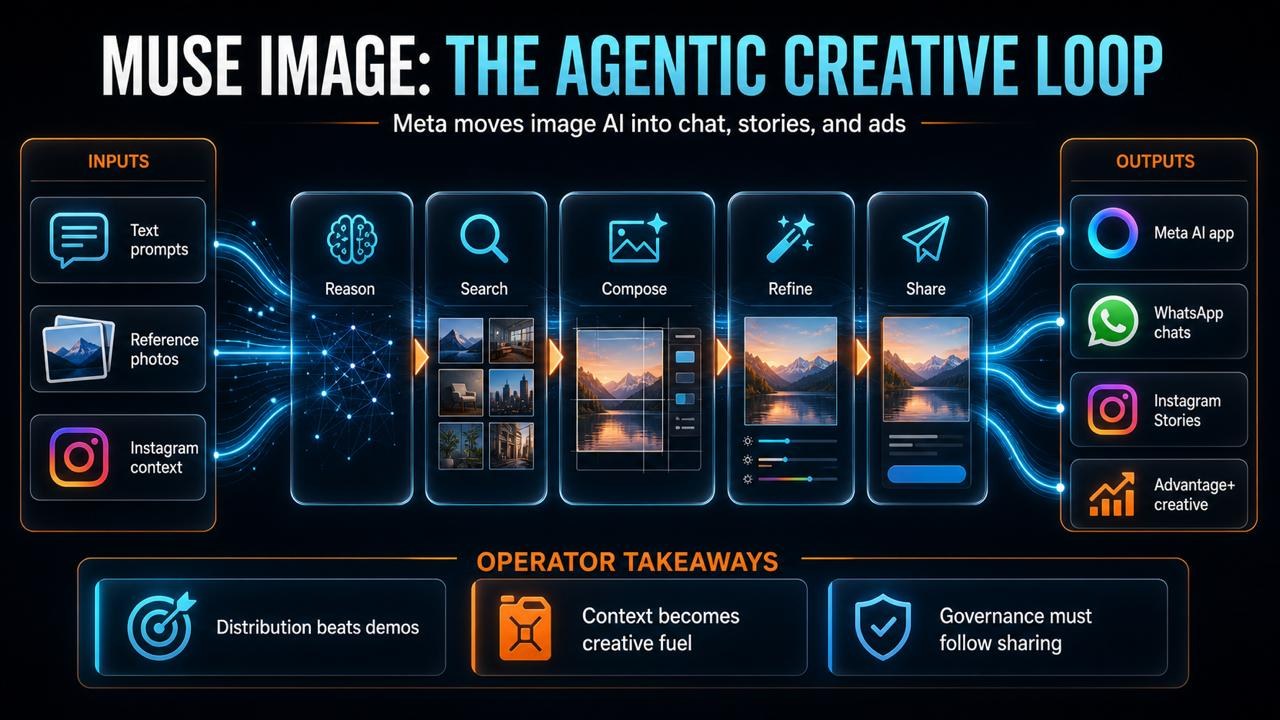
According to reporting from The Verge, Muse Image pairs with Muse Spark to reason through prompts, plan layouts, use web context, and blend multiple visual references before generating. That moves the workflow from “type prompt, get picture” toward a more agentic creative loop.
- Idea and context: the prompt, brand direction, reference photos, and social context.
- Reasoning and search: the system plans the visual and can use contextual inputs.
- Generation and refinement: users create, edit, sketch, and iterate across turns.
- Distribution: outputs can move directly into feeds, stories, chats, and eventually ads.
- Performance feedback: the long-term opportunity is creative testing tied to engagement and conversion data.
Why this matters for marketers and operators
For marketers, creators, and operators, Muse Image points toward a different creative operating model. The old workflow was slow: brief the creative team, wait for concepts, revise, resize for every channel, test, launch, and repeat.
The new workflow is faster: give the AI product context, generate variants, edit in place, publish directly, and feed performance data back into the system. That does not remove human judgment. It changes where judgment is most valuable.
The hard part will not be producing more assets. The hard part will be deciding which assets are on-brand, legally safe, emotionally right, and commercially useful. More output can mean more creative velocity, but it can also mean more brand drift, likeness risk, and low-quality content moving faster than approval workflows can keep up.
The privacy and governance problem
The most sensitive part of Muse Image is the Instagram context layer. Meta says users can mention Instagram accounts in Meta AI prompts, allowing the system to use public photos to help build a visual. Meta also says users have controls to turn this off.
That is powerful, and it is also where governance gets serious. If public photos become creative fuel, businesses need clear rules around consent, likeness, disclosure, brand safety, and reuse. Teams cannot treat “available on the platform” as the same thing as “approved for commercial use.”
This is the same pattern leaders are seeing across enterprise AI: the model gets better, the workflow gets easier, and the governance surface gets larger. If your organization needs to put guardrails around AI adoption, review Netsync AI Assurance and the internal governance resources below.
AI Pathfinder takeaways
- Distribution beats demos. The strongest AI products will often be embedded closest to the real workflow, not isolated in a separate sandbox.
- Context becomes creative fuel. Prompts, references, photos, brand assets, and social signals become inputs to the creative system.
- Governance must follow sharing. Once AI-generated visuals move into feeds, chats, and paid media, approvals, rights, audit trails, and brand rules matter more.
AI action plan for enterprise teams
- Audit the creative workflow.
Identify where your team loses time today: briefing, asset creation, resizing, approvals, personalization, distribution, or measurement. - Build a brand-safe AI creative system.
Do not just give teams a prompt box. Give them approved assets, tone rules, product facts, legal guardrails, and review checkpoints. - Create a likeness and consent policy.
If AI tools can reference public photos, team members, creators, customers, or partners, define what is allowed before the first campaign goes live. - Separate experimentation from production.
Let teams test fast, but require stronger review before anything reaches paid media, customer communications, or regulated campaigns. - Measure creative velocity and quality.
Track not just how many assets AI generates, but which ones improve conversion, engagement, speed, and brand consistency.
Related internal reading
- AI Governance Checklist
- AI Agent Use Case Library
- Human-in-the-Loop AI Governance
- Enterprise AI Roadmap Template
- AI Readiness Scorecard
Frequently asked questions
What is Meta Muse Image?
Meta Muse Image is Meta’s image-generation model from Meta Superintelligence Labs. It is designed for image creation and editing inside Meta AI and Meta’s social apps.
Where can people use Muse Image?
Meta says Muse Image is available through Meta AI and is rolling into WhatsApp, Instagram Stories, Facebook, Messenger, and Advantage+ creative for advertisers.
Why is Muse Image important for businesses?
Muse Image matters because it moves image generation closer to distribution, letting creative teams generate, refine, share, and eventually test assets inside the same ecosystem where campaigns and conversations already happen.
What is the biggest governance risk?
The biggest risk is using public photos, brand assets, people, or likenesses without clear consent, disclosure, review, and usage policies.
How should enterprise teams respond?
Enterprise teams should separate experimentation from production, define brand and legal guardrails, require approval checkpoints, and measure both creative velocity and creative quality.
References and source links
- Meta: Introducing Muse Image
- The Verge: Meta’s new Muse Image model can pull other Instagram users into AI photos
- Axios: Meta’s AI catch-up effort gets a new look
- CNBC: Meta AI Muse Image
- Bloomberg: Meta Debuts New AI Image Generation Model
- Meta AI
- OpenAI
- Google Gemini
About Jason Fleagle
Jason Fleagle is the Head of AI for Netsync and an AI and growth consultant who helps organizations move from AI hype into practical, governed, production-ready adoption. Connect with Jason on LinkedIn or explore more AI strategy resources at thejasonfleagle.com.