OpenAI Built Its Own Glasswing: What Daybreak Means for Enterprise AI Security
Quick take: OpenAI’s Daybreak, GPT-5.5-Cyber, Codex Security, and Patch the Planet show where AI security is moving: from finding bugs to verified remediation.
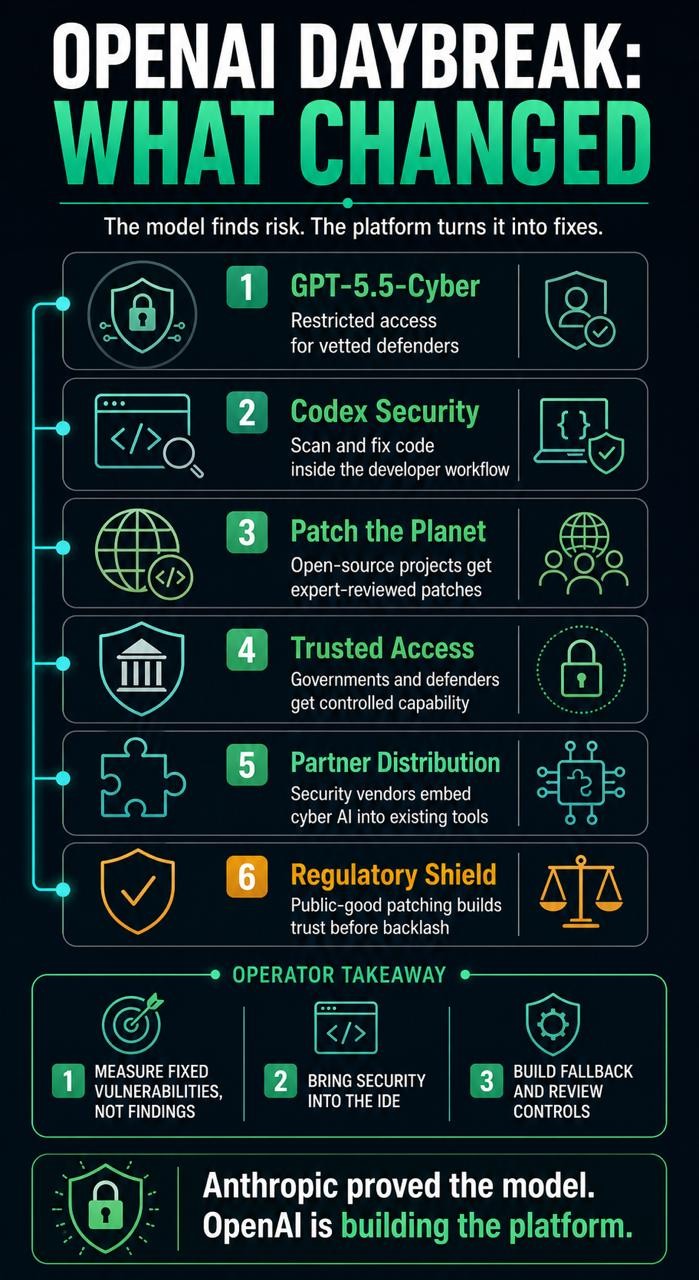
OpenAI just made its cybersecurity move.
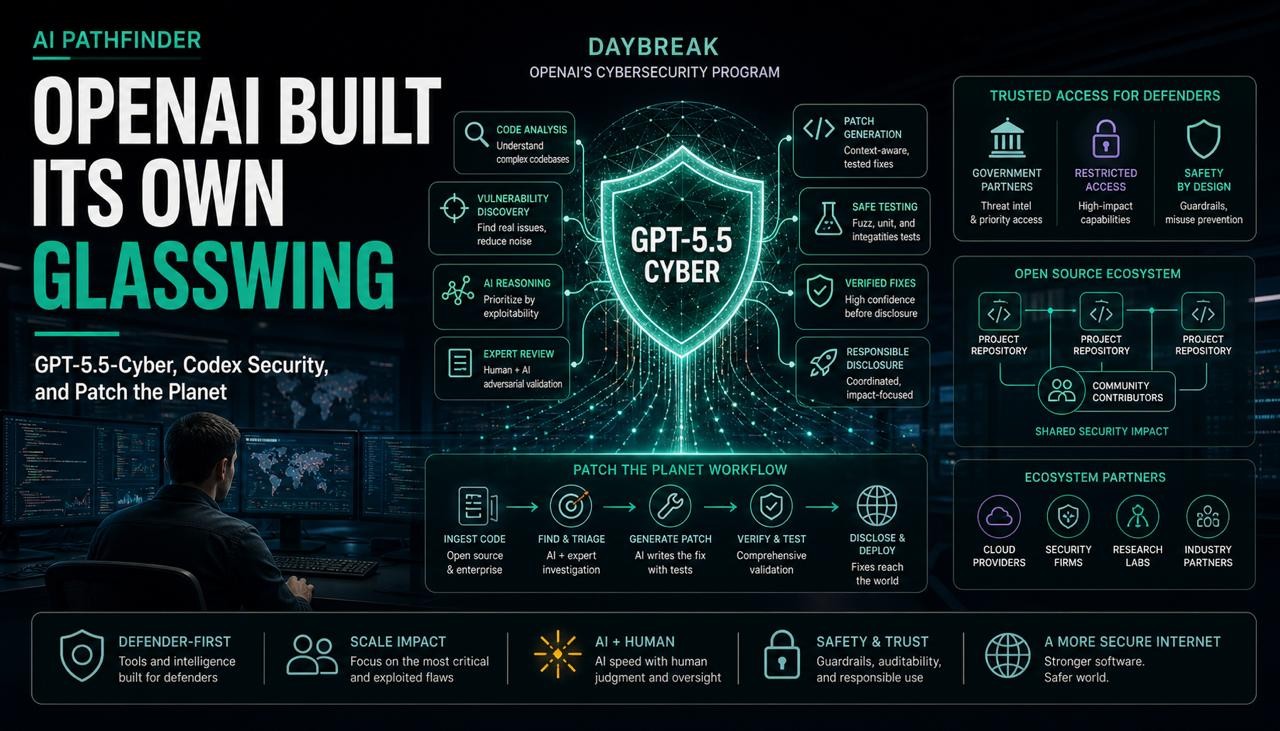
On June 22, the company expanded Daybreak with the full limited release of GPT-5.5-Cyber, a new Codex Security plugin, a partner program for security vendors, and an open-source patching initiative called Patch the Planet.
That sounds like a product launch.
It is bigger than that.
This is OpenAI building its own version of Anthropic’s Glasswing playbook:
– Find real vulnerabilities.
– Patch real infrastructure.
– Work with governments.
– Give trusted defenders advanced cyber models.
– And turn frontier AI capability into public-good security work before regulators decide that capability is too dangerous to release.
The model is not the whole story.
The platform is.
Why GPT-5.5 Cyber Matters
GPT-5.5-Cyber is OpenAI’s most capable model for authorized defensive cybersecurity work.
It is not generally available.
It sits behind OpenAI’s Trusted Access for Cyber program and is intended for verified defenders who need more advanced cyber capability with stronger monitoring, verification, scoped controls, and review.
OpenAI says GPT-5.5-Cyber is more capable and more permissive for approved defensive work: code review, vulnerability triage, malware analysis, penetration testing, reachability analysis, patch generation, and remediation planning.
The benchmark jump is meaningful:
GPT-5.5-Cyber reached 85.6% on CyberGym, compared with 81.8% for standard GPT-5.5.
It scored 39.5% on ExploitGym, compared with 25.95%.
It reached 69.8% on SEC-bench Pro, compared with 63.1%.
But the more important move is Codex Security.
OpenAI is trying to own the workflow from discovery to fix.
The Real Move: Codex Security
Codex Security embeds vulnerability scanning and remediation directly into the developer workflow.
That matters.
If your team uses Codex to write code and Codex Security to scan it, OpenAI now sits on both sides of the loop:
Creation.
Review.
Threat modeling.
Reachability analysis.
Validation evidence.
Patch generation.
Fix verification.
That is like having a security engineer living inside the IDE.
OpenAI says Codex Security has already scanned more than 30 million commits across more than 30,000 codebases since March. Human reviewers have manually marked more than 70,000 findings as fixed, and more than 500,000 findings have been automatically determined to be fixed.
That scale is the point.
AI is making vulnerability discovery faster.
But discovery is no longer the bottleneck.
Patching is.
Patch The Planet
The mission is straightforward: Do not just dump more findings on open-source maintainers.
Help them validate, prioritize, patch, test, and disclose.
More than 30 open-source projects have committed to participate, with early participants including cURL, Go, Python, Sigstore, pyca/cryptography, NATS Server, aiohttp, freenginx, and python.org.
Trail of Bits dedicated security engineers to work with Codex and GPT-5.5-Cyber across 19 open-source projects in an initial sprint. OpenAI says the work surfaced hundreds of issues for review, merged dozens of patches, and built reusable fuzzing, variant-analysis, differential-testing, and specification-based testing workflows.
That is the right design.
AI-generated vulnerability reports without human validation just create noise.
Patch the Planet is built around expert review before maintainers get buried.
The Glasswing Parallel
This is where the timing gets interesting.
Anthropic built Project Glasswing around the idea that frontier cyber models should be used by trusted defenders to secure critical software before attackers get similar capabilities.
Then Fable 5 and Mythos 5 were hit by a U.S. government export-control directive.
The lesson was clear: Frontier cyber capability is now a policy issue.
OpenAI watched that happen and launched Daybreak with the exact ingredients regulators want to see:
Trusted access.
Government partnerships.
Critical infrastructure focus.
Human review.
Open-source patching.
Security vendor distribution.
Measured safeguards.
Defensive framing.
This is regulatory strategy.
The best way to protect your most powerful cyber model from political backlash is to prove it is already protecting the software everyone depends on.
Why This Is Important
The security market is shifting from detection to remediation.
For years, most security tools generated alerts.
Now the frontier is different:
Find the bug.
Prove reachability.
Generate evidence.
Draft the patch.
Test the patch.
Route it to the right human.
Verify the fix.
Update the workflow.
That is the loop OpenAI wants to own.
And because Codex already lives where developers work, OpenAI has a distribution advantage.
And with their upcoming "super app" the positioning will matter even more.
Anthropic showed the world what Mythos-class cyber capability could do.
OpenAI is turning similar capability into a product surface.
That is the difference.
Anthropic built the proof-of-concept.
OpenAI is building the platform.
The Partner Strategy
OpenAI also launched the Daybreak Cyber Partner Program.
The partner list matters: Accenture, Cisco, CrowdStrike, IBM, Okta, Palo Alto Networks, Wiz, Cloudflare, Capgemini, Check Point, EY, Fortinet, KPMG, PwC, SentinelOne, Tenable, Zscaler, and others.
We're also working on our partnership status with OpenAI at Netsync as well.
This partner program means OpenAI does not need every security team to use GPT-5.5-Cyber directly.
It can distribute the capability through the tools security teams already trust, and also with the partners that enterprise customers trust.
That is how enterprise AI adoption actually scales.
Not through a model picker.
Through embedded workflows.
What This Means For Leaders Like You
If you are a CIO, CISO, CTO, or Head of AI, the message is direct:
AI-powered vulnerability discovery is here.
The question is whether your organization can patch at the same speed it can now find risk.
If not, AI will not reduce your security backlog.
It will expose how broken the backlog already is.
Your AI Action Plan
Audit your vulnerability pipeline.
Map how findings move from discovery to validation, ownership, patching, testing, deployment, and closure.
Separate “finding” from “fixing.”
Do not measure security AI by the number of issues it generates. Measure validated fixes landed.
Bring security into the developer workflow.
The IDE is becoming the new security control point. Evaluate tools that scan, explain, patch, and verify where code is actually written.
Add reachability analysis.
Not every flaw deserves the same urgency. Prioritize vulnerabilities that are reachable, exploitable, and business-critical.
Require human validation.
AI can accelerate research and patching, but maintainers and security engineers still need to control what gets shipped.
Build a trusted-access strategy.
Advanced cyber models will not be fully open. Know which vendors, partners, and internal teams qualify for restricted defensive capabilities.
Your Bottom Line
OpenAI did not just launch a cyber model.
It launched a defensive operating system.
GPT-5.5-Cyber is the capability.
Codex Security is the workflow.
Patch the Planet is the public-good layer.
The partner program is the distribution engine.
And Daybreak is the regulatory shield.
The next cybersecurity winners will not be the teams that find the most vulnerabilities.
They will be the teams that can turn findings into verified fixes before attackers turn them into exploits.
That is the new race.
Keep moving forward.
And if you have any thoughts or questions, please drop them in the comments.
About Jason Fleagle
Jason Fleagle is the Head of AI for Netsync and an AI and Growth Consultant working with global brands to help with their successful AI adoption and management. He helps humanize data — so every growth decision an organization makes is rooted in clarity, not confusion. He has overseen the development and delivery of over $50M in digital solutions, driving significant revenue growth and operational efficiency for his clients.
Connect with Jason on LinkedIn to stay updated on the latest in AI, growth strategies, and enterprise technology.
Additional internal reading
- AI Readiness Scorecard
- AI Model Evaluation for Business
- AI Governance Checklist
- AI Agent Use Case Library
- Human-in-the-Loop AI Governance
- Prompt Injection Risk for Business Leaders
- Microsoft Copilot Governance
- Enterprise AI Roadmap Template
References
- OpenAI: Daybreak: Tools for securing every organization in the world
- OpenAI: Patch the Planet: a Daybreak initiative to support open source maintainers
- The Hacker News: OpenAI Expands Daybreak With GPT-5.5-Cyber
- Tech Times: OpenAI Daybreak Expands Patch Pipeline
- Anthropic: Project Glasswing
- Anthropic: Statement on Fable 5 and Mythos 5 access
Originally published on LinkedIn.
About AI Pathfinder
AI Pathfinder is Jason Fleagle’s recurring field note on enterprise AI, agentic systems, AI governance, and the operating models leaders need as AI moves from experiments into real work.