
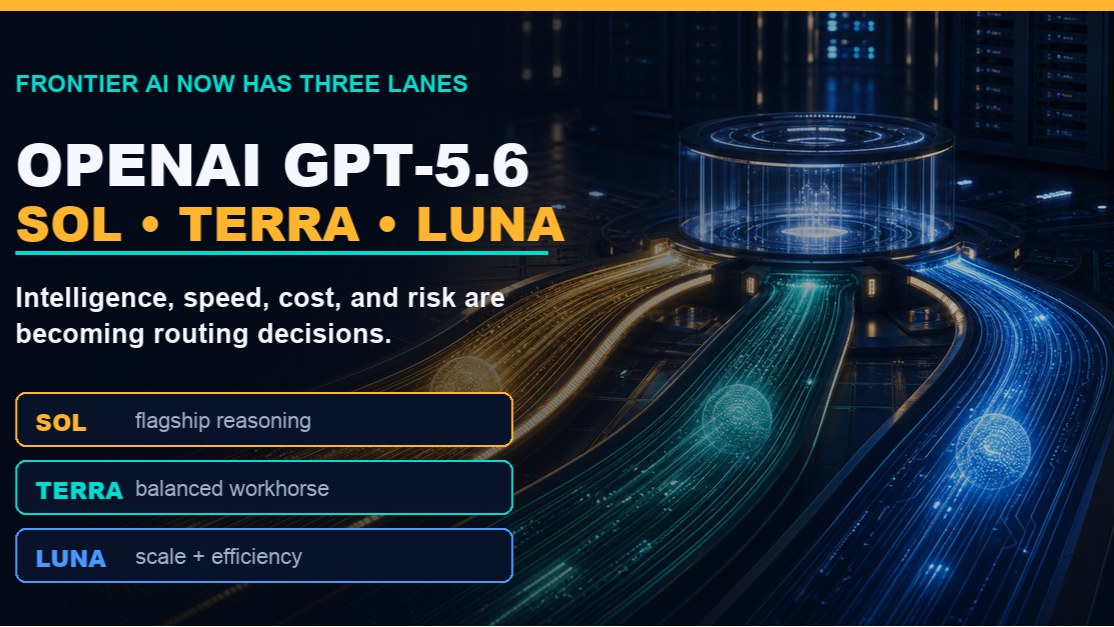
OpenAI Launches GPT-5.6 Preview With Three Lanes: Sol, Terra, and Luna
OpenAI’s GPT-5.6 preview is worth reading as a product announcement, but the more useful signal is in the packaging.
OpenAI introduced three lanes: Sol, Terra, and Luna.
Sol is the flagship model. Terra is the balanced option. Luna is the fast, lower-cost lane.
That structure says a lot about where enterprise AI is heading. The model conversation is moving away from a single leaderboard question and toward something more operational: which level of intelligence, speed, cost, and risk fits the job in front of us?
That is the useful GPT-5.6 story for business leaders.
The next wave of AI maturity will come from routing work well.
The bite
GPT-5.6 Sol is OpenAI’s strongest model in this preview family. OpenAI positions it for software engineering, professional knowledge work, scientific research, computer use, and cybersecurity.
The release also introduces a deeper max reasoning setting and an ultra mode designed for complex work that can use subagents.
That last part is the one to watch.
Sol is being aimed at long-running, tool-heavy workflows where the model has to plan, coordinate, recover, and verify. In that kind of work, raw answer quality matters, but it is only part of the job. The model has to keep track of the environment. It has to use tools without losing the thread. It has to know when the work is unfinished.
Terra sits in the middle lane, with GPT-5.5-competitive performance at lower cost. Luna is built for speed and affordability when the task does not justify the premium tier.
This is how AI becomes an operating layer. You stop treating every task like it deserves the most expensive model in the room.
You route the work.
The three-lane strategy
Most companies still talk about model selection as if there is one answer.
Which model is best?
That question will get less useful as model families mature. The better operating question is simpler and harder: which model is best for this workflow?
A board memo, a CRM cleanup, a codebase migration, a support ticket summary, a cyber review, and a marketing outline do not place the same demand on the system. They differ in ambiguity, cost sensitivity, failure risk, review burden, tool access, and expected output quality.
GPT-5.6 makes that distinction explicit.
Sol is for the hardest work: deep analysis, complex code, research, cyber, long-horizon tool use, and decisions where the cost of being wrong is high.
Terra is for strong everyday business work where quality matters, but the premium lane is hard to justify on every run.
Luna is for scale: summaries, classification, first drafts, cleanup, routing, lightweight research, and other high-volume work where speed and cost shape the economics.
Enterprise AI will be deployed through these kinds of routing decisions. The mature teams will stop asking for one preferred model and start building rules for which model handles which class of work.
Sol points toward agent work
OpenAI says Sol performs strongly on command-line workflow benchmarks that test planning, iteration, and tool coordination.
That matters because coding agents rarely fail for one clean reason. They lose context. They misunderstand the environment. They make a plausible change and forget to test it. They fix the visible error and miss the underlying issue. They use a tool, get a bad result, and keep going anyway.
That is why terminal-style benchmarks are a better proxy for real agent work than another tidy Q&A score. They test whether the model can operate inside a messy environment and keep moving toward an outcome.
For enterprise leaders, this is the shift to pay attention to: the best models are starting to look less like answer engines and more like workers inside a workflow.
That does not remove the need for human judgment. It raises the value of good delegation.
Ultra mode is the bigger hint
The most interesting feature in the GPT-5.6 preview may be ultra mode. OpenAI describes it as going beyond a single agent by using subagents to accelerate complex work.
That points to the next practical unit of AI work.
A serious workflow may use one agent to research, another to write, another to test, another to critique, another to check sources, and another to prepare the final handoff. The human becomes the operator, reviewer, and decision maker.
That sounds powerful because it is. It also creates a new management problem.
If one agent can drift, five agents can drift in five directions. Multi-agent work needs scope, permissions, logs, checkpoints, review lanes, and a clear owner for the final output.
This is where many companies will get surprised. Agent orchestration is an operating model as much as a technical capability. Someone has to define the work, split the work, verify the work, and decide what is safe to use.
Cyber capability meets government reality
OpenAI is treating this preview carefully.
The GPT-5.6 family is starting with a limited preview for trusted partners and organizations. OpenAI’s Deployment Safety Hub says the company previewed its plans and model capabilities with the U.S. government before launch and, at the government’s request, is beginning with a smaller partner group whose participation has been shared with the government.
That sentence is a sign of the times.
Frontier model releases now sit inside a policy environment. Access, capability, safety, and geopolitics are connected.
OpenAI also says it believes in broad access and plans to make GPT-5.6 Sol, Terra, and Luna generally available in the coming weeks. The company says the current process should not become the long-term default because powerful tools need to reach users, developers, enterprises, cyber defenders, and global partners.
Still, the preview structure shows where the industry is headed. Shipping frontier AI now means managing the capability and the access model at the same time.
Stronger models need stronger safeguards
OpenAI’s system card frames Sol, Terra, and Luna as High capability in both cybersecurity and biological and chemical risk under its Preparedness Framework. The company says none of the three reaches its High threshold for AI self-improvement.
That nuance matters.
Sol appears especially strong in cybersecurity. OpenAI says GPT-5.6 improves the performance-efficiency frontier for longer security tasks, including vulnerability research and exploitation-related work. It also says the model is better at helping people find and fix vulnerabilities than at reliably carrying out real attacks under tested conditions.
That is the narrow path frontier labs are trying to walk: give defenders stronger tools, preserve legitimate security work, and make prohibited offensive use harder to complete, easier to detect, and easier to stop.
The safeguard stack around GPT-5.6 is part of the product story. OpenAI describes model refusals for prohibited cyber assistance, real-time misuse classifiers, generation pauses, review by a larger reasoning model in higher-risk cases, account-level review across risk signals, differentiated access, monitoring, enforcement, and continued testing.
For enterprise leaders, safety is no longer a PDF attached to the release. Safety is runtime infrastructure.
The system can inspect, pause, escalate, route, withhold, monitor, and enforce. That is the shape of serious enterprise AI: layered controls around the model, not a single policy line outside the workflow.
Automated red-teaming is becoming infrastructure
One detail from OpenAI’s system card should not get lost: the company says it dedicated more than 700,000 A100-equivalent GPU hours to automated red-teaming for universal jailbreaks.
That is a staggering amount of compute for adversarial testing.
It also shows a deeper pattern. AI safety is becoming an AI workload. Models are being used to attack, test, and harden other models. The feedback loop is getting faster: stronger models create new risks, automated red-team systems find more weaknesses, safeguards get patched, and the next release ships with a thicker control layer.
Traditional software QA was never built for this kind of system. Frontier AI needs adversarial infrastructure.
Pricing changes the management problem
The GPT-5.6 pricing also reinforces the routing story.
According to OpenAI’s preview notes, pricing per 1 million tokens is:
| Model | Input | Output | Best fit |
|---|---|---|---|
| Sol | $5 | $30 | Premium reasoning, code, cyber, research, complex analysis |
| Terra | $2.50 | $15 | Strong everyday business workflows |
| Luna | $1 | $6 | Speed, scale, summaries, cleanup, routing, lower-risk volume |
This is where AI leaders need to change the spreadsheet.
Token cost matters, but task cost matters more. A cheap model that fails three times and requires human cleanup may cost more than the expensive model that gets the job right once. A premium model used for every low-risk summary will burn budget for no good reason.
Good AI operations will track cost per completed workflow, including retries, tool calls, escalations, review time, and human correction.
The winning question is practical: what is the cheapest safe path to a usable result?
Speed becomes part of the interface
OpenAI also says GPT-5.6 Sol will launch on Cerebras for select customers at up to 750 tokens per second.
That matters because speed changes how people behave.
A slow model feels like a batch job. A fast model feels like a collaborator. Fast responses make agents easier to supervise, developer workflows easier to maintain, and long-running tasks less painful to manage.
Quality still matters most for high-risk work, but latency shapes adoption. If the model is smart and slow, users hesitate. If the model is smart and fast, delegation feels more natural.
Speed is becoming part of the competitive frontier.
Why this bites
GPT-5.6 is a packaging shift as much as a model release.
OpenAI is creating a clearer model economy:
- Sol for maximum capability
- Terra for balanced everyday work
- Luna for speed and cost efficiency
- max reasoning effort for deeper work
- ultra mode for subagent orchestration
- layered safeguards for higher-risk domains
- limited preview access for trusted partners
- government coordination before broader rollout
That is the operating system of frontier AI taking shape.
The future of enterprise AI will involve model routing, agent orchestration, safety controls, access tiers, cost management, and human review. The companies that do this well will build an AI assurance layer around their workflows instead of letting model access sprawl across the business.
Your AI Pathfinder action plan
Here is what I would do this week.
- Build a model routing map.
List your AI workflows and tag each one by complexity, risk, cost sensitivity, tool access, and review burden. - Stop sending everything to the premium lane.
Reserve the strongest model for work where ambiguity, risk, or business value justifies the cost. - Define escalation rules.
Start simple: Luna for low-risk repetitive work, Terra for business workflows, Sol for complex analysis, code, cyber, research, and high-value decisions. - Prepare for subagent workflows.
Ultra-style orchestration needs ownership rules. Decide who is accountable when multiple agents contribute to one output. - Add review lanes for high-risk domains.
Cybersecurity, biology, legal, finance, healthcare, and production code need validation standards before agentic workflows scale. - Track cost per completed task.
Measure the full workflow cost, including retries, tool calls, review time, and human correction. - Watch access and policy risk.
Frontier AI availability is now tied to safety review and government coordination. Build fallback paths in case access rules, regional availability, or safety controls change. - Build your AI assurance layer.
Combine routing, permissions, monitoring, audit logs, human review, and outcome measurement before the workflows become too large to govern.
Frequently asked questions
What is GPT-5.6 Sol?
GPT-5.6 Sol is OpenAI’s flagship model in the GPT-5.6 preview family. OpenAI positions it for software engineering, professional knowledge work, scientific research, computer use, and cybersecurity.
What are Terra and Luna?
Terra is the balanced GPT-5.6 model, designed for strong performance at lower cost. Luna is the fastest and most cost-efficient lane in the family.
What is ultra mode?
Ultra mode is a GPT-5.6 capability that uses subagents to accelerate complex work. It points toward workflows where multiple specialized agents contribute to one larger result.
Is GPT-5.6 generally available?
OpenAI says GPT-5.6 is starting as a limited preview for trusted partners and organizations through the API and Codex, with broader availability planned in the coming weeks.
Why is the release limited?
OpenAI says it previewed the models and capabilities with the U.S. government before launch. At the government’s request, it is beginning with a small group of trusted partners before broader release.
How much does GPT-5.6 cost?
According to OpenAI’s preview notes, Sol is priced at $5 input and $30 output per 1 million tokens. Terra is $2.50 input and $15 output. Luna is $1 input and $6 output.
Why does this matter for enterprises?
GPT-5.6 points toward an operating model where organizations route work across model tiers based on intelligence, speed, cost, risk, and workflow complexity.
The bottom line
GPT-5.6 gives enterprise leaders a clearer picture of where AI operations are going.
Sol is the premium reasoning lane. Terra is the balanced workhorse. Luna is the scale lane. Ultra mode points toward multi-agent execution. The system card shows how much safety, access control, and adversarial testing now surround frontier releases.
The companies that win with AI will not simply pick the strongest model and call the strategy finished.
They will learn how to deploy the right model, at the right cost, with the right safeguards, for the right workflow.
Keep moving forward.
About Jason Fleagle
Jason Fleagle is the Head of AI for Netsync and an AI and Growth Consultant working with global brands to help with successful AI adoption and management. He helps humanize data so every growth decision an organization makes is rooted in clarity, not confusion. He has overseen the development and delivery of more than $50 million in digital solutions, driving revenue growth and operational efficiency for clients.
Connect with Jason on LinkedIn for practical guidance on AI adoption, agentic workflows, growth strategy, and enterprise technology.
References
- OpenAI: Previewing GPT-5.6 Sol: a next-generation model
https://openai.com/index/previewing-gpt-5-6-sol/
- OpenAI Deployment Safety Hub: GPT-5.6 Preview System Card
https://deploymentsafety.openai.com/gpt-5-6-preview
Additional internal reading
- AI Readiness Scorecard
- AI Model Evaluation for Business
- AI Governance Checklist
- AI Agent Use Case Library
- Human-in-the-Loop AI Governance
- Prompt Injection Risk for Business Leaders
- Microsoft Copilot Governance
- Enterprise AI Roadmap Template
Originally published as an AI Pathfinder article on LinkedIn. This WordPress version was reviewed for cleaner table formatting, source links, internal links, and mobile readability.
About AI Pathfinder
AI Pathfinder is Jason Fleagle’s recurring field note on enterprise AI, agentic systems, AI governance, and the operating models leaders need as AI moves from experiments into real work.