
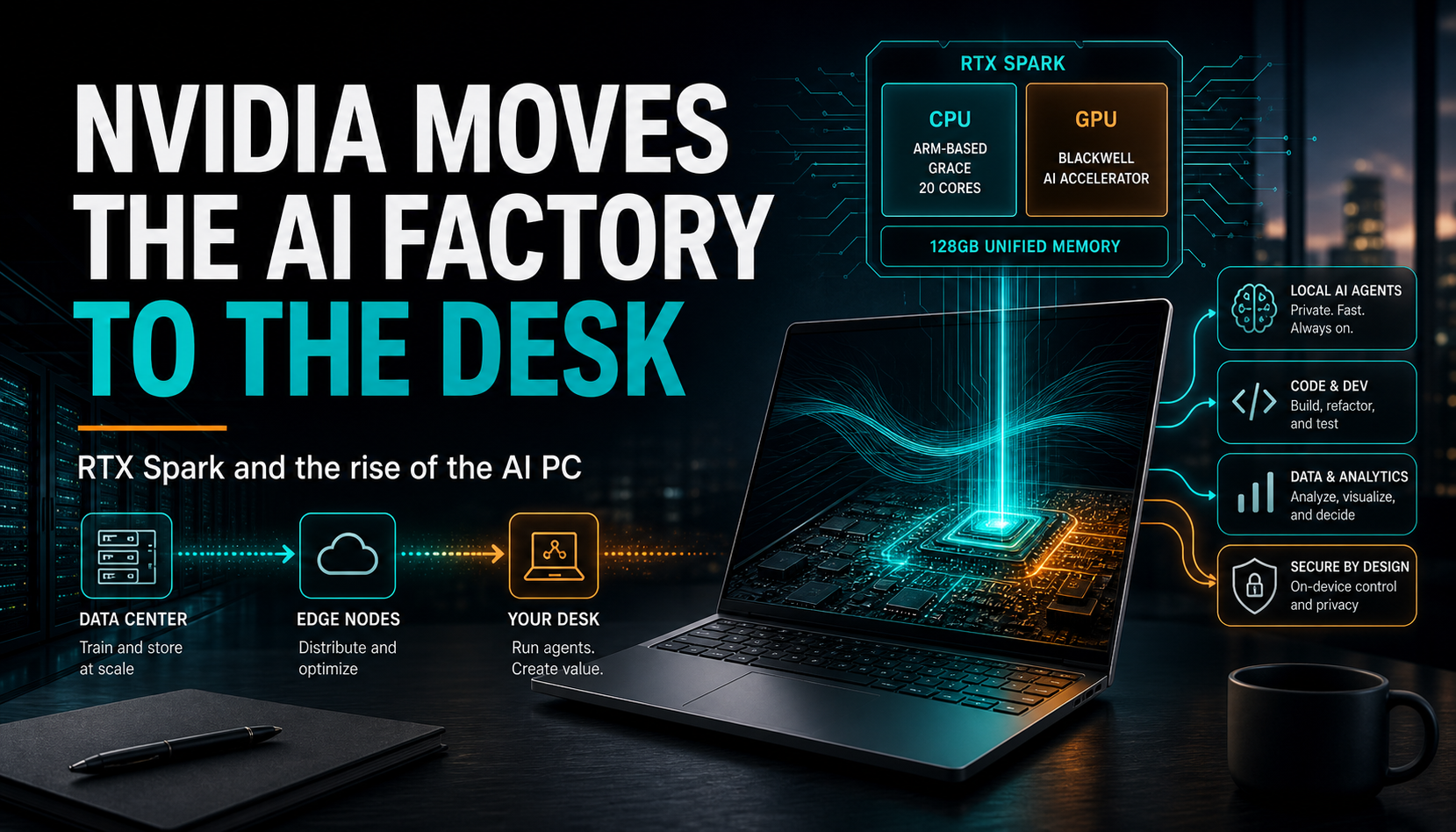
For years, Nvidia has owned the data center story, especially as it relates to AI. The company powered the GPUs behind the frontier models, the hyperscaler buildouts, the AI factories, and the massive infrastructure race defining this era of technology.
But at Computex 2026, Nvidia made a different move.
It came for the PC.
Nvidia unveiled RTX Spark, a new Windows PC platform built with Microsoft and supported by major manufacturers including ASUS, Dell, HP, Lenovo, Microsoft Surface, and MSI, with Acer and GIGABYTE expected to follow.
This is Nvidia taking its data center AI playbook and compressing it into a personal computer.
A laptop. A desktop.
A machine sitting on the desk, capable of running local agents, frontier models, creative workflows, code tasks, and AI-native applications without depending entirely on the cloud.
That is the real signal. The AI factory is no longer only in the data center.
It is moving to the edge.
And the PC is becoming one of its nodes.
The Architecture: Grace CPU + Blackwell GPU
RTX Spark combines a 20-core Nvidia Grace CPU with a Blackwell RTX GPU, connected through Nvidia’s NVLink-C2C chip-to-chip interconnect.
It supports up to 128GB of unified memory and up to 1 petaflop of AI compute.
The CPU handles control flow, data movement, tool routing, application logic, and agent orchestration.
The GPU handles the parallel math required for inference, multimodal generation, graphics, video, and local model execution.
The unified memory matters because agentic workflows are context-hungry.
Large models. Long documents. Multimodal assets. Local files. Codebases. Tool calls. Multiple agents working together.
Those workflows need memory, bandwidth, and coordination. Nvidia is effectively building a PC architecture designed around local agent execution instead of traditional app launching.
That is the BIG shift.
The PC is becoming less like a passive tool, and more like an active compute node.
RTX Spark also accelerates a much bigger market transition.
The Windows PC ecosystem is moving deeper into Arm.
Apple already proved the viability of Arm-based laptops with the M-series. Qualcomm pushed Windows on Arm forward with Snapdragon X. Now Nvidia is entering with the full weight of its GPU ecosystem, CUDA stack, AI software, developer tools, and Microsoft partnership.
That makes this different. Nvidia is not just another chip supplier. It is bringing an ecosystem.
CUDA. RTX. DLSS. TensorRT. OptiX. FP4. OpenShell. Developer tooling. Gaming. Creative apps. AI frameworks.
That is why Intel, AMD, Qualcomm, and Apple all have to pay attention.
The old PC race was about CPU performance, battery life, and app compatibility.
The new PC race is about local AI capability, agent security, unified memory, GPU acceleration, and how well the machine can become a daily AI work partner.

Why This Matters For Operators
The first RTX Spark machines will likely be premium devices for creators, AI developers, engineers, and power users.
But the enterprise implications are bigger than the first wave of laptops.
There are three shifts operators should be watching.
1. Local Agentic AI Is Becoming Real
For the last few years, most serious AI workloads lived in the cloud or on large on-prem hardware.
That made sense.
The models were large. The compute requirements were too high.
But that is changing.
RTX Spark is built for agents running on the user’s primary device. Nvidia says RTX Spark can support local 120-billion-parameter LLMs with up to a 1 million token context window, along with creative workflows like 12K video editing, 4K AI video generation, and large 3D scenes.
That changes the enterprise conversation.
Local AI can reduce latency. Local AI can improve privacy. Local AI can lower cloud dependency. Local AI can support disconnected or controlled environments. Local AI can keep sensitive work closer to the user.
That does not mean the cloud goes away.
It means the architecture becomes hybrid.
Some intelligence runs locally.
Some routes to cloud models.
Some is governed by policy.
Some is blocked entirely.
That is the next AI operating model and where things are going.
2. The Windows AI PC Finally Has A Serious Apple Silicon Answer
Apple changed expectations for what a laptop could be.
Fast. Quiet. Efficient. Long battery life. High performance on battery. Tightly integrated hardware and software.
Windows has been trying to answer that for years.
RTX Spark gives Microsoft a much stronger answer for the AI era.
Not just “Windows on Arm.”
Windows on Arm with Nvidia’s AI stack.
Windows on Arm with local agents.
Windows on Arm with a GPU architecture built for inference, media, gaming, and creative work.
Windows on Arm with new security primitives and Nvidia OpenShell for agent control.
For enterprise IT leaders, this matters because hardware refresh strategy is about to get more complicated.
The question will not simply be: Which laptop has the best CPU?
It will be:
- Which device can securely run local AI agents?
- Which device supports our data policies?
- Which device works with our AI workflows?
- Which device can reduce cloud cost without creating new security risk?
- Which device gives our developers and operators the best agentic workbench?
That is a very different buying framework, and will becoming more commonplace.
3. The AI Factory Extends To The Desk
Nvidia has spent years talking about AI factories.
Usually, that means data centers.
Massive GPU clusters.
Networking.
Storage.
Power.
Cooling.
Token generation at scale.
But RTX Spark pushes that concept outward.
The AI factory is no longer only a centralized facility.
It becomes distributed.
In the cloud.
In the data center.
At the edge.
On the workstation.
On the laptop.
At the desk.
That does not mean every employee needs a high-end AI PC.
But it does mean some enterprise workflows will benefit from local compute, and a large signal that AI is going to be moving to a lot more outside the traditional data center whether that be cloud vs on-prem.
- Developers working with code agents.
- Creative teams generating and editing media.
- Analysts working with sensitive documents.
- Security teams investigating local data.
- Engineers running simulation or model-assisted design.
- Executives using private agents over files, email, and workflows.
The PC becomes part of the AI infrastructure plan.
Not just an endpoint to manage.
A compute node to govern.
The Security Layer Matters
There is one more piece that should not get lost in the hardware excitement.
Agents running locally on primary devices create real risk.
They need identity.
Containment.
Policy.
Permissioning.
Auditability.
Data controls.
The ability to decide what stays local and what can go to the cloud.
Nvidia and Microsoft are addressing this through new Windows security primitives and Nvidia OpenShell, a runtime designed to define what agents can and cannot do, route queries based on privacy policy, and help protect sensitive data.
That is important.
Because the future of the AI PC will not be decided by raw performance alone.
It will be decided by trust.
Can the agent access the right files, but not the wrong ones?
Can it use applications without leaking data?
Can IT govern local AI behavior?
Can compliance teams audit what happened?
Can security teams contain the blast radius when something goes wrong?
If the answer is no, enterprise adoption slows down.
If the answer is yes, the AI PC becomes much more than a premium laptop.
It becomes a new enterprise work surface.
Frequently Asked Questions: Nvidia RTX Spark and the AI PC
What is Nvidia RTX Spark?
Nvidia RTX Spark (also called the N1X) is a new Windows AI PC platform unveiled at Computex 2026. It combines a 20-core Nvidia Grace Arm-based CPU with a Blackwell RTX GPU, connected via NVLink-C2C, with up to 128GB of unified memory and up to 1 petaflop of AI compute. It is designed to run local AI agents, large language models, and multimodal workflows directly on the device without full cloud dependency.
Which laptop brands will support Nvidia RTX Spark?
Nvidia announced RTX Spark support from ASUS, Dell, HP, Lenovo, Microsoft Surface, and MSI at launch, with Acer and GIGABYTE expected to follow. Nvidia plans to release more than 30 laptops and 10 desktops powered by the RTX Spark chip over time.
How does Nvidia RTX Spark compare to Apple Silicon?
RTX Spark is Nvidia and Microsoft’s most direct answer to Apple’s M-series chips. Like Apple Silicon, it uses an Arm-based CPU architecture for power efficiency. Unlike Apple Silicon, it brings Nvidia’s full AI stack — CUDA, TensorRT, DLSS, and Blackwell GPU architecture — to Windows, enabling local LLM inference, agentic workflows, and GPU-accelerated creative tasks that go beyond what Apple Silicon currently offers for enterprise AI workloads.
What does RTX Spark mean for enterprise hardware refresh cycles?
Enterprise IT leaders planning hardware refreshes in 2026 and 2027 should evaluate Arm-based Windows devices before committing to x86. RTX Spark shifts the buying framework from “which laptop has the best CPU” to “which device can securely run local AI agents, support data policies, and reduce cloud dependency without creating new security risk.”
What is Nvidia OpenShell?
Nvidia OpenShell is a runtime layer designed to govern local AI agents on RTX Spark devices. It defines what agents can and cannot do, routes queries based on privacy policy, and helps protect sensitive data from leaving the device. It is a key component of the security architecture for enterprise AI PC deployments.
When will RTX Spark laptops be available?
Nvidia announced that the first RTX Spark laptops will be available in Fall 2026. The initial wave will be premium, ultra-thin devices (as thin as 14mm) targeted at creators, AI developers, and power users, with broader price points expected to follow.
References and Sources
- CNBC: Nvidia’s new chip to power fresh line of Windows laptops by Dell, HP (May 31, 2026)
- Jason J. Fleagle on LinkedIn: Nvidia Just Moved the AI Factory to the Desk with RTX Spark
- Netsync — Enterprise AI and Technology Solutions
Frequently Asked Questions: Nvidia RTX Spark and the AI PC
What is Nvidia RTX Spark?
Nvidia RTX Spark (also called the N1X) is a new Windows AI PC platform unveiled at Computex 2026. It combines a 20-core Nvidia Grace Arm-based CPU with a Blackwell RTX GPU, connected via NVLink-C2C, with up to 128GB of unified memory and up to 1 petaflop of AI compute. It is designed to run local AI agents, large language models, and multimodal workflows directly on the device without full cloud dependency.
Which laptop brands will support Nvidia RTX Spark?
Nvidia announced RTX Spark support from ASUS, Dell, HP, Lenovo, Microsoft Surface, and MSI at launch, with Acer and GIGABYTE expected to follow. Nvidia plans to release more than 30 laptops and 10 desktops powered by the RTX Spark chip over time.
How does Nvidia RTX Spark compare to Apple Silicon?
RTX Spark is Nvidia and Microsoft’s most direct answer to Apple’s M-series chips. Like Apple Silicon, it uses an Arm-based CPU architecture for power efficiency. Unlike Apple Silicon, it brings Nvidia’s full AI stack — CUDA, TensorRT, DLSS, and Blackwell GPU architecture — to Windows, enabling local LLM inference, agentic workflows, and GPU-accelerated creative tasks that go beyond what Apple Silicon currently offers for enterprise AI workloads.
What does RTX Spark mean for enterprise hardware refresh cycles?
Enterprise IT leaders planning hardware refreshes in 2026 and 2027 should evaluate Arm-based Windows devices before committing to x86. RTX Spark shifts the buying framework from “which laptop has the best CPU” to “which device can securely run local AI agents, support data policies, and reduce cloud dependency without creating new security risk.”
What is Nvidia OpenShell?
Nvidia OpenShell is a runtime layer designed to govern local AI agents on RTX Spark devices. It defines what agents can and cannot do, routes queries based on privacy policy, and helps protect sensitive data from leaving the device. It is a key component of the security architecture for enterprise AI PC deployments.
When will RTX Spark laptops be available?
Nvidia announced that the first RTX Spark laptops will be available in Fall 2026. The initial wave will be premium, ultra-thin devices (as thin as 14mm) targeted at creators, AI developers, and power users, with broader price points expected to follow.
References and Sources
- CNBC: Nvidia’s new chip to power fresh line of Windows laptops by Dell, HP (May 31, 2026)
- Jason J. Fleagle on LinkedIn: Nvidia Just Moved the AI Factory to the Desk with RTX Spark
- Netsync — Enterprise AI and Technology Solutions
About the Author
Jason J. Fleagle is a Chief AI Officer, AI architect, and enterprise technology strategist. He is the founder of Catalyst Brand Group, a consulting agency specializing in AI software development, digital marketing, and automation. Jason also serves as Chief AI Officer at Netsync, where he helps enterprise leaders design and deploy secure, high-ROI AI systems that drive measurable business outcomes.
Follow Jason on LinkedIn for weekly AI Pathfinder insights on enterprise AI, infrastructure, and the future of intelligent work. To discuss AI strategy for your organization, contact the Netsync team.
Originally published on LinkedIn: Nvidia Just Moved the AI Factory to the Desk with RTX Spark
Table of content
- What is Nvidia RTX Spark?
- Which laptop brands will support Nvidia RTX Spark?
- How does Nvidia RTX Spark compare to Apple Silicon?
- What does RTX Spark mean for enterprise hardware refresh cycles?
- What is Nvidia OpenShell?
- When will RTX Spark laptops be available?
- What is Nvidia RTX Spark?
- Which laptop brands will support Nvidia RTX Spark?
- How does Nvidia RTX Spark compare to Apple Silicon?
- What does RTX Spark mean for enterprise hardware refresh cycles?
- What is Nvidia OpenShell?
- When will RTX Spark laptops be available?