
OpenAI Launches Voice Updates With GPT-Live & It's Not What You Think
Quick take: OpenAI GPT-Live moves voice AI from turn-based chat toward a real-time workflow interface. Here is what operators should watch next.
Voice AI just crossed an important line with OpenAI's GPT-Live.
On July 8, 2026, OpenAI introduced GPT-Live, a new generation of voice models designed to make talking with ChatGPT feel more like a real conversation.
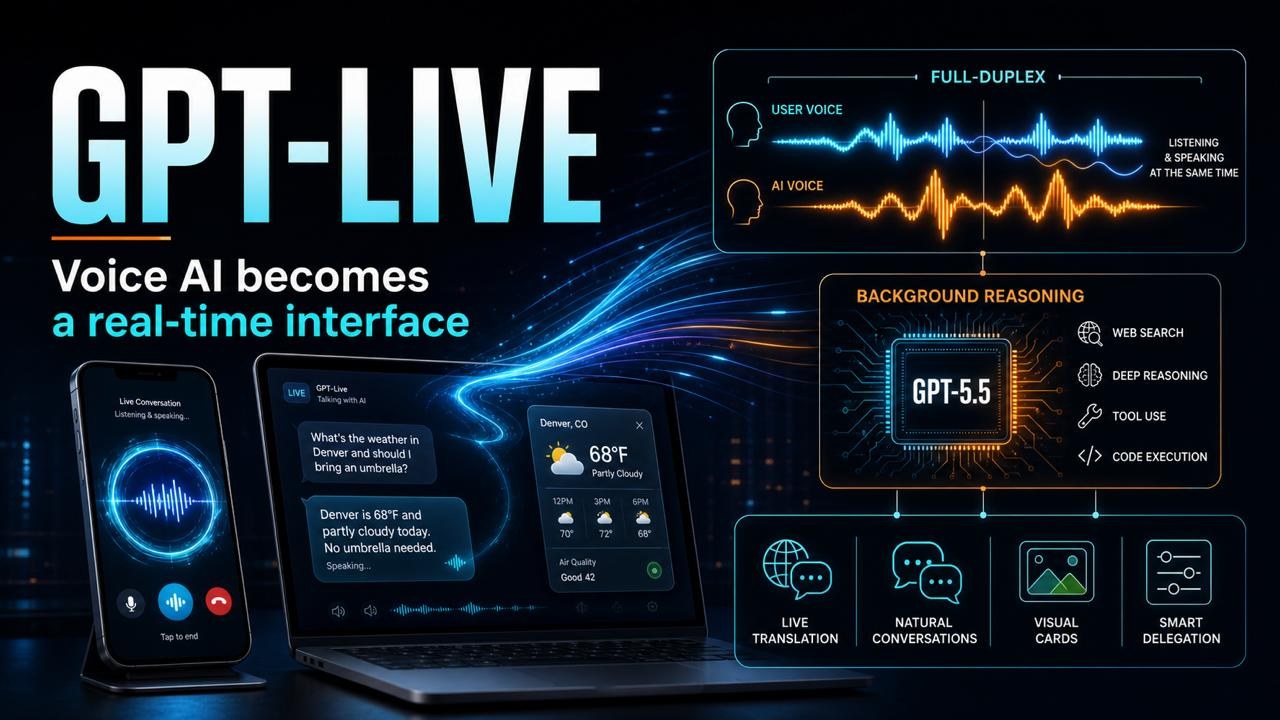
The headline feature is full-duplex voice.
That means GPT-Live can listen and speak at the same time. You can interrupt it. You can pause and think. It can acknowledge you naturally with small cues like “mhmm” or “yeah.” It can keep track of timing better. It can even support live translation.
That may sound like a product improvement, but it's definitely bigger than that.
GPT-Live is OpenAI’s move to make voice a real-time interface for AI work, tasks, and conversations.
The Shift From Chatbot to Conversation Layer
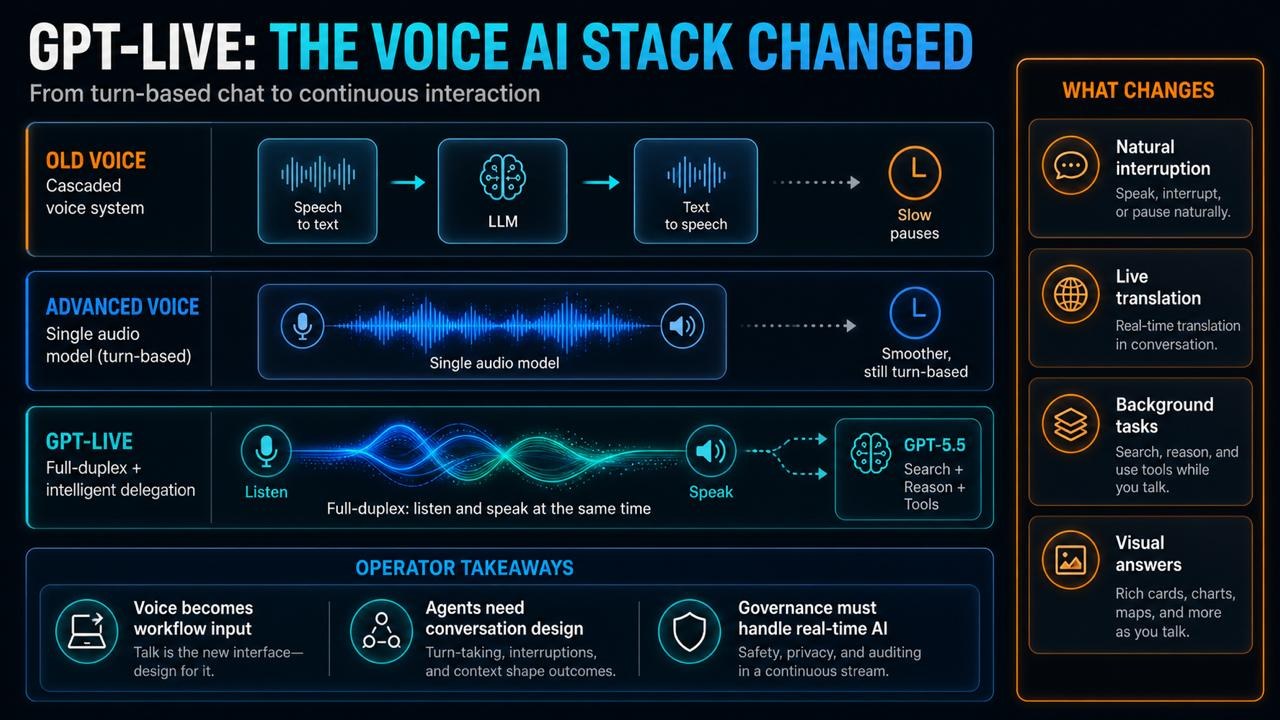
Most AI voice products still feel like turn-taking.
You speak. The model waits. It processes. Then it speaks back.
That is useful, but it does not feel natural. Real conversation is messier. People interrupt. They pause. They change direction mid-sentence. They think out loud.
GPT-Live is built for that world.
OpenAI says the model continuously processes input while generating output. That lets it decide many times per second whether to speak, keep listening, pause, interrupt, or invoke a tool.
That is the architectural shift.
Voice is no longer just speech-to-text wrapped around a chatbot, but it is finally becoming the interaction layer.
The Real Breakthrough: Delegation
The most important part of GPT-Live may not be the voice, but actually the delegation layer.
OpenAI says GPT-Live can hand more complex work to its latest frontier model in the background. At launch, that model is GPT-5.5.
So if you ask a simple question, GPT-Live can answer naturally in the moment. But if you ask something that needs web search, deeper reasoning, tools, or more complex work, GPT-Live can delegate that task behind the scenes and keep the conversation moving.
That matters because it separates two jobs: Real-time conversation & Deep task execution.
Those are not the same thing.
A great voice model has to be fast, fluid, and socially aware. A great reasoning model has to be slower, deeper, and more deliberate.
GPT-Live combines both.
That is the pattern you should be paying attention to.
Why This Matters
The first wave of AI at work was text-based. Prompt in. Answer out.
The next wave will be conversational. Talk through the problem. Let the AI ask clarifying questions. Delegate the research. Review the result. Steer the next step.
That changes how people use AI.
A worker does not need to stop, open a prompt box, write a perfect instruction, and wait. They can talk while walking, commuting, building, selling, teaching, troubleshooting, or operating.
That means voice AI becomes a workflow input.
For teams, that opens new use cases:
Sales coaching. Field support. Language practice. Customer service simulations. Training. Hands-free research. Meeting prep. Technical troubleshooting. Operational checklists. Executive briefings.
The best use cases will not be “talk to a chatbot”, but go ahead and “talk through the work.”
Your Operator Takeaway
GPT-Live is not just better voice features, but more like a signal that AI interfaces are becoming more ambient, more natural, and more agentic.
The old interface was: Type a prompt → get a response.
The new interface is becoming: Start a conversation → delegate work → keep steering.
That is a major shift for adoption.
Typing prompts is still a barrier for a lot of people. Talking is not. If voice becomes good enough, daily AI usage can move from “I should remember to use ChatGPT” to “I’ll just ask while I’m doing the work.”
That is where adoption gets interesting.
What Still Needs Work
GPT-Live is not the full agentic voice future yet.
I'm excited to see what Peter Steinberger, the creator of OpenClaw creates for an OpenAI enterprise version for agentic use-cases.
OpenAI says it is rolling out now across ChatGPT on iOS, Android, and web, with API access coming soon. GPT-Live-1 will be the default voice model for Go, Plus, and Pro users, while GPT-Live-1 mini will power Free users.
But there are still limits.
At launch, GPT-Live does not support voice with video or screen sharing in ChatGPT. Some languages may have fluency gaps or non-native accents. Enterprises will also need to think carefully about privacy, recording, consent, emotional reliance, and real-time safety.
Voice raises the stakes.
When AI sounds natural, people trust it differently. That means governance has to evolve too.
Your AI Action Plan
Start mapping voice-first workflows. Look for moments where typing slows people down: field work, sales, support, training, executive prep, and mobile work. Separate conversation from execution. Do not judge voice AI only by how naturally it talks. Judge whether it can delegate deeper work and return useful results. Build conversation design into your AI strategy. Turn-taking, interruption handling, silence, clarification, and escalation now matter. Create real-time governance rules. Voice AI needs policies for sensitive topics, recordings, privacy, minors, customer interactions, and regulated work. Test adoption with non-technical users. The biggest impact may come from people who never became strong prompt writers but are comfortable talking through a problem.
Frequently Asked Questions
What is GPT-Live? GPT-Live is OpenAI’s new generation of voice models for ChatGPT Voice. It is designed for more natural, real-time human-AI conversation.
What makes GPT-Live different? It uses a full-duplex architecture, meaning it can listen and speak at the same time. That enables interruption, pauses, more natural timing, and live translation.
Can GPT-Live do deeper reasoning? Yes. OpenAI says GPT-Live can delegate complex work to a frontier model behind the scenes. At launch, it uses GPT-5.5 in the background.
Where is GPT-Live available? OpenAI says GPT-Live is rolling out globally in ChatGPT across iOS, Android, and ChatGPT.com. API access is coming soon.
What are the limits? At launch, GPT-Live does not support voice with video or screen sharing in ChatGPT. Some languages may have accent or fluency limitations.
About Jason Fleagle
Jason Fleagle is the Head of AI for Netsync and an AI and Growth Consultant working with global brands to help with their successful AI adoption and management. He helps humanize data — so every growth decision an organization makes is rooted in clarity, not confusion. He has overseen the development and delivery of over $50M in digital solutions, driving significant revenue growth and operational efficiency for his clients.
Connect with Jason on LinkedIn to stay updated on the latest in AI, growth strategies, and enterprise technology.
Additional internal reading
- AI Readiness Scorecard
- AI Model Evaluation for Business
- AI Governance Checklist
- AI Agent Use Case Library
- Human-in-the-Loop AI Governance
- Prompt Injection Risk for Business Leaders
- Microsoft Copilot Governance
- Enterprise AI Roadmap Template
References
Originally published on LinkedIn.
About AI Pathfinder
AI Pathfinder is Jason Fleagle’s recurring field note on enterprise AI, agentic systems, AI governance, and the operating models leaders need as AI moves from experiments into real work.