Imagine your engineering lead has a recurring payment bug to fix. The AI agent needs to trace the retry logic, change several files, write useful tests, and explain what it verified. A finance colleague needs a different kind of care: reconcile a workbook against contracts and produce a recommendation someone can defend.
These hypothetical tests illustrate the buying decision behind Google's latest release. Complex work happens often enough that waiting, retries, and reviewer time matter as much as the model's best answer.
Google introduced Gemini 4 Neon on November 18, positioning it between Carbon's deeper reasoning and Hydrogen's faster everyday execution. The useful question for leaders is where that balance produces more accepted work with less supervision.
Why this matters
Neon deserves a place in evaluations of repository-level coding and document-heavy professional work. Independent results support that recommendation, with meaningful losses alongside the wins. The model is available through paid developer and consumer surfaces, but access, tools, and operating costs differ by product.
Start by testing the default high thinking level against the model you already use. Raise effort only when you can identify the failure it fixes. Keep your review standard unchanged.
What Google actually shipped
The AI Studio model specification lists gemini-4-neon as a stable model, rather than a preview identifier. It accepts text, images, video, audio, and PDFs, and outputs text. Reading a video does not mean it generates video. Image generation, audio generation, and the Live API are not supported.
Supported capabilities include function calling, structured outputs, code execution, computer use, file search, URL context, and grounding with Google Search and Maps. Those tools make it possible to build a workflow around the model. They do not establish that every consumer interface exposes the same tools or permissions.
The context limit needs careful reading. Input, thinking, and output share a single 1,048,576-token window. Default synchronous output is limited to 65,536 tokens. Longer generation needs background execution or client-side continuation, and the input already occupies part of the shared window. You cannot fill the context with a million tokens of documents and expect another million tokens of answer space.
Google's launch describes rollout to Pro and Ultra subscribers in the Gemini app and AI Studio, and to paid Gemini API projects. Antigravity's announcement explicitly covers its desktop app, CLI, and IDE extensions for Pro and Ultra subscribers, with enterprise access through Gemini for business. The API supports both generateContent and the Interactions API. Neon has no free API tier.
A consumer subscription is not evidence of an enterprise data agreement or API budget. The AI Studio and Gemini API region list is product-specific. The launch pages do not establish an identical country rollout, quota, or entitlement across the app, API, and Antigravity. You will want to verify the surface and account your team will actually use.
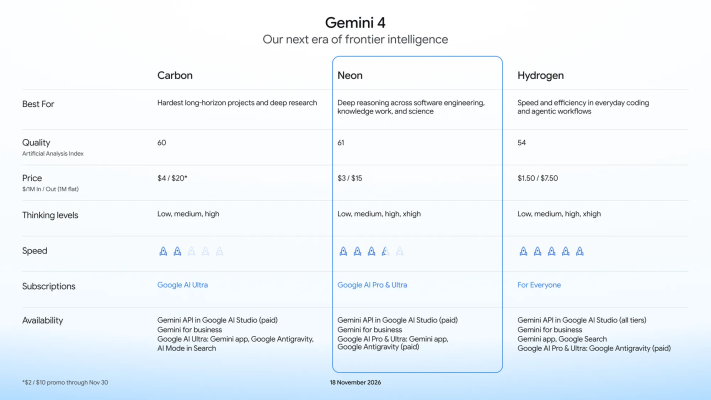
Google’s November 18 launch comparison of Carbon, Neon and Hydrogen. Carbon’s displayed rates reflect its announced post-promotion pricing; the introductory rates expire November 30, 2026.
Where the benchmark case holds up
Google's model card provides a useful starting point, but its table combines different evaluation sources and settings. The evaluation methodology distinguishes Google's own runs, third-party evaluations, and competitor self-reports. Google generally uses the highest thinking setting and single-attempt scoring unless a benchmark specifies otherwise. That distinction matters more than counting highlighted cells.
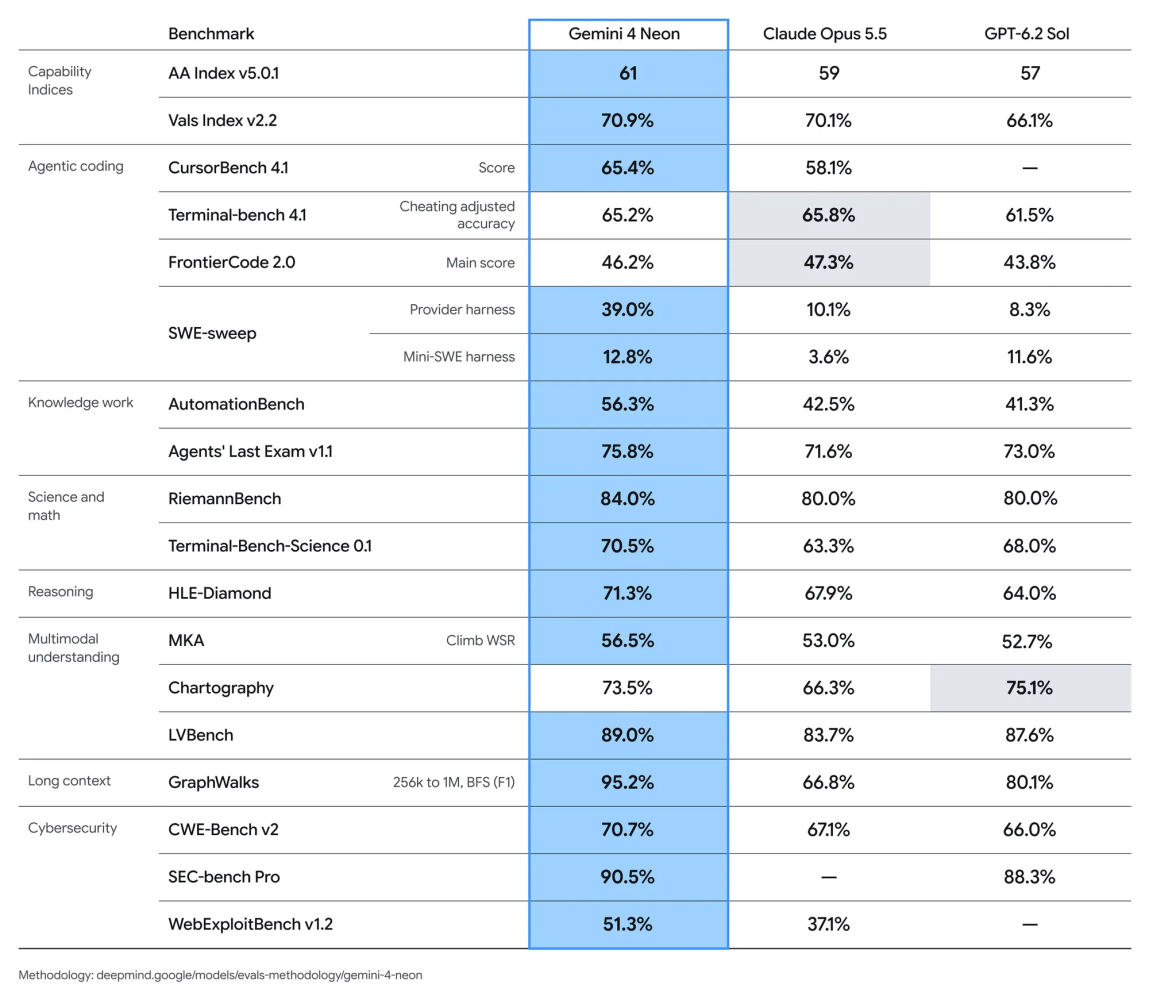
Google / Google DeepMind launch benchmark table, retrieved November 23, 2026. Evaluation sources, effort settings and harnesses differ. Cybersecurity results use the conditions specified in Google’s evaluation methodology.
For long context, Google reports GraphWalks BFS F1 of 95.2% for Neon, against 66.8% for Claude Opus 5.5 and 80.1% for GPT-6.2 Sol. These are Google's self-computed results on 200 problems spanning 256,000 to one million tokens. They justify testing relationships scattered through a large document set. They do not establish that Neon will interpret a disputed contract correctly.
The same table contains clear losses. On Terminal-Bench 4.1, cheating-adjusted accuracy is 65.2% for Neon, 65.8% for Opus, and 61.5% for Sol. Google's methodology attributes Neon's result to Artificial Analysis using Antigravity CLI 1.5.9 and the other results to the public leaderboard. This is a model-plus-harness comparison, with no demonstrated statistical significance for the small Neon-Opus gap.
On Chartography, Neon scores 73.5%, below Sol's 75.1% and above Opus's 66.3%. Google computed Neon and Sol without tools and took Opus's result from its system card. A team doing financial-chart interpretation should preserve that distinction and include its own difficult charts in testing.
The DeepMind model card still warns about hallucinations and gives a March 2026 knowledge cutoff. Strong document scores do not remove the need to verify citations, dates, formulas, and source conflicts.
Independent tests reveal a more useful tradeoff
Cognition's current FrontierCode 2.0 board, gives a concrete coding comparison across its 132-task suite:
- Neon at high, in Antigravity CLI: 46.2% main score and $4.38 average cost per rollout.
- Claude Opus 5.5 at max, in Claude Code: 47.3% and $12.82.
- GPT-6.2 Sol at max, in Codex: 43.8% and $1.29.
- Claude Fable 5.2 at xhigh, in Claude Code: 50.2% and $17.73.
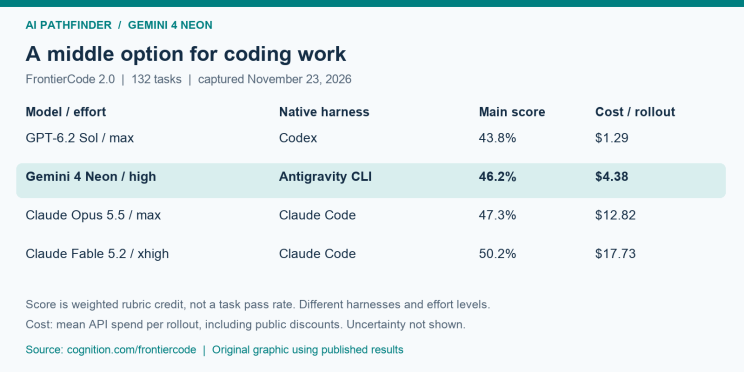
Original AI Pathfinder graphic from Cognition's FrontierCode 2.0 leaderboard, captured November 23, 2026. Main score is a weighted rubric aggregate, not a task pass rate. Costs are mean spend per rollout at list API pricing including public discounts. Different native harnesses and effort settings are shown. Repeat counts and uncertainty are not established by this table.
That is a credible middle option, rather than a universal winner. Neon scores above Sol here but costs more. It scores below Opus and Fable while costing less. Whether that makes it the better purchase depends on the errors your reviewers must repair or what your team is looking for in terms of outcomes.
Cognition explains its grading in terms engineers will recognize: correctness, maintainability, inferred requirements, and scope. A solution failing a blocking criterion receives zero. Higher reasoning effort can also make results worse when an agent overcomplicates a change. For our hypothetical payment bug, the useful test is whether the patch respects the service's existing behavior and catches the regression, not whether the agent produces a longer explanation.
For professional work, the Vals Index v2.2 board, dated November 19 shows Neon at 70.87%, compared with Fable 5.2 at 71.31%, Opus 5.5 at 70.14%, and Sol at 66.06%. The published costs per test are $7.40, $17.94, $24.77, and $3.18, respectively.
Vals combines finance, coding, legal, and tax benchmarks using sector weights based on U.S. GDP. It is a weighted index, not the percentage of an employee's job that can be automated. Neon's displayed uncertainty is ±0.94 and Fable's is ±0.96, with error bars defined as one standard error. Their numerical ordering does not establish a decisive capability difference. Vals lists xhigh as Neon's default evaluation effort while warning that individual benchmarks may use different settings.
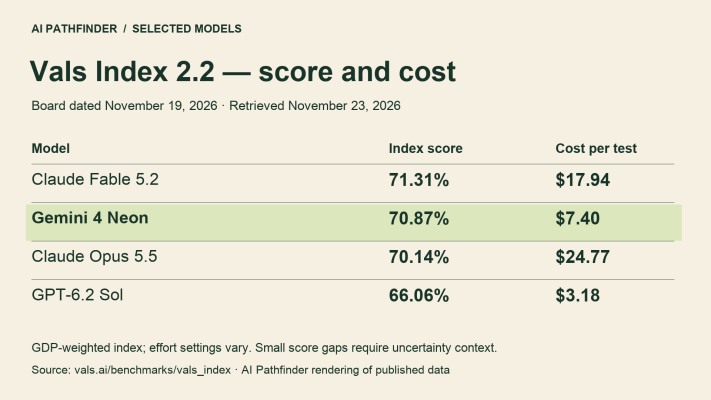
AI Pathfinder rendering of selected Vals Index v2.2 results. Board dated November 19, retrieved November 23, 2026. Evaluation efforts vary; interpret the close scores alongside the uncertainty described above.
Those results make Neon worth testing for the hypothetical finance assignment. They also show why a team satisfied with Sol's outputs should not assume a switch will save money.
A launch ranking needs a date
Google's announcement reported Neon third overall on the Artificial Analysis Intelligence Index with a score of 61. The live model page, still shows 61 for xhigh but displays rank six among 95 entries. Those entries include different effort configurations. A launch-day rank should not become an undated headline.
Artificial Analysis uses Intelligence Index v5.0.1, combining distinct evaluations rather than a single accuracy test. Its live browser capture showed $6.44 per index task and 25.8 minutes per task for Neon xhigh. An earlier text capture returned 23.7 minutes. These are changing measurements of that benchmark workload, not an estimate for how long your chat or code fix will take.
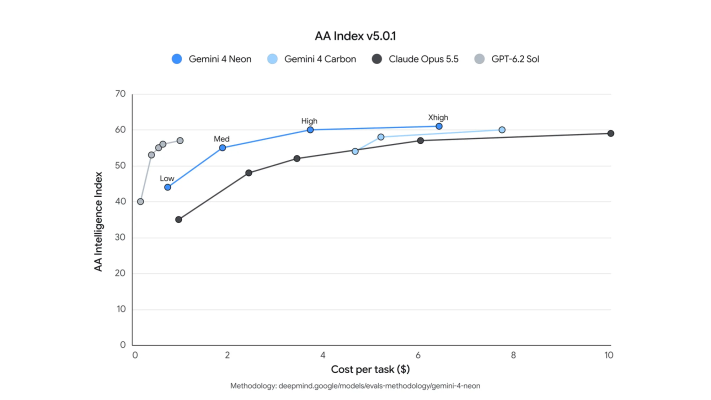
Google’s November 18 launch presentation of Artificial Analysis Intelligence Index v5.0.1 versus cost per task. Effort levels are labeled. This chart is a launch snapshot.
Arena illustrates the same problem. Google's launch reported second overall at 1,336. The Agent Arena page retrieved for this article, dated November 22, instead shows Neon high as preliminary, third at 1,331. A browser recheck hit a security-verification page, so that latter reading rests on the saved text extraction. Neither snapshot supports an evergreen second-place claim.
The Rundown's launch analysis usefully emphasizes the tradeoffs and pricing caveat. It is reporting on evaluations, not a separate independent reproduction of Google's scores.
Antigravity changes the system you are evaluating
The substantive Antigravity news is Orchestrator's Neon-Hydrogen pairing. Google describes Neon handling planning, architecture, and difficult reasoning, with Hydrogen executing routine edits, package updates, and test runs. When Hydrogen encounters friction, work returns to Neon to inspect the state and revise the plan.
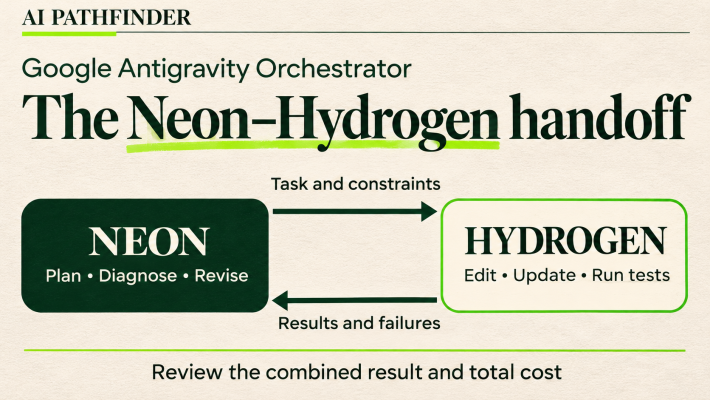
Google Antigravity’s Neon–Hydrogen workflow.
For a development lead, that creates a separate candidate to evaluate alongside Neon alone. The pairing may be useful when a task contains substantial routine execution after a difficult diagnosis. It also creates handoffs that need inspection: did the worker receive the constraints, did the planner notice a failed test, and did either agent claim completion prematurely?
Google reports SWE-sweep subtask-weighted reward of 39.0% in Antigravity versus 12.8% in its mini-SWE vision harness. These are Google's own evaluations, and the Antigravity harness includes subagents suited to bug finding. That difference cannot be credited solely to the underlying model or transferred to your custom API agent.
Google also claims its lowest fabrication rate yet in internal Antigravity testing. That is useful vendor evidence to investigate, not an independent reliability guarantee. Keep actual test output, diffs, and unresolved failures visible to the reviewer. A fluent completion message is not evidence that the patch works.
So use the AI harness Antigravity to help improve outputs.
AI Studio is where migration details become expensive
The AI Studio migration guide is more useful to builders than the launch demos. Neon supports low, medium, high, and xhigh thinking, with high as the default. Google recommends choosing the lowest effort that meets your quality bar.
For existing Gemini 4 applications, the request schema can stay the same, but the thinking defaults may change. For older Gemini integrations, review caching, sampling parameters, tool declarations, conversation state, and timeouts before changing the model string.
Explicit caching is unsupported. Implicit caching applies to prompts of at least 4,096 tokens, and a cache hit receives the discount. Custom temperature, top_p, and top_k values within range are ignored. Declare tools natively rather than asking for raw-text JSON tool calls without declared tools. Preserve thought signatures in client-managed histories, or use the Interactions API's previous_interaction_id for continued sessions.
The output cap includes thinking tokens. A cap inherited from an older integration can consume the budget before the useful answer finishes. Google warns that hard prompts may take several minutes and recommends background execution or client timeouts of at least 15 minutes. Your product still needs a user-facing timeout, cancellation path, and spending boundary appropriate to the job.
The price advantage has a calendar attached
Neon's Standard API pricing is $3 per million input tokens, $0.15 per million cached input tokens, and $15 per million output tokens, including thinking. The published Neon Standard table does not list a separate long-input surcharge. Do not import an older Gemini model's long-context pricing bands.
Batch, Flex, and Priority are supported consumption options, but the prices above are Standard rates. Tool charges, token usage, cache behavior, and service tier all belong in the estimate.
Carbon complicates the comparison. Its launch pricing footnote says introductory input/output rates of $2/$10 expire November 30, 2026, after which $4/$20 apply. On November 23, Neon's token rates are therefore 50% higher than Carbon's promotional rates, while 25% lower than Carbon's announced post-promotion rates.
That does not tell you which completes a task more cheaply. Different models can consume different amounts of thinking, tool context, and retries. Add reviewer effort and the comparison can change again. The same principle applies in my Astra and Sol upgrade analysis: price the accepted deliverable, with the actual operating conditions attached.
Security results do not authorize broader access
Google's evaluation methodology says the cybersecurity results were run without safety filters. Its launch separately describes Neon for cyber rolling out to eligible defenders through the Fairwind Program. Those results should not be presented as the behavior or availability of the ordinary public endpoint.
The model card also still labels Neon's full Safety & Security Report as forthcoming. It carries forward several frontier-risk determinations from Argon after a material-capability-change assessment, rather than claiming every critical-capability evaluation was rerun for Neon.
For either hypothetical assignment, retain least-privilege access and approval before production changes. Better benchmark performance is a reason to test the model inside your controls, not a reason to remove them.
Your AI Pathfinder Action Plan
Choose a recurring assignment with a clear owner and a reviewable deliverable. For the payment bug, use a sandboxed repository snapshot. For the finance brief, use an authorized document set with known conflicts and a checked reference workbook. These are proposed tests, not reported Neon outcomes.
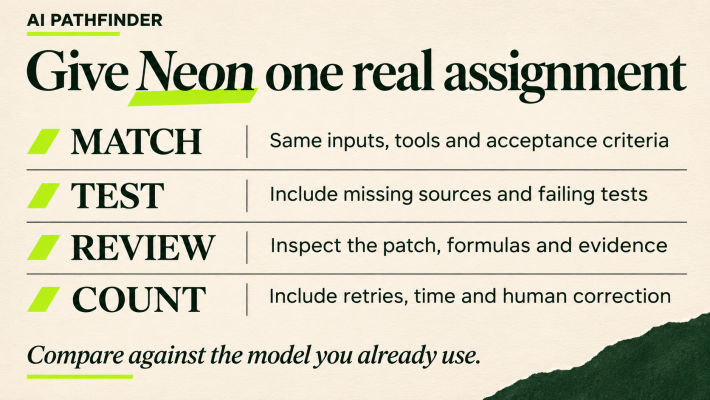
Run the same work under the same permissions and acceptance criteria. Count failed attempts and human corrections before deciding whether to switch.
- Freeze the comparison. Give the current model and Neon the same input, tool access, task instructions, and review rubric. Record model IDs, effort, harness versions, pricing date, and output caps. Test Orchestrator separately if you plan to use it.
- Include difficult cases. Use ordinary work alongside missing information, contradictory sources, failing tests, and instructions embedded in retrieved documents. Define which errors block acceptance and which require escalation.
- Review the artifact before the explanation. The engineering reviewer runs tests and inspects the diff. The finance reviewer checks formulas and traces recommendations to the supplied sources. Hide model labels where practical to reduce preference bias.
- Count the whole job. Log accepted outcomes, failures, retries, elapsed completion time, tool spend, billed tokens, and hands-on review and rework. Report both typical and slow-case latency. A failed attempt remains in the cost total.
- Make a bounded decision. Switch only the work where Neon meets the acceptance bar and improves the outcome you selected. Keep the current model for other work, name a rollback owner, and set a review date. Value staff time separately from cash savings unless spending actually changes.
The Bottom Line
Neon has a credible case in demanding daily work: competitive coding, strong professional-work results, and useful controls for adjusting reasoning effort. Its losses, changing rankings, and Carbon's temporary pricing discount are part of that case.
Bring one real assignment to the next team review. Agree on what an acceptable result looks like before anyone sees the model output. That gives you a defensible upgrade decision instead of another subscription justified by a launch chart.
About Jason Fleagle
Jason Fleagle is Head of AI at Netsync and writes AI Pathfinder about practical AI adoption, business value, and secure operations.