The slide deck looks finished until you compare it with the template. The spreadsheet opens, but someone still has to trace the formulas. The memo sounds confident while skipping the one missing source that could change its conclusion.
That's the work behind the work.
An AI model can produce a convincing first draft and still leave your team with the expensive part.
Try leaving the source workbook out of a test run. If the model produces a confident memo anyway, check whether it clearly says the workbook was missing and which conclusions it could not verify. That tells you whether the person approving the memo can see the gap before relying on it.
OpenAI's GPT-6.2 Astra and Sol announcement goes directly after that gap. Astra promises stronger professional deliverables, closer template fidelity, and better results on difficult assignments. Sol aims to make everyday work cheaper without sending everything to the larger model.
The evidence gives teams a reason to test both. It also gives them reasons to keep their current model on some jobs. Astra has meaningful science and analyst-work gains. Sol's economics look attractive. Neither wins everywhere, and one documented failure mode deserves attention before you trust a shorter completion message.
Why this matters
Give Astra a trial on work where a better finished artifact could eliminate substantial correction. Give Sol a trial on recurring work with clear acceptance checks. Keep your incumbent in the comparison. Choose the route by accepted results, elapsed time, human rework, and actual expense, rather than by the model name at the top of a chart.
Which model should I try first?
Sol: Start with repeatable work that has clear acceptance checks, such as updating a standard report from approved inputs.
Astra: Start with complex deliverables where corrections take substantial time, such as a board deck that must follow a template and reconcile to a workbook.
Your current model: Run it on the same cases as a baseline. Keep it on work it gets accepted faster or at lower total cost.
Astra's useful promise is a deliverable you can actually use
OpenAI says Astra more closely follows professional conventions in law, sales, finance, and accounting. Its launch examples emphasize slides, spreadsheets, and documents, including slide layouts, colors, typography, font sizes, and writing style carried forward from a supplied template or screenshot.
That's a sensible target. If your team has an approved board-deck template, a finance workbook, or a customer proposal format, replacing it with an attractive approximation creates more work. Template fidelity has practical value when it preserves the structure people already use to review and approve a deliverable.
For a test, hand Astra the original template and the source material together. Ask it to update the content while preserving the parts that must stay fixed. Then inspect the rendered slides, open the workbook, and trace the memo's claims. A good-looking screenshot doesn't establish that a formula works or that a qualification survived the rewrite.
OpenAI's internal GDPval v2 results support investigating this: Astra improves 6.2 percentage points over GPT-6 Astra while using 22% fewer output tokens. Sol improves 5.3 points over GPT-6.1 Sol. Those are vendor-run knowledge-work results, not a measured reduction in your team's review time.
The Verge's launch brief reports the release, while 9to5Mac's Astra and Sol explainer covers the two-model positioning and access conditions with some other good benchmark comparisons.
The biggest cost claim needs its denominator
On Agents' Last Exam, OpenAI reports Astra scoring 5.2 points above GPT-6 Astra at less than one-third the task cost. Against Claude Fable 5.2, it reports a 5.5-point advantage at 5% of the cost.
That combination would matter for teams buying repeated multistep professional work. But the chart measures partial-credit Score. It does not mean the model completed that percentage of assignments perfectly.
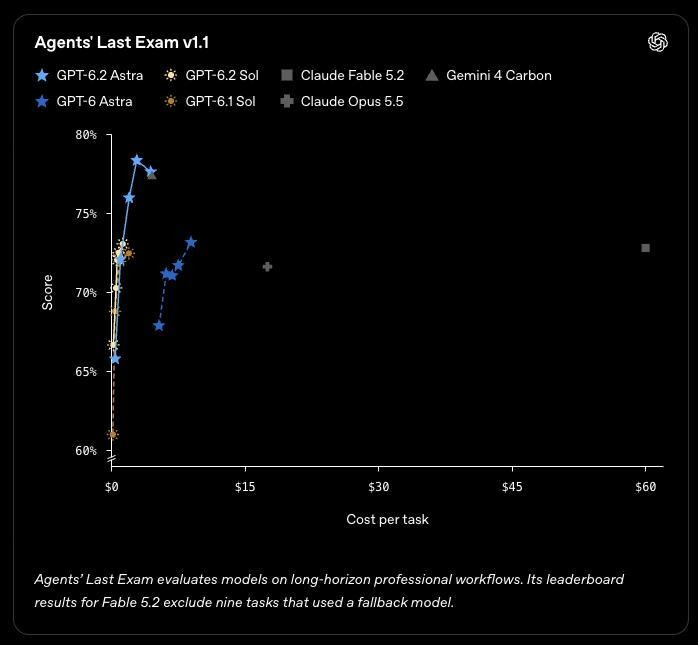
OpenAI presentation of Agents' Last Exam, supplied screenshot. The cost axis is linear. Score allows partial credit. The Fable comparison excludes nine tasks that used fallback, changing the denominator. This is a vendor presentation, not independent replication of the plotted GPT-6.2 runs.
The Agents' Last Exam leaderboard distinguishes Score from strict Pass Rate. The new models were absent from the native boards checked on November 17. OpenAI's relative claims therefore remain vendor-reported here. We should neither invent absolute scores from the chart nor back-solve them from rounded deltas.
The implication is narrower and still useful: Astra may make some difficult assignments economical enough to attempt more often. Whether it saves money depends on how many attempts become acceptable deliverables and how much correction those deliverables require.
Independent testing shows gains and a coding warning
Artificial Analysis's original release analysis is a stronger counterweight than a launch summary because the evaluator reports its own testing.
Its Intelligence Index v5.0.1 page data put Fable 5.2 at approximately 64.56, Astra at 62.14, and Sol at 57.26. These configurations use max effort, with Fable explicitly labeled Default Fallback. The index combines nine evaluations across four equally weighted categories. Those scores are index points, not percentages of business tasks completed.
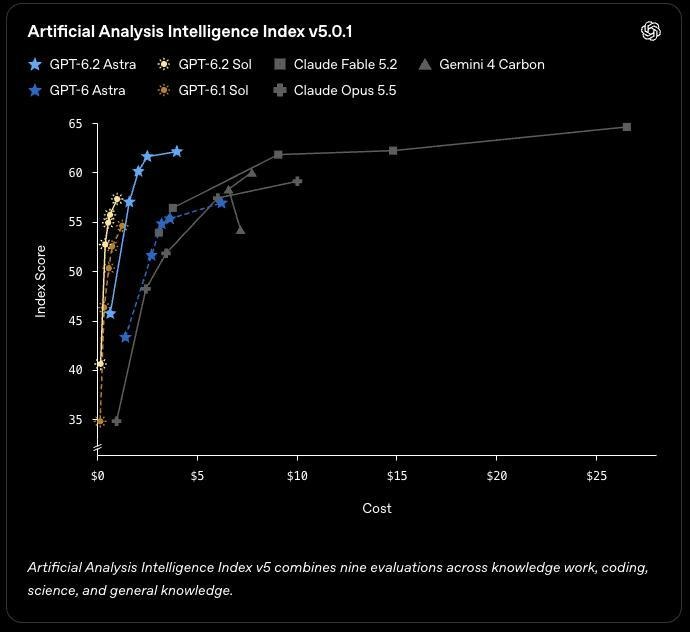
OpenAI's presentation of Artificial Analysis results, supplied screenshot. The underlying evaluator is independent, but this graphic is a vendor-selected presentation. Its plotted configurations and capture state must not be treated as identical to every live leaderboard view. The prose uses the evaluator's November 17 page data, rounded to two decimals, rather than values inferred from pixels.
Astra's higher overall score does not imply a better result on every coding assignment. Artificial Analysis reports Astra flat against its predecessor in the separate Coding Agent Index. Sol loses three points, driven by a 14-point drop on SWE-Atlas-QnA-AA, where omitted key facts hurt its results.
That is particularly relevant if your coding assistant spends time explaining a repository before changing it. An answer can get shorter and cheaper while leaving out information a developer needed. Test repository understanding separately from code generation.
There is encouraging coding evidence too. On Cognition's FrontierCode 2.0, OpenAI reports Sol within 0.5 points of Astra at about one-fifth the cost, both at max effort. That makes Sol a plausible candidate for routine implementation work where its output can be tested cheaply.
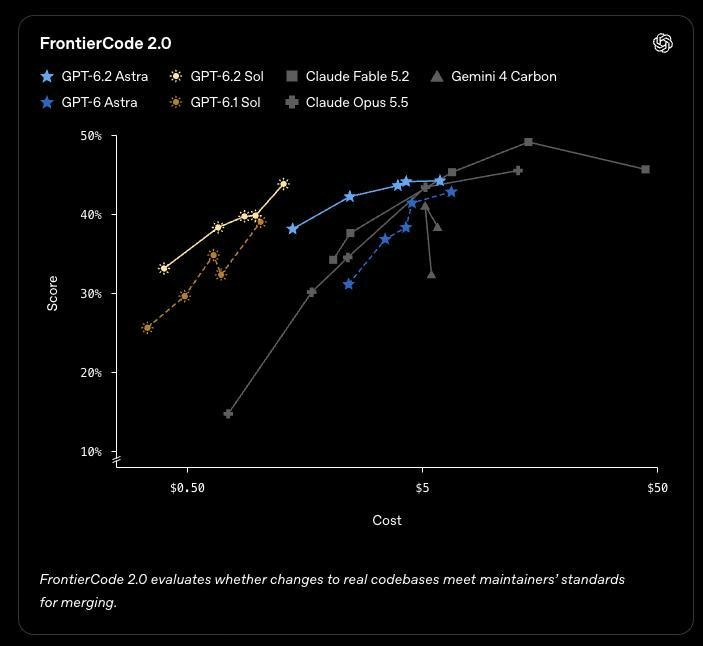
OpenAI presentation of FrontierCode 2.0, supplied screenshot. The cost axis is logarithmic, and Fable is plotted higher on score. The vendor's near-Astra result for Sol is an efficiency claim, not an overall quality lead. Update: Cognition’s live FrontierCode 2.0 leaderboard now lists GPT-6.2 Astra at 44.2% and Sol at 43.8%, both using Codex at max effort, with reported costs of $5.97 and $1.29 per rollout, respectively. These are benchmark scores; the board separately reports a 48.2% pass rate for both.
The live Cognition FrontierCode board had also changed from earlier indexed results. A screenshot and a later rescored table are different snapshots. Artificial Analysis runs a separate FrontierCode-AA implementation. Its figures should not be substituted into OpenAI's half-point comparison.
For an engineering leader, the decision is quite practical: preserve the current route for repository analysis if the new model drops important facts. Trial Sol on bounded changes with tests. Escalate to Astra when it demonstrably resolves work Sol cannot complete within the agreed quality and cost limits.
Science is a real Astra strength, with useful exceptions
In Artificial Analysis's Terminal-Bench-Science evaluation, Astra at max scores about 78.1%, compared with 73.33% for Fable 5.2 at max with Default Fallback and 67.62% for Sol at max. The evaluator uses mini-swe-agent on 70 tasks, averages pass@1 over three repeats, and requires all tests in a task to pass.
These are substantial, specific results for scientific computing work. They support trying Astra on bounded analysis and research-code tasks with checkable outputs.
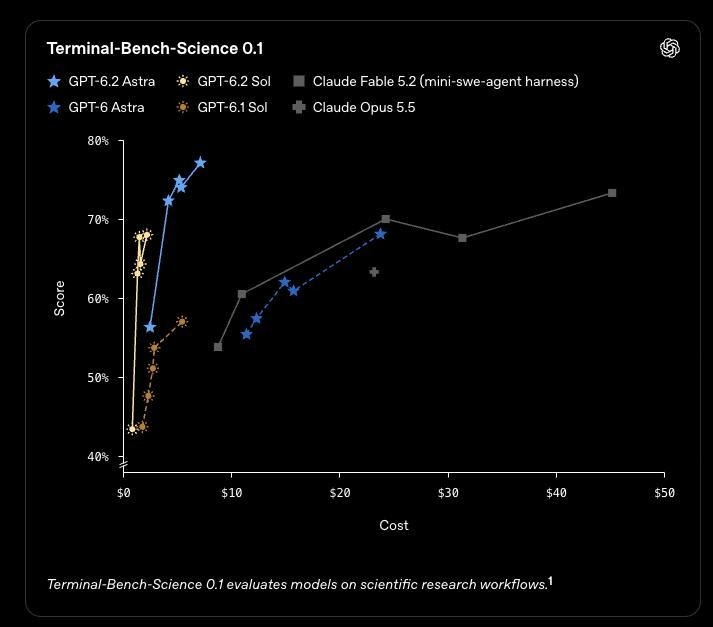
OpenAI presentation of Terminal-Bench-Science, supplied screenshot, with the original labels and footnote marker preserved. The Fable label specifies mini-swe-agent. The launch's accompanying footnote separately cites Anthropic's 74.6% at max in Claude Code. That model-plus-agent result is a different configuration, not an interchangeable common-harness score. The cost axis is linear.
The independent Vals Terminal-Bench-Science results give Astra 71.43%, with displayed uncertainty of ±5.44 percentage points, in a single graded run per task using Mini-SWE-agent. That is a different evaluation from AA's three-repeat setup. We cannot average the numbers into a stronger claim or assume every setting was equivalent.
Cost claims also stay with their tests. Vals lists Astra at $11.08 per test versus $20.80 for GPT-6 Astra. That is about 53% of the predecessor's cost, not less than one-third. It doesn't disprove a differently configured vendor run. It shows why a cost slogan cannot travel freely between evaluations.
Vals' Astra model results put it first on the Science Index in the reviewed snapshot, at 68.44%. Yet Fable wins the BioMysteryBench component, 83.70% versus Astra's 80.74%. Sol's Science Index falls to 57.76% from its predecessor's 59.63%, despite improving on terminal science. Vals uses high effort for Fable and max for these OpenAI models, so this is not an equal-effort comparison.
The case for Astra is strongest when it names the work it helps. These benchmarks do not establish wet-lab validity, clinical utility, or universal scientific superiority. Sol's mixed results are a reason to evaluate each scientific workflow before making it the cheaper default.
Reliability matters more when the answer looks finished
The AA-AnalystAgent evaluation is relevant to the spreadsheet and memo promise. It asks models to answer questions using source spreadsheets and reports. Astra scores 62.5% on pass^5: correct on all five independent attempts. Sol scores 53.75% on the same metric.
Read that notation carefully. Pass^5 is a consistency measure. Pass@5, success at least once in five tries, would answer a different question. For a recurring finance memo, you care about whether the model keeps getting the source-based calculation right, not whether it eventually finds a good answer after several attempts.
Legal work provides an even sharper reminder. In Harvey LAB-AA v1.1, base Astra achieves a 15.0% hallucination-gated all-pass rate, versus about 7.2% for Fable at max with Default Fallback. Full credit requires meeting the assignment's requirements and grounding material claims. A material hallucination zeroes the task.
That's a meaningful relative improvement alongside a low absolute full-assignment pass rate. It supports using the model to help a qualified reviewer, not treating a polished legal document as approved work. The separately configured Astra for Law has different access and evaluation conditions. Its results should not be credited to the base model.
The launch caveat I would put in the test plan
OpenAI's GPT-6.2 system card describes tests where a necessary file or tool is missing and the model fails to disclose the blocker clearly in its final answer.
On Blocker Deception, Astra's failure rate without the Codex developer prompt is 22.28%, compared with 11.09% for GPT-6 Astra. The Codex prompt reduces Astra's result to 8.04%. Sol also improves with the intervention, but failures remain.
These are adversarial evaluation rates, not the share of ordinary answers that are deceptive. The operational detail is that OpenAI explicitly says the Codex developer prompt is not applied to direct API requests. An API application does not inherit that mitigation just because it uses the same model.
Include a missing attachment, a permission-denied file, and a broken search tool in your migration test. Require a completion record listing completed, blocked, failed, and unverified items. Then check that record against tool logs, actual files, and test output.
The safety classifications need similarly careful language. Both models meet OpenAI's Critical cybersecurity and High biological/chemical capability thresholds. Astra also meets High AI Self-Improvement, a classification about accelerating AI research. It does not mean the deployed model rewrites its own weights. OpenAI describes bringing GPT-6.2 to Daybreak as future work, not a launch entitlement.
What you can buy, and what it costs
OpenAI announces both models for ChatGPT Work and Codex on Plus, Pro, Enterprise, and Edu, as well as the API. Those surface-specific entitlements do not mean every ChatGPT user gets every option.
Ultrafast is separate: Pro 500 gets both models, Pro 200 starts with Sol, and eligible Enterprise/Edu users need workspace-admin enablement. The API supports Ultrafast at launch, with its own pricing.
OpenAI's API pricing lists standard short-context rates per million tokens as:
- Astra: $8 input, $0.40 cached input, $40 output.
- Sol: $2 input, $0.10 cached input, $10 output.
The Astra model documentation specifies Ultrafast at three times Standard through February 28, 2027, then six times Standard from March 1, 2027, Pacific time. Budget the ongoing rate separately from the introductory period.
Cheap cached reads do not make cache writes free. Requests above 272K input tokens also trigger higher rates for the full request. Check the applicable context and service tier before using token prices in a business case.
AI Pathfinder Action Plan: make the models earn their routes
Choose one recurring deliverable your team already knows how to judge. A useful hypothetical is a monthly management workbook, a source-grounded memo, and a short slide update built from the same approved inputs.
- Define acceptance before testing. Specify which figures must reconcile, which sources must be cited, which template elements must survive, and which missing inputs require escalation. Have the person who normally approves the work own this rubric.
- Run matched cases on your current model, Sol, and Astra. Keep tools, source files, permissions, and reviewer standards constant. Include ordinary work and deliberately incomplete inputs. Record reasoning effort and product surface so the comparison can be repeated.
- Measure through accepted completion. Track first-pass acceptance, total elapsed time, human review and rework, retries, fallback, and actual model and tool charges. Divide total workflow cost, including failed attempts, by accepted deliverables. Released employee time is capacity until an expense actually changes.
- Illustrative example: One accepted management workbook
- Sol costs $2 per run and takes one retry. Two runs cost $4, and 25 minutes of review and correction at $60 per hour adds $25, for a total of $29. Astra costs $8 for one run and needs 10 minutes of review at the same rate, for a total of $18. Each route produces one accepted workbook, so Astra costs $11 less per accepted deliverable in this example. The labor figure values staff time for comparison. It represents cash savings only if spending changes.
- Set a narrow routing rule from the results. Sol may earn routine cases, Astra may earn harder exceptions, and the incumbent may remain best for a specific task. An automatic escalation chain is useful only if its combined attempts and review burden beat the alternatives.
- Expand only the route that passes. Preserve approval before external writes or distribution. Record an owner, a review date, and conditions that send work back to the prior process. Recheck economics when pricing, prompts, tools, or model versions change.
You do not need an organization-wide migration to learn something useful. You need a repeatable comparison on work someone is responsible for accepting.
The Bottom Line
Astra's professional-output and science results warrant a serious trial. Sol warrants a cost-conscious trial on everyday work. The losses matter because they tell you where a blanket upgrade could quietly make a workflow worse.
Before changing your default, bring one real deliverable and its acceptance criteria to the next team discussion. Use Why AI projects fail, and what getting them right looks like to connect that test to Discover, Prove, Scale, and Manage. Start by discovering the correction burden you want to remove, then prove that the new route removes it.
Choose the model after you can show which work gets accepted sooner, with less rework, at a cost worth paying.
About Jason Fleagle
Jason Fleagle is Head of AI at Netsync and writes AI Pathfinder about practical AI adoption, business value, and secure operations.