A photo and a short message often leave a service-business owner with another job: chasing the details needed to understand the request. That back-and-forth takes time away from customers and scheduled work. This unpublished intake prototype explored getting the request, photos and owner notes into one reviewable handoff before attempting to automate quoting.
Designing service intake for owner review
The recorded preview used a fictional service-company identity and warned visitors against entering real personal information. That context matters: the artifact was a demonstration of service intake, not evidence that a cabinet business had commissioned or adopted the system. Its useful question was narrow. Could a request and its supporting photos arrive together in a form the owner could work through?
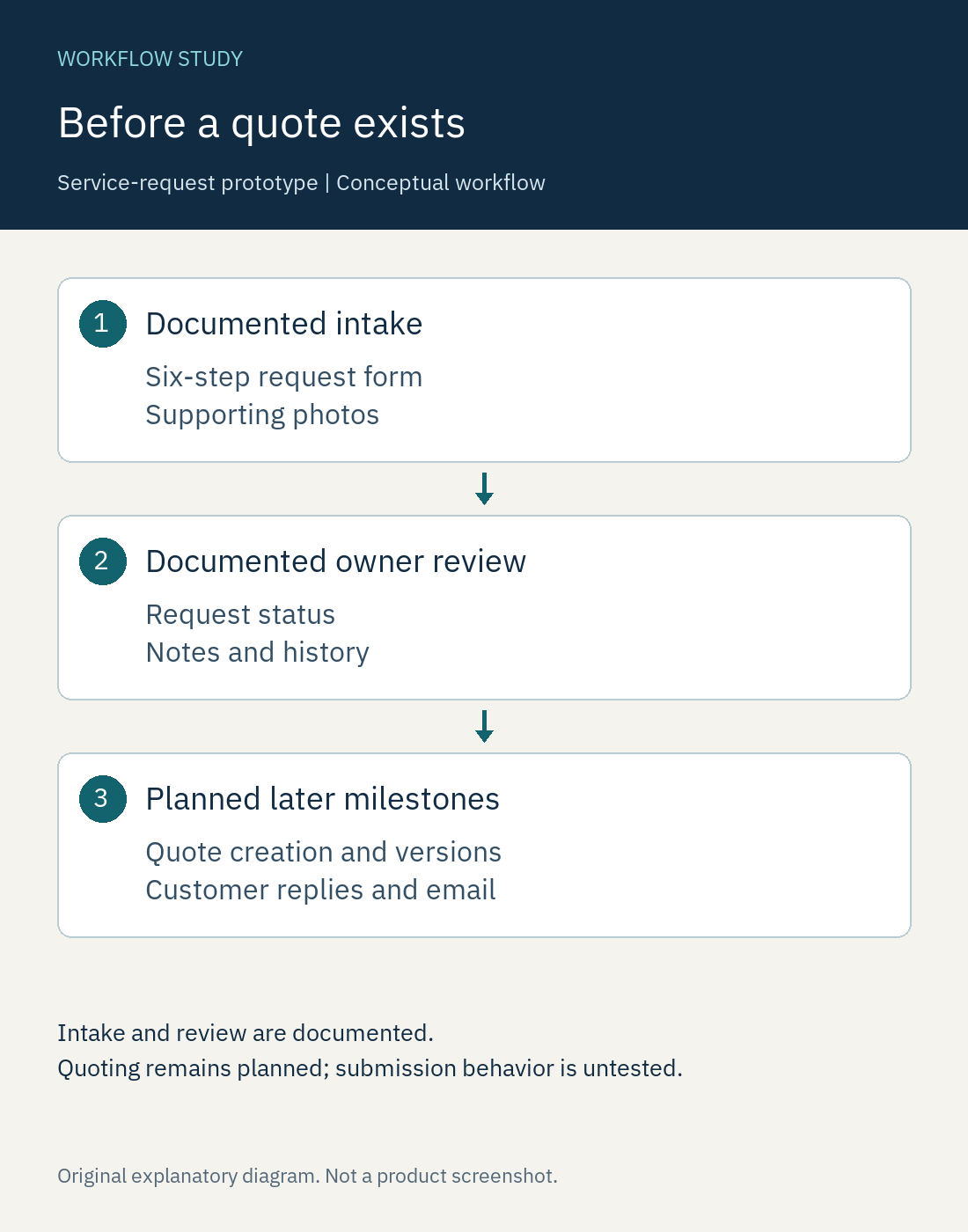
The documented flow starts with the visitor's six-step form. The request then belongs in the owner dashboard, where status, notes and history give the owner a way to manage the review. Those are concrete workflow surfaces. They do not establish that an estimate was calculated, accepted or sent.
Where the first milestone stopped
The W3C accessible forms tutorial recommends clear labels, instructions, validation and feedback. Those are useful criteria for the next form test, not a claim that this prototype has passed an accessibility audit.
The build record separated intake from the rest of the commercial process. Quote creation and versioning, customer responses and email belonged to later milestones. Earlier notes also left owner setup outstanding. Keeping those boundaries visible prevents a request-management prototype from being mistaken for a complete quoting application.
Duplicate-safe submission appears in the build notes, but the available review did not independently test it. The same restraint applies to runtime AI: an AI-assisted software build does not, by itself, establish that an AI model estimates jobs inside the application.
The artifact and the next test
The outcome at this stage was an unpublished intake-and-review artifact. There is no verified customer deployment, accepted quote or measured improvement in response time. The available project record also does not establish a component-by-component account of my implementation work, so I am keeping the description at the level the artifact supports.
A useful next evaluation would follow a fictional request from form submission into owner review, check what happens on a repeated submission, and inspect whether photos, notes and status remain attached to the right request. Quoting and outbound email would need their own tests when those milestones exist.
For Tulsa-area operators, home-service website design addresses the customer-facing path into a request. This fictional intake prototype is not a claim of a local customer deployment.
Projected impact: a scenario to test, not a delivered result
All inputs and calculated amounts in this section are hypothetical sample assumptions, not customer measurements, industry benchmarks or a forecast for this project. They are chosen to make the budgeting arithmetic inspectable. No verified delivered ROI is established for this case.
This illustrative projection covers intake preparation and clarification only. It assumes a future tested flow with complete requests, followed by owner review. Quote creation, pricing, customer responses and email remain later milestones. The scenario does not assume those features shipped or that more requests become paid jobs.
Hypothetical monthly inputs for a service-business owner screening incoming requests: 120 service requests; 20 total staff minutes each in the manual baseline; 5 to 8 assisted preparation minutes plus 5 minutes of human review and correction each. Add 2 hours per month for maintenance and exception oversight. Use $50 per hour as an assumed loaded labor value and $60 per month for incremental tools, hosting and usage. These operating allowances are sample budgets, not vendor quotes.
- Projected baseline effort
- 120 × 20 ÷ 60 = 40 staff hours per month.
- Projected assisted effort, including review
- 120 × (5 to 8 preparation minutes + 5 review minutes) ÷ 60 + 2 maintenance hours = 22 to 28 staff hours per month.
- Projected capacity released
- 40 baseline hours minus 22 to 28 assisted hours = 12 to 18 staff hours per month.
- Projected capacity value
- 12 to 18 hours × $50/hour = $600 to $900 per month in labor capacity value.
- Projected capacity value less operating spend
- $600 to $900 capacity value minus $60 incremental operating spend = $540 to $840 per month, before implementation costs.
This is recurring monthly modeled potential, not cash savings or additional revenue. Freed hours only become useful capacity if the team can redeploy them. Payroll does not fall merely because preparation takes less time. Any avoided overtime or outside-service expense would need separate evidence. The dollar balance compares capacity value with operating spend; it is not profit or a cash-flow return.
The range varies only the assumed assisted preparation time. It is not a confidence interval or a promise of typical results. The comparison requires the same completed work and acceptance quality, with review and correction included. Lower adoption, harder cases, failed outputs, added support or higher operating costs can reduce the benefit to zero or make it negative.
One-time implementation costs are unknown and excluded, including setup, integration, training and initial validation. Any required migration or hardware acquisition is also excluded and must be priced separately. With that incomplete investment cost basis, no ROI percentage or payback period is claimed. Do not annualize this sample month as a forecast without validating sustained volume, adoption and costs.
Evaluate your request-intake workload
Before extending intake into quoting, clarify workflow design and review boundaries so an estimate cannot be mistaken for an approved offer.
Define the required fields and photos before automating the handoff. Test incomplete and repeated submissions, then measure owner effort across comparable requests. If customers need extensive help to complete the form, that support belongs in the after-state too.
Bring your intake checklist and the clarifying questions you ask most often. We can discuss a request flow that is small enough to test before investing in quote automation.