For a dental operations team, performed work and future treatment plans lead to different follow-up decisions. When that distinction is lost, a reviewer has to reconstruct the context before preparing the handoff. This demonstration concept explored how structured visit information could support reviewable administrative outputs while keeping professional judgment in control.
Separating current dental work from future plans
In a May 2026 working exchange about an event demonstration, a collaborator sent me a reconstruction resource and structured JSON that we had discussed. That exchange establishes my participation and receipt of the material. The collaborator supplied the resource. It does not establish that I authored it or implemented every part of the later application.
The resource separated current procedures from future possibilities and included confidence, timestamped rationale and timeframes. Those distinctions gave the workflow more substance than a generic healthcare dashboard. They made it possible to discuss what information an output depended on and what still needed review. The exact incorporation of that resource into the application has not been verified.
The handoff needs to preserve uncertainty
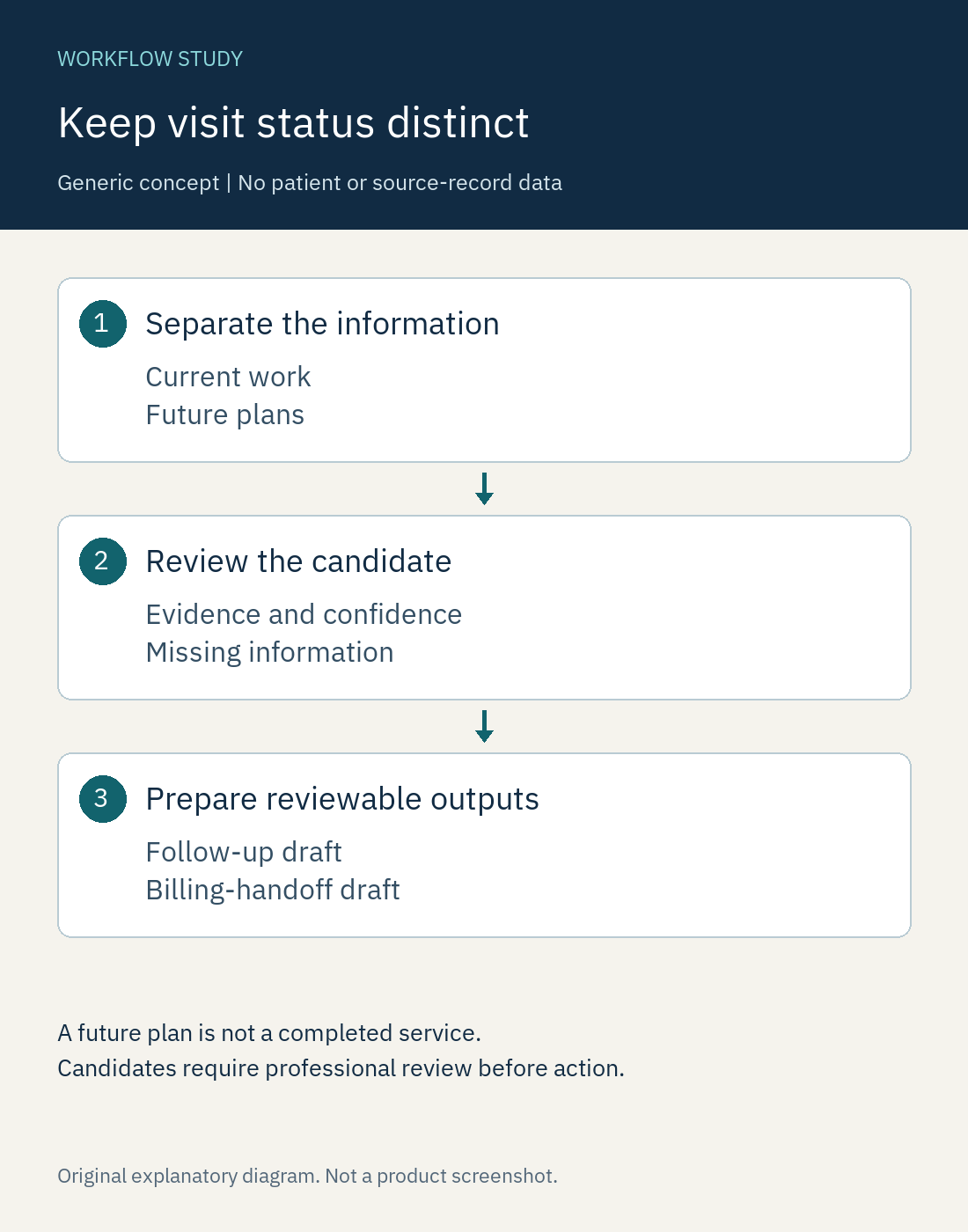
The recorded application concept used an action center to connect visit information with follow-up and billing-handoff outputs. A useful reading of that concept is a sequence of reviewable candidates. A future procedure should remain a future plan. A coding estimate should remain an estimate until an appropriate professional confirms it.
That is especially important when a candidate depends on missing information. Confidence labels and explanatory text can help a reviewer inspect an output, but they do not establish clinical correctness or make a service billable. Any real implementation would need explicit responsibility for reviewing the candidate before it enters a patient communication or billing process.
The diagram here explains that distinction using generic labels only. It contains no visit record, patient scenario, clinical code, fee or personal information. It is an original conceptual diagram, not a product screenshot.
What the application record does and does not show
The available review records a six-version demonstration build with a login-gated preview. Although that preview carried a synthetic-data label, the label does not establish the provenance of the separately supplied source material. No source record or clinical-style scenario is reproduced here.
Related work on a broader healthcare demonstration and possible dashboard integration belongs to a different effort. It cannot establish that this dental build connected to an EHR, wrote a chart, sent a claim or contacted a patient. The available record also does not verify that the build was shown to event attendees.
The concrete artifacts are the recorded application and the related structured resource. They support an explanation of the proposed handoff. They do not establish clinical accuracy, reimbursement improvement, patient benefit, production use or regulatory compliance.
A safe next evaluation
The voluntary NIST AI Risk Management Framework provides general AI risk-management context. It does not establish clinical validity, source-data provenance or regulatory compliance for this concept.
Further evaluation should begin with newly created, explicitly verified fictional fixtures and the right clinical and billing reviewers. The test should check whether current work stays separate from future plans, whether missing information remains visible, and whether candidate outputs stop for review before any external action.
My participation in the working exchange is documented. The narrower division of UI, engineering and testing responsibility remains unconfirmed, so this account does not claim sole authorship or a completed clinical deployment.
Any move toward real administrative use belongs within responsible healthcare AI planning, with appropriate professional reviewers and verified data permissions.
Projected impact: a scenario to test, not a delivered result
All inputs and calculated amounts in this section are hypothetical sample assumptions, not customer measurements, industry benchmarks or a forecast for this project. They are chosen to make the budgeting arithmetic inspectable. No verified delivered ROI is established for this case.
The following is an invented administrative workload for budgeting, unrelated to the supplied visit scenario. It contains no patient information, clinical codes or fees. Any time benefit depends on a future authorized, tested implementation with professional review. It does not estimate clinical accuracy, patient outcomes or reimbursement.
Hypothetical monthly inputs for a dental operations team preparing administrative handoffs: 240 administrative visit handoffs; 15 total staff minutes each in the manual baseline; 4 to 6 assisted preparation minutes plus 5 minutes of human review and correction each. Add 4 hours per month for maintenance and exception oversight. Use $35 per hour as an assumed loaded labor value and $100 per month for incremental tools, hosting and usage. These operating allowances are sample budgets, not vendor quotes.
- Projected baseline effort
- 240 × 15 ÷ 60 = 60 staff hours per month.
- Projected assisted effort, including review
- 240 × (4 to 6 preparation minutes + 5 review minutes) ÷ 60 + 4 maintenance hours = 40 to 48 staff hours per month.
- Projected capacity released
- 60 baseline hours minus 40 to 48 assisted hours = 12 to 20 staff hours per month.
- Projected capacity value
- 12 to 20 hours × $35/hour = $420 to $700 per month in labor capacity value.
- Projected capacity value less operating spend
- $420 to $700 capacity value minus $100 incremental operating spend = $320 to $600 per month, before implementation costs.
This is recurring monthly modeled potential, not cash savings or additional revenue. Freed hours only become useful capacity if the team can redeploy them. Payroll does not fall merely because preparation takes less time. Any avoided overtime or outside-service expense would need separate evidence. The dollar balance compares capacity value with operating spend; it is not profit or a cash-flow return.
The range varies only the assumed assisted preparation time. It is not a confidence interval or a promise of typical results. The comparison requires the same completed work and acceptance quality, with review and correction included. Lower adoption, harder cases, failed outputs, added support or higher operating costs can reduce the benefit to zero or make it negative.
One-time implementation costs are unknown and excluded, including setup, integration, training and initial validation. Any required migration or hardware acquisition is also excluded and must be priced separately. With that incomplete investment cost basis, no ROI percentage or payback period is claimed. Do not annualize this sample month as a forecast without validating sustained volume, adoption and costs.
Evaluate a dental administrative handoff
The handoff should preserve human review and decision authority; a candidate output is not an authorization to communicate with a patient or submit a claim.
Begin with newly created, verified fictional records and clinical and billing reviewers. The application’s synthetic label does not establish permission to reuse a separate source record. Validate current-versus-future status and review stops before any real communication or claim handoff.
Describe the preparation, checking and correction steps without sending patient information. We can discuss a safe demonstration and how to measure administrative effort without treating coding confidence as clinical proof.