If you lead presales architecture, discovery notes can look more complete than they are. A buyer’s preference becomes a requirement, an estimate becomes a price, and the architect has to untangle both before the proposal can move forward. This configurator prototype organized discovery into an editable brief so the assumptions could be inspected before sizing or pricing was accepted.
Separating infrastructure facts from assumptions
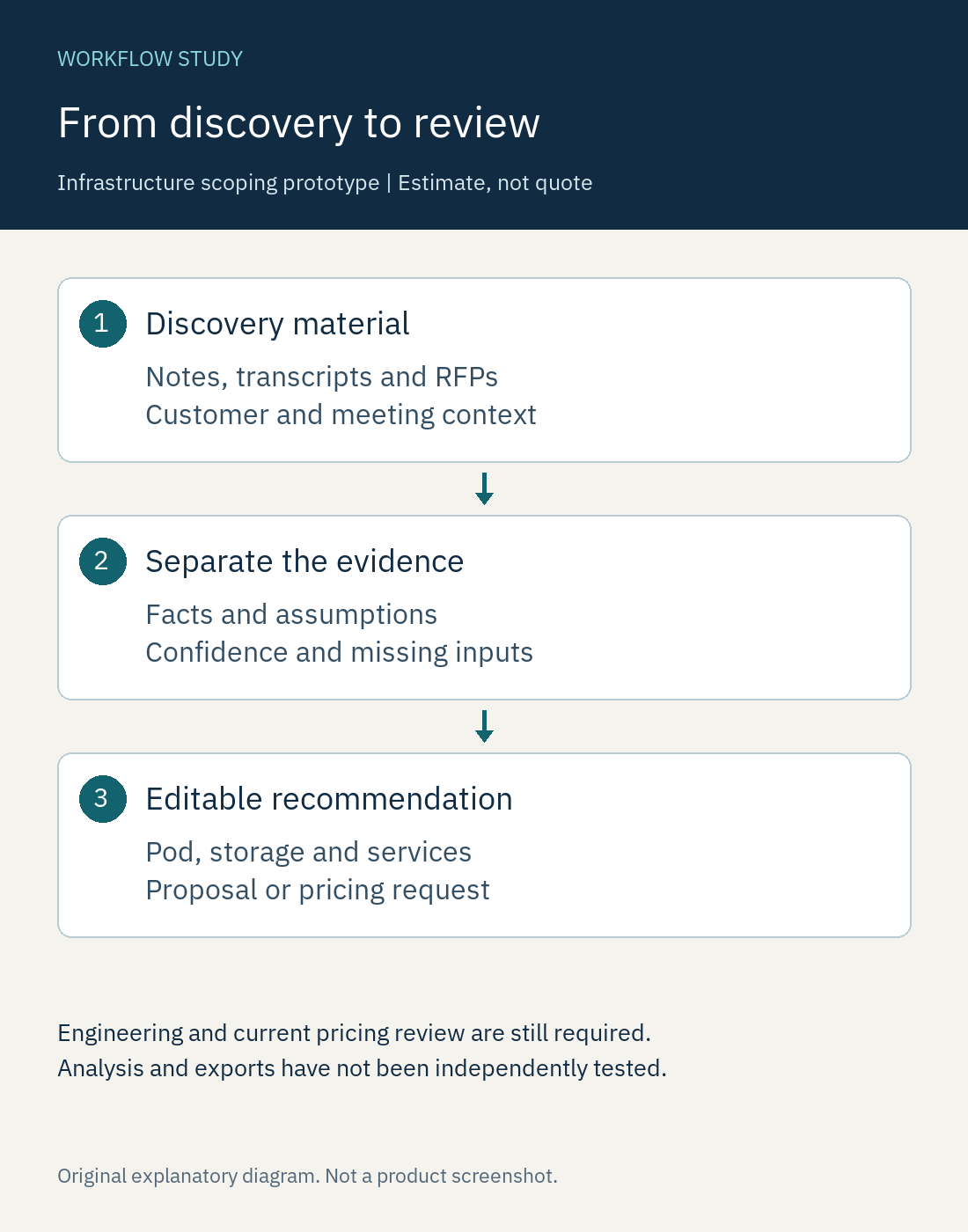
The documented inputs were discovery notes, meeting transcripts and RFP material. The recorded preview brought customer and meeting information together with opportunity assumptions, a recommended pod, storage posture and services estimates. Those fields describe a scoping workflow: collect what is known, identify what has been assumed, and make the preliminary recommendation editable.
Build notes describe AI analysis that separates facts from assumptions and carries confidence and missing-information notes into the recommendation. That separation matters because a transcript can contain a possibility, a preference or an unanswered question that should not become a firm infrastructure requirement.
The export is an engineering handoff
The build record describes Markdown and HTML outputs for a proposal or pricing request. Their intended role was to carry the scoping work forward for review. A storage posture or services estimate in a preliminary brief still needs checking against workload needs, current vendor information and engineering judgment.
The available review did not run a live model call or test an exported file. It therefore supports a description of documented analysis and export capability, rather than a claim that a complete discovery-to-quote transaction succeeded. There is no established pricing feed, validated sizing algorithm or accepted customer quote in this record.
A concrete prototype with a limited result
The artifact was a four-version build with a rendered preview and recorded deployment URL. That makes the scoping concept inspectable. It does not establish customer adoption, hardware compatibility, capacity suitability or a reduction in sales-cycle time. The project record does not yet identify my exact design and implementation responsibilities, so this account makes no sole-builder claim.
The next useful test would use fictional discovery material, inspect each fact and assumption, deliberately omit a required input, and compare the recommendation with the exported brief. An engineer would then need to review the proposed configuration and the provenance of each price. Until that work is complete, the output remains a scenario estimate rather than an approved configuration or quote.
An infrastructure brief should fit the wider enterprise AI landing-zone planning, including identity, data access, monitoring and deployment boundaries.
Projected impact: a scenario to test, not a delivered result
All inputs and calculated amounts in this section are hypothetical sample assumptions, not customer measurements, industry benchmarks or a forecast for this project. They are chosen to make the budgeting arithmetic inspectable. No verified delivered ROI is established for this case.
This projection estimates preparation capacity for preliminary briefs, conditional on a validated future workflow. It includes architect review and correction. It does not estimate hardware savings, validated sizing, quote acceptance or a shorter sales cycle, and it does not imply that the prototype’s exports have been tested.
Hypothetical monthly inputs for a presales architecture team preparing preliminary briefs: 8 preliminary infrastructure briefs; 360 total staff minutes each in the manual baseline; 120 to 180 assisted preparation minutes plus 90 minutes of human review and correction each. Add 2 hours per month for maintenance and exception oversight. Use $90 per hour as an assumed loaded labor value and $120 per month for incremental tools, hosting and usage. These operating allowances are sample budgets, not vendor quotes.
- Projected baseline effort
- 8 × 360 ÷ 60 = 48 staff hours per month.
- Projected assisted effort, including review
- 8 × (120 to 180 preparation minutes + 90 review minutes) ÷ 60 + 2 maintenance hours = 30 to 38 staff hours per month.
- Projected capacity released
- 48 baseline hours minus 30 to 38 assisted hours = 10 to 18 staff hours per month.
- Projected capacity value
- 10 to 18 hours × $90/hour = $900 to $1,620 per month in labor capacity value.
- Projected capacity value less operating spend
- $900 to $1,620 capacity value minus $120 incremental operating spend = $780 to $1,500 per month, before implementation costs.
This is recurring monthly modeled potential, not cash savings or additional revenue. Freed hours only become useful capacity if the team can redeploy them. Payroll does not fall merely because preparation takes less time. Any avoided overtime or outside-service expense would need separate evidence. The dollar balance compares capacity value with operating spend; it is not profit or a cash-flow return.
The range varies only the assumed assisted preparation time. It is not a confidence interval or a promise of typical results. The comparison requires the same completed work and acceptance quality, with review and correction included. Lower adoption, harder cases, failed outputs, added support or higher operating costs can reduce the benefit to zero or make it negative.
One-time implementation costs are unknown and excluded, including setup, integration, training and initial validation. Any required migration or hardware acquisition is also excluded and must be priced separately. With that incomplete investment cost basis, no ROI percentage or payback period is claimed. Do not annualize this sample month as a forecast without validating sustained volume, adoption and costs.
Evaluate discovery-to-brief effort
For the discovery-to-brief handoff, reviewable workflow design helps define who checks assumptions and accepts the exported result.
Use permitted discovery material, a workload checklist and current vendor inputs. An architect must approve the reasoning and price provenance. If the recommendation requires substantial redesign, the modeled time advantage may disappear.
Bring a sanitized discovery example and the checklist your architect uses before approving a preliminary brief. We can discuss which assumptions should remain visible and how to time the complete handoff.