Assessment prototype | Current report generation unverified
An AI-readiness score leaves a leadership team with a practical question: what should we do next? For an advisor, the work continues through use-case selection, risk review and a report people can act on. If that handoff is weak, the team can finish the assessment and still have no owner for the next decision.
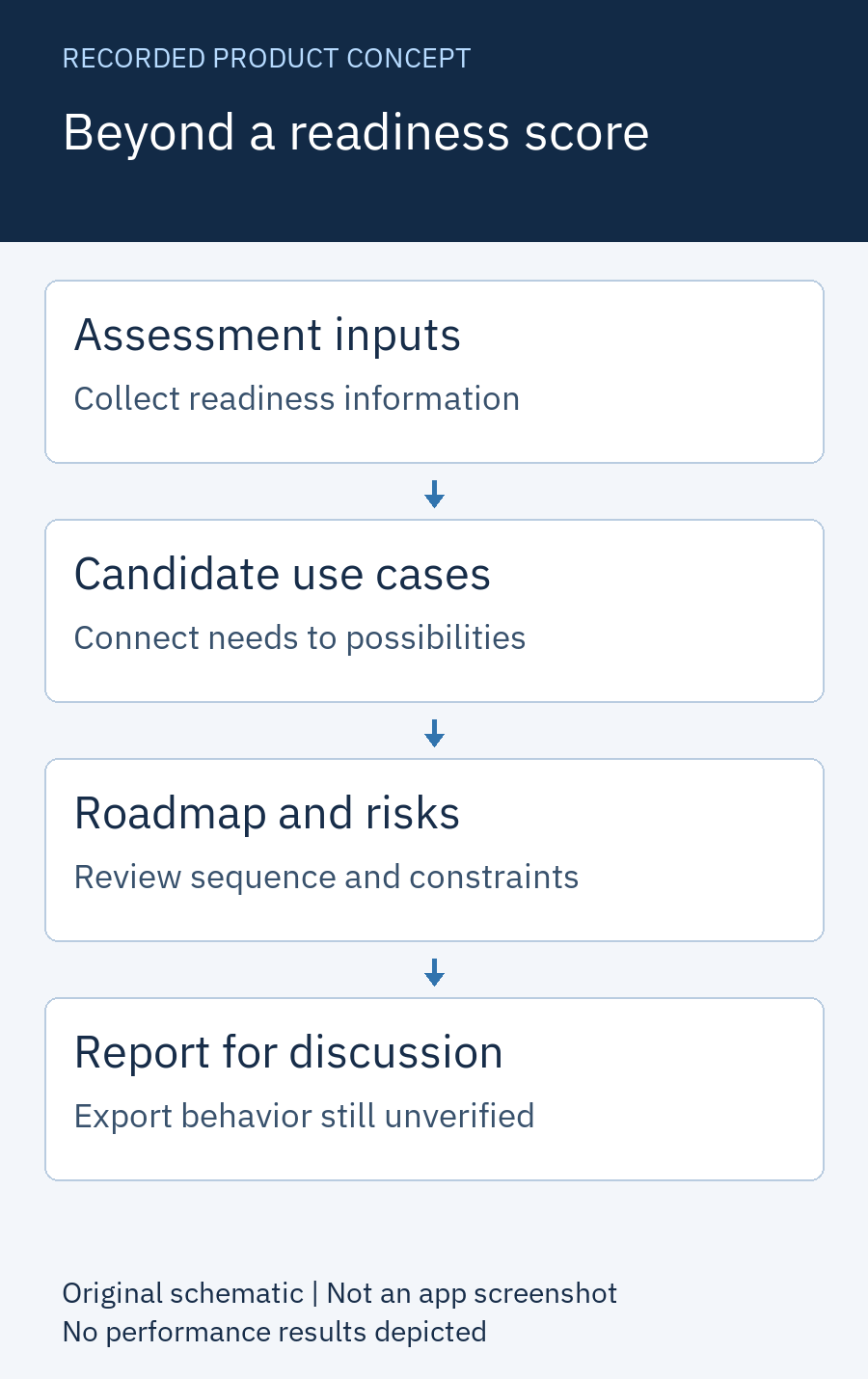
The recorded prototype connects assessment inputs to candidate use cases, solution recommendations, a 90-day roadmap and risk assessment. Its intended output is a report a team can review together.
Connecting readiness inputs to a reviewable roadmap
The product concept addresses a specific gap between discovery and planning. A recommended use case needs a place in an implementation sequence. It also needs an account of the risks that could prevent it from working. Bringing those outputs together gives a reviewer a way to ask whether an attractive idea belongs near the beginning of the roadmap or should wait.
The recorded application was oriented toward Cisco-related solution recommendations. That describes the focus of the prototype, not a vendor endorsement or a validated fit between a recommended product and a customer's environment. The available record does not establish the scoring weights, question schema or technical basis for the recommendations.
The report was part of the product
The build history describes assessment processing, use-case recommendations, solution suggestions, roadmap and risk outputs, plus PDF use-case detail. The PDF mattered because the result needed to leave the application and remain understandable to the people making the decision.
Earlier API and PDF problems appear in that history, followed by reported changes to recommendation generation and report layout. These details show where development effort went. They do not establish that the current application produces a complete, accurate report. During the November 11, 2026 inspection, the database was restoring, so generation and export were not run.
Keep the assessment, sizing tool and older reports separate
Historical AI-readiness PDFs also exist, with executive summaries, maturity assessments, use-case detail, roadmaps and risk mitigations. They belong to a related report family whose recorded deployment differs from this quiz. They cannot responsibly be presented as output from this exact application.
An infrastructure-sizing configurator also serves a different purpose: translating discovery into infrastructure choices. Its capabilities should not be folded into an assessment story simply because both tools support an AI conversation. The same care applies to an earlier business-advisor concept. Shared subject matter does not establish a shared implementation.
What this prototype establishes
The voluntary NIST AI Risk Management Framework is a useful reference when reviewing risk considerations in a proposed AI roadmap. It does not validate this application’s scoring or recommendations.
The concrete artifact is a recorded assessment application with a sixteen-version build history and a defined set of decision outputs. Current end-to-end operation, recommendation accuracy and customer adoption remain unverified. There is no measured improvement in assessment speed or business results to report.
The available record also does not establish my exact engineering contribution or a contributor breakdown for this build, so I am keeping that attribution open. The useful product idea is clear: connect readiness information to opportunities, sequencing and risks, then let a person examine the result before acting on it.
A facilitated engagement is a separate path from this prototype; AI readiness assessment services addresses the organizational decisions behind the inputs.
Projected impact: a scenario to test, not a delivered result
All inputs and calculated amounts in this section are hypothetical sample assumptions, not customer measurements, industry benchmarks or a forecast for this project. They are chosen to make the budgeting arithmetic inspectable. No verified delivered ROI is established for this case.
This hypothetical projection covers report preparation and review after a completed intake. It assumes a future validated assessment flow. It is not a result from this quiz or the separately identified historical report family, and it assigns no financial benefit to a readiness score or roadmap by itself.
Hypothetical monthly inputs for an advisory team preparing reviewed AI-readiness reports: 8 assessment reports; 300 total staff minutes each in the manual baseline; 90 to 120 assisted preparation minutes plus 90 minutes of human review and correction each. Add 2 hours per month for maintenance and exception oversight. Use $75 per hour as an assumed loaded labor value and $100 per month for incremental tools, hosting and usage. These operating allowances are sample budgets, not vendor quotes.
- Projected baseline effort
- 8 × 300 ÷ 60 = 40 staff hours per month.
- Projected assisted effort, including review
- 8 × (90 to 120 preparation minutes + 90 review minutes) ÷ 60 + 2 maintenance hours = 26 to 30 staff hours per month.
- Projected capacity released
- 40 baseline hours minus 26 to 30 assisted hours = 10 to 14 staff hours per month.
- Projected capacity value
- 10 to 14 hours × $75/hour = $750 to $1,050 per month in labor capacity value.
- Projected capacity value less operating spend
- $750 to $1,050 capacity value minus $100 incremental operating spend = $650 to $950 per month, before implementation costs.
This is recurring monthly modeled potential, not cash savings or additional revenue. Freed hours only become useful capacity if the team can redeploy them. Payroll does not fall merely because preparation takes less time. Any avoided overtime or outside-service expense would need separate evidence. The dollar balance compares capacity value with operating spend; it is not profit or a cash-flow return.
The range varies only the assumed assisted preparation time. It is not a confidence interval or a promise of typical results. The comparison requires the same completed work and acceptance quality, with review and correction included. Lower adoption, harder cases, failed outputs, added support or higher operating costs can reduce the benefit to zero or make it negative.
One-time implementation costs are unknown and excluded, including setup, integration, training and initial validation. Any required migration or hardware acquisition is also excluded and must be priced separately. With that incomplete investment cost basis, no ROI percentage or payback period is claimed. Do not annualize this sample month as a forecast without validating sustained volume, adoption and costs.
Evaluate assessment-to-roadmap effort
The report should support enterprise AI roadmap planning, with named owners and a sequence the leadership team can challenge.
First identify the exact build and validate its questions, recommendation method and complete export. Then agree a reviewer and a decision owner. Recommendations still need customer context and follow-through before they can change operating performance.
Bring your current intake, a permitted report example and the decisions the report should support. We can discuss a reviewable handoff and the preparation effort worth measuring.