
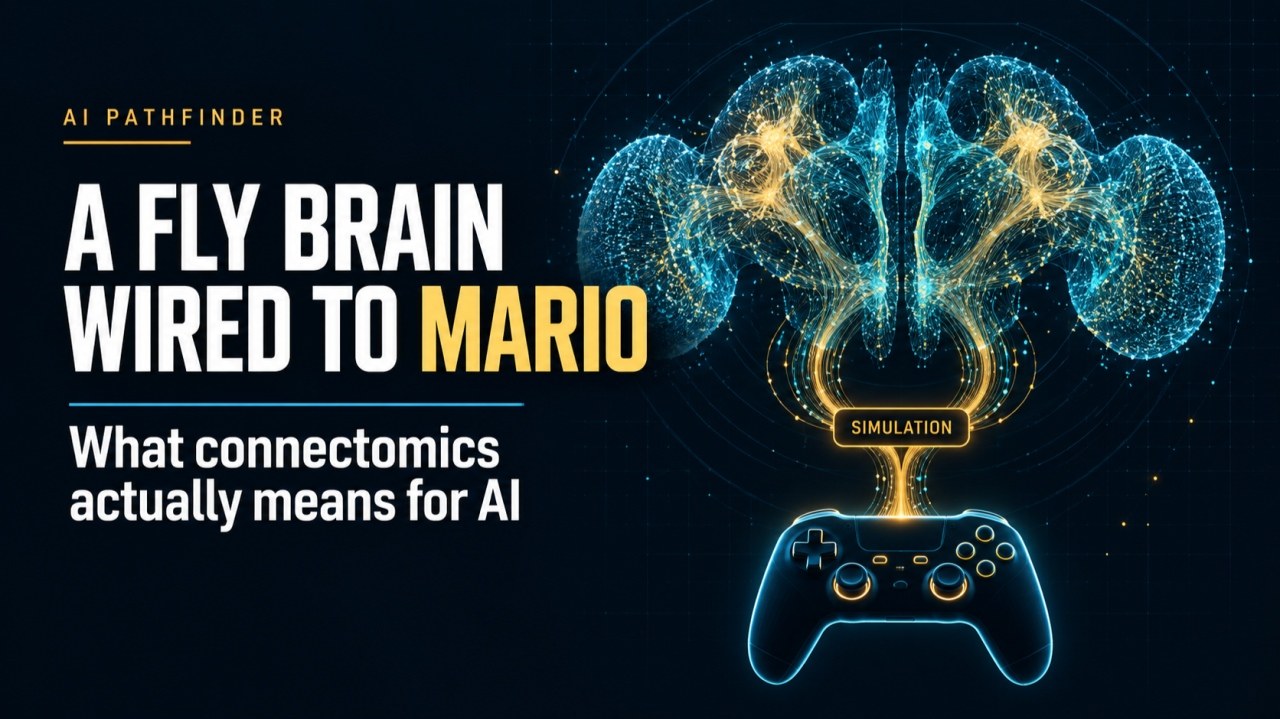
Connectome-based simulation, not evidence of learning to play.
Someone connected a model built from fruit fly neural wiring to Super Mario 64.
The project sends game images into simulated visual neurons, lets signals pass through a network derived from a real fly’s anatomy, and translates selected neural activity into controller inputs.
That is a wonderfully strange thing to build. It also invites a conclusion the evidence does not support: that somebody uploaded a fly brain pattern and taught it to play Mario.
The science underneath the demo deserves more attention than that headline would give it.
Let’s dive into it.
Why this matters
Researchers at HHMI Janelia, Google Research, Cambridge and collaborators have completed a map of the male fruit fly’s central nervous system. Google reports more than 166,000 neurons and 125 million synaptic connections.
Independent developers are using that resource to build interactive simulations. Their projects expose both the possibilities of open neuroscience and the considerable distance between a wiring diagram and a working biological model.
For AI leaders, the useful question is what these systems demonstrate, which parts developers supplied, and how an experiment distinguishes meaningful behavior from activity that merely looks impressive.
What scientists actually mapped
A connectome is a map of neurons and their connections. This one includes the central brain, both optic lobes and the ventral nerve cord, which is roughly analogous to a spinal cord.
The intact connection between brain and nerve cord matters. Researchers can trace circuits linking sensory inputs to motor outputs across the central nervous system, rather than studying disconnected pieces.
The Google Research announcement describes the work published in Cell on September 3, 2026. The Janelia project page records an earlier milestone: the MaleCNS v1.0 dataset was released on June 8. Publication and public data availability are different events.
AI helped reconstruct neural shapes from electron microscope images. Human experts then proofread and annotated the map. HHMI’s account places the achievement within nearly two decades of research, involving hundreds of researchers and sustained improvements in imaging and computation.
The payoff already extends beyond a beautiful visualization. Scientists are examining visual and taste circuits, comparing male and female nervous systems, and investigating how differences in connectivity relate to different behaviors.
That is a substantial scientific achievement without adding a claim about digital consciousness.
What the Mario project does
The independent Fly64 repository connects MaleCNS-derived wiring to a native build of Super Mario 64.
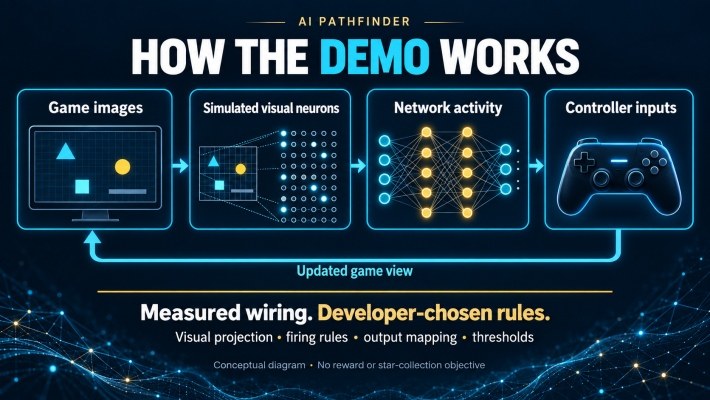
Its loop is straightforward:
Game images → simulated visual neurons → neural network activity → controller inputs → updated game images.
The model receives a separate first-person view from Mario’s eye height. The developer samples that view through an approximate fly-eye arrangement, while a human observer watches the ordinary game camera.
Selected groups of descending neurons supply the output. In the developer’s mapping, DNg100 activity drives forward movement, differences between left and right DNa02/DNg13 activity control steering, and bursts in DNp01/DNp10 trigger jumps.
Those mappings are engineering choices. So are the rules governing simulated firing, the visual projection, background drive, smoothing and control thresholds.
The technical notes are explicit about the limits: measured wiring does not establish recovered fly physiology, behavior, experience or consciousness. The author also says the code was entirely AI-generated, made for fun and not personally reviewed.
There is no training objective, reward or goal to collect stars. Mario can walk into a wall and stay there.
I find the experiment interesting because it makes an anatomical dataset interactive. I would not describe it as a fly learning Mario. That would assign a capability the project does not claim.
The failed walking test is worth reading
A separate project, FLYBRAIN, currently documents an attempt to connect a MaleCNS-based simulation to a MuJoCo fly body.
The proposed interface converts motor-neuron firing rates into joint torques and body measurements into sensory drive. It does not use a trained walking policy, but developers still chose the coupling equations and many model parameters. The site’s phrase “no controller” should be read with that distinction in mind.
Its initial nerve-cord test compared driven activity with an undriven baseline and a scrambled-wiring condition.
Under the tested drive, the model produced a synchronous oscillation rather than the required walking rhythm. Scrambling the wiring reproduced the dominant oscillation. The test failed its own pass criteria.
That control matters. If the effect survives scrambling the connections under examination, the effect alone cannot establish that the measured pattern of connectivity caused the desired behavior.
The site also reports that a preliminary body trial fell over. As of September 16, the public record did not report completed experiments for the full open-loop and proprioceptive-feedback stages. Later cord tests also failed; a reflex test was reported as not evaluable.
These are results from a particular simplified model and selected stimulation protocols. They do not show that the biological fly’s wiring cannot generate walking. Uniform neuron parameters, simplified synapses, omitted mechanisms and the choice of input all limit what can be concluded.
The site also distinguishes its language-model-generated narration from the simulation. Words written in a fly’s voice are not evidence that the simulated network understands language.
Why this matters in AI
AI’s role in producing the connectome is already concrete: it helps turn microscopy into a usable anatomical resource.
The possible influence in the other direction is more exploratory. Detailed biological wiring can help researchers formulate and test hypotheses about perception, coordination and behavior. Whether those findings yield better artificial intelligence requires separate evidence.
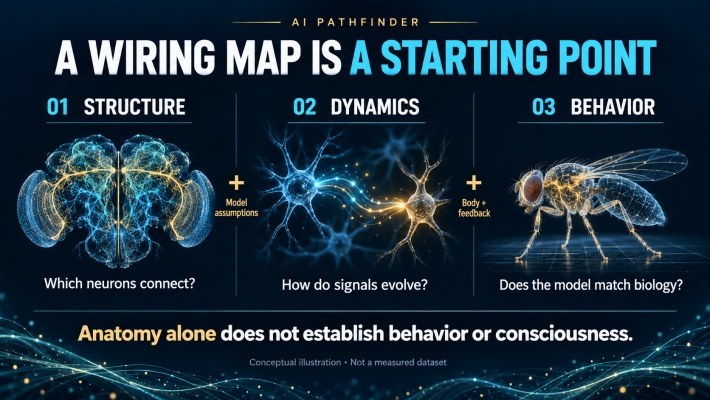
A static map does not specify everything needed to reproduce a nervous system’s behavior over time. A simulator has to make assumptions about how cells respond, how signals change, what sensory input means and how activity affects a body.
Google and HHMI both point toward work that combines structure with recorded neural activity in fish. That pairing is worth watching because it gives researchers additional measurements against which to test their models.
None of these materials establishes a replacement for large language models, an AGI breakthrough or a consciousness result.
My practical takeaway is about evaluating systems. Once a convincing interface surrounds a complex model, it becomes easy to attribute the entire result to that model and overlook the decisions encoded around it.
The fly projects make those decisions unusually visible.
What this could mean for the future of AI
As we map more nervous systems, the opportunity is to discover mechanisms that engineers can test in artificial ones. A useful result might be a better way to filter sensory noise, coordinate movement or update a prediction—not a digital copy of an animal.
The distinction matters: an AI system can learn from biology without reproducing an entire brain. Researchers could translate a circuit’s organizing principle into an algorithm, use its connectivity to constrain a model, or test a simulated circuit inside a larger system. Each route still has to prove its value.
Learning from circuits, not just copying their shape
There is already a concrete example worth watching. A Nature study of an electric fish combines connectomics, physiological recordings and computational modelling to examine how a circuit learns to cancel predictable sensory responses. The authors identify connectivity that helps multiple sites of learning work together and supports fast, accurate cancellation that is robust to noise.[6]
That is a finding about a particular biological circuit and its model, not proof of a superior general-purpose AI. But it gives engineers a specific question to investigate: could a similar mechanism help a machine distinguish expected consequences of its own actions from genuinely new information?
Three possibilities worth testing
More efficient perception and control. Circuit maps could suggest which connections and feedback loops a system actually needs. For a robot or an edge device, the useful outcome would be reliable behavior with less computation or energy. Biological inspiration alone guarantees neither; the implementation must beat an appropriate baseline on real hardware.
More adaptable learning. Understanding how biological circuits coordinate changes across different cells could suggest new ways to update artificial systems as conditions change. A demanding test would be whether a system can learn something new while retaining useful earlier capabilities. The fish study offers a bounded example of coordinated plasticity, not a solution to that broader AI problem.[6]
Specialized components within larger AI systems. My expectation is that useful ideas may arrive as individual capabilities before anything resembling a whole artificial brain. A biologically informed perception or motor-control component could sit alongside a language model rather than replace it. That is a possible engineering direction, not something the Mario demo has established.
More maps are only part of the answer
Comparing brains can help researchers distinguish recurring circuit patterns from differences between individuals or sexes. The male and female fly datasets make some of those comparisons possible.[1][3] To understand what a circuit does, researchers also need measurements of its activity, learning and interaction with the world.
Google describes work combining neural activity and structure in the same larval zebrafish brain, while HHMI describes efforts to build predictive models from connectomes and whole-brain activity recordings.[1][2] Those measurements give researchers ways to test whether a proposed mechanism explains biology, rather than merely producing plausible-looking motion.
The longer-term possibility is a productive exchange: AI helps map biology; biological experiments reveal candidate mechanisms; engineers test whether those mechanisms improve AI. The first step is already demonstrated. Progress through the rest should be judged by reproducible gains in learning, robustness, energy use and behavior—not the number of neurons in a visualization.
For leaders, this is worth following as a source of new technical approaches. It is not yet a reason to replace an AI roadmap with a promise of uploaded minds. We may learn valuable computational principles well before we can reproduce a whole brain, and neither achievement would, by itself, establish consciousness.
Your AI Pathfinder Action Plan

Use the same scrutiny on the next AI demonstration you evaluate:
- Name the claim precisely. “Produces controller inputs” and “learns to complete a game” require different evidence. So do “drafts a response” and “resolves a customer issue.”
- Inspect the surrounding software. Identify what the model contributes and what comes from fixed rules, retrieval, filtering, human intervention or downstream automation.
- Ask for a baseline that could challenge the explanation. Where safe and appropriate, remove or replace the component receiving credit. If performance stays the same, investigate what is actually producing the result.
- Measure the outcome separately from system activity. Neural spikes do not prove walking. Tool calls do not prove task completion. Define success before selecting the best-looking run.
These are evaluation practices, not a claim that enterprise software works like a fly brain.
Frequently Asked Questions
Did researchers upload a living fly?
No. The research reconstructs anatomical connectivity. The independent demos apply mathematical rules to data derived from that map.
Why do the projects show different neuron and connection counts?
They use different inclusion and preprocessing rules. A graph entry representing a weighted connection is also not interchangeable with a count of individual synapses. Read each number with its dataset version and definition.
Does the failed simulation diminish the connectome?
It limits the claims that can be made about that simulation. The anatomical dataset remains useful for circuit analysis and for building better-tested models.
The Bottom Line
The complete male fruit fly connectome gives researchers a detailed, accessible resource for investigating how a nervous system connects perception to action.
The Mario demo makes that resource approachable. The failed body experiments show how much remains to be established when turning anatomy into behavior.
Follow the work that tests predictions against measured biology, publishes useful controls and makes its assumptions inspectable. That evidence will tell us more about the implications for AI than an animated fly or a moving game character can.
References
[1] Google Research — A connectomics milestone: Mapping the complete male fruit fly brain (September 3, 2026)
[2] HHMI — Completing the Connectome: How Pursuing a Map of the Fly Brain Rewired Neuroscience (September 3, 2026)
[3] HHMI Janelia — Male CNS Connectome: dataset, methods and release history
[4] ornata/fly — Fly64 repository and linked technical notes (independent demonstration)
[5] FLYBRAIN — Body-coupling experiments, controls and limitations (independent project; reviewed September 17, 2026)
[6] Perks, Petkova, Muller et al. — Connectome analysis of a cerebellum-like circuit for sensory prediction. Nature (2026)
About Jason Fleagle
Jason Fleagle is Head of AI at Netsync and writes AI Pathfinder for leaders turning AI research into practical decisions. Explore his work at thejasonfleagle.com and follow AI Pathfinder.
Originally published on LinkedIn.
Table of content
Related articles
September 18, 2026