Product concept and recorded prototype | Generation and export unverified
If you run content operations, generating more drafts can simply move the bottleneck to your editor. An article or webinar still has to become channel-specific copy without losing facts or voice. This prototype explored keeping brand context and source material together, with editing before export, so the whole accepted bundle could be evaluated rather than the speed of generation alone.
Setting brand voice before content repurposing
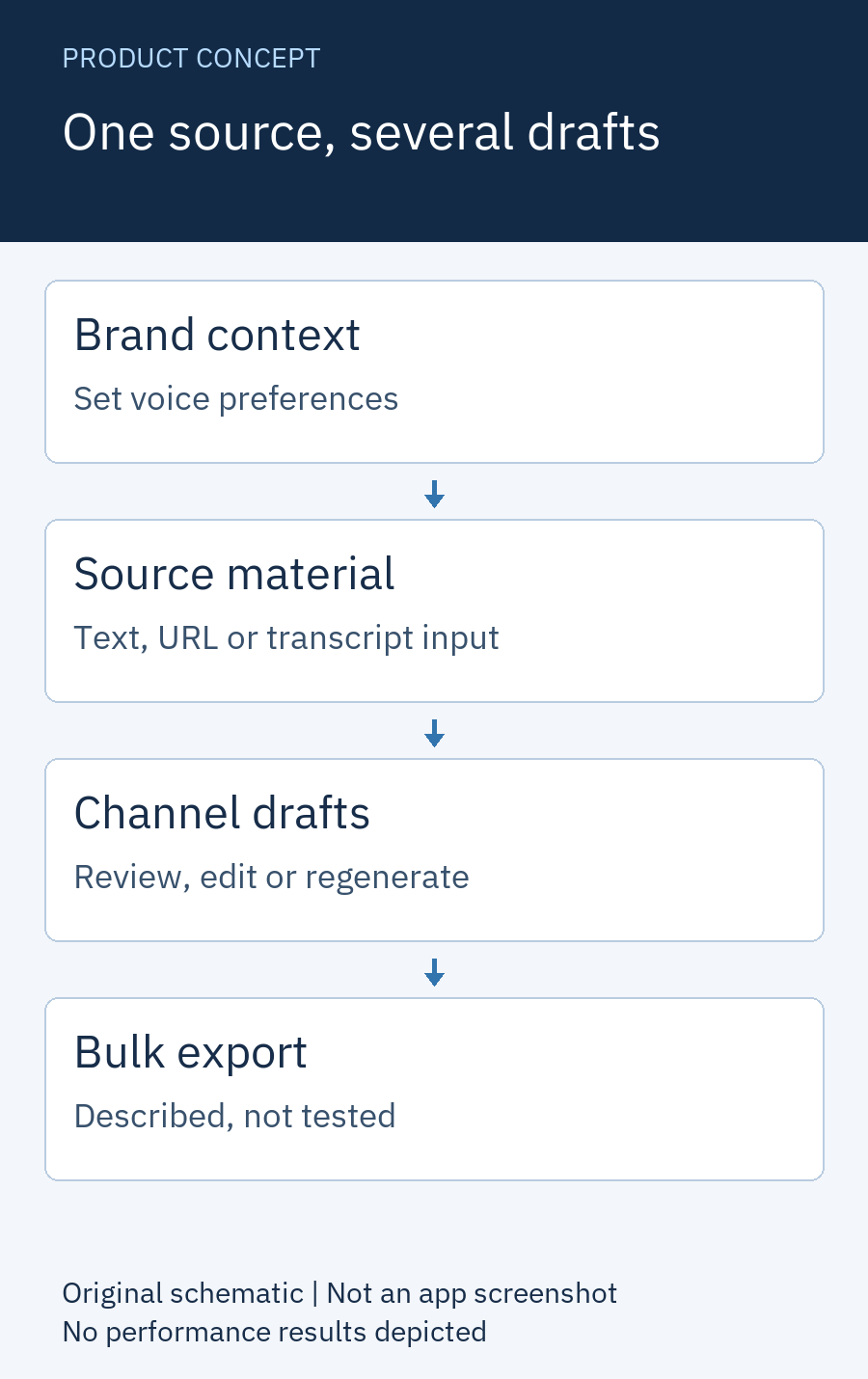
The recorded feature set begins with a brand-voice setup wizard, followed by text, URL or transcript input. It describes channel-specific outputs for X, LinkedIn, Instagram, email, blogs and video scripts. The design would let the same source and voice context support several formats instead of asking the user to start over for each destination.
That is the product rationale. Consistent voice still needs to be judged against real examples of the brand's writing. A saved profile alone cannot establish that the generated work sounds right.
Leave room for the editor
The described sequence is source input, generation, editing or regeneration, then bulk export. It ends with drafts a person can inspect. Transcript input does not establish an audio-transcription service, a URL field does not establish universal website extraction, and bulk export does not mean automatic social publishing.
A prior inspection observed the landing page and recorded an earlier API-parameter fix. The database was restoring at the time, and neither content generation nor export was exercised.
A concept, with a limited record
This remains a recorded prototype with unverified generation and export. The available evidence does not establish my exact implementation role, collaborator contributions, the model provider or the export formats. It also provides no basis for time-saving percentages, engagement gains or customer results.
The next useful test would compare several channel drafts with their source and a permitted brand sample: did the substance survive, does the voice fit, and can an editor revise and retrieve the output? Those questions would tell us more than a landing-page promise.
For an operating team, AI workflow planning for marketing teams should define ownership and acceptance before increasing the number of drafts.
Projected impact: a scenario to test, not a delivered result
All inputs and calculated amounts in this section are hypothetical sample assumptions, not customer measurements, industry benchmarks or a forecast for this project. They are chosen to make the budgeting arithmetic inspectable. No verified delivered ROI is established for this case.
A bundle means the same agreed set of channel outputs in both workflows. This projection includes editing, fact-checking and revisions before acceptance. It is an explicit sample scenario, not the prototype’s landing-page saving claim. Generation and export remain unverified, and export does not mean automatic publishing.
Hypothetical monthly inputs for a marketing team adapting source material into channel bundles: 12 accepted channel-content bundles; 180 total staff minutes each in the manual baseline; 30 to 60 assisted preparation minutes plus 60 minutes of human review and correction each. Add 2 hours per month for maintenance and exception oversight. Use $50 per hour as an assumed loaded labor value and $60 per month for incremental tools, hosting and usage. These operating allowances are sample budgets, not vendor quotes.
- Projected baseline effort
- 12 × 180 ÷ 60 = 36 staff hours per month.
- Projected assisted effort, including review
- 12 × (30 to 60 preparation minutes + 60 review minutes) ÷ 60 + 2 maintenance hours = 20 to 26 staff hours per month.
- Projected capacity released
- 36 baseline hours minus 20 to 26 assisted hours = 10 to 16 staff hours per month.
- Projected capacity value
- 10 to 16 hours × $50/hour = $500 to $800 per month in labor capacity value.
- Projected capacity value less operating spend
- $500 to $800 capacity value minus $60 incremental operating spend = $440 to $740 per month, before implementation costs.
This is recurring monthly modeled potential, not cash savings or additional revenue. Freed hours only become useful capacity if the team can redeploy them. Payroll does not fall merely because preparation takes less time. Any avoided overtime or outside-service expense would need separate evidence. The dollar balance compares capacity value with operating spend; it is not profit or a cash-flow return.
The range varies only the assumed assisted preparation time. It is not a confidence interval or a promise of typical results. The comparison requires the same completed work and acceptance quality, with review and correction included. Lower adoption, harder cases, failed outputs, added support or higher operating costs can reduce the benefit to zero or make it negative.
One-time implementation costs are unknown and excluded, including setup, integration, training and initial validation. Any required migration or hardware acquisition is also excluded and must be priced separately. With that incomplete investment cost basis, no ROI percentage or payback period is claimed. Do not annualize this sample month as a forecast without validating sustained volume, adoption and costs.
Evaluate your content-bundle economics
Repurposing is one part of organic content marketing; distribution, audience fit and editorial quality still need attention beyond the export.
Use source material you may reuse, real brand examples and an acceptance rubric for the same channel bundle. Count rewrites and rejected drafts. A faster first pass has little economic value if it creates more editing work or needs additional distribution spend.
Bring one reusable source, a writing sample and the channel outputs you need. We can discuss an equal-quality comparison that includes your editor’s time rather than just counting generated drafts.