
A weekly business review can consume half a morning before anyone reviews the business. Someone gathers updates, reconciles numbers, builds slides, and chases the missing explanation.
That is the kind of work worth testing against Google’s new Gemini agent. The useful question is whether it can deliver a report your team trusts without making someone supervise every handoff.
Why this matters
At Gemini at Work on October 8, Google announced a “universal agent” that combines knowledge work, coding, media creation, persistent memory, and execution across business applications.[1] My recommendation: evaluate it on one recurring assignment with a clear finished product, not a collection of impressive prompts.
There is a promising idea here. There is also a meaningful difference between Google’s announced vision and what every customer can turn on today.
What Google is trying to replace
The announcement describes a cloud-running agent that keeps working after you close your laptop, carries context across devices, and can create temporary sub-agents for parts of an assignment.[1] A separate coworker-agent concept gives a persistent team role its own identity, storage, and Workspace presence.[1]
Google also describes reusable skills, shared tool registries, and inline work across Gmail, Drive, Docs, Slides, Sheets, Chat, and Calendar.[1] Instead of asking for a summary, copying it into a spreadsheet, and starting over in a presentation tool, you would delegate the broader assignment.
CBS News’s October 8 coverage frames the announcement as another move in the competition for virtual office assistants. Its descriptions of autonomous work and memory are attributed to Google and Thomas Kurian, not to an independent product test.[2]
The enterprise opportunity is less time spent moving context between applications. But if a person still has to repair the numbers, rebuild the slides, and investigate every source, the organization has bought a different kind of busywork.
What is available, and what is still arriving
Google’s current product page explicitly says multi-step background delegation, mobile and desktop experiences, and third-party model choice are in early access. Don’t read the keynote as a general-availability declaration for the entire experience.[3]
- Financial Services and Legal specializations are in preview. Healthcare, Government, and Retail are described as coming soon.[1]
- The existing Canvas document-and-presentation assistant became generally available in July. That is not the same as universal background execution across Workspace.[4]
- Federated query mode for BigQuery, Spanner, Cloud SQL, and AlloyDB for PostgreSQL, plus its Knowledge Catalog integration, is in preview.[4][5]
Model choice needs particular care. The keynote says Gemini can orchestrate Gemini and Anthropic Claude models today; the product page still identifies third-party choice as early access.[1][3] Separately, October 8 release notes document Claude Opus 5.5 and Sonnet 5.5 in AI developer tools, disabled by default and requiring administrator consent and consumption billing.[4] Access in a developer tool does not establish access in every agent surface.
Ask your account team to demonstrate the exact workflow in your tenant, edition, and region. A feature shown onstage is not an entitlement.
Start with the report, then work backward
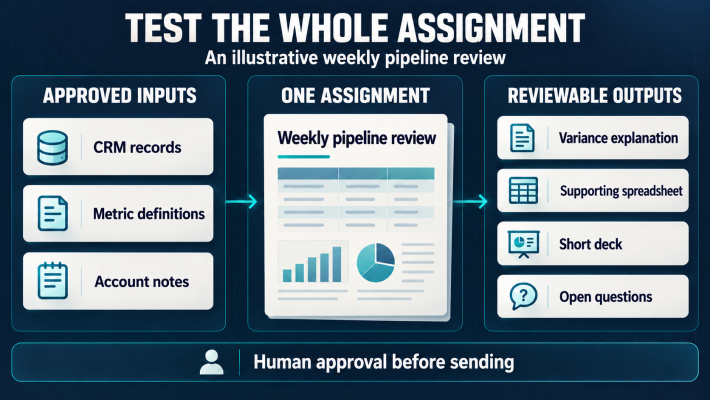
Consider an illustrative sales-operations assignment: prepare the weekly pipeline review from approved CRM records, finance definitions, and account notes. Produce a variance explanation, supporting spreadsheet, short deck, and list of unresolved questions. Stop before sending anything to customers.
This tests several useful capabilities together. Can the agent find the right records? Apply your definition of qualified pipeline? Explain why a number changed? Put the result where the team already works?
Google’s data announcement describes an especially practical pattern: generate and save an operational query, then rerun that report without incurring token costs.[1] Treat that as Google’s stated capability, not a promise of free analytics. Query execution, storage, and other services still need a cost review.
The sensible design is to have an analyst approve the query and metric definitions before repeated execution. Use AI for investigation and explanation; don’t ask it to reinvent the calculation every Friday.
Two adjacent assignments are worth considering once access is confirmed. A launch coordinator could assemble a readiness document from project updates and flag missing owners. An engineering team could ask for a tested pipeline repair in a review branch rather than an automatic production change. Google describes both Workspace coordination and data-engineering capabilities, including PySpark generation, notebooks, and pipeline troubleshooting.[1] These are pilot designs, not outcomes I have measured.
Your data setup will decide how useful this is
Google’s Data Cloud documentation draws a distinction the broad launch language can obscure. Ingestion mode copies source data into a Gemini Enterprise data store. Federated mode queries it in place using the user’s credentials.[5] “Connect your data” can therefore describe different architectures.
There is also an important scope limit: attaching a connector does not restrict it to one dataset or database. It can reach the resources that the authenticated user is permitted to query.[5]
For the pipeline-review example, check the underlying permissions rather than merely telling the agent to use the sales dataset. Instructions about where to look are not access controls.
Google recommends a scoped conversational analytics data agent when a workload needs deterministic limits on tables and curated queries. Its documentation also acknowledges that dynamically generated query accuracy can vary on complex schemas.[5] That makes the setup decision fairly concrete: broad connectors for exploration, curated data and verified queries for a recurring number the CFO will question.
Google reports that Bloomberg Media improved SQL query accuracy by 63% during initial development after grounding agents in Knowledge Catalog.[1] That is a vendor-reported customer result, not an independent benchmark or a forecast for your environment. Use your own known questions and accepted answers to test whether the approach works.
Price the assignment, including the interruptions
Google’s August billing announcement describes seat subscriptions, pooled quotas, and consumption options.[7] Current documentation says the Pay-as-you-go edition requires an invoiced Cloud Billing account receiving an active monthly invoice.[6] Existing Workspace access alone should not be treated as proof that the proposed agent workflow is licensed.
Get a written breakdown of the applicable edition, included quotas, model consumption, sandbox execution, data services, and connector or third-party charges. Then measure total cost per accepted report, including the time people spend correcting it.
Spend controls also have a practical caveat. Google’s documentation says stopping usage can take a few minutes, so charges can exceed the configured limit.[8] A cap is useful protection, not a guarantee of an exact maximum invoice.
For a scheduled report, decide what happens if a quota or spending limit interrupts the job. Someone still needs the report before the meeting.
Give the agent a role you can inspect
Google describes agent identities, audit trails, sandboxing, and Agent Gateway policy enforcement.[1] The technical documentation is more specific: Gemini Enterprise supports the gateway’s outbound mode, while additional content and semantic controls depend on configuration.[9]
Before a pilot, have an administrator demonstrate which identity retrieves data, which tools it can call, where its actions are recorded, and how access is revoked. Test a prohibited action as well as an allowed one.
Healthcare teams can apply the same approach to a nonclinical administrative report using synthetic or approved nonsensitive data. That is an illustrative starting point, not evidence that the announced Healthcare specialization has shipped. Adding patient information requires a separate review of covered services, agreements, permissions, and downstream systems.
AI Pathfinder action plan
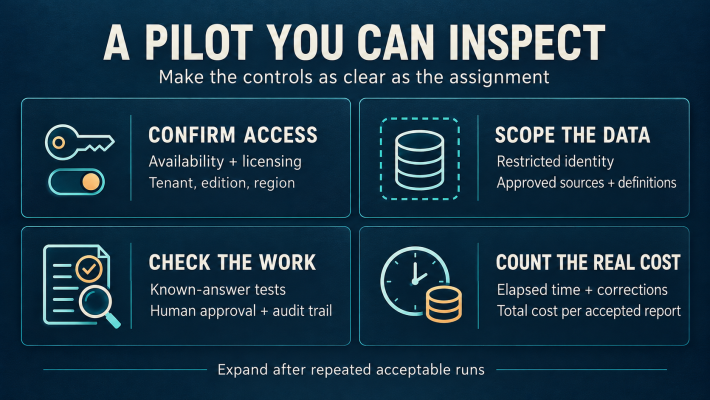
For your next pilot, bring the business owner and the administrator together around one actual assignment:
- Define the finished artifact and the person who accepts it. Include examples of unacceptable answers.
- Confirm current availability and licensing for every step, especially background work, model selection, and write actions.
- Assemble approved sources, metric definitions, and a small set of known-answer tests. Verify access with a restricted test identity.
- Compare the agent-assisted run with the existing process. Track elapsed time, human correction, factual errors, and total cost.
- Expand only after repeated acceptable runs. Keep sending, publishing, production changes, and other consequential actions behind explicit approval until separately tested.
Frequently asked questions
Does this require moving everything into Google?
No wholesale migration is the stated proposition. But check each connector: Google documents both data-copying and in-place query modes.[5]
Can we assume everything announced is generally available?
No. Early access, preview, existing GA features, and future specializations coexist in this announcement.[1][3][4]
Your bottom line
Bring last week’s report, its source data, and its corrections to the next Gemini demonstration. Ask the agent to do that assignment. Then have the person who normally owns the report decide whether the result is usable and whether the work actually became easier.
About Jason Fleagle
Jason Fleagle is Head of AI at Netsync and writes AI Pathfinder about practical enterprise AI decisions. Find more of his work at thejasonfleagle.com and netsync.com.
Sources
[1] Google Cloud: Introducing the Gemini agent — October 8, 2026
[2] CBS News, Mary Cunningham: Google launches Gemini AI workplace agent — October 8, 2026
[3] Google Cloud: Gemini for business — accessed October 8, 2026
[4] Google Cloud: Gemini Enterprise release notes — entries through October 8, 2026
[5] Google Cloud: Connect to Data Cloud — updated October 8, 2026
[6] Google Cloud: Compare editions — updated October 7, 2026
[7] Google Cloud: Flexible billing and cost controls — August 26, 2026
[8] Google Cloud: Overages and spend controls — updated October 7, 2026
[9] Google Cloud: Agent Gateway overview — updated October 7, 2026
Originally published on LinkedIn.