

A trillion-parameter model is an interesting announcement. A model your team can operate safely, affordably, and well enough to finish useful work is a buying decision.
Mistral Large 4 deserves a serious evaluation. It does not yet justify a private-deployment purchase order.
Why this matters
On October 6, 2026, Mistral launched the public API preview of Mistral Large 4, calling it its largest and most capable model to date.[1] The important qualification: the weights have not been released. Mistral’s Hugging Face page lists October 31 as the expected release, not a completed delivery.[8]
Editorial note, October 8: this is an assessment of this week’s preview announcement, not an announcement that downloadable weights are available. Mistral Large 3, released December 2, 2025, provides the already-released comparison.[4]
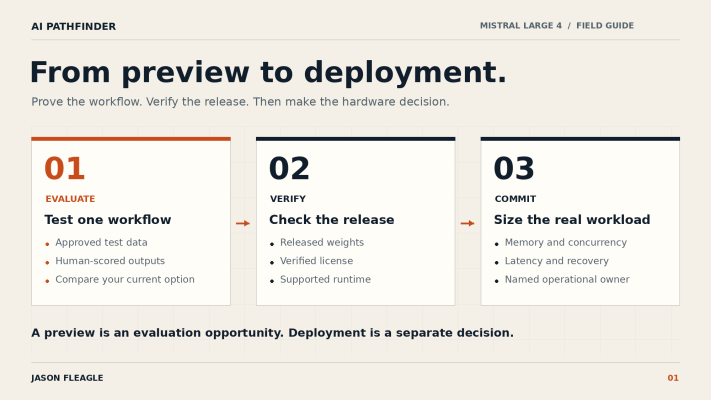
My recommendation: use the preview to find out whether a specific workflow benefits. Keep licensing approval and infrastructure commitments behind a separate release-and-validation gate.
What is actually available
Mistral’s model documentation identifies Large 4 as a public preview and lists a one-million-token context window, image and text capabilities, function calling, and structured outputs.[2] Those are useful ingredients for document analysis and supervised agents. They do not establish accuracy on your records or permission to connect the model to production systems.
The parameter numbers need care. The documentation lists 1.05 trillion total parameters and 52 billion active parameters, and identifies a 1.6-billion-parameter vision encoder.[2] The Hugging Face preview description uses the rounded one-trillion figure and explains that 49 billion active parameters becomes 52 billion when embeddings and output layers are included.[8]
These are different counting conventions, not evidence of two separate releases. For procurement, retain the exact model version and the vendor’s accounting instead of turning a rounded headline into a hardware specification.
In a mixture-of-experts model, only part of the model is active for a token. That does not make a trillion-parameter model equivalent to a small dense model you can size from its active count alone. Storage, memory, serving software, context length, and concurrent requests still matter.
“Largest” also needs a boundary. Mistral calls this its largest model, not the world’s largest.[1] Size is a reason to investigate its capabilities, not a ranking of enterprise usefulness.
Start with work someone can check
I’d begin with document-heavy tasks where a person can inspect the evidence: compare contract clauses, reconcile a spreadsheet against supporting documents, or draft an engineering review with references to the relevant drawings. These are proposed evaluations, not customer results.
Give the model a bounded collection and require it to distinguish an extracted fact from an inference. Include conflicting versions, missing information, and a document containing instructions it must ignore. A polished answer that quietly uses the wrong revision should fail.
For healthcare, consider an illustrative workflow that drafts staff guidance from approved administrative policies. Start with synthetic questions and documents cleared for the environment. Require source references and human review. Do not turn a successful policy-document demonstration into approval for patient records or clinical decisions.
Before introducing protected health information, have the organization’s privacy and security teams confirm the applicable contractual requirements, covered services, configuration, and downstream tools. Nothing in this model announcement settles those questions.
Keep an existing smaller model or approved hosted service in the comparison. If it completes the task with fewer corrections and less operating burden, the larger model has not earned the workload.
Read the benchmark fine print before the leaderboard
Mistral reports 61.7% on DeepSWE v1.1, 28.3% on Terminal-Bench 4, and 59.9% on AutomationBench, which covers 657 business workflows.[1] The spread is more useful than a blanket claim that the model is “good at agents.” Different environments ask very different things of an agent.
These figures come from Mistral’s announcement, which attributes several evaluations to outside benchmark organizations. They are not tests I ran, and I have not independently reproduced them. A benchmark score does not predict your team’s acceptance rate, response time, or cost per completed task.
Mistral also reports 93.3% attack resistance on Lakera’s B3 benchmark.[1] That is a reason to examine the evaluation, not permission to let untrusted documents control an agent. A strong result on a defined attack set does not establish immunity to new attacks, different tools, or a badly configured application.
For your trial, measure accepted outputs, unsupported claims, reviewer corrections, retries, latency, and unauthorized tool attempts. Include the reviewer’s time in the cost. A cheaper response that requires extensive repair may be the expensive option.
Open weights and an open-source license are different checks
Right now, the practical Large 4 offering is a hosted preview with a promised weight release.[1][8] Do not treat “Open” in a catalog as proof that the downloadable artifacts, license, and operating instructions have arrived.
The official preview pages reviewed for this article do not establish a final weight license. Large 3’s Apache 2.0 license is explicit in its announcement and model card; that is not evidence that Large 4 inherits it.[4][5]
Open weights describe access to learned parameters. Source access concerns code. Licensing determines what you may do with the artifacts. Those questions overlap, but none substitutes for the others.
The Open Source Initiative’s Open Source AI Definition 1.0 goes beyond downloadable weights: it includes freedoms to use, study, modify, and share, along with requirements concerning data information, code, and parameters.[6] An OSI-approved software license on an artifact is not, by itself, proof that an entire AI system meets that definition.
When the release arrives, legal and engineering should inspect the actual license and artifact inventory together. Check commercial use, redistribution, modification, notices, and any restrictions before approving deployment or fine-tuning. Compare that package with proprietary hosted models on the controls and capabilities your workload needs, rather than assuming either category is automatically preferable.
Hardware and sovereignty come with operating responsibilities
Mistral says Large 4 was trained on 3,800 NVIDIA Grace Blackwell GPUs in its European datacenters and that the preview runs on the same infrastructure.[1] That is a statement about Mistral’s infrastructure. It is not a customer inference requirement or a verified deployment recipe.
Large 3 offers a useful historical reference, not a sizing shortcut. Its December 2025 announcement describes an optimized NVFP4 checkpoint running on a single eight-A100 or eight-H100 node with vLLM.[4] Its model card separately describes FP8 and NVFP4 hosting options and warns about deployment complexity.[5] Those vendor statements concern Large 3. Do not reuse them as a Large 4 bill of materials.
For Large 4, wait for the released checkpoint, supported runtime, precision format, and documented serving configuration. Then validate memory use, concurrency, latency, recovery, and quality on representative traffic before buying capacity.
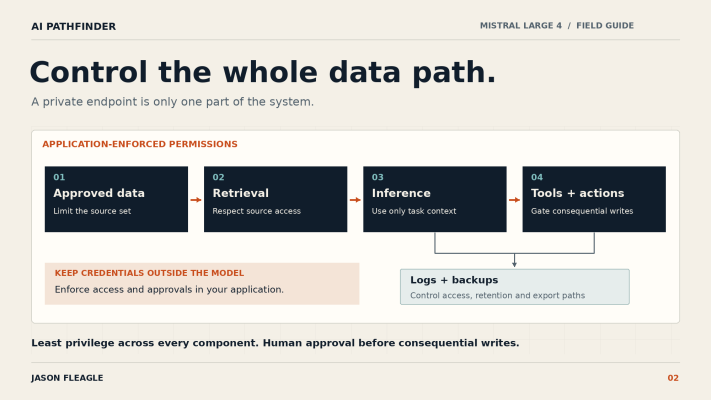
Self-hosting can let you control the inference environment. It also makes patching, monitoring, access management, and incident response your team’s problem. Trace prompts through retrieval, inference, logs, tools, and backups. A private endpoint with a connector that exports sensitive records is still an export path.
Keep tool credentials outside the model, enforce permissions in the application, and require approval before consequential writes. Give an agent access to the minimum data and actions needed for its task. Model-level refusal behavior should supplement those controls, not replace them.
Your AI Pathfinder action plan
Bring one proposed workflow to the evaluation meeting and agree on these gates:
- Define an acceptable output and the errors that stop the trial before anyone sees the demo.
- Compare the preview with your current option using the same approved documents, tools, and review criteria.
- Record the exact endpoint, model identifier, settings, test date, and failures. Recheck results when the preview changes.
- Hold private-deployment approval until the weights, license, runtime, and measured serving configuration are available.
- Name the person who can pause the workflow and the team responsible for recovery.
If the preview is useful, you have evidence to continue. If it fails, you have a specific problem to retest rather than another vague AI pilot.
Frequently asked questions
Can we download Large 4 today?
The official release page still describes an upcoming release, with October 31, 2026 as its current expected date.[8] Treat that as a schedule, not a guarantee.
Does the context window mean we should load everything?
No. Select relevant, authorized material and test whether the model can retrieve and correctly use it. A documented capacity limit is not an accuracy promise.
The bottom line
Test a workflow now if the preview’s terms and data controls fit. Make the hardware decision later, using released artifacts and measured operating requirements. The useful outcome is a system your team can trust with a defined job, with evidence explaining why.
About Jason Fleagle
Jason Fleagle is Head of AI at Netsync and writes AI Pathfinder about practical enterprise AI decisions. Find more of his work at thejasonfleagle.com and netsync.com.
Sources
[1] Introducing Mistral Large 4 (October 6, 2026; accessed October 8)
[2] Mistral Large 4 documentation (October 6, 2026; accessed October 8)
[4] Introducing Mistral 3 (December 2, 2025)
[5] Mistral Large 3 Instruct model card (2512 release; accessed October 8, 2026)
[6] Open Source AI Definition 1.0 (accessed October 8, 2026)
[8] Mistral Large 4 upcoming release (accessed October 8, 2026; October 31 is expected, not actual)
Originally published on LinkedIn.