Quick take: DeepSeek V4 Pro and Grok 4.6 have made premium AI pricing harder to defend by shifting the decision toward cost per accepted workflow outcome—not raw token price or a single leaderboard score.
New AI models DeepSeek V4 Pro and Grok 4.6 made slow, expensive intelligence harder to defend.
DeepSeek moved V4 Pro into production with a one-million-token context window and an output price of $0.87 per million tokens, at least until its new pricing takes effect.[1]
Grok 4.6 arrived with a 500,000-token context window and API pricing of $2 per million input tokens and $6 per million output tokens.[2][3] Artificial Analysis placed its performance close to the top of the market across several agentic evaluations.[4]
Neither model has taken an undisputed crown, but both are changing how teams decide which AI models to use.
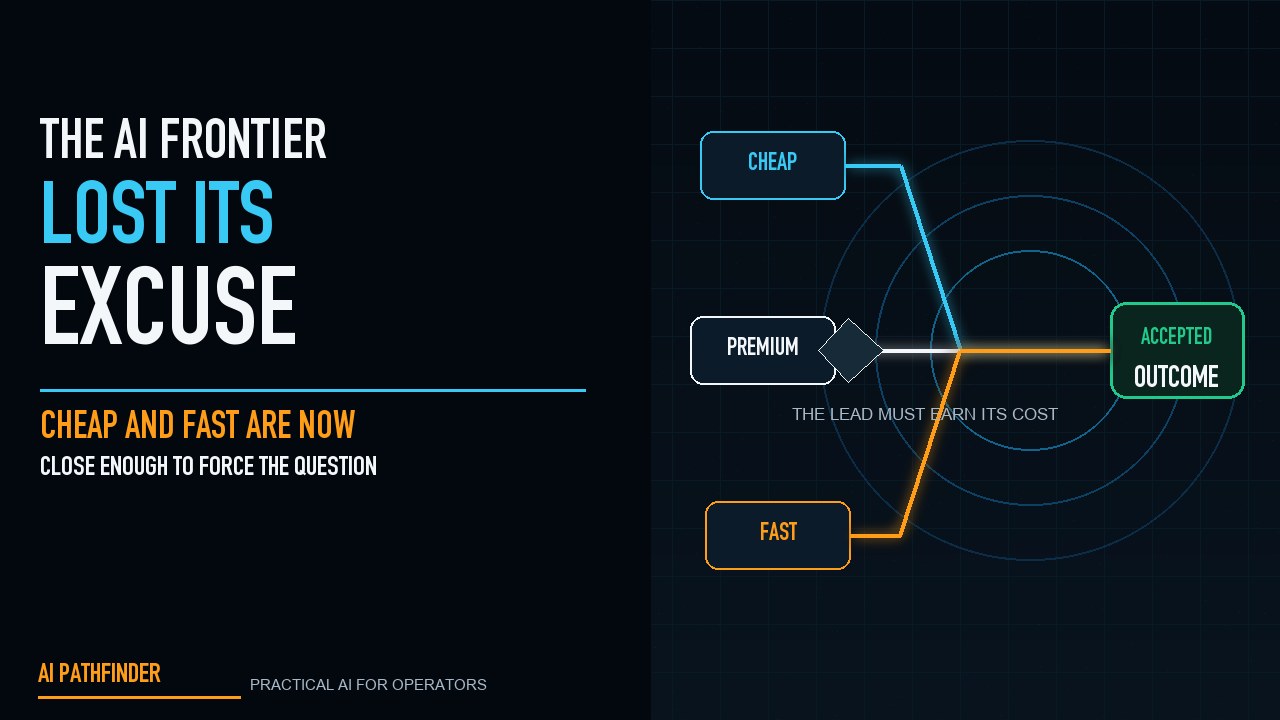
For years, premium providers could defend high prices and long waits with a familiar answer: this is what the best intelligence costs. DeepSeek is putting even more pressure on the price side of that argument. Grok puts pressure on workflow efficiency. A small quality lead no longer settles the decision when a close competitor can reach an acceptable result with fewer measured turns and lower model cost.
Why This Matters
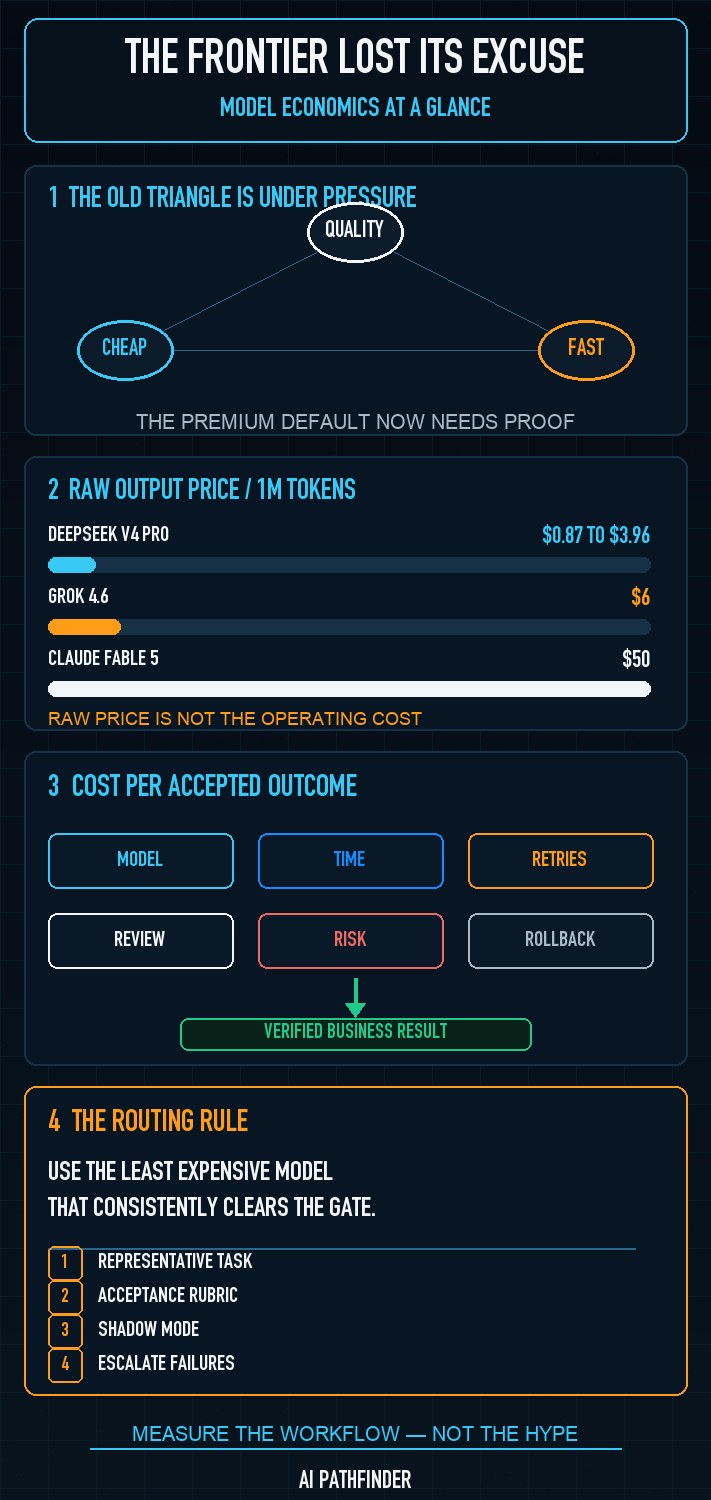
The model market has long forced buyers to trade among intelligence, speed, and price. DeepSeek V4 Pro and Grok 4.6 do not erase those tradeoffs. They make it harder to treat the most expensive model as the automatic default.
The useful question is no longer limited to which model tops a leaderboard. Teams need to know which model produces an accepted result at the best balance of quality, time, cost, and control.
What shipped
DeepSeek’s production endpoint now runs DeepSeek-V4-Pro-0813. It supports a one-million-token context window, up to 384,000 output tokens, tool calls, JSON output, the Responses API, and Anthropic-compatible access.[1]
Its launch-window pricing is $0.435 per million uncached input tokens, $0.003625 per million cached input tokens, and $0.87 per million output tokens.[1]
That headline needs a date attached. DeepSeek has announced peak and off-peak pricing effective August 16, 2026. V4 Pro output rises to $1.98 per million tokens off-peak and $3.96 at peak. Uncached input rises to $0.66 off-peak and $1.32 at peak.[1]
The price advantage survives the increase. Claude Fable 5 is priced at $10 per million input tokens and $50 per million output tokens.[5] DeepSeek remains dramatically cheaper on raw tokens, although token price alone says nothing about retries, reliability, latency, or human review.
SpaceXAI positions Grok 4.6 for long-running agents, coding, knowledge work, and multi-step application building.[2] Its standard API costs $2 per million input tokens and $6 per million output tokens. A fast variant costs twice as much.[2][3]
On Artificial Analysis’s composite Intelligence Index, Grok 4.6 scored 61. That tied GPT-5.6 Sol Max, trailed Claude Fable 5 Max with fallback by one point, and trailed Claude Opus 5 Max by two.[4]
Close scores do not make the models interchangeable. They do force the premium model to make a stronger economic case.
Benchmark versions change the story
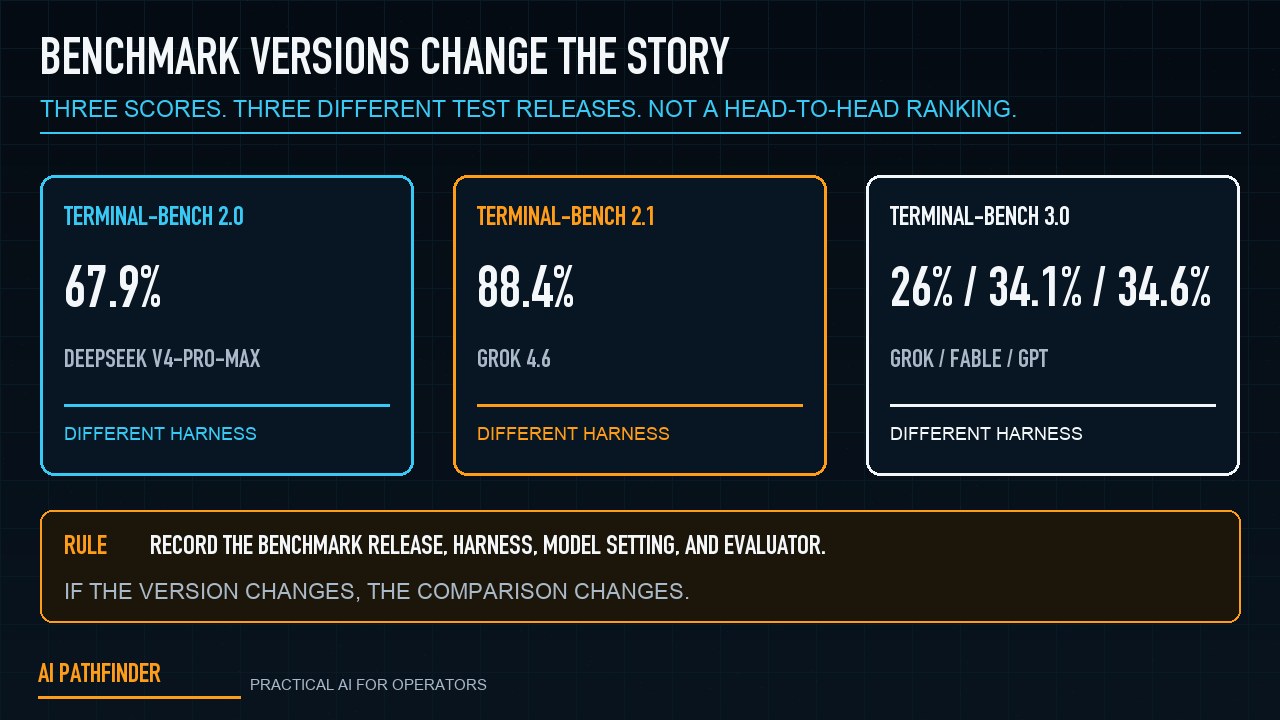
DeepSeek-reported results list V4-Pro-Max at 67.9 percent on Terminal-Bench 2.0.[6] V4-Pro-Max is a benchmark configuration, not the production API model name. Artificial Analysis reports Grok 4.6 at 88.4 percent on Terminal-Bench 2.1.[4] SpaceXAI’s launch table uses Terminal-Bench 3.0 and reports 26 percent for Grok 4.6, 34.1 percent for Fable 5 Max, and 34.6 percent for GPT-5.6 Sol Max.[2]
None of those figures is directly comparable across versions.
If the version changes, the comparison changes. Buyers should record the benchmark release, harness, model setting, and evaluator beside every score.
The market is moving toward workflow economics
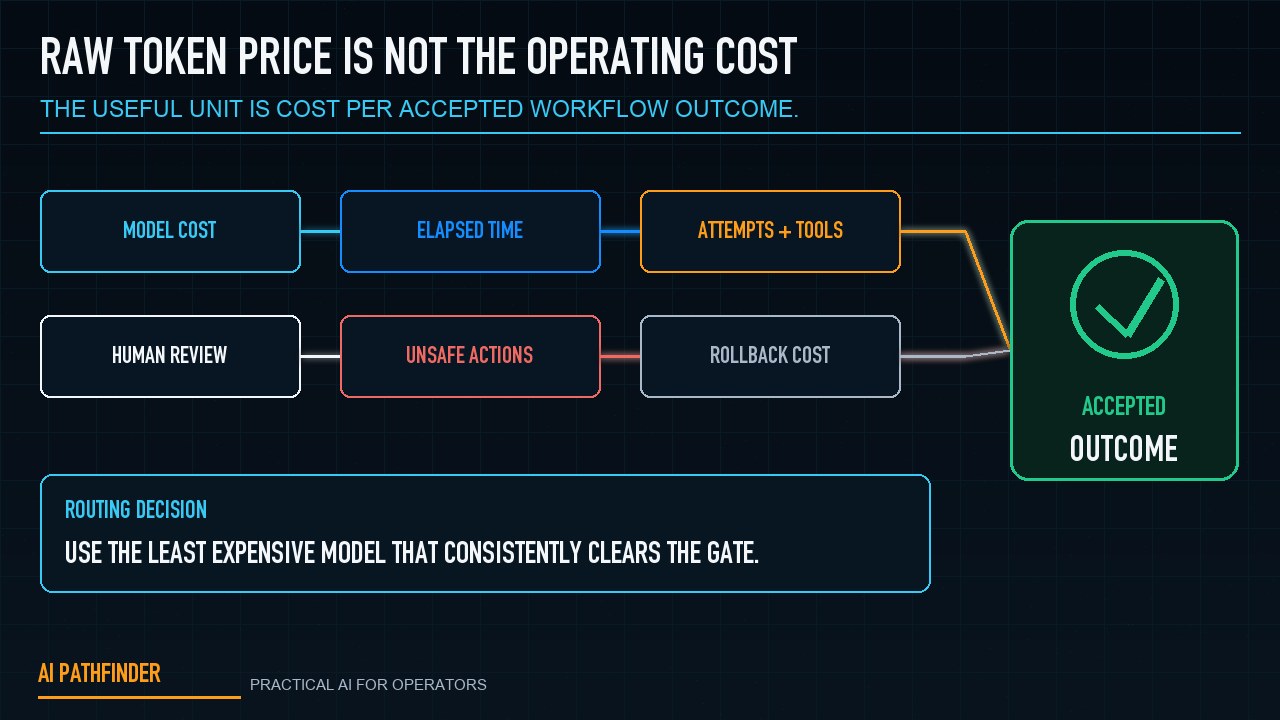
Raw token price is not the operating cost. The more useful unit is cost per accepted workflow outcome.
That includes:
- Successful task completion
- Total elapsed time
- Model and tool costs
- Attempts, tool calls, and failures
- Human correction time
- Unsafe or unauthorized actions
- Rollback and incident cost
A cheap model that loops five times, calls the wrong tools, or creates three hours of cleanup can become the expensive option. A premium model can earn its price when it handles the difficult case correctly on the first pass, respects policy boundaries, and produces work that survives review.
Grok 4.6 shows why this measurement matters. Artificial Analysis measured it at $0.84 per task on its evaluation set. On AA-Briefcase, the evaluator reports roughly 53 turns for Grok 4.6 versus 103 for Claude Opus 5 Max, with substantially lower aggregate input-token usage in that evaluation.[4]
That does not establish a universal runtime advantage. It shows how fewer turns and lower model prices can create meaningful savings even when a model does not win every intelligence benchmark.
DeepSeek creates pressure from the other direction. Even after the announced increase, its peak output rate of $3.96 per million tokens remains far below Fable 5’s $50.[1][5] The unanswered question is whether DeepSeek’s reliability, latency, governance fit, and accepted-task rate hold up in each buyer’s environment.
Use benchmarks to shortlist models, then make the routing decision with representative work.
Why premium providers should pay attention
The strongest models still matter. Large migrations, scientific problems, security investigations, and long-running agents may justify paying for every available point of capability.
Many of the workflows enterprises are trying to automate are bounded tasks: classify a ticket, reconcile a document, update a code path, investigate an alert, prepare a first draft, compare a contract, or assemble a customer brief. When a cheaper model consistently clears the acceptance bar, unused intelligence becomes expensive overhead.
DeepSeek compresses the raw cost of capable inference. Grok narrows the quality gap while showing stronger measured efficiency on specific agentic evaluations. Premium providers can answer through better reliability, security, governance, support, tool use, or lower review burden. A narrow benchmark lead by itself is becoming a weak defense.
AI Pathfinder Action Plan
Run a two-week model-routing sprint around one workflow that already costs the business real time or money.
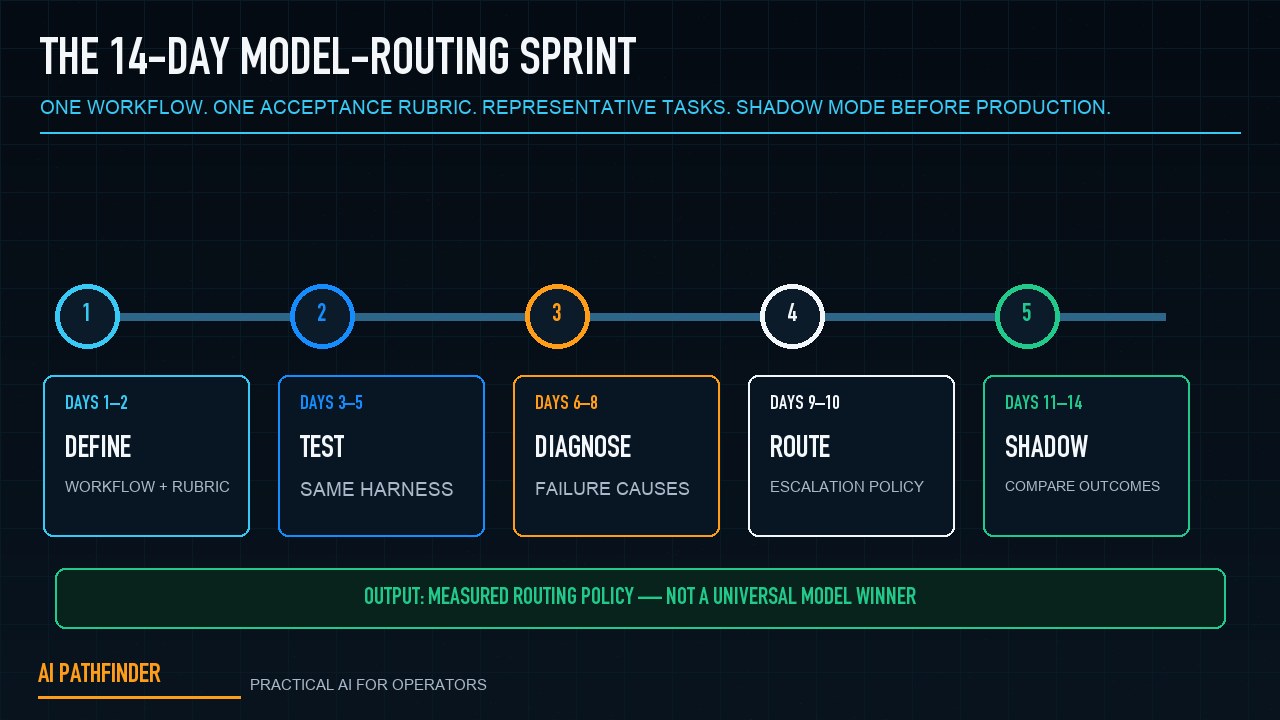
- Days 1 and 2: Pick the workflow, define one acceptance rubric, and collect 20 to 50 representative tasks. Include correctness, completeness, policy compliance, formatting, citations where needed, and tool behavior.
- Days 3 through 5: Run DeepSeek V4 Pro, Grok 4.6, and the current premium model through the same harness. Record model cost, elapsed time, turns, tool calls, failures, and reviewer minutes.
- Days 6 through 8: Classify the failures. Separate model weakness from poor prompts, weak tools, missing context, and harness defects.
- Days 9 and 10: Design a routing policy. Use the least expensive model that consistently clears the gate, then escalate low-confidence, high-risk, or failed tasks to the premium model.
- Days 11 through 14: Run the routed workflow in shadow mode. Compare cost per accepted outcome with the existing baseline before changing production traffic.
The goal is a measured routing decision, not a universal model winner.
Frequently asked questions
Is DeepSeek V4 Pro as capable as Claude Fable 5?
The evidence does not support that blanket conclusion. Performance varies by benchmark, version, harness, reasoning setting, and task. DeepSeek’s strongest verified story is a large raw price advantage combined with serious agent and coding capability. Its value should be tested against the same acceptance rubric used for other models.
Is Grok 4.6 universally faster?
No. The public evidence supports strong turn and task efficiency in specific evaluations, plus an optional fast API tier. It does not establish a wall-clock win across every coding harness and workload.[2][4]
The Bottom Line
DeepSeek V4 Pro and Grok 4.6 did not settle the argument over the best model. They raised the standard for defending a premium.
Premium models can still earn premium pricing through higher acceptance rates, lower risk, less review, or faster delivery. Teams should measure that value in representative workflows rather than infer it from a leaderboard.
Related reading: Alibaba Launches New AI Model Qwen3.8-Max to Compete with AI Frontier Models
About Jason Fleagle
Jason Fleagle is Head of AI at Netsync and the creator of AI Pathfinder. He helps leaders move beyond AI hype and build practical, governed systems that create measurable business value.
Follow AI Pathfinder for grounded analysis on AI models, agents, enterprise architecture, and the operating decisions behind production-ready AI.
Sources
- [1] DeepSeek Models & Pricing
- [2] Introducing Grok 4.6
- [3] Grok 4.6 Model Documentation
- [4] Grok 4.6 Benchmarks and Analysis
- [5] Claude Fable 5
- [6] DeepSeek Ships V4 Pro as Its Flagship Model Leaves Preview
Related Reading
- AI Readiness Scorecard
- AI Model Evaluation for Business
- AI Governance Checklist
- AI Agent Use Case Library
- Human-in-the-Loop AI Governance
- Prompt Injection Risk for Business Leaders
- Microsoft Copilot Governance
- Enterprise AI Roadmap Template
Originally published on LinkedIn.
About AI Pathfinder
AI Pathfinder is Jason Fleagle’s recurring field note on enterprise AI, agentic systems, AI governance, and the operating models leaders need as AI moves from experiments into real work.