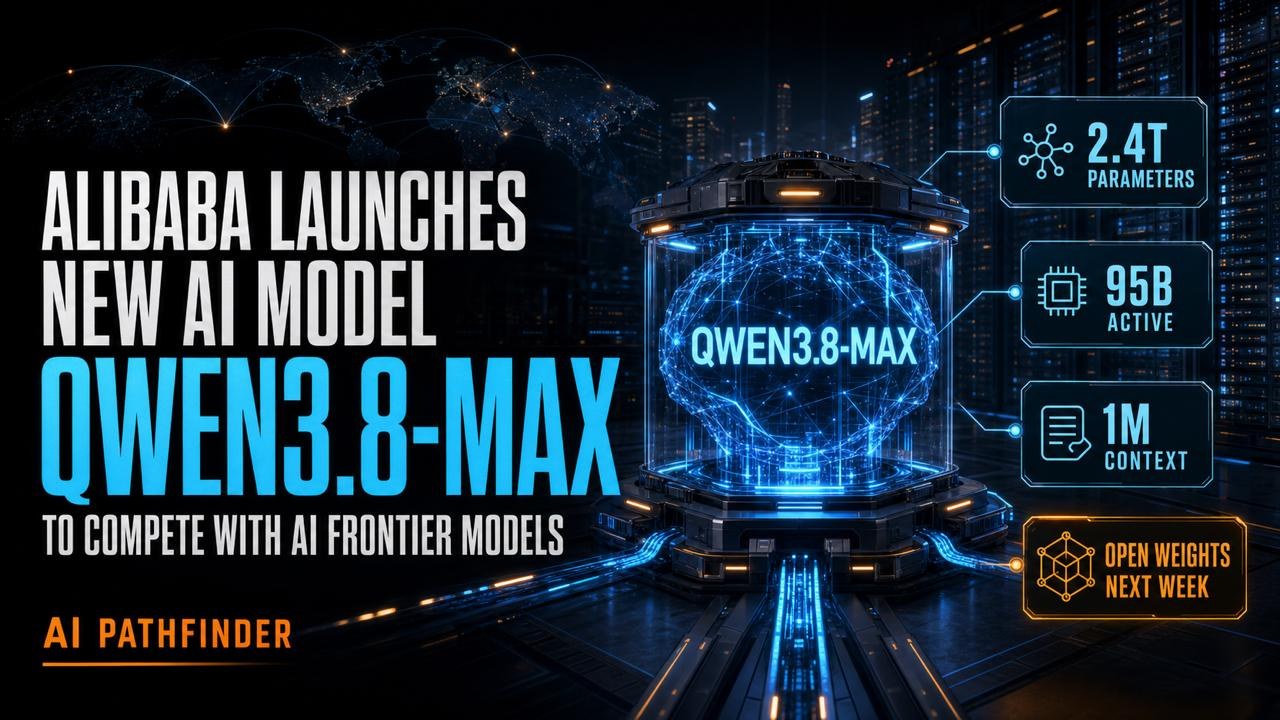
Alibaba Launches New AI Model Qwen3.8-Max to Compete with AI Frontier Models
Alibaba’s 2.4-trillion-parameter flagship is competitive on selected frontier evaluations, built for long-running agent work, and headed for an open-weight release. The enterprise question is whether it can deliver accepted outcomes inside a controlled workflow.
Alibaba has launched Qwen3.8-Max, its largest and most capable AI model so far.
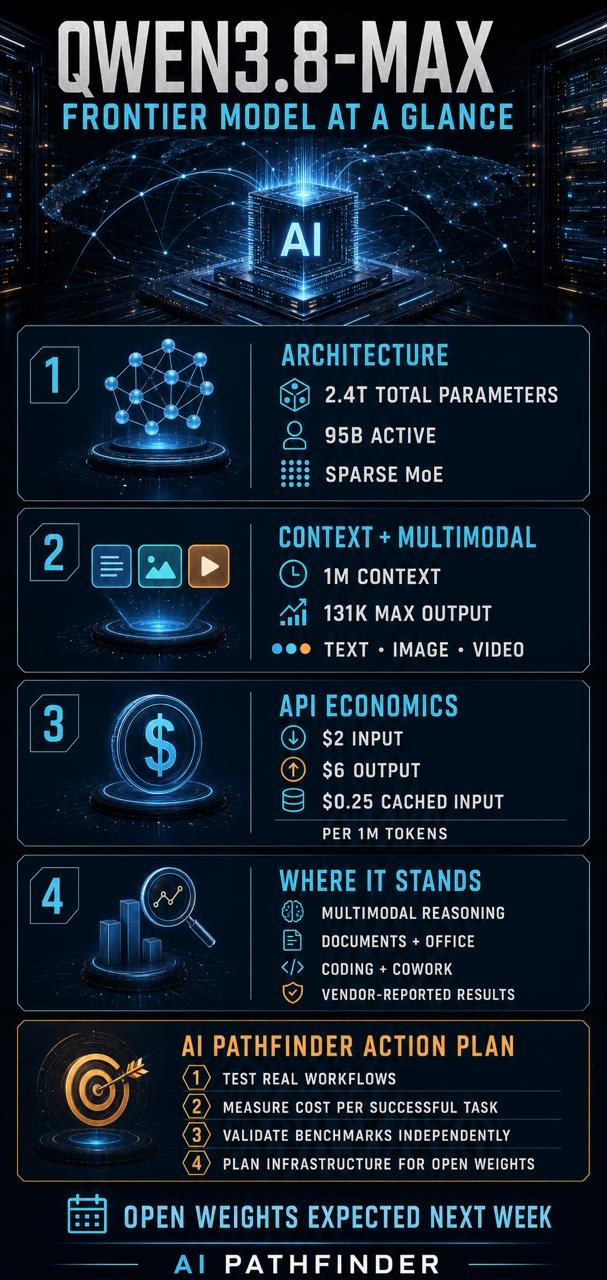
The headline numbers are hard to ignore: 2.4 trillion total parameters, 95 billion active parameters, a context window of up to 1 million tokens, native multimodal capabilities, and planned open weights.
Alibaba’s benchmark table places Qwen3.8-Max near the frontier on selected agent, document, vision, and long-horizon evaluations, while showing clear losses on others. That mixed result is more useful than a victory narrative: the frontier has not been won, but frontier-level capability is spreading across more providers, interfaces, and deployment models.
Why the Release of Qwen3.8-Max Matters
According to the official Qwen announcement, Qwen3.8-Max is available now through QwenCloud APIs. Alibaba plans to release the model weights on Hugging Face and ModelScope next week, which would make this the first open-weight Qwen-Max-class model.
The model uses a sparse mixture-of-experts architecture. Although it contains 2.4 trillion parameters in total, Alibaba says 95 billion are active during inference. It also supports a context window of up to 1 million tokens and can work with text, images, long documents, video, software interfaces, and tool-based agent workflows.
Alibaba’s announcement on X describes the target clearly: advanced coding, real-world work, research, and long-horizon tasks.
The launch is broader than a model API. South China Morning Post reports that Qwen3.8-Max is available globally through Alibaba Cloud Model Studio and QwenWork, a workplace agent platform now in public beta. Alibaba owns SCMP, so I would treat it as useful product reporting rather than independent validation.
What Alibaba actually released
The availability details matter because several reports blur the model release with the coming weight release.
Available now:
- Qwen3.8-Max through QwenCloud and Alibaba Cloud Model Studio APIs
- QwenWork access through web and desktop applications
- OpenAI-compatible chat completions and responses interfaces
- an Anthropic-compatible API interface
- documented integrations with Claude Code, Codex, Qwen Code, Qoder, and OpenClaw
- selectable reasoning effort at low, medium, and xhigh levels
Announced for next week:
- open weights for Qwen3.8-Max on Hugging Face and ModelScope
That distinction is important. Developers can test the hosted model today. They cannot yet treat the open-weight package, license terms, download requirements, quantizations, and practical serving stack as verified production facts.
Open weight also does not mean easy to self-host. A model with 95 billion active parameters still requires substantial compute, memory, networking, inference engineering, and observability. The downloadable artifacts may expand deployment choice, but they will not turn Qwen3.8-Max into a laptop model.
Is Qwen3.8-Max really competitive with frontier models?
On selected tests, yes.
Alibaba reports that Qwen3.8-Max scored 93.0 on PaperBench, ahead of the listed GPT-5.6 Sol score of 90.5 and Fable 5 score of 88.8. It reports 86.1 on OSWorld-Verified, above the listed Fable 5 score of 85.0 and GPT-5.6 Sol score of 83.2.
The model also scored 86.6 on Terminal Bench 2.1, between GPT-5.6 Sol at 88.8 and the listed Anthropic models at 84.6. On WideSearch, Alibaba reports 81.9, narrowly above Fable 5 at 81.2.
Other results are less flattering. Qwen3.8-Max scored 67.7 on SWE-bench Pro, below Fable 5 at 80.0 and Opus 4.8 at 69.2. On FrontierSWE, it scored 73.5 while Fable 5 reached 88.8. On GPQA Diamond, Qwen3.8-Max matched Fable 5 at 92.6 but trailed GPT-5.6 Sol at 94.1.
These are Alibaba-reported comparisons, not an independent tournament with one uniform harness. Some scores come from Alibaba’s internal evaluations, while others use public benchmarks under differing harnesses, tool budgets, context settings, and model-specific configurations.
The fair conclusion is narrower: Qwen3.8-Max appears frontier-competitive across a meaningful set of tasks. It does not dominate the field, and the public numbers do not tell you which model will perform best inside your data, tools, permissions, and acceptance criteria.
CNBC’s coverage reflects the competitive framing and reported that Alibaba shares rose after the announcement. The business signal is clear even if the benchmark winner is not: buyers now have another credible frontier provider to evaluate.
The more important claim is long-horizon work
Alibaba spends much of its announcement describing work that lasts hours or days rather than one prompt-response cycle.
In one Alibaba-reported demonstration, Qwen3.8-Max operated inside an autonomous coding loop for roughly 16 days. The public repository accumulated 265 commits, 127 pull requests, and 151 issues. The system converted requirements into issues, claimed work, wrote code, ran tests, inspected failures, and sent problems back through the loop.
In another Alibaba-reported demonstration, the model spent about five days reproducing a research paper and then attempting to improve it. Alibaba says the run produced roughly 7,600 lines of code, more than 1,100 actions, and 33 GPU training rounds. A separate 24-hour competition run reportedly beat 458 of 526 teams.
These are vendor demonstrations. They are not independent proof that an enterprise can leave the model alone for two weeks and receive safe, production-ready work. However, they are worth exploring.
They do reveal the design target. Qwen3.8-Max is being trained for persistent work inside a harness with tools, state, feedback, verification, and retry loops. That is a different product ambition from building a more fluent chatbot.
The enterprise value will depend on the surrounding system:
- Can the agent recover cleanly after a failed tool call?
- Does it preserve state across hours or days without drifting from the objective?
- Are tests and acceptance criteria independent of the model doing the work?
- Which actions require human approval?
- Can operators inspect the evidence behind a change?
- Can the system stop, roll back, and resume without duplicating side effects?
A long-running agent without those controls is not autonomous productivity. It is unattended operational risk.
One million tokens is capacity, not comprehension
A 1-million-token context window can hold thousands of pages. SCMP translates the limit to roughly 750,000 words or equivalent content in one query.
That can be useful for large document collections, codebases, video transcripts, research corpora, and multimodal project work. It may reduce the need to split every task into tiny chunks.
It does not guarantee that the model will recall every detail, preserve priorities across the full window, distinguish current facts from stale ones, or cite the right source when two documents conflict.
Test long-context performance with the failure modes that matter in your workflow:
- buried requirements
- conflicting versions
- missing evidence
- stale instructions
- tables, charts, and scanned pages
- permissions that change across documents
- facts that must be quoted exactly
Context size tells you what the system can ingest. Retrieval quality, source hierarchy, evaluation, and verification determine whether the output can be trusted.
The open-weight release could change the buying conversation
The coming weight release may matter as much as the benchmark table.
Enterprises increasingly want choices beyond one closed API. They want to compare hosted access, private endpoints, controlled cloud deployments, and self-managed infrastructure. They also want negotiating leverage, provider resilience, predictable data paths, and fewer architectural dead ends.
Qwen3.8-Max could add another serious option. But teams should wait for the actual model repositories and inspect:
- license and acceptable-use terms
- access or gating requirements
- weight formats and quantizations
- supported inference frameworks
- minimum viable serving hardware
- throughput and latency under production load
- multimodal and tool-use support in the chosen serving stack
- safety, telemetry, and update behavior
Do not confuse possession of model weights with control of the full data path. Prompts, traces, logs, tool calls, vector stores, evaluation data, and observability systems must also remain inside the required trust boundary.
Price comparisons need a completed-work metric
The official Qwen announcement does not provide a simple global price table in the article. AIHubMix, a third-party model aggregator, lists Qwen3.8-Max at $1.69 per million input tokens, $5.07 per million output tokens, and $0.17 per million cached input tokens, with a listed usable context of 991,000 tokens.
Treat those figures as indicative aggregator pricing, not verified QwenCloud pricing. Provider, region, caching, reasoning effort, modality, and tool usage can change the bill. The same page also lists text as the supported input modality even though Alibaba positions Qwen3.8-Max as natively multimodal, which is a good reminder to verify the exact endpoint rather than buy from a comparison card.
Token price is only one component of agent economics. A cheaper model can cost more if it retries tools, produces longer outputs, needs more human correction, or creates failures downstream.
Measure cost per accepted workflow outcome:
- successful completion rate
- model and infrastructure cost
- latency and time to usable result
- tool calls and tool errors
- retries and abandoned runs
- human review and correction time
- unsafe or unauthorized actions
- rollback and incident cost
The winning model is the one that completes the approved work reliably at an acceptable total cost.
AI Pathfinder Action Plan
Use the launch as an evaluation trigger, not a migration order.
- Choose two or three production-shaped workflows: one coding or tool-use task, one long-document task, and one multimodal or desktop task.
- Define an accepted outcome before comparing models. Include correctness, evidence, latency, human correction, and prohibited actions.
- Test Qwen3.8-Max against the model you already use with the same source material, tools, permissions, and retry limits.
- Separate API evaluation from open-weight evaluation. Hosted performance does not prove that your future self-hosted stack will behave the same way.
- Verify the complete data path, including prompts, traces, logs, tools, retrieval systems, and telemetry.
- Put long-running work behind independent tests, checkpoints, approval gates, budgets, stop conditions, and rollback.
- Measure cost per accepted result rather than relying on token price or one benchmark score.
- Keep a provider fallback path. Competition is valuable only if your architecture lets you use it.
Frequently Asked Questions
Is Qwen3.8-Max available now, and is it open source?
The hosted model is available through QwenCloud, Alibaba Cloud Model Studio, and QwenWork. Alibaba says open weights will follow next week, but the repository, license, access terms, and serving artifacts were not yet available when this article was prepared. Open weight is not automatically the same as unrestricted open source.
Does it beat Anthropic and OpenAI models?
It beats or matches listed frontier models on several Alibaba-reported evaluations and trails them on others. The benchmark configurations are not uniform, and some tests are internal. It is reasonable to call the model frontier-competitive, but not the universal winner.
Can an enterprise run it on-premises?
Possibly, once the weights and supported serving stack are available. The 95-billion-active-parameter footprint still implies substantial infrastructure. Teams should benchmark hardware requirements, latency, throughput, multimodal support, and operations before making a deployment claim.
Does a 1-million-token context window eliminate retrieval systems?
No. Large context can reduce some chunking and retrieval work, but enterprises still need source selection, permissions, freshness controls, conflict handling, citations, and verification.
Your Bottom Line
Qwen3.8-Max deserves attention because it combines three trends in one release: frontier-competitive performance, long-horizon agent work, and a planned open-weight path.
The model does not win every benchmark, and Alibaba’s demonstrations still need independent testing. That is not a reason to dismiss it. It is a reason to evaluate it like an operator rather than a fan.
Run it against real work. Keep the permissions narrow. Verify the result independently. Count the human cleanup. Then decide whether Qwen3.8-Max earns a place in your model portfolio.
Which would matter more to your organization: another frontier API, an open-weight deployment option, or a model that can stay useful inside a verified multi-day workflow?
Related AI Pathfinder reading
- AI Model Evaluation for Business
- AI Governance Checklist
- AI Agent Use Case Library
- Human-in-the-Loop AI Governance
- Enterprise AI Roadmap Template
Sources and further reading
- CNBC: Alibaba shares rally after unveiling Qwen3.8-Max
- Qwen Team: Qwen3.8-Max, a new bar for coding and cowork
- South China Morning Post: Qwen3.8-Max made widely accessible ahead of open-weights release
- Alibaba Group announcement on X
About Jason Fleagle
Jason J. Fleagle helps business and public-sector leaders turn AI uncertainty into practical strategy, governance, architecture, and measurable operating outcomes. He leads AI strategy at Netsync Network Solutions and writes AI Pathfinder for leaders trying to adopt AI without losing control of risk, cost, or execution.
Learn more at thejasonfleagle.com and Netsync.
Originally published on LinkedIn.
Table of content
Related articles
September 18, 2026