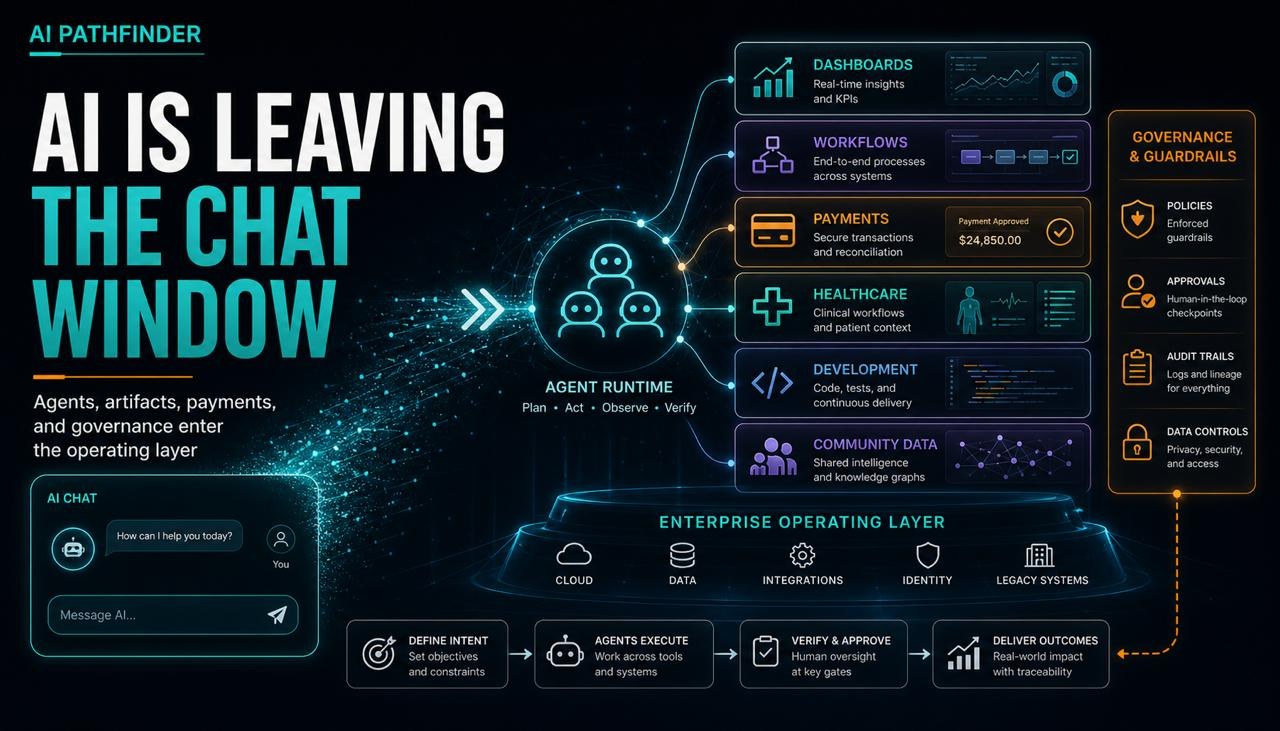
AI is moving from chatbots into agents, payments, dashboards, regulated workflows and governance. Here is what enterprise leaders should do next.
This week’s biggest AI stories all point in the same direction.
AI is no longer just a place where people ask questions.
It is becoming infrastructure.
It is building dashboards.
Writing code while you sleep.
Handling payments.
Pulling context from communities.
Entering healthcare systems.
Moving into regulated industries.
And, in Anthropic’s case, getting pulled offline by the U.S. government.
That is the real story.
Not one model.
Not one company.
Not one product launch.
The center of gravity is shifting from “AI that answers” to “AI that operates.”
Top AI Updates This Week
The most important AI story of the week was Anthropic.
On June 12, Anthropic said the U.S. government issued an export-control directive requiring the company to suspend access to Claude Fable 5 and Claude Mythos 5 for any foreign national, whether inside or outside the United States.
That included foreign-national Anthropic employees.
Anthropic said the practical result was that it had to disable both models for all customers to ensure compliance.
Fable 5 had launched only days earlier as Anthropic’s first generally available Mythos-class model. Mythos 5 was the restricted version, aimed at vetted cybersecurity and infrastructure partners through Project Glasswing.
Then the access went dark.
Anthropic said the government’s concern appeared to involve a narrow jailbreak technique that asked the model to read code and identify software flaws. Anthropic argued that the capability was not unique to Fable 5 and was already available in other public models.
But the government still moved.
That is the new reality.
Frontier AI access is no longer just a product decision.
It is a national security decision.
The Access Risk Problem
For enterprise leaders, the lesson is simple:
Availability you do not control is a dependency you cannot fully trust.
If your team wired Fable 5 into a production workflow on Monday, it was gone by Friday.
That does not mean companies should avoid frontier models.
It means they need a real model dependency strategy.
Which workflows depend on which models?
What happens if access is restricted?
What happens if a model gets pulled in one region?
What happens if export controls apply to employees, contractors, or customers?
What happens if your backup model behaves differently?
These are no longer theoretical questions.
They are operating questions.
Cyber Leaders Push Back
The Anthropic shutdown also triggered a backlash from cybersecurity leaders.
Axios reported that a group led by former Facebook security chief Alex Stamos urged the Trump administration to reverse the restrictions, arguing that the move hurts defenders more than attackers.
Their core argument is worth paying attention to:
If similar capabilities exist in other public models, blocking Fable 5 does not eliminate the risk.
It may just remove one of the best tools from the defenders trying to secure systems first.
That is the tension.
The same AI capability can help attackers find vulnerabilities.
It can also help defenders fix them.
The question is not whether the capability exists.
The question is who gets to use it, under what controls, and for what purpose.
OpenAI Buys The Agent Runtime
While Anthropic dealt with access restrictions, OpenAI moved deeper into agent infrastructure.
OpenAI announced plans to acquire Ona, a startup focused on secure, persistent environments for AI agents.
That matters because the next generation of agents will not just answer a prompt and disappear.
They will need environments.
Memory.
Tools.
Credentials.
Sandboxes.
Logs.
Approval flows.
The ability to continue working after you close your laptop.
TechRadar reported that Ona’s infrastructure is expected to strengthen Codex, which OpenAI is positioning beyond coding into broader long-running work.
That is the signal.
The agent war is becoming an infrastructure war.
The best model is not enough.
The agent needs a place to work.
Perplexity Computer Shows The Artifact Shift
The Perplexity Computer example fits directly into this pattern.
The interesting part was not that Computer answered a question.
It built a living artifact.
A dashboard.
A ranked list.
A prospecting system.
Something a user could act on.
That is the shift from chat to work product.
The old pattern was:
Ask a question.
Get a response.
Do the work yourself.
The new pattern is:
Describe the outcome.
Let the system research, structure, build, and render the artifact.
Then review and improve it.
That changes the job of the operator.
The bottleneck is no longer “Can I build the thing?”
The bottleneck becomes “Can I identify the right thing worth building?”
Meta’s Group Problem: Community Data Becomes Product Surface
The AI Report’s “Facebook AI pulls from Groups” story points to another shift:
AI systems are starting to turn community context into product context.
That is powerful.
It also gets messy fast.
Communities are full of lived experience, niche expertise, informal advice, edge cases, and real-time signals that normal search misses.
That makes them valuable input for AI.
But community content also carries consent, privacy, attribution, moderation, and trust problems.
If AI starts turning group conversations into answers, summaries, recommendations, or discovery surfaces, platforms need to be very clear about what is being used, how it is being represented, and who controls the context.
This is another example of AI leaving the chat window.
It is not just answering with web pages.
It is pulling from social layers.
That changes the governance conversation.
Visa Turns Agents Into Economic Actors
The other major signal came from Visa and OpenAI.
AP reported that Visa is embedding its payment network into ChatGPT so AI agents can recommend and complete purchases on behalf of users.
That is a big deal.
Because once agents can spend money, they stop being productivity tools and start becoming economic actors.
Visa says the system will include guardrails like spending limits, approval steps, approved merchants, tokenized credentials, and fraud monitoring.
That is exactly the right conversation.
Agentic commerce will not scale because people trust agents blindly.
It will scale when the payment, authorization, dispute, and audit layers are strong enough for people to delegate safely.
The agent does not just need intelligence.
It needs trust infrastructure.
The Fake AI Problem
AI Secret’s “Fake AI Beat Real AI” framing points to the other side of this shift.
As AI becomes infrastructure, imitation becomes a product strategy.
Some of the next wave will be real agentic systems.
Some will be thin wrappers.
Some will be humans behind the curtain.
Some will be automation dressed up as intelligence.
And some will be “AI” experiences that win not because they are technically superior, but because they are more convincing, better distributed, or easier to use.
That matters for operators.
The market will not only reward the most capable system.
It will reward the system that creates trust, reduces friction, and produces a useful output.
Sometimes fake AI beats real AI because the buyer does not actually care how the work got done.
They care whether the work got done.
That is why enterprise leaders need to evaluate outcomes, controls, and provenance instead of buying the label.
AI Enters Regulated Work
This week also showed AI moving deeper into regulated industries.
Anthropic announced a partnership with Tata Consultancy Services. TCS will provide Claude to 50,000 employees across 56 countries and build Claude-powered products for clients in financial services, healthcare, public services, aviation, telecom, life sciences, and other regulated sectors.
That is not a casual software rollout.
That is enterprise distribution.
TCS is not just using Claude internally. It is packaging Claude into industry-specific offerings like insurance claims processing and banking lending advisory.
At the same time, NHS England is expanding Microsoft 365 Copilot to 505,000 staff after a 30,000-worker pilot. TechRadar reported that the pilot saved users an average of 43 minutes per day.
That is what mainstream AI adoption looks like.
Not a viral chatbot.
A half-million-person workflow rollout.
Administrative work.
Clinical support.
Document creation.
Summarization.
Information retrieval.
Agent building through Copilot Studio.
This is where AI starts to become organizational infrastructure.
Accountability Is Catching Up
The final story is accountability.
OpenAI is reportedly facing a multistate attorneys general investigation focused on user safety, data handling, minors, seniors, engagement, health data, and model behavior.
Separately, a Mississippi federal judge sanctioned four attorneys after AI-generated hallucinated citations appeared in legal filings. Two lawyers were barred from practicing before the court for two years, and all four were removed from the case.
The message is clear:
AI use does not remove human responsibility.
If the model lies and you file it, that is still on you.
If the model recommends harm and your system lacks safeguards, regulators will ask why.
If the model touches health, finance, legal, security, or public-sector workflows, “the AI did it” is not a defense.
It is an admission that your operating model was incomplete.
Why This Matters
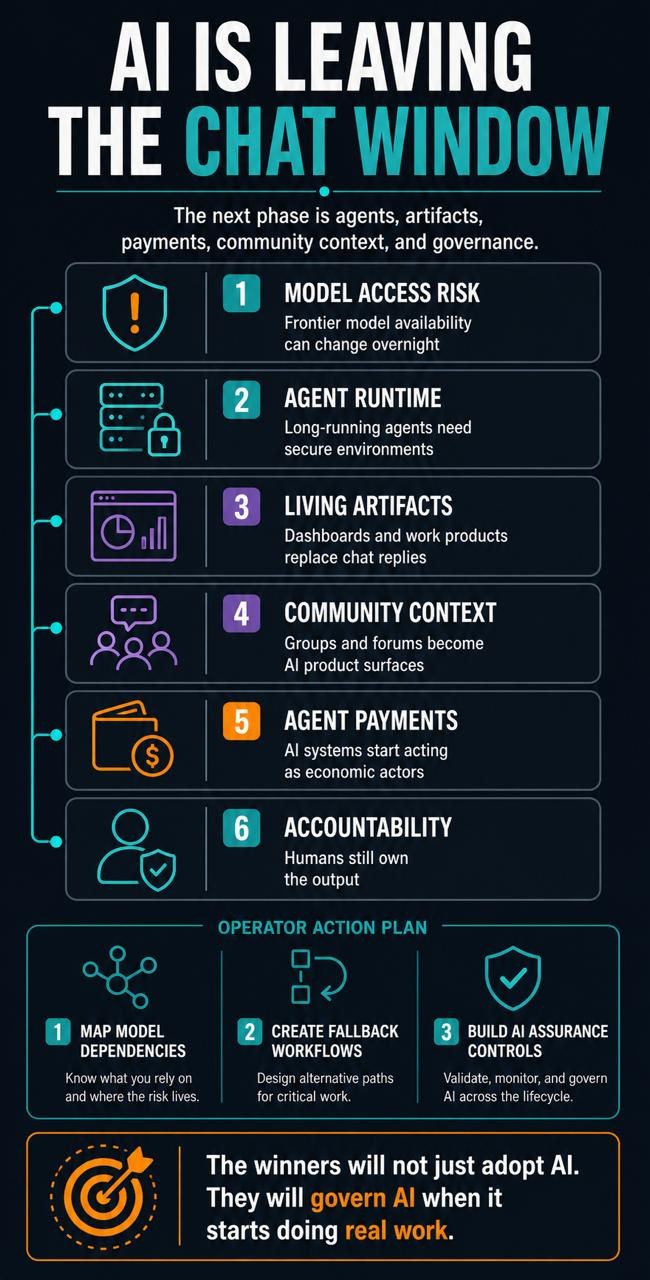
Put the stories together: Anthropic shows frontier model access can disappear overnight.
OpenAI shows agents need persistent infrastructure.
Perplexity shows the output is becoming a living artifact.
Meta shows community data is becoming an AI surface.
Visa shows agents are entering payments.
TCS and NHS show regulated industries are moving at scale.
OpenAI and the legal sanctions show accountability is catching up.
AI Secret’s framing reminds us that the market will also be flooded with convincing imitations.
That is the new AI market.
Not chatbots.
Operating systems.
Not prompts.
Workflows.
Not answers.
Actions.
Not adoption.
Governance.
The companies that win from here will not simply be the ones with the most AI tools.
They will be the ones that build the operating model around them.
Your AI Action Plan
Here is what I would do this week.
Map your model dependencies.
List every AI model used across your organization, what workflow it supports, what data it touches, and what happens if access changes.
Build fallback paths.
Do not let one frontier model become a single point of failure. Define backup models, backup workflows, and manual fallback steps.
Move from prompts to artifacts.
Look for workflows where AI can produce a usable work product: dashboards, reports, prospect lists, code changes, briefs, research memos, or operational plans.
Add controls before agents spend or act.
If agents can make purchases, update records, trigger workflows, or touch production systems, they need permissions, limits, approvals, logs, and rollback paths.
Treat community data as sensitive context.
If your AI pulls from forums, groups, reviews, Slack, Teams, or internal communities, define consent, attribution, privacy, and moderation policies before scaling.
Evaluate the work, not the AI label.
Some products will be real agents. Some will be wrappers. Some will be humans plus automation. Measure outcomes, provenance, controls, and reliability.
Treat regulated workflows differently.
Healthcare, finance, legal, security, and public-sector workflows need stronger review, validation, and auditability than everyday productivity tasks.
Train people on accountability.
The human owner still owns the output. Every AI-assisted workflow needs a clear reviewer, escalation path, and verification standard.
Your Bottom Line
AI is leaving the chat window.
It is entering the operating layer of the enterprise.
That creates leverage.
It also creates dependency.
The next phase will not be won by the companies that simply buy more AI.
It will be won by the companies that know how to govern AI when it starts doing real work.
Agents need infrastructure.
Models need fallback plans.
Payments need trust rails.
Community data needs policy.
Regulated work needs auditability.
Legal work needs verification.
Enterprise AI needs an operating model.
That is the lesson from this week.
Keep moving forward.
About Jason Fleagle
Jason Fleagle is the Head of AI for Netsync and an AI and Growth Consultant working with global brands to help with their successful AI adoption and management. He helps humanize data — so every growth decision an organization makes is rooted in clarity, not confusion. He has overseen the development and delivery of over $50M in digital solutions, driving significant revenue growth and operational efficiency for his clients.
Connect with Jason on LinkedIn to stay updated on the latest in AI, growth strategies, and enterprise technology.
Additional internal reading
- Cisco Live 2026: AgenticOps Has Arrived
- AI Just Hit the Guardrails: The Week Frontier AI Became Regulated
- AI Model Evaluation for Business
- AI Governance Checklist
- AI Agent Use Case Library
- Human-in-the-Loop AI Governance
- Prompt Injection Risk for Business Leaders
- Microsoft Copilot Governance
References
- Anthropic: Statement on the US government directive to suspend access to Fable 5 and Mythos 5
- Axios: Cybersecurity leaders push Trump administration to restore Anthropic access
- Anthropic: TCS and Anthropic partner to bring Claude to regulated industries
- TechRadar: OpenAI plans to acquire Ona to strengthen Codex cloud capabilities
- AP: Visa plugs its payment network into ChatGPT
- TechRadar: Microsoft rolls out Copilot to over half a million NHS England staff
- AP: OpenAI hit with multistate probe into possible user harm
- Business Insider: Judges are losing patience with lawyers’ AI mistakes
- AI Secret: Fake AI Beat Real AI
- The AI Report: Facebook AI pulls from Groups
Originally published as an AI Pathfinder article on LinkedIn. This version includes additional internal links and review paths for enterprise AI leaders.
About AI Pathfinder
AI Pathfinder is Jason Fleagle’s recurring field note on enterprise AI, agentic systems, AI governance, and the operating models leaders need as AI moves from experiments into real work.