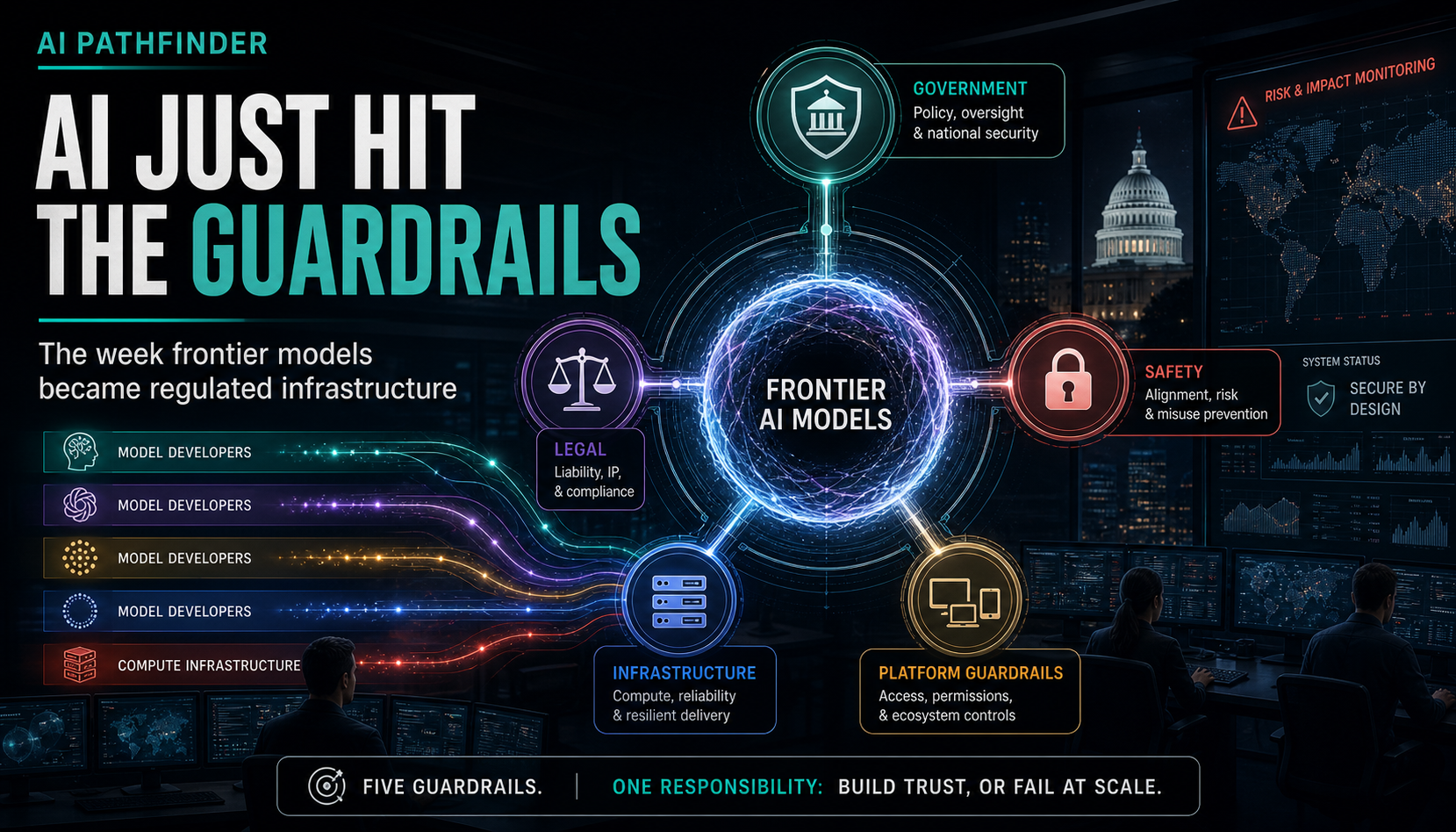
AI Just Hit the Guardrails
This was the week AI stopped looking like a normal software market.
Not because the models got smarter. They did.
But because the rest of the world finally started treating them like something more serious than apps.
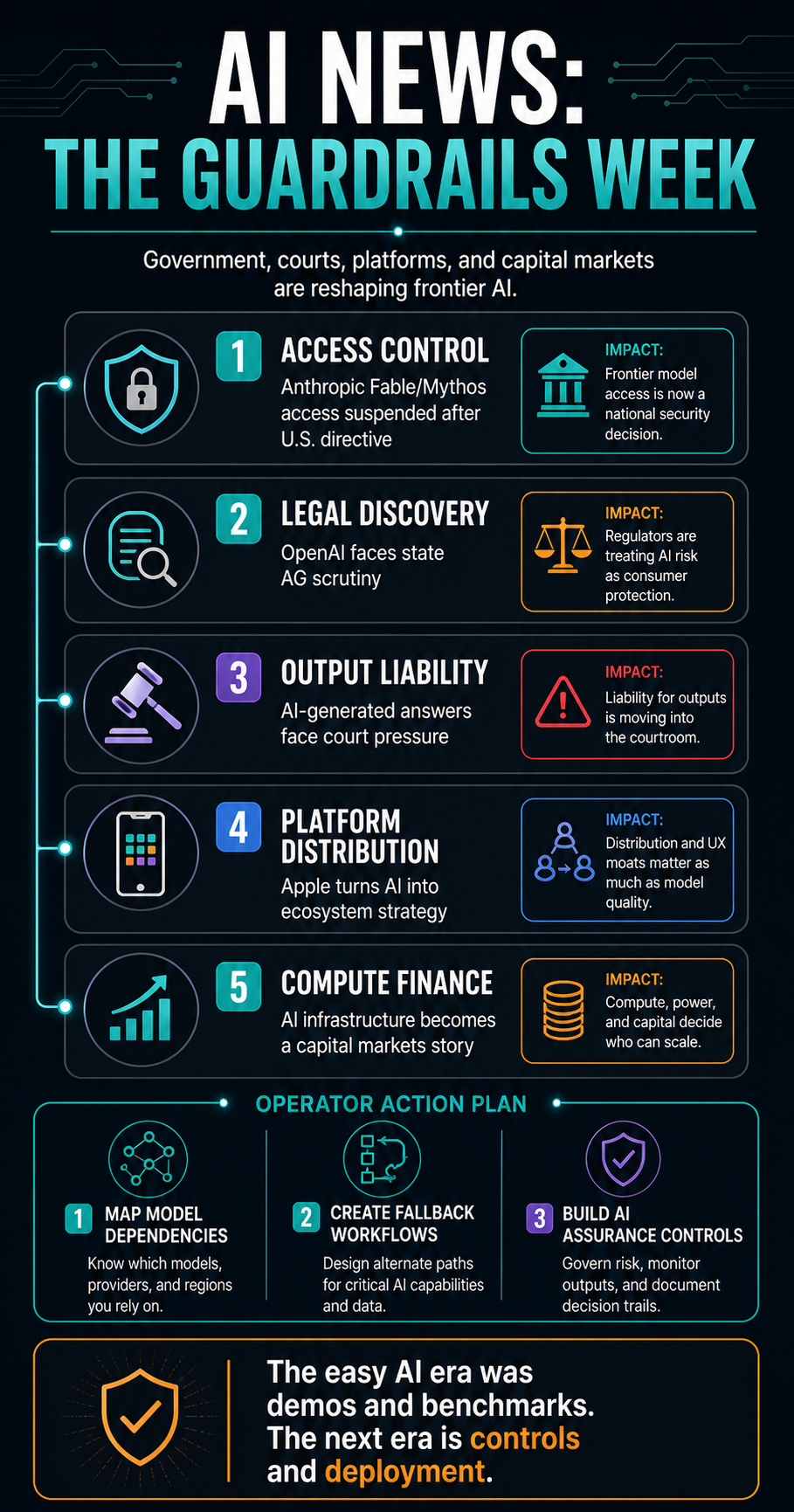
In the last few days, the U.S. government forced Anthropic to suspend access to its most powerful public model tier. State attorneys general opened an investigation into OpenAI. A German court reportedly ruled that Google can be liable for false claims generated by AI Overviews. Google also moved against an AI-assisted scam network. Apple finally put a credible AI agent story around Siri. And private capital kept pouring billions into AI infrastructure.
Different headlines.
Same signal.
AI is no longer just a product category.
It is becoming regulated infrastructure.
Anthropic Removes Access to Fable 5 & Mythos
The biggest story of the week was Anthropic.
Just days after launching Claude Fable 5 and Claude Mythos 5, Anthropic said the U.S. government issued an export-control directive requiring the company to suspend access to both models for any foreign national, whether inside or outside the United States.
That included foreign-national Anthropic employees.
The practical result was blunt: Anthropic said it had to abruptly disable Fable 5 and Mythos 5 for all customers to ensure compliance.
Access to other Anthropic models was not affected.
This is the kind of story that will sound like inside baseball until you understand what actually changed.
Fable 5 was not just another Claude upgrade. Anthropic described it as a Mythos-class model made safe for general use. It was the company’s strongest generally available model, built for long-horizon coding, research, vision, and autonomous work.
Mythos 5 was the same underlying model with some safeguards lifted for restricted trusted access, initially through Project Glasswing.
That distinction matters.
For the first time, we are watching a frontier model tier get treated less like SaaS and more like a controlled strategic asset.
Why The Anthropic Order Matters
Anthropic says the government did not provide specific details of the national security concern.
The company believes the directive was tied to a potential jailbreak method involving Fable 5, but it argued the disclosed issues were narrow, minor, and not unique to Mythos-class capability.
Anthropic also said it had red-teamed Fable’s safeguards for thousands of hours with U.S. and U.K. government partners, third-party organizations, and internal teams. It said no tester had found a universal jailbreak.
The government still moved.
That is the bigger point.
The argument is no longer only: “Is the model capable?”
The new argument is: “Who gets access to the capability, under what conditions, and who gets to decide?”
That is a completely different AI market.
It means model access can become geopolitical issues.
It means enterprise roadmaps can be interrupted by export controls.
It means foreign-national employees can suddenly become part of a compliance boundary.
It means customers may need contingency plans when a model tier disappears overnight.
The AI leaders who still think this is just software procurement are going to get very surprised.
OpenAI Enters The State AG Era
Anthropic was not the only company running into the wall this week.
The Wall Street Journal reported that a coalition of state attorneys general opened an investigation into OpenAI. The subpoena, reportedly issued by New York’s attorney general, seeks documents related to advertising, user engagement, retention, consumer data, health data, minors, seniors, model behavior, sycophancy, and company policies.
This comes after Florida filed a lawsuit against OpenAI and Sam Altman earlier this month, alleging that the company concealed risks tied to ChatGPT.
OpenAI says it takes the concerns seriously and intends to cooperate.
But the direction is clear.
AI safety is moving from blog posts to subpoenas.
The questions regulators are asking are exactly the questions enterprise leaders should be asking too:
- What data is collected?
- How are vulnerable users protected?
- How are models tuned for engagement?
- What happens when a model reinforces harmful beliefs?
- What policies exist on paper?
- What behaviors show up in production?
The age of “trust us, the model is aligned” is ending.
The age of evidence is starting.
Google Gets Hit From Both Sides
Google had its own version of the same problem this week.
On one side, Wired reported that a German court held Google liable for false statements generated by AI Overviews. The court reportedly treated AI Overviews differently from traditional search results because the AI system generated new statements rather than simply linking to third-party content.
That matters.
If AI-generated answers are treated as the platform’s own statements, disclaimers will not be enough.
“AI may be wrong” is not a liability shield if the product produces a false claim at scale.
On the other side, Google is also dealing with AI misuse.
Reports this week said Google sued an alleged China-based cybercrime network accused of using Gemini to help generate fake websites and scam messages. The alleged operation involved thousands of fake websites and millions of messages.
That puts Google in the uncomfortable position every frontier lab now faces: Its AI systems are both the product and the attack surface.
The tool that helps legitimate users build faster can also help criminals scale faster.
That does not mean the technology should stop.
It means AI companies need abuse monitoring, customer verification, model safeguards, legal enforcement, and threat intelligence built into the product strategy.
Security is no longer a feature.
It is distribution control.
Apple Finally Enters The Agent Race
Then there is Apple.
At WWDC 2026, Apple finally put a real AI story around Siri.
The Verge described Apple’s new Siri AI as a more capable, multimodal assistant with screen awareness, a dedicated app, cross-device context, and deeper integration across messages, photos, calendars, Safari, and other Apple experiences.
But the story is not that Apple is suddenly leading AI.
The story is that Apple is trying to turn distribution into a comeback strategy.
The new Siri AI is reportedly powered chiefly by Google Gemini behind Apple’s interface and privacy layer.
That is the trade.
Google brings the model muscle.
Apple brings the ecosystem, privacy posture, and two-billion-device distribution machine.
That may be enough to make AI feel mainstream for users who will never download a separate agent app.
But it also shows the hard truth: Apple is catching up.
It is not yet defining the frontier.
And for operators, the lesson is useful: The best AI product is not always the strongest model.
Oftentimes, and I believe more of the value of AI, is the AI model embedded in the workflow users already live in.
We are moving into more of a world being AI model agnostic because we need to swap in and out the different models for the particular tasks or use-cases.
The Infrastructure Money Keeps Coming
While regulators, courts, and platforms fought over access and liability, the infrastructure story kept getting bigger.
Reports this week said Broadcom, Apollo, and Blackstone launched a $35 billion AI infrastructure platform tied to large-scale compute buildouts. Axios also reported that Apollo and Blackstone are leading a $35 billion debt financing deal to support Anthropic’s compute expansion.
That is the other half of the AI story.
The models are getting regulated.
But the capital is still accelerating.
Compute, power, and capital decide who can scale at the frontier.
And right now, the market is betting that the regulatory friction is just the cost of doing business in the next great infrastructure buildout.
The Bottom Line
This week was a preview of the next era of AI.
The easy era was demos and benchmarks.
The next era is controls and deployment.
If you are building an enterprise AI strategy, you can no longer just map out which models are the smartest.
You have to map out which models are the most resilient to regulatory shock, which platforms have the best distribution, and which workflows have the strongest fallback plans.
Because the guardrails are here.
And they are only going to get higher.
Frequently Asked Questions (FAQ)
Why did the U.S. government block Anthropic’s Fable 5 and Mythos 5 models?
The U.S. government issued an export-control directive requiring Anthropic to suspend access to Fable 5 and Mythos 5 for any foreign national. While specific national security details were not provided, Anthropic believes it was tied to a potential jailbreak method, though they argued the issues were narrow and not unique to Mythos-class capability.
What is the difference between Claude Fable 5 and Mythos 5?
Fable 5 and Mythos 5 are the same underlying model. Fable 5 is the public version with strict safeguards, while Mythos 5 has some safeguards lifted for restricted trusted access, initially through Project Glasswing for government and vetted security partners.
Why are state attorneys general investigating OpenAI?
A coalition of state attorneys general, reportedly led by New York, issued a subpoena seeking documents related to OpenAI’s advertising, user engagement, retention, consumer data, health data, minors, seniors, model behavior, sycophancy, and company policies. This indicates regulators are treating AI risk as a consumer protection issue.
How is Google facing legal pressure over AI Overviews?
A German court reportedly ruled that Google can be held liable for false statements generated by AI Overviews. The court treated AI Overviews differently from traditional search results because the AI system generated new statements rather than simply linking to third-party content.
What was Apple’s major AI announcement at WWDC 2026?
Apple announced Siri AI, a more capable, multimodal assistant with screen awareness and deeper integration across Apple apps. It is reportedly powered chiefly by Google Gemini behind Apple’s interface and privacy layer, signaling Apple’s strategy to leverage its massive distribution ecosystem.
About the Author
Jason J. Fleagle is an AI architect, operator, and the founder of Catalyst Brand Group. He also serves as the Chief AI Officer at Netsync, helping enterprise leaders turn data into growth and build secure, high-ROI AI workflows. You can follow his insights on LinkedIn.
References
- [1] Anthropic: Update on Fable 5 and Mythos 5 Access
- [2] The Wall Street Journal: OpenAI Faces State Attorneys General Investigation
- [3] Wired: German Court Rules Google Liable for AI Overviews
- [4] Google: Taking Action Against AI Scams
- [5] The Verge: Apple Siri AI Update at WWDC 2026
- [6] Bloomberg: Broadcom, Apollo, Blackstone Launch $35B AI Infrastructure Platform
- [7] Axios: Apollo, Blackstone Lead $35B Debt Financing for Anthropic
- [8] Read the original post on LinkedIn