
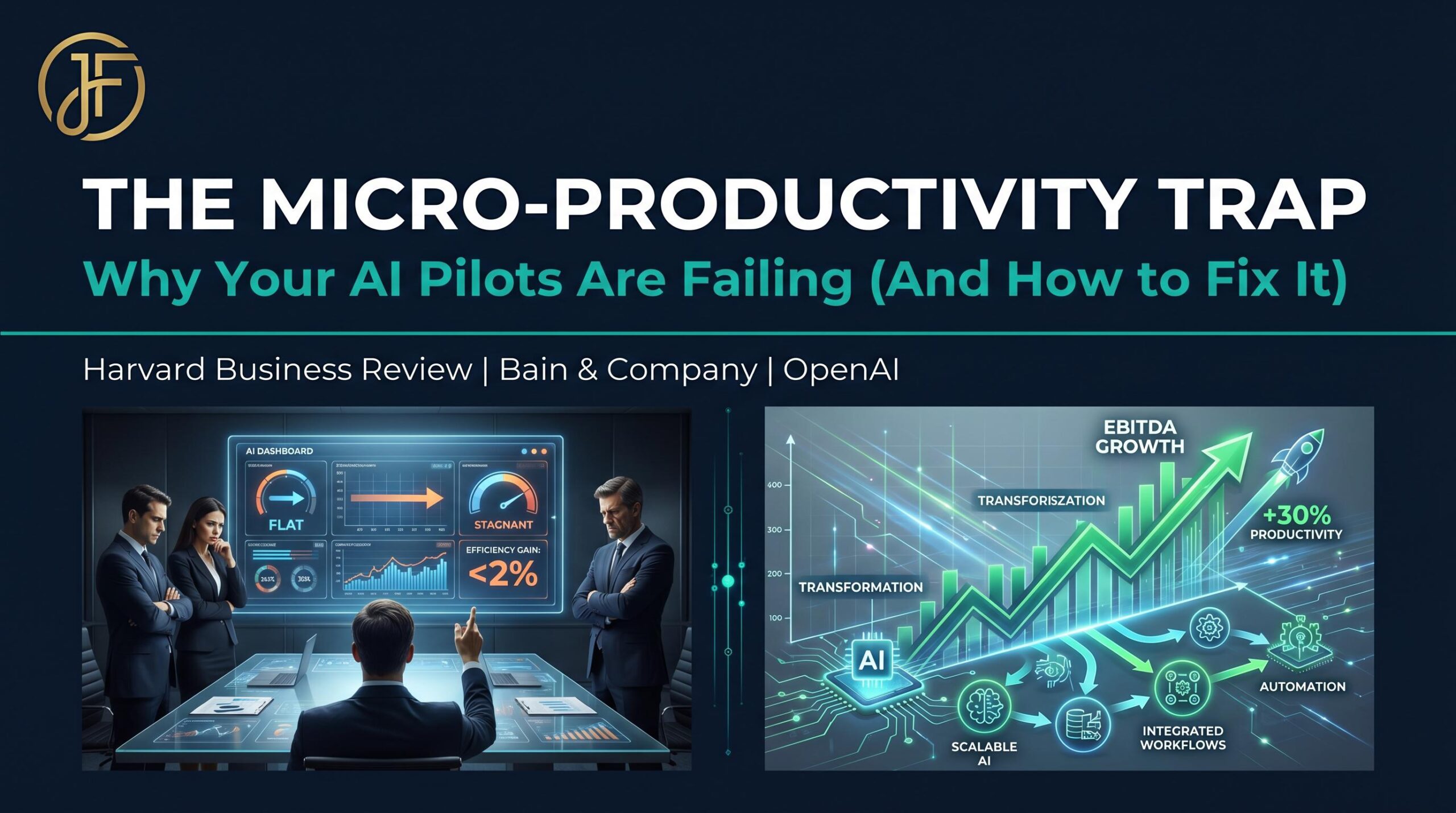
You have run the pilots. You have bought the licenses. Your team is using AI every day.
So why is none of it showing up on the P&L?
Harvard Business Review, Bain & Company, and OpenAI’s Chief Economist just published a joint piece that names the disease most enterprise AI programs have — but nobody is calling out.
It is called the micro-productivity trap.
Here is a clear framework for why enterprise AI programs fail, what the companies succeeding are doing differently, and how to move your organization from AI experimentation to AI transformation.
The Diagnosis: What the Trap Actually Is
According to the HBR piece, companies fall into the micro-productivity trap when they treat AI like a plug-and-play SaaS investment — isolated use cases, scattershot pilots, and task-level optimization without rethinking workflows or value propositions.
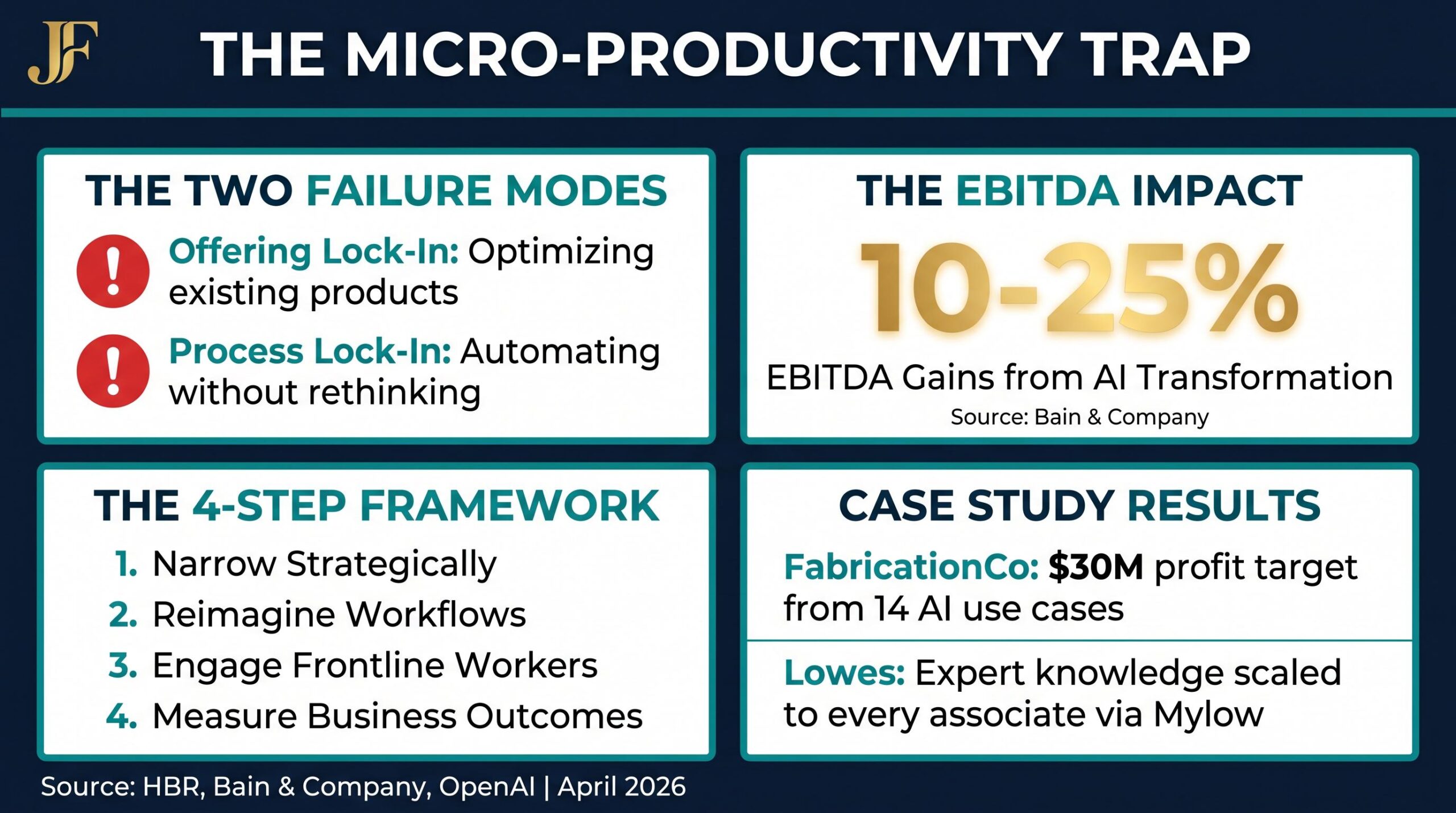
This manifests in two specific failure modes:
- Offering lock-in: Using AI to optimize existing offerings instead of reimagining the core value proposition.
- Process lock-in: Automating current processes without rethinking them.
The result is a dangerous illusion of progress. Individuals realize productivity gains on key tasks, but those gains stall at the firm level. Why? Because the surrounding workflow still depends on tacit knowledge, manual handoffs, or legacy systems not built for AI.
AI can accelerate a task, but unless you address the workflow bottlenecks, productivity gains will never translate into business value.
The Stat That Should Wake Up Every Leader
The companies that escape the trap do not just see incremental improvements. They see structural financial shifts.
According to the article, Bain’s clients that have embraced true AI transformation are experiencing 10–25% EBITDA gains, which continue to increase as the programs scale. That is not just a productivity improvement — it is an entire business transformation.
| AI Approach | Typical Outcome | P&L Impact |
|---|---|---|
| Isolated pilots / task automation | Individual time savings | Minimal to none |
| Workflow redesign + AI integration | Cross-functional efficiency gains | Moderate improvement |
| Full AI transformation (4-step framework) | Structural business model shift | 10–25% EBITDA gains (Bain) |
The 4-Step Framework: How to Escape the Trap
To move from “improve the task” to “reinvent the business,” the HBR authors outline four steps taken by every successful AI transformation program.
Step 1: Narrow Possibilities Strategically
Resist the urge to spread AI everywhere. Identify four or five critical business domains and concentrate your transformation efforts there. The top domains across Bain’s client work are software development, customer support, knowledge worker efficiency, and marketing.
Case Study: FabricationCo
A Fortune 1000 manufacturer assembled a team of frontline operators and managers for a week-long cross-functional workshop focused on AI use case discovery. They mapped workflows end-to-end and surfaced 14 discrete AI use cases representing tens of millions of dollars in potential value. By focusing on this small subset, they are now on track to realize approximately $30M in additional profit.
Step 2: Reimagine Workflows Across the Organization
Process redesign — not the technology — is the most challenging part of AI deployment, and it often creates the most value. You must consider the full scope of work across the company, not just department silos. Successful AI really comes down to balancing people, processes, and technologies effectively.
Case Study: Lowe’s
Lowe’s focused on their core value: helping customers complete projects. They realized expertise was bottlenecked. Instead of just automating tasks, they rebuilt the workflow to democratize expertise. They launched Mylow (for online visitors) and Mylow Companion (for in-store associates), scaling expert home improvement knowledge across the entire organization.
Step 3: Engage Those Closest to Today’s Process to Lead Change
The people who do the work know where the real bottlenecks are. Frontline workers must be the most important change agents, not just recipients of change. This creates ownership, reduces resistance, and surfaces insights that leadership alone would miss. The data, context, and how it gets integrated into AI workloads is crucial to the successful outcomes for any AI project.
Step 4: Select the Right Measures of Success
Most companies measure AI success at the task level — time saved, prompts used, licenses activated. Transformative companies measure at the business outcome level: EBITDA, revenue, customer satisfaction, and cycle time. The wrong metrics create the micro-productivity trap because you optimize for what you measure.
| Wrong Metrics (Vanity) | Right Metrics (Business Outcomes) |
|---|---|
| Prompts used per week | Revenue impact per workflow |
| AI licenses activated | EBITDA improvement |
| Time saved on tasks | Cycle time reduction |
| Pilot completion rate | Customer satisfaction improvement |
| Features deployed | Cost reduction per process |
The Operator’s Perspective
This HBR article is essentially a blueprint for what separates AI consultants who deliver ROI from those who just deliver slide decks and talk about AI.
The four steps map directly to the consulting motion we use at NetSync for working with customers to execute a successful AI deployment:
- Narrow: AI use case discovery workshop and roadmap.
- Reimagine: Workflow redesign — not just automation — with an AI solution recommendation.
- Engage: Frontline-led change management, creating the hardware, software, and services that will get you the results you want.
- Measure: After deployment, focus on ongoing management to get valuable business outcomes, not vanity metrics, and continue innovating for the future.
If your AI program is not showing up on the P&L, it is time to stop optimizing tasks and start reinventing workflows.
Your AI Transformation Action Plan
Here are three steps you can take this week to escape the micro-productivity trap:
- Diagnose your trap: Are you suffering from offering lock-in or process lock-in? Look at your current AI pilots and ask honestly whether they are just speeding up old processes.
- Run a discovery session: Schedule a one-day cross-functional AI discovery session. Put frontline workers and key decision-makers in the same room. If you need a starting point, reach out to the NetSync team for a discovery meeting.
- Pick one workflow to reinvent: Do not try to boil the ocean. Pick one cross-functional workflow and redesign it from the ground up, assuming AI is part of the operating model.
Is your AI program optimizing tasks — or reinventing your business?
Related AI Pathfinder Articles
If you found this valuable, these related issues from the AI Pathfinder series go deeper on the tools and infrastructure powering AI transformation in 2026:
- Issue #52: GPT-5.5 — Is This the New Leading AI Model?
- Issue #53: DeepSeek V4 — The Open-Source AI Leader?
- Issue #54: The Great AI Realignment — Microsoft, OpenAI & the Geopolitical Firewall
- Issue #55: OpenAI on AWS — GPT-5.5, Codex & AI Agents on Bedrock
Frequently Asked Questions
What is the micro-productivity trap in AI?
The micro-productivity trap is when companies use AI to speed up individual tasks without rethinking the underlying workflows or business model. Individuals see gains, but the firm’s P&L does not improve. It was identified by Bain & Company and OpenAI’s Chief Economist in a joint Harvard Business Review article published in April 2026.
Why are enterprise AI pilots failing?
Most enterprise AI pilots fail because they optimize existing broken processes rather than redesigning them. They suffer from offering lock-in (optimizing existing products) or process lock-in (automating without rethinking). The result is activity that looks like progress but does not move the business forward.
What EBITDA gains can companies expect from AI transformation?
According to Bain & Company’s research cited in the HBR article, companies that have moved beyond isolated AI pilots to full AI transformation are seeing 10–25% EBITDA gains, with those gains continuing to increase as programs scale.
What is the 4-step framework for AI transformation?
The four steps are: (1) Narrow Possibilities Strategically — focus on 4–5 critical domains; (2) Reimagine Workflows — redesign processes, do not just automate them; (3) Engage Frontline Workers — make them change agents, not just recipients; and (4) Measure Business Outcomes — track EBITDA, revenue, and cycle time, not just tasks saved.
How do I start an AI transformation at my company?
Start with a cross-functional AI use case discovery session. Map your highest-value workflows end-to-end. Identify where value is leaking and where AI can change the economics of the business. Then pick one workflow to redesign from the ground up — not automate, but redesign. NetSync offers discovery workshops and AI roadmap services to help organizations do exactly this.
References
- How to Move from AI Experimentation to AI Transformation — Harvard Business Review, April 2026
- Why Internal & External AI Pilots Are Failing for Teams (And How to Fix It) — Jason J. Fleagle, LinkedIn, April 30, 2026
- NetSync — AI Solutions and Enterprise Technology
About Jason Fleagle
Jason Fleagle is the Head of AI for NetSync and an AI and Growth Consultant working with global brands to help with their successful AI adoption and management. He helps humanize data — so every growth decision an organization makes is rooted in clarity and confidence. Jason has helped lead the development and delivery of over 500 AI projects and tools, and frequently conducts training workshops to help companies understand and adopt AI.