
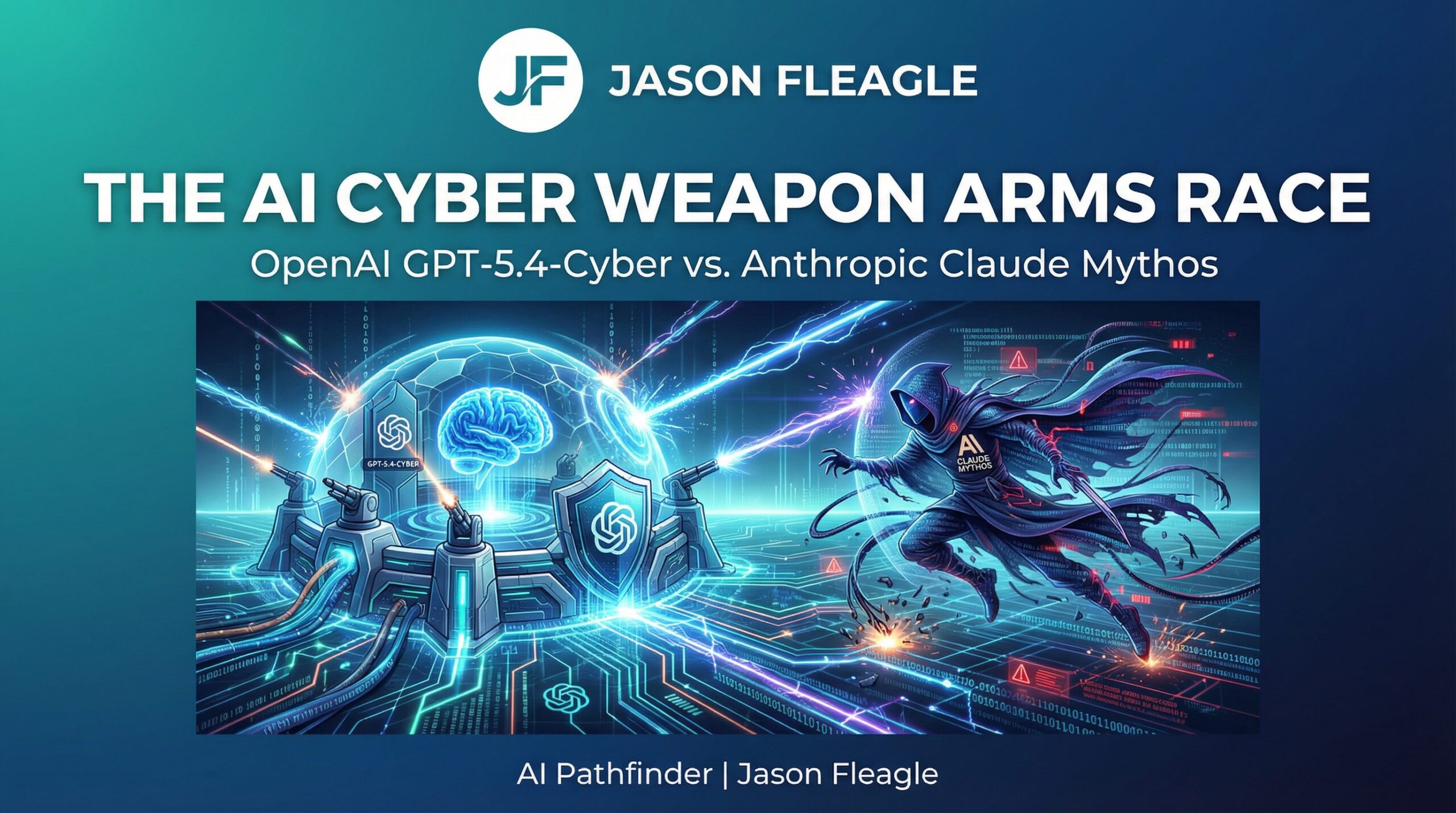
Most of the AI conversation still sounds like it is about chatbots, copilots, and productivity.
That is not where this is going.
This week, OpenAI introduced GPT-5.4-Cyber, a variant of its flagship model optimized for cybersecurity use cases and rolled out through its Trusted Access for Cyber program.
On the surface, the framing is defensive.
The stated goal is to help security teams find and fix vulnerabilities faster, improve secure coding workflows, and give authenticated defenders better tools to reduce risk earlier in the software lifecycle.
That is the official story.
But the more important story is strategic.
This looks a lot like OpenAI’s answer to Anthropic’s Mythos preview.
Anthropic signaled where the frontier was heading: models capable of identifying serious vulnerabilities across real software environments.
OpenAI is now signaling something slightly different: not just frontier capability, but operational deployment into cyber workflows.
That matters.
Because once a frontier model can reliably identify, validate, and help remediate vulnerabilities inside real environments, the line between defensive cyber capability and offensive cyber capability gets very thin.
That is the threshold we are crossing.
There is a temptation to read GPT-5.4-Cyber as just another AI product extension.
That would be a mistake.
This is a sign that frontier labs now see cyber operations as a primary deployment lane.
OpenAI is not merely saying, “our model can reason about security.”
It is saying, in effect, that frontier AI should sit inside the workflows responsible for identifying and reducing real software risk.
That is a much bigger claim.
Because once AI enters a live cyber workflow, the question changes.
It is no longer only:
- Can the model assist a human analyst?
It becomes:
- How fast can a system identify, prioritize, and reduce vulnerabilities?
- How much of that loop can be compressed?
- How much of that loop becomes machine-speed?
That is why the Mythos comparison matters.
Anthropic’s preview was a strong signal that frontier cyber capability was arriving.
OpenAI’s move suggests the rollout into practical defender workflows is already underway.
The dual-use problem is no longer theoretical
Cybersecurity has always been a dual-use domain.
The same knowledge used to harden systems can be used to break them.
The same testing approach that helps defenders can help attackers.
The same workflow used to find vulnerabilities before release can be inverted to find them before defenders can patch them.
OpenAI effectively acknowledges this in its own framing.
That is what makes this release important.
This is not simply a model built to help defenders, but more of a public sign that frontier AI can now sit near the boundary where defense and offense start to blur.
Even if the rollout is constrained, even if the intention is defensive, the strategic implication remains the same: advanced cyber capability is becoming more automatable.
And once that happens, the economics change.
Vulnerability discovery accelerates.
Exploit hypotheses can be generated faster.
Defensive triage has to compress.
Patch windows matter more.
The advantage of slow, manual defense shrinks.
That is a BIG shift.
The defender’s problem is changing
For years, the defensive instinct was straightforward:
- build higher walls
- add more tooling
- add more controls
- add more alerts
- add more analysts
That model was already under stress.
Now it becomes even harder to sustain.
If offensive capability becomes partially automated, persistent, and cheap to scale, then human-speed defense becomes even less viable.
That does not eliminate the need for human judgment.
It raises the bar for what the human team has to orchestrate.
Security teams are moving into an environment where:
- reconnaissance can speed up
- vulnerability discovery can speed up
- remediation suggestions can appear instantly
- attack and defense cycles both compress toward machine speed
That is why this release matters beyond security marketing.
It is another sign that cyber is becoming an AI-speed domain.
This may be OpenAI’s real answer to Mythos
The easiest way to think about this release is as a product story.
The more useful way to think about it is as a strategic response.
Anthropic’s Mythos preview raised the stakes by showing that frontier AI was moving toward serious vulnerability research.
OpenAI’s GPT-5.4-Cyber suggests that the next move is not just who has the more impressive cyber model.
It is who becomes the operating layer inside real security workflows.
That is a very different race.
The competition is no longer only about benchmark performance.
It is about workflow insertion.
It is about trust.
It is about access.
It is about which lab becomes embedded in how defenders actually work.
That is the more commercially and strategically important contest.
What smart organizations should do now
The wrong reaction is panic.
The second wrong reaction is complacency.
The right reaction is to understand what kind of transition this really is.
Organizations should now be asking:
- Where are we still relying on purely human-speed vulnerability triage?
- How quickly can we validate, prioritize, and remediate discovered weaknesses?
- What parts of the security workflow should become more autonomous?
- What controls need to exist before AI systems participate more deeply in those loops?
- If attackers gain AI leverage first, where are we most exposed?
This is where a lot of teams will underestimate what is happening.
The challenge is not only whether AI can help defenders.
It is whether defenders can operationalize AI quickly enough to keep pace with what adversaries will inevitably do with similar capabilities.
That is the real race.
The strategic focus is shifting
The old mental model was higher walls.
The emerging model is faster, more adaptive, more autonomous defense.
That does not mean controls stop mattering.
It means static defense loses relative advantage in a world where both discovery and exploitation cycles accelerate.
The organizations that will hold up best in this next phase will not just be the ones with stronger controls.
They will be the ones that can:
- detect faster
- validate faster
- patch faster
- recover faster
- and eventually deploy trusted AI defenders that can operate at the speed this new environment requires
That is the real meaning of GPT-5.4-Cyber — a signal that AI vs. AI cyber operations are moving from theory into infrastructure.
And that changes the game.
Final question
If Anthropic’s Mythos preview was the warning shot, GPT-5.4-Cyber looks like OpenAI’s first real move onto the field.
The real question is not whether this trend is coming, but whether defenders will be ready before attackers are.
Given that reality, is cyber strategy now shifting from building higher walls to building faster, more autonomous defenders that can match offensive pace?
Let me know in the comments, and please remember to like, comment, and share/repost this if you found it valuable.
About the Author
I’m Jason Fleagle — an AI architect + operator and the founder of Netsync and Catalyst Brand Group. I run a consulting agency that blends AI software development, digital marketing, and automation. I’m focused on revenue-first, real-world deployments (not “AI science projects”), and I’m building products like Growth OS and Personify.
If you want to build AI systems that actually drive revenue and operational leverage, let’s talk.