
Let’s be honest. The AI model leaderboard is getting boring, or at least hard to follow and keep up with the tiny incremental changes.
For the last year, it’s been a predictable heavyweight title fight: OpenAI lands a jab, Anthropic counters with a hook, Google throws a body blow. The specs get bigger, the prices get adjusted, but the fundamental game remains the same: massive, human-trained models competing on the same handful of benchmarks.
While we were all watching the main event, a new contender just walked into the ring and quietly changed the rules. That contender is MiniMax, and their new M2.7 model isn’t just another competitor — it’s a glimpse into the next era of AI development.
It’s a model that helps build itself.
This is a production model, available now, that handled 30–50% of its own reinforcement learning and development workflow. It autonomously analyzed failure trajectories, planned code modifications, and optimized its own performance over hundreds of iterative loops. [1]
If your AI strategy is still about picking the best model off a static leaderboard, you’re about to be lapped. The new race is about leveraging models that can compound and improve themselves. This is the real beginning of the agentic economy.
Here’s the breakdown of what MiniMax M2.7 is, why it matters, and what you need to do about it.
Pillar 1: The Self-Evolving Engineer
The headline feature of M2.7 is its role in its own creation. MiniMax didn’t just automate a few CI/CD pipelines; they built a research agent harness where the model itself was the lead engineer. It was responsible for managing data pipelines, provisioning and structuring the data for its own training runs. It set up and configured the infrastructure for reinforcement learning. And it autonomously read logs, identified bugs in the training process, and wrote the code to fix them — over 100 rounds of self-optimization.
On the MLE Bench Lite, a series of machine learning competitions designed to test these autonomous research skills, M2.7 achieved a medal rate of 66.6%, tying with Google’s new Gemini 3.1 and approaching the state-of-the-art set by Anthropic’s Claude Opus 4.6. [1]
Why it matters: This is the first commercial example of a recursive self-improvement loop at scale. It’s a force multiplier. While other labs are spending human capital on the tedious work of RLHF and infrastructure management, MiniMax has built a system where the model itself shoulders a significant portion of that load. This accelerates the development cycle exponentially — and it sets a new benchmark for what “AI-assisted AI development” actually means in production.
Pillar 2: The Agentic Powerhouse
A self-improving model is a great story, but it’s useless without raw performance. M2.7 delivers, and it’s specifically tuned for the agentic workloads that matter in the real world.
It’s not built to be a better chatbot. It’s built to be a better thinker and doer. Take a look at some of these benchmarks and why they matter.
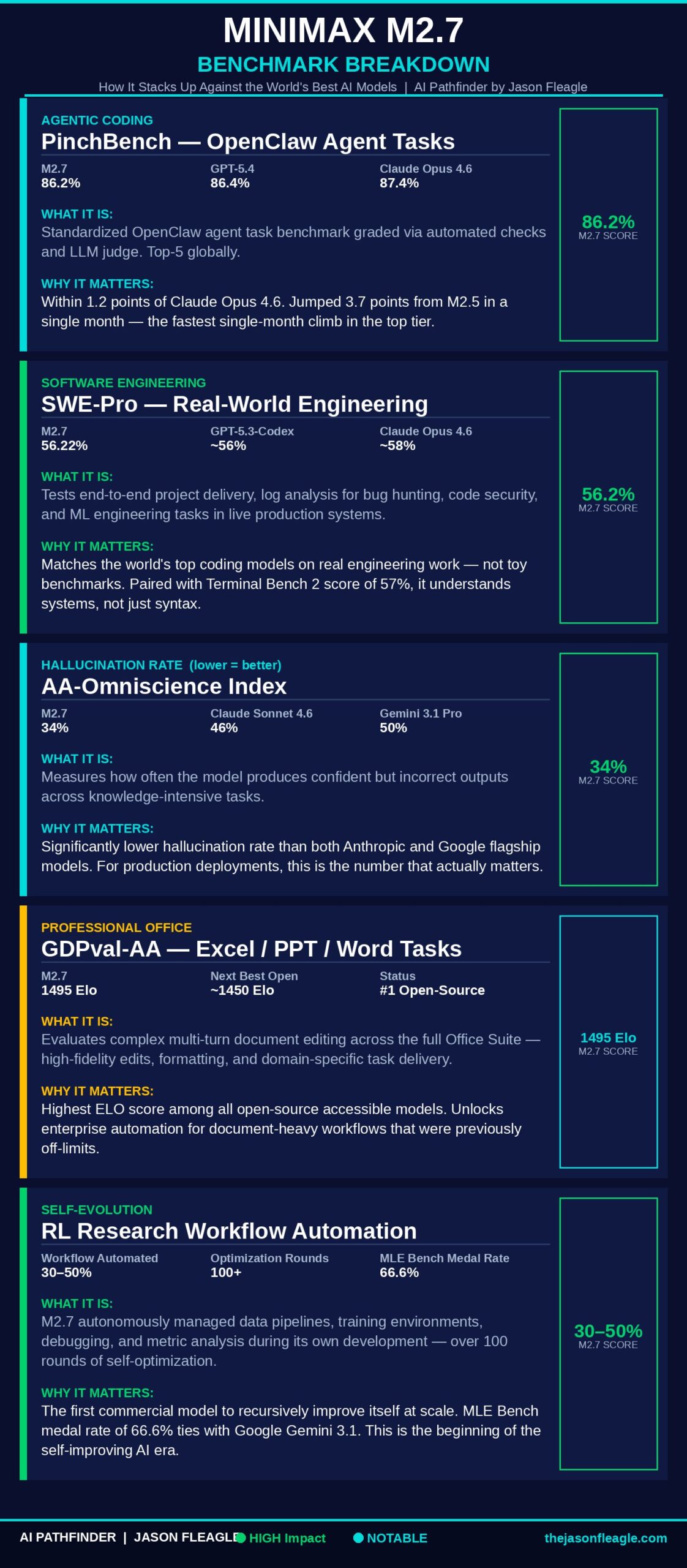
On the SWE-Pro benchmark — which tests real-world software engineering including end-to-end project delivery, log analysis, and code security — M2.7 scored 56.22%, matching the highest levels of global competitors like GPT-5.3-Codex. [2] On PinchBench, the leading OpenClaw agent task benchmark, it scored 86.2%, placing top-5 globally and within 1.2 points of Claude Opus 4.6. [3]
The number that should get every enterprise leader’s attention, though, is the hallucination rate: 34%. That’s significantly lower than Claude Sonnet 4.6 at 46% and Gemini 3.1 Pro at 50%. [1] For production deployments where accuracy is non-negotiable — legal, finance, healthcare, compliance — this is the metric that unlocks use cases that were previously too risky to touch.
And on professional office tasks (Excel, PPT, Word), M2.7 achieved an ELO score of 1495 on GDPval-AA, the highest among all open-source accessible models. [2] That’s not a benchmark for researchers. That’s a benchmark for the actual work that happens in every enterprise on the planet every single day.
This is something that can be taken off the shelf today and then customized and integrated safely and securely into environments.
My “Spicier” Take: The Great Model Divide Is Coming
For the past two years, we’ve treated LLMs like interchangeable cloud services. You pick one based on a simple trade-off between cost, speed, and intelligence.
That era is over.
The analysis from Kilo.ai’s benchmarks revealed a crucial insight: M2.7 has a unique “behavioral profile.” [3] It is “exploration-heavy,” meaning it reads far more context and analyzes dependencies more deeply than other models before acting. This makes it slower on simple tasks but allows it to solve complex reasoning problems that other models — even larger, more expensive ones — completely miss.
On Kilo Bench, an 89-task autonomous coding evaluation, M2.7 solved tasks that no other model in the comparison could solve. Not because it was the fastest. Because it was the most thorough. The SPARQL task it uniquely solved required understanding that an EU-country filter was an eligibility criterion, not an output filter. That’s a reasoning distinction, not a coding one. [3]
This is the future of AI strategy. It’s not about finding the one “best” model. It’s about building a portfolio of specialized agents with different cognitive architectures, deployed against the tasks they are uniquely suited to solve.
We are about to see a great divide:
The Renters will continue to treat AI as a monolithic utility, sending all their tasks to a single, general-purpose API. They’ll be stuck with the performance, cost, and limitations of that single provider — and they’ll pay a premium for the privilege.
The Owners will build a sophisticated, multi-agent system. They’ll deploy exploration-heavy models like M2.7 for deep analysis and complex problem-solving, while using faster, cheaper models for routine tasks. They’ll route work to the right cognitive engine for the job. And they’ll have a compounding advantage that gets harder to close every quarter.
This is a far more complex strategy. But it’s where the sustainable competitive advantage lives. It’s the difference between having a single hammer and having a full toolkit.
I’ve been saying this for the last few years now at this point, and it’s great to see this starting to come to fruition with usage and what the market is showing.
Your 3-Step Action Plan
1. Benchmark Your Workloads, Not Just Models.
Stop looking at generic leaderboards. Identify the top 3–5 most critical, complex workflows in your business that could be automated. Run them through multiple models — including M2.7 via OpenRouter or Kilo — and analyze the behavior. Which model is fast but shallow? Which is slow but deep? You need to understand the cognitive profile of your work before you can match it to the right model.
2. Build a Router, Not Just a Wrapper.
Your internal AI platform needs to become more than a simple API wrapper that adds a key. It needs to become an intelligent routing layer. Your next hire shouldn’t be a prompt engineer; it should be a systems architect who can design a platform that dynamically routes tasks to the best-fit model based on complexity, cost, and required depth of reasoning.
3. Invest in Self-Improvement Loops.
The lesson from M2.7 is that the game is going meta. How can you use AI to improve your own AI systems? Start by building automated evaluation harnesses that constantly test your agents against business-specific benchmarks. Feed the failures back into a fine-tuning pipeline. The goal is to create a system that, like M2.7, gets smarter on its own — without requiring a human to manage every iteration.
The Bottom Line
The age of the monolithic LLM is ending. The age of the specialized, multi-agent workforce is beginning.
MiniMax M2.7 is the opening bell.
It’s not the biggest model. It’s not the most famous name. But it’s the first production model to close the loop on its own development — and it performs at the top tier of the global leaderboard while doing it.
The companies that understand this shift and act on it now will build an infrastructure advantage that compounds every quarter. The ones that don’t will be paying rent to the AI landlords who did.
It’s your move.
Ready to Build Your Multi-Agent AI Strategy?
- Work with me on AI consulting → scalingmillions.com/ai-consultant
- See more case studies → thejasonfleagle.com/category/case-studies/
- Subscribe to my YouTube channel → youtube.com/@jjfleagle
- Learn AI marketing fundamentals → theaimarketingcourse.com
About Jason Fleagle
Jason Fleagle is an AI architect and Chief AI Officer who helps enterprise organizations turn data into growth. He’s delivered over $70M in revenue impact through AI-powered marketing, automation, advertising, and strategic consulting. His work focuses on practical, ROI-driven AI implementations that deliver measurable results in time savings, cost reduction, and workforce transformation.
References
- VentureBeat, “New MiniMax M2.7 proprietary AI model is ‘self-evolving’ and can perform 30-50% of reinforcement learning research workflow,” March 18, 2026. venturebeat.com
- MiniMax Official Website, “MiniMax M2.7 Model Card,” March 2026. minimax.io
- Kilo.ai Blog, “MiniMax-M2.7 Is Now Available in Kilo. Here’s How It Performs,” March 18, 2026. blog.kilo.ai
- Reddit, /r/LocalLLaMA, “Benchmarked Minimax M2.7 through 2 benchmarks,” March 2026. reddit.com/r/LocalLLaMA
- Medium, “MiniMax M2.7: Best Agentic AI LLM is Here,” March 2026. medium.com