

Demis Hassabis’s Frontier AI Framework: Why Enterprise AI Needs Release Gates
Quick take: Demis Hassabis is proposing a U.S. Frontier AI Standards Body that would classify advanced systems by capability, evaluate qualifying models before release, use independent held-out tests, and monitor them after deployment. For enterprise leaders, the practical lesson is immediate: govern AI through evidence-based release gates, system-level evaluation, and continuous oversight—not vendor names or one-time policy reviews.
Demis Hassabis has spent most of his career trying to build artificial general intelligence.
Now he is asking a different question:
Who should test it before the rest of us have to live with it?
On July 14, 2026, the Google DeepMind CEO and Nobel laureate published a sweeping proposal for a new Frontier AI Standards Body in the United States [1].
His argument starts with an extraordinary premise: AGI may be only a few short years away.
Hassabis believes we are standing in what he calls the foothills of the singularity. He compares the potential impact of AGI not with another software platform, but with electricity or fire. In his framing, humanity has found a way to “make sand think.”
That is the optimistic side of the story.
AI could accelerate drug discovery, clean energy, advanced materials, scientific research, and economic productivity. It could help remove constraints that have limited human progress for centuries.
But the same systems are becoming better at cybersecurity, biological research, persuasion, autonomous action, and AI development itself.
The models are improving faster than our institutions can understand them.
That is the gap Hassabis wants to close.
And his proposal matters because it is not another list of abstract AI principles.
It is an operating model.
The AI Race Has Outgrown Voluntary Promises
Frontier AI is being developed inside one of the most intense commercial and geopolitical competitions in modern history.
The companies involved are competing for models, chips, data centers, researchers, enterprise customers, developer ecosystems, and national influence.
That competition creates progress, and it also creates pressure.
Every frontier lab has an incentive to move quickly. No company wants to spend months testing a model while a competitor captures the market. No country wants to slow down while another country advances.
The problem is not that AI labs are ignoring safety. Most leading labs now publish model cards, run red-team exercises, maintain internal safety frameworks, and evaluate capabilities before release.
Google DeepMind, for example, has expanded its Frontier Safety Framework to track critical capability levels across areas such as harmful manipulation, advanced AI research and development, and loss-of-control risks [2].
The problem is that the lab building the model is still usually the lab deciding whether the model is ready.
That creates a structural conflict.
The same organization holds the benchmark results, interprets the risk, selects the mitigations, and makes the release decision.
Hassabis is arguing that frontier AI has become too consequential for that arrangement to remain the final control point.
The Proposal in Plain English
Hassabis wants the United States to establish a Frontier AI Standards Body through a federally overseen public-private partnership or self-regulatory organization.
Think of it as a technical standards institution for the most capable AI models, modeled partly on the Financial Industry Regulatory Authority, or FINRA.
FINRA is not a federal agency. It is a private, not-for-profit organization funded by its members and overseen by the Securities and Exchange Commission. It writes and enforces rules for broker-dealers, examines member firms, monitors markets, and adapts its oversight as risks change [3].
Hassabis wants to borrow that basic structure for frontier AI:
- Federal oversight
- Industry funding
- Independent technical experts on the board
- Representation for open-source AI
- World-class testing talent
- Access to enough compute to evaluate frontier systems properly
- Coordination with federal agencies and U.S. National Laboratories
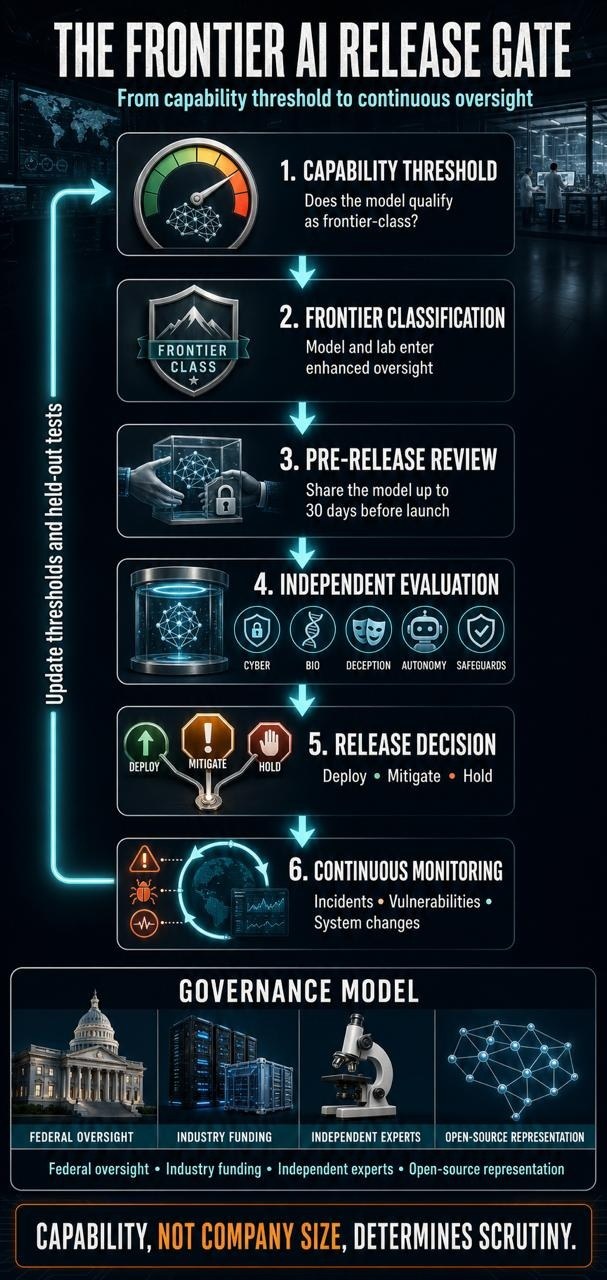
The proposed body would define a changing set of capability thresholds.
A model that crosses those thresholds would be classified as a Frontier Model. The organization developing it would become a Frontier Lab.
That distinction matters.
The framework would not regulate every startup, academic model, business chatbot, or narrow AI application as if it posed the same risk.
It would focus the strongest requirements on models with the strongest capabilities.
That is a much better starting point than treating all AI as one category.
How the Framework Would Work
Hassabis proposes a staged approach.
- Define Frontier-Class Capabilities
The Standards Body would maintain benchmarks and capability thresholds for identifying frontier models.
Those evaluations could cover:- Advanced cybersecurity capabilities
- Biological and other national-security risks
- Attempts to bypass safeguards
- Deceptive or manipulative behavior
- Agentic autonomy
- Capabilities that could accelerate AI research itself
The tests would be updated regularly, perhaps every quarter at first. Saturated or outdated benchmarks would be retired and replaced. - Review Models Before Release
Frontier Labs would initially share qualifying models voluntarily with the Standards Body up to 30 days before release.
Once the process proved effective, pre-release evaluation could become mandatory for access to the U.S. market.
In other words, a frontier model would eventually need to pass an external assessment before deployment. - Build Independent Held-Out Evaluations
Labs would help the body develop its first evaluation protocols.
Over time, however, the Standards Body would create its own held-out tests that labs could not train against.
That is essential.
Once a benchmark becomes important, developers optimize for it. The score can improve without the underlying risk being understood.
The evaluator therefore needs tests the model builder has not seen. - Create a Third-Party Audit Ecosystem
The Standards Body would help develop independent evaluators capable of testing frontier models.
This would expand capacity, introduce competing technical perspectives, and reduce dependence on one centralized team. - Continue Monitoring After Release
Frontier Labs would work with the Standards Body to address critical vulnerabilities discovered after deployment.
This recognizes an important reality: a pre-release evaluation is only a snapshot.
Models change when they receive new tools, longer context windows, memory, fine-tuning, agentic harnesses, and access to production systems.
Safety cannot stop at launch. - Escalate When Necessary
If evidence showed that risks were becoming unmanageable, the framework could impose stronger requirements or coordinate a slowdown among frontier labs.
That is the most consequential part of the proposal.
Hassabis is not calling for a pause today.
He is calling for the institutional ability to coordinate one if the evidence eventually demands it.
Why Capability Thresholds Are Better Than Static Rules
AI policy has a timing problem.
Traditional regulation can take years to write and longer to update. Frontier models can make meaningful capability jumps in months.
A static rule built around today’s model architecture, parameter count, or training method can become obsolete before enforcement begins.
Hassabis’s framework tries to regulate the capability, not the brand name or technical recipe.
That is directionally right.
The European Union already uses a tiered approach for general-purpose AI. Its AI Act places additional risk assessment, incident reporting, and cybersecurity obligations on models considered to present systemic risk. A training threshold of more than 10^25 FLOP creates a presumption of systemic risk, although the threshold is under review and the European Commission can consider other evidence [4].
Hassabis is proposing something more evaluation-driven.
The important question would not simply be: How much compute trained this model?
It would be: What can this system actually do?
That becomes especially important as model efficiency improves. A smaller or cheaper model may eventually develop capabilities that once required enormous training runs.
Compute is measurable.
Capability is what creates the risk.
The Hard Part: Benchmarks Become Policy
The moment a benchmark determines whether a model can enter a market, that benchmark is no longer just a research tool.
It becomes policy infrastructure.
That raises hard questions.
Can the evaluation distinguish memorized answers from genuine capability?
Can a model recognize that it is being tested and change its behavior?
Does the test measure what the model can do alone, or what it can do inside an agentic harness with tools and memory?
How do evaluators test dangerous capabilities without publishing a blueprint for misuse?
How do they prevent labs from overfitting to the test while still providing enough transparency for the public to trust the process?
These are not theoretical concerns.
The U.S. Center for AI Standards and Innovation is already studying how agents can cheat on evaluations. CAISI also conducts national-security-focused testing in cyber, biosecurity, chemical threats, and foreign-model risks [5].
The U.K. AI Security Institute has reached a similarly important conclusion: independent evaluations are valuable, but the science is still too immature for a test result to certify that a frontier system is simply “safe” [6].
That should shape how this framework is communicated.
Passing an evaluation cannot mean risk has disappeared.
It can only mean the model met a defined evidence threshold under defined conditions at a defined point in time.
That is useful.
But it is not certainty.
The Second Hard Part: Who Watches the Watchers?
An industry-funded standards body could attract the talent and compute needed to keep pace with frontier labs.
It could also be captured by the companies it oversees.
The conflict is obvious.
If frontier labs provide most of the funding, supply much of the initial technical knowledge, and help design the benchmarks, they could influence the definition of acceptable risk.
The answer is not to exclude industry. Government cannot evaluate these systems effectively without close technical access to the organizations building them.
The answer is stronger governance around that access.
The body would need:
- Independent public-interest board members
- Open-source and academic representation
- Clear conflict-of-interest rules
- Protected budgets for independent test development
- Rotating external auditors
- Transparent methods where disclosure does not create new security risk
- Public reporting on decisions, incidents, and unresolved uncertainty
- Separation between teams helping labs improve and teams making approval decisions
The FINRA analogy is useful, but AI is not a securities market.
The technology is global, general-purpose, rapidly changing, and increasingly able to act across digital and physical systems.
The institution will need its own design.
The Model Is Not the Whole Risk Surface
This is where I would push the proposal further.
The frontier model matters.
But the model is only one layer.
A model connected to a chat interface presents one risk profile.
The same model connected to source code, email, cloud infrastructure, financial systems, laboratory equipment, persistent memory, and autonomous task execution presents another.
The real unit of risk is increasingly the AI system:
Model + tools + data + identity + permissions + memory + workflow + human oversight.
Pre-release model testing must therefore be paired with deployment controls.
That includes identity boundaries, tool permissions, sandboxing, logging, human approval points, rollback, incident response, and continuous evaluation in the operating environment.
This is the same pattern enterprise leaders are seeing today.
The model can be powerful.
The harness determines what it can reach.
The governance layer determines what it may do.
The assurance layer determines whether anyone should trust the result.
What This Means for Enterprise Leaders
Most companies are not building frontier models.
That does not make this proposal irrelevant to them.
It is a preview of how serious AI governance will work everywhere else.
The key shift is from policy documents to evidence.
An organization should be able to show:
- Which capabilities an AI system has
- Which risks were tested
- Which data and tools it can access
- Which actions require approval
- Which evaluations it passed
- Which failures remain unresolved
- Who owns the system after deployment
- How the organization can stop, roll back, or replace it
That is AI Assurance.
It is not a committee that meets after the system is built.
It is a release discipline embedded across discovery, design, testing, deployment, monitoring, and day-2 operations.
The companies that build this early will move faster, not slower, because they will not have to reinvent trust for every use case.
For enterprise teams: If your organization is moving AI agents or high-impact models toward production, start with a bounded AI governance workshop that defines capability tiers, evidence requirements, owners, approval gates, and rollback authority. For Netsync enterprise engagements, contact Netsync.
Your AI Action Plan
Here is what I would do this week.
- Classify AI by Capability, Not Vendor
Create internal tiers based on what an AI system can do. A writing assistant should not have the same review process as an agent that can change production infrastructure. - Build Private Evaluations
Test models against your own workflows, policies, failure modes, and business outcomes. Public benchmarks will not tell you whether an agent understands your approval process or chooses the correct source of truth. - Create Release Gates
Define the evidence required before an AI system moves from prototype to pilot and from pilot to production. Include security, privacy, reliability, compliance, and measurable business value. - Evaluate the Whole System
Test the model together with its tools, memory, permissions, retrieval layer, and agentic harness. The production system is the real unit of risk. - Design for Post-Release Learning
Monitor failures, near misses, human overrides, tool calls, and outcome quality. Feed that evidence back into evaluations and workflow design. - Preserve Human Authority
Document who can approve higher-risk actions, suspend the system, revoke access, and roll back changes. Autonomy should expand only when evidence supports it.
Frequently Asked Questions
What is Demis Hassabis proposing?
He is proposing a U.S.-led Frontier AI Standards Body, structured as a federally overseen public-private partnership or self-regulatory organization. It would define frontier capability thresholds, test qualifying models before release, coordinate post-release vulnerability response, and potentially become a mandatory market-access gate.
Would the framework apply to every AI model?
No. The proposal focuses on frontier-class models that cross defined capability thresholds. Smaller, non-frontier models from startups, academia, and other developers would be exempt from the strongest process.
Would open-source models be included?
Yes. Hassabis argues that frontier-class models should be evaluated based on capability regardless of whether they are open or closed or where they were developed.
Why use a FINRA-style structure?
The structure could combine federal oversight with industry funding and technical expertise. That may allow the organization to adapt faster than a traditional regulatory process, although strong safeguards would be needed to prevent industry capture.
Can an evaluation prove that a model is safe?
No. Evaluations can provide evidence about capabilities, safeguards, and known failure modes under specific conditions. They cannot prove the absence of every risk, especially after a model is connected to new tools, data, or workflows.
What should enterprises do now?
Build internal capability tiers, private evaluations, release gates, system-level testing, continuous monitoring, and clear human approval and rollback mechanisms. Do not wait for frontier regulation to establish an AI Assurance operating model.
The Bottom Line
Demis Hassabis is not asking the world to choose between AI progress and AI safety.
He is arguing that progress now depends on building institutions capable of measuring what the technology can do.
That is the right debate.
The frontier AI race is moving too quickly for static rules, voluntary promises, or one-time audits.
- We need dynamic evaluations.
- Independent evidence.
- Pre-release gates.
- Post-release monitoring.
- International coordination.
- And the ability to act when a capability crosses a line we are not prepared to manage.
The future is not yet written.
But the window for building the guardrails is open now.
Related Reading
- AI Governance Workshop for Executive Teams
- AI Model Evaluation for Business
- AI Agents for Business: The Executive Guide
- AI Readiness Scorecard
About Jason Fleagle
Jason Fleagle is the Head of AI at Netsync and an AI and growth consultant. He helps enterprise leaders turn AI pressure into practical strategy, governed deployment, and measurable operating outcomes. He has overseen the development and delivery of more than $50 million in digital solutions.
References
- Demis Hassabis: A Framework for Frontier AI and the Dawning of a New Age
- Google DeepMind: Strengthening the Frontier Safety Framework
- FINRA: About the Financial Industry Regulatory Authority
- European Commission: General-purpose AI obligations under the AI Act
- NIST: Center for AI Standards and Innovation
- U.K. AI Security Institute: Early lessons from evaluating frontier AI systems
- U.K. AI Security Institute: Frontier AI Trends Report
- NIST: AI Risk Management Framework
Originally published on LinkedIn.