Imagine your team has confirmed a vulnerability in a Linux-hosted Java service. The permanent fix is available, but testing isn't finished. People still depend on that service, and rushing the update could interrupt their work. What can you safely do while the patch catches up?
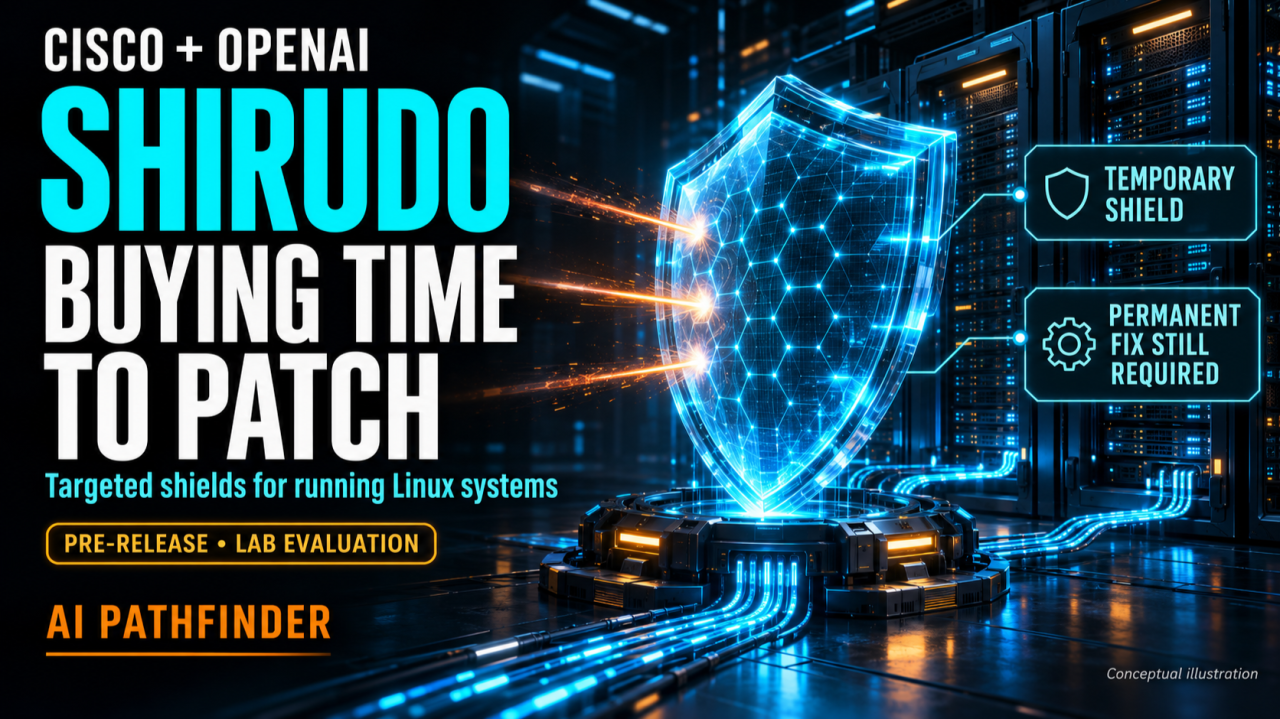
That's the problem behind Cisco and OpenAI's November 23 launch of Shirudo, an open-source runtime for targeted protections on running Linux systems. Its own FAQ says it isn't ready for production. Today, it's an idea to evaluate in an isolated lab, not something to roll into that hypothetical service.
The possibility is worth understanding: give engineers a way to block a specific dangerous operation while they finish the permanent fix. I'd start with a practical question: can you identify the behavior you need to stop without stopping the work your users need to do?
A running service, a dangerous input, and a narrower intervention
In Isovalent's controlled demonstration, a Codex-driven workflow generated Java bytecode that added an input check around Base64 decoding. The team attached the mitigation to a running Elasticsearch 9.5.5 process, attempted an exploit, and reported that the attack failed while Elasticsearch kept running.
That gives the idea something concrete to stand on. Calif's Java4Shell disclosure identifies CVE-2026-114938 as a memory-corruption flaw in OpenJDK's optimized Base64 decoder. Base64 converts binary data to text and back. The demonstration put a check in front of that vulnerable operation rather than waiting for a complete runtime update.
The interesting AI contribution is the generation of a specific mitigation that engineers could test. The launch names Codex, but supplies no exact model checkpoint or shield-generation success rate. This was Java instrumentation inside an application, not proof that a kernel eBPF rule alone stopped Java4Shell or that every Java service is covered.
Infosecurity Magazine also distinguishes the builders' demonstration from independent evaluation. This article reviews documentation and source code, not a deployment I tested yet, but I can't wait to give it a test. I think in light of recent cybersecurity events its much needed today.
How the shield reaches the work
Shirudo supports two paths worth keeping separate. eBPF lets small programs run at defined points in the Linux kernel, which manages access to system resources. A suitable shield can inspect an operation and refuse the path an exploit needs. Java agents instead change behavior inside the Java Virtual Machine, or JVM, that runs the application.
Both depend on reaching the right place. A BPF shield needs an available attachment point. LWN's earlier reporting on Cisco's shielding work describes how missing nearby hooks made some mitigations more complex. That reporting explains the constraint, not independent validation of the new Shirudo project.
The Shirudo repository describes signed micropatches called “upatches.” An operator host builds and signs them. Targets verify and load them, with packages distributed through an OCI registry, a repository for software artifacts. A TPM, a security component on the target, signs measurements of the loaded state so another machine can check them.
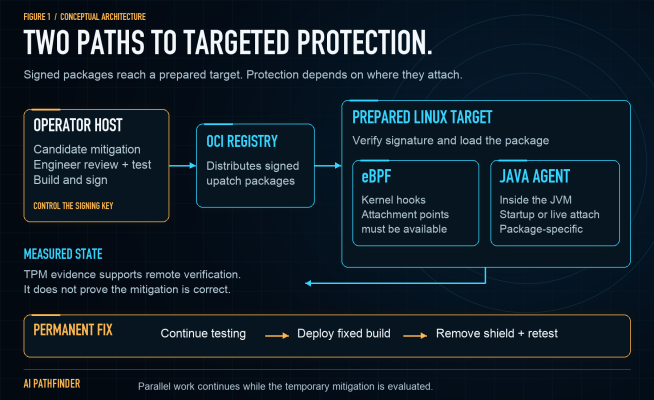
Figure 1. Conceptual architecture based on the OpenAI announcement and Shirudo documentation. The temporary shield and permanent fix proceed on separate tracks. Review is an operator responsibility, and Java coverage depends on how the JVM loads its agent.
Before you budget the test, check the foundation
“Without a reboot” applies to suitable protections on an already prepared target. The installation guide says installing the target package protects nothing by itself. Initial enforcement requires booting through Shirudo's initialization environment.
Give your platform lead this short compatibility check before asking for a demo:
- Kernel: the system requirements require the bpf-next signed-loader ABI and carried kernel changes, including security hooks. An ordinary distribution name or kernel version number doesn't establish compatibility. Each shield also needs its own attachment points.
- Boot and hardware: targets need TPM 2.0, the BPF security module, root for target operations, systemd 256 or newer, a systemd/dracut initial RAM filesystem, and a unified kernel image. The build/signing host has separate requirements.
- Existing tools: Shirudo admits BPF through signed loaders. The interoperability documentation explains why tools loading their own unsigned BPF programs are refused. Cilium, Falco, and bpftrace cannot simply run unchanged under that policy.
- Support: the version documentation lists no stable software release or maintained stable branch. The architecture matrix gives x86-64 the fullest CI coverage, with arm64 less mature and no booted riscv64 target. Open code isn't a support or compatibility promise.
For Java, add a process-level check. The ordinary Java-agent deployment path reaches particular newly started JVMs through their startup environment. Existing JVMs keep their loaded agents until restart. The java-base64 package separately documents attachment to a running JVM, including one outside that startup path. Verify which route your test uses. A package installed on the host proves neither coverage of every JVM nor that uninstalling it reverses existing instrumentation.
These checks can save your engineers a lot of unproductive setup. If the foundation doesn't fit, that's a useful evaluation result you should consider.
What would make you trust the result?
A signed shield tells you an authorized key signed it. The eBPF verifier checks program safety rules. Neither proves that the shield blocks the right behavior, preserves legitimate requests, or provides adequate security coverage. Shirudo's threat model explicitly excludes the correctness and safety of an authorized signer's upatch.
Its security model addresses root on the target without the signing key, under stated deployment assumptions. A compromised kernel or signing host falls outside that claim. Java instrumentation is an application mitigation, not that kernel-enforced boundary against root. TPM evidence can establish measured state when properly verified, but cannot establish that a business transaction still works.
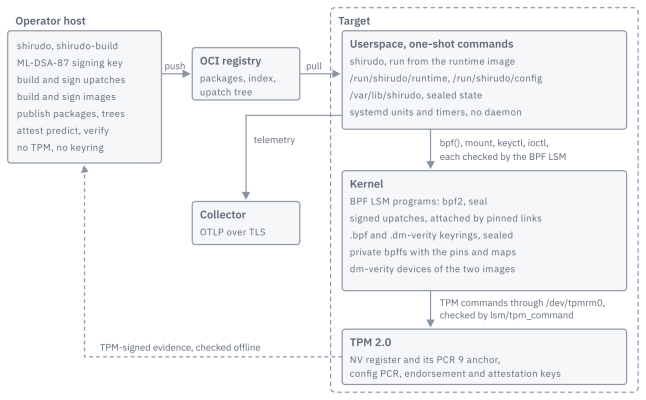
Official project architecture. Operator signing, package distribution, kernel controls and TPM evidence. Source: Shirudo documentation.
So test the transaction. Send representative valid requests as well as the authorized negative test. Watch errors, tail latency, resource use, and interactions with existing controls. The published overhead measurements are useful planning material from a test VM with a software TPM, not a production-workload benchmark. The reported 0.71% of one vCPU measured historical timers with no upatch loaded and excluded newer signed keepalive behavior. It isn't total system overhead.
Include failure recovery. If the registry becomes unreachable, loaded upatches keep running while updates fail. If boot initialization fails, the machine can continue booting with enforcement dependent on where it stopped. The initialization guide explains those cases. Check protection after recovery as carefully as application health.
Bring one delayed patch to the lab
Return to the hypothetical Java service. I'd ask the security and application owners to agree on one narrow test: block the identified exploit path, preserve legitimate work, and demonstrate how to remove the mitigation. Keep the permanent update scheduled.
Figure 2 outlines recommended operator practice. Shirudo doesn't supply the fleet inventory, rollout scheduling, or cross-target consistency that would make it an automatic deployment workflow.
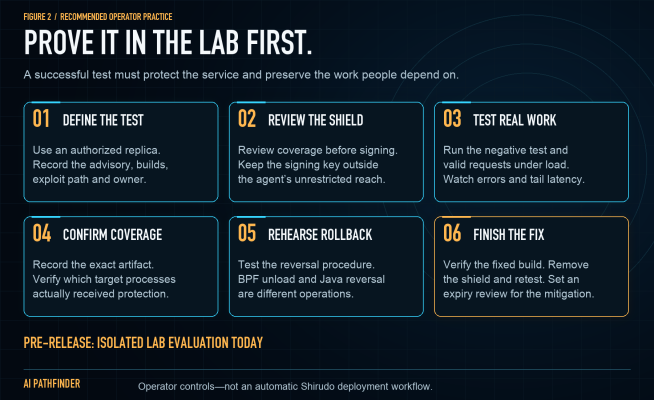
Figure 2. Recommended operator controls, not an automatic Shirudo workflow. Production canaries are conditional on future readiness and successful evaluation. For today's pre-release project, perform this rehearsal in an isolated test environment.
Start with an authorized, isolated replica and record the advisory, affected builds, reachable path, and owner. Stop if you can't reproduce the scenario safely. Have a security engineer review the candidate's coverage and exceptions before signing, and keep the signing key outside the AI agent's unrestricted reach.
Then let the application owner test normal work, the negative case, and representative load in a small isolated group. Reject a mitigation that stops the demonstration but breaks the service. Record the exact artifact and which processes actually received it.
Rehearse rollback before calling the test successful. BPF unloads and Java reversal aren't interchangeable. For Java, establish the package-specific reversal or restart procedure. Finally, verify the permanently fixed build is running, remove the temporary shield through that tested procedure, and retest. Set an expiry review so temporary protection doesn't quietly become permanent.
My take: Shirudo is worth an engineering evaluation where those prerequisites fit. The useful outcome would be less time exposed, with acceptable service disruption and a completed permanent fix. This launch also supplies no measured ROI or reason to replace your existing endpoint, web-filtering, or patching controls. So having a test is very important to do.
Take one delayed patch to your security and platform leads. Ask them to write down the exact operation a temporary shield would need to block, the legitimate work it must preserve, and the evidence they'd need to remove it safely. You'll have a useful test brief before anyone starts installing software.
About Jason Fleagle
Jason Fleagle is the Head of AI at Netsync and helps executives and business leaders turn AI pressure into practical strategy, governed workflows, trusted adoption, and measurable business value.