Anthropic just did something important.
It released Claude Fable 5, the first generally available “Mythos-class” model from the company.
That phrase matters.
Until now, Mythos-class capability mostly lived behind restricted access through Project Glasswing, Anthropic’s defensive cybersecurity program for government, critical infrastructure, and vetted security partners.
Now Anthropic is splitting the model into two paths:
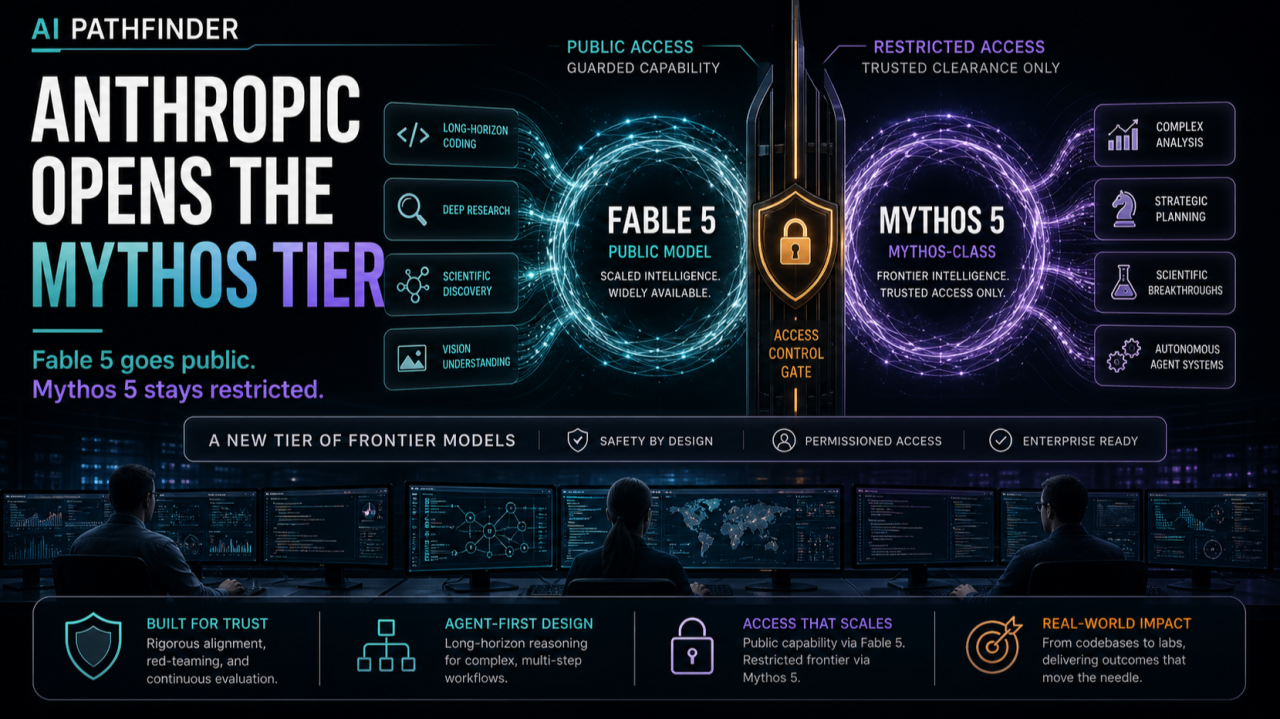
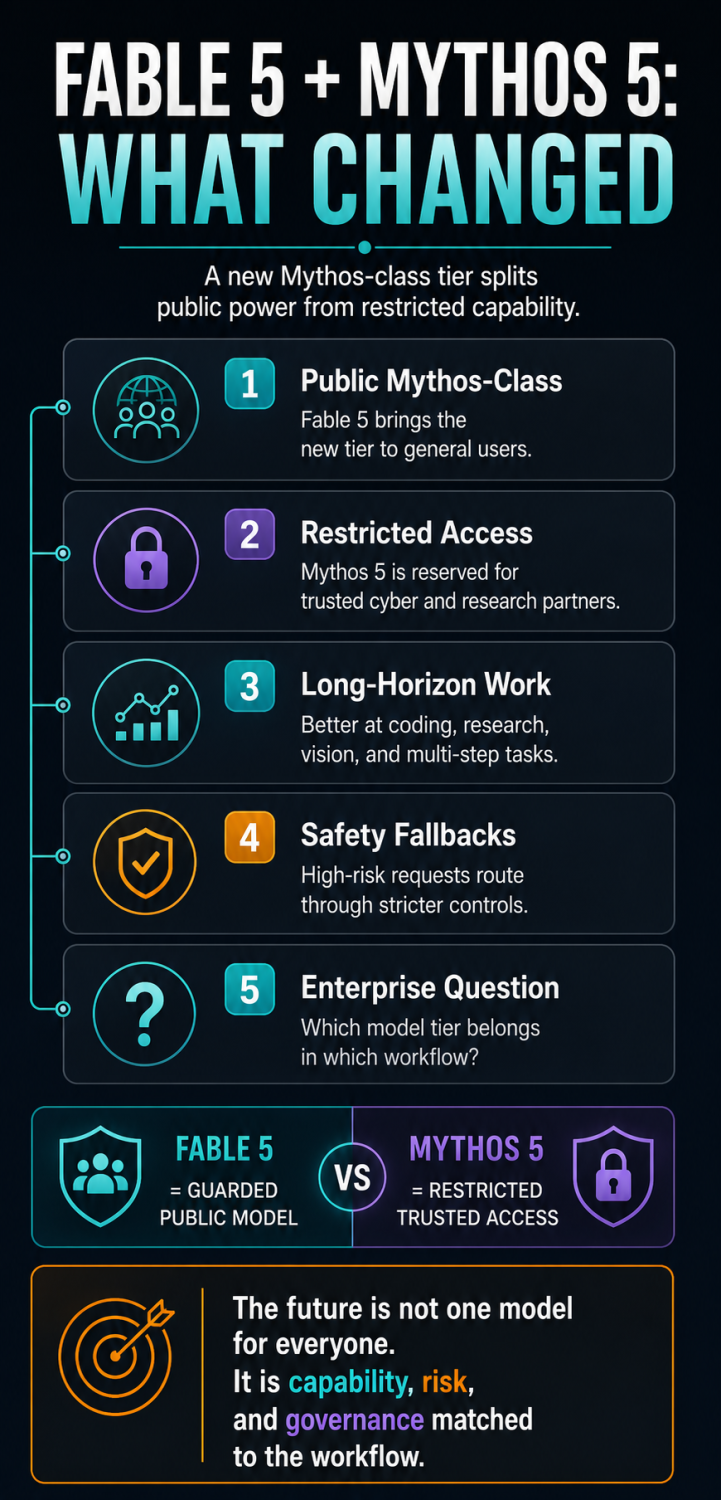
Claude Fable 5: the public version, with safeguards.
Claude Mythos 5: the same underlying model, but with some safeguards lifted for restricted government, cybersecurity, and eventually vetted biomedical research partners.
That is the headline.
But the bigger story is this: Anthropic is no longer just competing model-for-model with OpenAI, Google, and xAI.
It is trying to define a new release pattern for frontier AI.
Public power.
Restricted capability.
Safety fallbacks.
Trusted access.
And a clear admission that some model capabilities are now too powerful to release without controls.
Why It Matters
Claude Fable 5 is Anthropic’s most capable public model yet.
According to Anthropic, it beats prior Claude models across software engineering, knowledge work, vision, scientific research, and long-running autonomous tasks.
The company says the longer and more complex the task, the more Fable 5 pulls away from earlier models.
That is the key signal.
This release is not just about better answers.
It is about longer-horizon work.
- Code migrations.
- Scientific pipelines.
- Document reasoning.
- Vision-heavy tasks.
- Memory-backed workflows.
- Autonomous multi-step execution.
In other words, the model is moving from “respond to me” toward “work through this.”
That is where the enterprise value starts to compound.
Fable 5 vs. Mythos 5
The product architecture is the story.
Fable 5 and Mythos 5 are the same underlying model.
The difference is access and safeguards.
Fable 5 is generally available, but Anthropic has added classifiers that route certain high-risk requests to Claude Opus 4.8 instead of letting Fable answer directly.
Those areas include cybersecurity, biology and chemistry, and distillation attempts.
Anthropic says more than 95% of Fable 5 sessions do not hit a fallback at all.
Mythos 5 is the restricted version.
It is initially available to Project Glasswing partners, with cyber safeguards lifted for defensive security work. Anthropic also plans a trusted access program for select biology researchers where some biology and chemistry restrictions are removed while cyber safeguards remain in place.
That is a major shift.
Anthropic is effectively saying: The same capability can be public, restricted, or domain-gated depending on risk.
That may become the default pattern for frontier model releases.
The Benchmark Story
Anthropic is making a big claim: Fable 5 is state-of-the-art on nearly all tested capability benchmarks.
The model reportedly leads on Cognition’s FrontierCode evaluation, which tests whether models can complete difficult coding tasks while meeting production-quality standards.
Stripe said Fable 5 compressed months of engineering work into days, including a codebase-wide migration across a 50-million-line Ruby codebase in one day.
That is the kind of claim operators should pay attention to.
Not because every enterprise will see the same result.
They will not.
But because it shows where the category is going.
The next frontier model is not just a better autocomplete engine.
It is becoming a migration engine.
A refactoring engine.
A research engine.
A workflow engine.
A system that can stay with a messy task long enough to produce something usable.
That changes the staffing model for software engineering, IT modernization, and enterprise transformation.
Vision Gets Serious
Fable 5 also appears to be a major jump in vision.
Anthropic says it can rebuild web app source code from screenshots, interpret detailed scientific figures, and perform complex visual tasks with much less scaffolding than earlier Claude models.
The flashiest example is Pokémon FireRed.
Anthropic says Fable 5 beat the game using only raw screenshots, with no maps, navigation aids, or extra game-state information.
That sounds like a novelty demo.
It is not.
The enterprise implication is that frontier models are getting better at operating from visual context alone.
- Screenshots.
- Dashboards.
- Diagrams.
- Charts.
- Application states.
- Scientific images.
Enterprise tools that were never designed for APIs.
That matters because a lot of business work still happens through messy visual interfaces.
If models can understand and act on those interfaces, the automation surface expands dramatically.
Memory and Long-Context Are Becoming Real
The other important improvement is persistence.
Anthropic says Fable 5 stays focused across millions of tokens and improves its work with persistent file-based memory.
That is exactly where agents have struggled.
They start strong.
Then they drift.
They forget.
They repeat mistakes.
They lose track of the plan.
They fail to carry lessons forward.
Fable 5 appears to improve that loop.
In Anthropic’s Slay the Spire tests, persistent memory improved Fable 5’s performance much more than it improved Opus 4.8, and Fable reached the final act more often.
Again, the game is not the point.
The point is the behavior pattern.
A useful enterprise agent needs to remember what it learned.
It needs to maintain context across long work.
It needs to update its approach based on failures.
It needs to keep a plan alive.
That is the direction Fable 5 is pointing.
The Science Leap
The most consequential part of the announcement may be scientific research.
Anthropic says Mythos 5 accelerated aspects of drug design by roughly 10x in internal protein design work.
The model reportedly ran protein design and bioinformatics pipelines, recovered from failures, and matched or beat skilled human operators across a set of targets.
Anthropic also says Mythos 5 produced molecular biology hypotheses that its scientists preferred over Opus-class models about 80% of the time, with one hypothesis about an E. coli protein mechanism later corroborated by independent lab work.
In genomics, Anthropic says Mythos 5 autonomously assembled single-cell data across millions of cells from 138 animal species and trained a custom model that outperformed a recent Science-published model despite being 100x smaller.
These are Anthropic’s claims, and the company says some results will be published in the coming months.
So leaders should treat them as promising, not fully settled.
But if even part of this holds up, the implication is massive.
AI is not just assisting research.
It is beginning to behave like a junior research organization.
- Selecting tools.
- Running pipelines.
- Testing hypotheses.
- Recovering from failure.
- Producing candidates.
That is a different level of leverage.
The Safety Fine Print
The fine print matters here.
Fable 5 is not simply “Mythos for everyone.”
It is Mythos-class capability with safeguards.
Anthropic says Fable 5 uses new classifiers to detect higher-risk requests and route them to Opus 4.8 instead.
That is a notable product decision.
Instead of hard refusing, Anthropic is trying to preserve user experience while reducing risk.
But there is a tradeoff.
Anthropic says the safeguards are intentionally conservative and may catch harmless requests.
The company also introduced a 30-day data retention policy for traffic on Mythos-class models, including Fable 5 and Mythos 5, saying the data will not be used to train models and is intended for safety, abuse detection, and reducing false positives.
That is something enterprise buyers should read carefully.
More capability now comes with more governance overhead.
Procurement, legal, privacy, security, and compliance teams need to understand what changes when they move from Opus-class to Mythos-class systems.
Pricing and Availability
Claude Fable 5 is available now through the API as claude-fable-5.
Pricing is $10 per million input tokens and $50 per million output tokens.
That is less than half the price of Mythos Preview, but still above Opus 4.8.
Anthropic says Fable 5 is included on Pro, Max, Team, and seat-based Enterprise plans at no extra cost through June 22, 2026.
After June 23, usage on those plans will require usage credits unless Anthropic extends the included window or capacity improves.
That tells you something important:
The model may be public, but capacity is still a constraint.
Frontier capability is becoming a supply chain problem.
Why This Bites
This release is not just another model update.
It is a new tier.
Anthropic now has a public model that sits above Opus in capability, but still below fully unrestricted Mythos access.
That creates a new frontier model structure:
- General models for everyday work.
- Premium models for complex enterprise tasks.
- Restricted models for high-risk domains.
- Trusted access for cybersecurity and biomedical work.
- Safety fallbacks for public use.
That may become the shape of the market.
Not one model for everyone.
A layered release system based on capability, risk, and trust.
For enterprise leaders, the question is no longer:
“What model is best?”
The better question is:
“What model tier is appropriate for this workflow, and what controls need to surround it?”
Your AI Pathfinder Takeaways
Test Fable 5 on long-horizon work.
Do not waste it on simple summarization. Test it on code migrations, complex research, multi-document reasoning, data analysis, application prototyping, and workflows where prior models lost the thread.
Watch the fallback behavior.
If your workflows touch cybersecurity, biology, chemistry, or model distillation, understand when Fable routes to Opus 4.8 and what that means for quality, latency, and governance.
Update your AI procurement checklist.
Mythos-class models introduce new issues: data retention, domain restrictions, safety fallbacks, trusted access, and capacity limits. Your governance model needs to account for all of it.
Prepare for the agentic enterprise.
Fable 5 is built for longer autonomous work. That means your organization needs better task design, better review loops, better permissions, and better evaluation methods.
Treat restricted models as a new category.
Mythos 5 is not a normal product. It is a restricted capability layer for vetted users. Expect more vendors to use similar release patterns as models become more powerful.
About the Author
Jason J. Fleagle is an AI architect, operator, and the founder of Catalyst Brand Group. He also serves as the Chief AI Officer at Netsync, helping enterprise leaders turn data into growth and build secure, high-ROI AI workflows. You can follow his insights on LinkedIn.