
A customer asks for a service quote. Your team has the information somewhere, but someone still has to find the right service description, confirm pricing, clarify the request, and get an expert to approve it. The customer waits while experienced people chase details.
AI might help. Whether it helps the business depends on what happens next:
Does the customer receive an accurate quote sooner?
Does the work cost less?
Do more qualified opportunities become profitable orders?
Does the team spend less time fixing and forwarding work?
Those are some of the outcomes leaders should define before approving an AI project. They give discovery a purpose, a pilot something meaningful to prove, and production owners a reason to keep measuring after launch.
Why this matters
AI done right starts with a business problem and a measurable outcome. Discover the workflow and its constraints. Prove the proposed improvement on real work. Scale what earns its place. Manage it so the value and controls survive ordinary operations. Across that process, keep four outcomes visible: time, cost, revenue, and people.
What a successful AI project should change
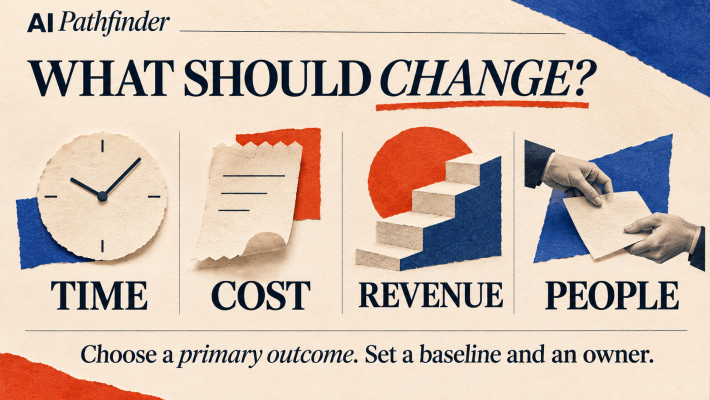
Four business outcomes, one accountable scorecard. A project need not improve every outcome.
Every project should choose a primary outcome and relevant secondary outcomes. It does not have to improve all four. A project can justify its cost through better service or more usable capacity, provided leadership understands that decision. Security, quality, and human accountability remain conditions of success even when they are not the primary benefit.
Time means work reaches an accepted finish sooner or requires less human effort. Measure both. Hands-on time includes preparation, review, correction, and fallback. Cycle time runs from the agreed arrival point to accepted completion, including waiting and handoffs. A model that drafts in seconds may leave a two-day approval queue untouched. Track unresolved cases and the slow end of the distribution as well as the average.
Cost means an expense the business can actually avoid, after the total cost of the change. Released employee hours are capacity unless payroll, overtime, contractor spending, or another expense changes. Include source preparation, integration, testing, training, model usage, support, monitoring, and maintenance. For unit economics, divide total workflow cost, including failed attempts, by accepted completed work.
Revenue means incremental business the organization can attribute and fulfill. Faster quotes may improve conversion, increase throughput, or shorten time to revenue. None automatically creates demand. Track comparable qualified opportunities through closed business, check whether the work would have been won anyway, and account for delivery capacity and contribution margin. Earlier receipt of the same revenue is a timing benefit, not additional revenue.
People and teams means a better way to perform the work. Look for usable capacity, less rework, manageable reviewer workloads, clearer roles, better handoffs, and sustained adoption. Ask employees what work disappeared and what new work arrived. If the expert now spends the whole day correcting AI drafts, the burden has moved. Faster output alone cannot establish that the team is better off, and recovered capacity is not a headcount-reduction promise.
Give each outcome a baseline, a target, a measurement method, and an accountable owner. That agreement becomes the scorecard for the entire project.
Why this discipline matters
The market offers reasons for optimism and reasons to be specific. In McKinsey’s August 2026 State of AI survey, 80% of respondents reported improved individual productivity, while 37% reported a positive contribution to organizational EBIT. Those are self-reports about different outcomes, not an audited project failure rate. BCG’s September 2026 Applied AI Index reports measurable AI value at almost half of surveyed companies, in a sample skewed toward large businesses.
A selected review of Netsync meeting material also surfaced practical obstacles: inconsistent business definitions, difficult source documents, uncertain permissions, and limited capacity to operate what had been proposed. The conversations included useful AI adoption, too. These are field patterns that inform the approach, not evidence that every organization has failed.
The adoption method I use connects Discover, Prove, Scale, and Manage. Discovery establishes which business improvement is worth pursuing. Proof tests whether the proposed change delivers it. Scaling puts the tested workflow into production. Management keeps its performance, economics, and risks under review.
There’s a good process to use that I created after 650+ AI projects, and its called the Humanize AI Framework. It informs how people participate throughout: understand their burden, explain what will change, preserve their authority, and test whether the result makes their work better.
Discover: define the problem before choosing the solution
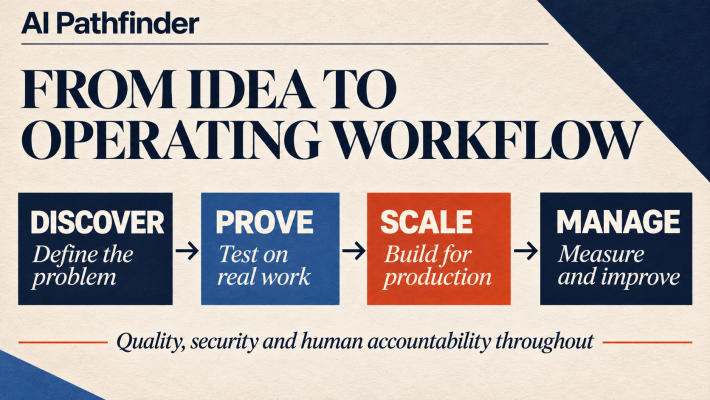
Discover, Prove, Scale, and Manage: a decision at each phase, with risk controls throughout.
Bring the workflow owner, a frontline employee, an expert reviewer, finance, and the relevant data and security owners into the same conversation. Walk through an ordinary case and an exception. Follow the work across systems and people until someone accepts the result.
In our hypothetical service-quote example, suppose the team handles 400 eligible requests each month. Staff search approved documents and prepare drafts, but expert reviewers must reconstruct the evidence before approving them. Missing inputs and unclear handoffs add delay. Giving staff a faster drafting tool would address only part of the problem.
Discovery should establish whether the bottleneck is interpretation, missing information, approval capacity, or a broken process. Better intake fields and pricing rules may solve much of it without AI. AI is a candidate where variable customer language and scattered approved content make interpretation and retrieval costly.
A filled-in AI Use Case Canvas
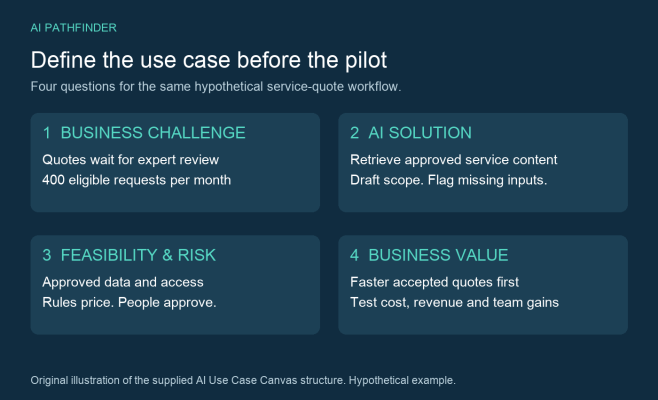
AI Use Case Canvas: define the challenge, solution, feasibility and risk, and business value together. Hypothetical example.
This text example follows the four sections of the AI Use Case Canvas used in discovery. All scenario numbers and targets below are hypothetical teaching assumptions, not customer results or market benchmarks.
1. Business Challenge. Customers wait for accurate service quotes. Coordinators search and assemble information, salespeople chase status, and experts repeatedly verify scope. The workflow occurs 400 times monthly. The assumed baseline is 60 hands-on minutes per accepted quote and a two-business-day median turnaround. The cost of inaction includes recurring overtime, diverted expert attention, and potentially lost business. Lost revenue remains unquantified until opportunity evidence supports it.
2. AI Solution. A generative model interprets the request, retrieves approved service descriptions, and prepares a structured draft with source references and missing-information flags. Conventional automation validates required fields and calculates prices from approved rules. This example does not need a predictive model. Inputs are authorized request text, current service catalog and price tables, approved terms, and relevant CRM fields. AI cannot invent a discount, promise availability, or send a quote.
3. Feasibility & Risk. Confirm that the source owners can supply current, permissioned data and identify which system is authoritative when records disagree. Assess CRM integration, versioning, access controls, retention, sensitive customer information, and the risk of misleading instructions embedded in requests. Data and security owners approve the pilot boundary before use. Missing prices, unsupported services, unusual contractual terms, and unresolved access questions go to people. Sector rules depend on the organization and workload: NERC CIP may be relevant in covered electricity-sector contexts, not as a universal AI requirement.
4. Business Value. Choose faster accepted quotes as the primary outcome. Secondary hypotheses are lower avoidable overtime, improved conversion, and reduced review burden. Set the four-outcome scorecard below, keep quality and access controls as hard gates, and have finance test the investment case. Expected ROI remains conditional until spending reductions and incremental margin are evidenced. Risk reduction is also measured through source fidelity, prevented unauthorized actions, and incident handling, not assumed because a control exists.
The canvas gives the team a shared explanation of the problem, the AI contribution, the constraints, and the intended result. The workflow owner leaves discovery with that canvas, a measured baseline, approved data scope, and a bounded proof plan. The decision is to proceed, fix prerequisites, use an existing tool, or stop. This prevents buying technology for a problem the team has not defined.
Prioritize the candidates before choosing a pilot
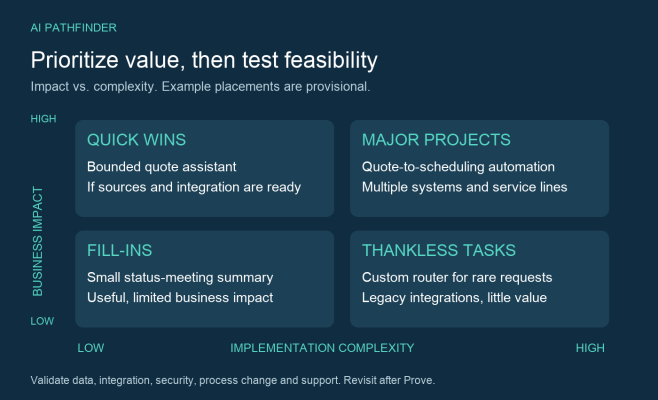
Impact rises upward. Complexity rises to the right. Placements are hypothetical and depend on evidence, including readiness and risk.
Complete a canvas for each serious candidate, then place the candidates on an impact-versus-complexity matrix. Business impact rises from bottom to top. Implementation complexity rises from left to right. Impact reflects the four business outcomes, with full costs, risk, and confidence considered. Complexity includes data readiness, integrations, security and compliance, process change, training, and ongoing support.
For this hypothetical business, the placements might look like this:
- Quick Wins, high impact and low complexity: the bounded service-quote assistant, if approved sources and a supported CRM connection already exist. It addresses a frequent customer-facing delay while keeping pricing and approval under control. If data cleanup or integration proves difficult, it moves right. An easy demo with little business value does not qualify.
- Major Projects, high impact and high complexity: automating quote-to-scheduling across several service lines. It could address a larger bottleneck, but live capacity, pricing, contracts, and fulfillment systems add dependencies. Break it into valuable bounded phases, beginning with the quote workflow where justified.
- Fill-ins, low impact and low complexity: summarizing a small internal status meeting. It may be useful, but should not displace work with a stronger business case.
- Thankless Tasks, low impact and high complexity: building a custom AI router for rare, low-value requests across several legacy systems. Deprioritize it unless mandatory compliance work or an enabling dependency changes the decision.
These placements are provisional judgments, not numerical scores or validated results. Record the evidence and confidence beside each one, and revisit the map after Prove. Discovery ends by selecting a meaningful, feasible pilot and documenting why it outranks the alternatives.
Prove: test the whole improvement on real work
Start with historical cases and a no-write shadow evaluation. Include difficult requests, stale sources, missing fields, permission failures, and attempted instruction injection. After the appropriate approvals, test a constrained live workflow against manual processing and a simpler intake-and-rules alternative. Use comparable case mixes and the same acceptance standard. Random assignment is preferable where practical.
For the quote workflow, an authorized request creates a case record. The system retrieves only permitted sources, and the model returns a draft scope, cited evidence, and unresolved questions. Rules check the structure, service eligibility, price arithmetic, and required approvals. A trained reviewer sees the evidence beside the draft, corrects or rejects it, and authorizes the final quote. A restricted integration can then save the approved version. Customer sending remains an authorized human action. Logs record sources, versions, approvals, costs, failures, and write status, with duplicate protection and a manual recovery route.
This design can improve the workflow because the reviewer no longer has to repeat every search. That claim has to survive measurement. Count searching, reviewing, correcting, retrying, and manual fallback through accepted completion. Include all assigned cases, including failures. Track the backlog so unfinished work cannot disappear from the results.
The four-outcome scorecard
These are illustrative discovery baselines and proposed targets for the same 400-request monthly workload. The “after” column is a target state to test, not an observed result. A real team replaces every assumption with records and names its owners.
TIME | Before: 60 hands-on minutes and a two-business-day median turnaround. Target after: 45 blended hands-on minutes and a one-business-day median. The operations analyst measures case timestamps and effort through acceptance, including exceptions. The workflow owner is accountable. Report the slowest cases and overdue queue alongside the median.
COST | Before: $3,000 monthly overtime for this work, with no AI project expense. Target after: $1,000 overtime plus $1,500 recurring project cost. Finance verifies payroll and the complete cost ledger. That would mean $500 less recurring expense monthly, before recovering a hypothetical $12,000 setup investment. Salary capacity is reported separately.
REVENUE | Before: 100 wins from 400 comparable qualified requests, a 25% conversion rate. Target after: 108 wins, or 27%. Sales operations owns the cohort analysis and attribution, with finance validating realized revenue and margin. The hypothesis requires sufficient demand, comparable opportunity quality, and fulfillment capacity. Follow cohorts until outcomes mature rather than comparing a closed cohort with an unfinished one.
PEOPLE AND TEAMS | Before: 400 monthly hands-on hours, 20 reviewer minutes per quote, and 20% of cases returned for missing information. Target after: 300 hours, 15 blended reviewer minutes, and 10% returned. The team manager validates effort logs, return reasons, workload feedback, and the destination of recovered time. The proposed operating target is 75% use among eligible cases, measured separately from draft acceptance and final completion. Rework and review time are already inside the hands-on totals.
The target effort assumes 300 cases use AI assistance at 40 minutes each, while 100 remain manual at 60 minutes: 300 hours overall. Review time assumes 300 assisted cases at an average of 13⅓ minutes and 100 manual cases at 20 minutes, producing a blended 15 minutes. These assisted averages include corrections and fallback. Track actual usage, reviewer effort, and acceptance rather than treating the target as a promise.
Agree on the exit criteria before testing. In this illustration, proceed only if the time target is supported, material quote errors do not increase, prohibited disclosures or actions are blocked, reviewer workload is acceptable, and the full-cost case meets the company’s investment hurdle. A security boundary failure pauses the pilot. Inconclusive quality or revenue evidence requires more observation or a narrower claim.
The proof lead delivers a comparison report with denominators, uncertainty, exceptions, actual costs, and employee feedback. The business owner, finance, and security reviewers decide whether to scale, repair and retest, narrow the scope, or stop. A small clean test cannot prove the absence of rare harms.
Scale: redesign the operating workflow around the evidence
If proof supports the change, the production work is more than giving everyone access. Connect the approved sources and CRM, establish version ownership, and remove redundant handoffs where evidence permits. Put the draft, citations, price checks, and unresolved questions on the reviewer’s working screen. Keep exceptional quotes on an explicit route with a named owner.
In the example, a faster draft produces faster customer turnaround only if reviewers can act on it. The team may need a shared review queue, clear delegation limits, and coverage when the usual approver is unavailable. Train coordinators and reviewers on real failure cases. Explain which decisions stay human and where people can question or correct the system.
Agree on the use of recovered capacity. The illustrative target releases 100 hours monthly. Suppose 40 of those hours remove overtime paid at $50 an hour. The remaining 60 hours can support follow-up and exception handling, subject to actual workload. They are not additional cash savings. Delivery capacity for any extra sold work must be confirmed separately.
What the target economics would mean
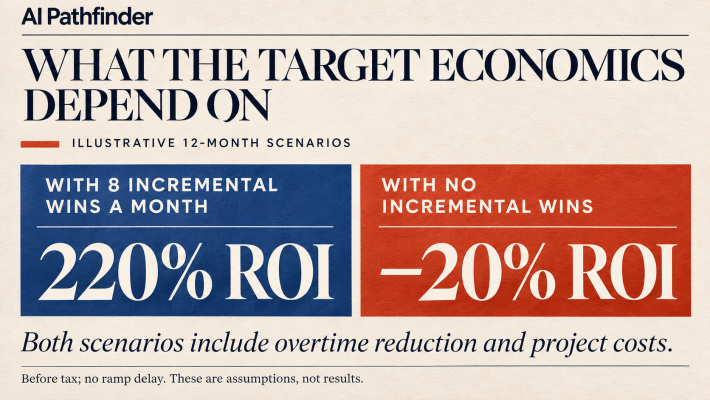
Assume the eight additional wins are genuinely incremental and each yields $2,500 of realized revenue at a 30% contribution margin after variable fulfillment costs. That would produce $20,000 of additional revenue and $6,000 of contribution monthly. Add the separate $2,000 overtime reduction and subtract $1,500 recurring project cost: $6,500 monthly net benefit before setup recovery.
With $12,000 setup and 12 months at that steady operating level, project cost is $30,000. Benefits are $96,000, net benefit is $66,000, and simple ROI is 220%. This is an illustrative, undiscounted, pre-tax scenario, not a forecast or a Netsync price. It assumes no ramp delay and full benefit realization throughout the period.
The setup allowance covers data preparation, integration, evaluation, security work, and training. Recurring cost covers model usage and retries, hosting, maintenance, monitoring, and ongoing support, including incremental internal effort. Do not charge per-case review twice. Revise the model for actual ramp, additional overhead, financing, or exit costs.
The revenue assumption carries most of this return. With no attributable additional wins, the same overtime reduction yields only $500 monthly after recurring costs. Over 12 months, the project loses $6,000 after setup, a negative 20% ROI. If overtime also stays unchanged, the spending case weakens further. Faster service and better work may still justify investment, but leadership must approve those benefits on their own terms.
Do not add a dollar value for the 100 released hours to those financial benefits. The hours enable the overtime reduction and follow-up capacity already described. Also keep avoided quote-preparation overtime outside the fulfillment costs used to calculate contribution margin, or adjust the model to remove the overlap.
The production lead delivers tested integrations, operating procedures, training, rollout and rollback plans, and named business and support owners. Expansion requires production acceptance and funded operating capacity. This stage prevents a good pilot from becoming an unsupported service.
Manage: keep the result true after launch
Sources change. Prices change. Models change. Employees find shortcuts, and the customer mix shifts. Management makes those changes visible before they quietly erase the gains.
The workflow owner reviews the same four-outcome scorecard against actual results. Finance reconciles reduced expenses and attributed margin. The team manager checks whether recovered capacity reached its intended destination and whether reviewer burden, rework, or bypass rates are rising. Usage alone is weak evidence of value.
The operating team monitors access, source freshness, quality, latency, cost per accepted quote, and failed integrations. It records incidents and near misses, tests recovery, and retests after material model, prompt, data, permission, or workflow changes. Give a named person authority to disable the system and restore the manual path.
My earlier edition, The AI Bill Is Not the Real Cost of the Work, explains why these costs belong around accepted completed work. Cheap generation can coexist with expensive correction.
At each agreed review, decide whether to continue, improve, restrict, retire, or expand. A new department or a broader class of quotes needs its own data, risk, and value check. Proven performance in the original scope does not automatically authorize more autonomy.
Your next working session
Choose one recurring workflow and bring its owner, a person who performs it, a reviewer, finance, and the relevant technical and security leads. Fill in the four canvas sections together. Choose one primary outcome, add the secondary outcomes that matter, and record baseline, target, measurement, and owner for each.
Leave with a decision about the next phase and the evidence required to enter it. If the sources, baseline, or permissions are missing, assign those gaps before funding a pilot. We can help create an AI readiness and AI agent governance checklist for you as needed.
An AI project earns expansion when the business can show what improved, who benefited, what it cost, and who will keep it working.
About Jason Fleagle
Jason Fleagle is the Head of AI at Netsync and writes AI Pathfinder about practical AI adoption, business value, and secure operations. He helps leaders connect AI strategy with governed workflows and measurable outcomes. Learn more about Netsync’s AI and automation services.