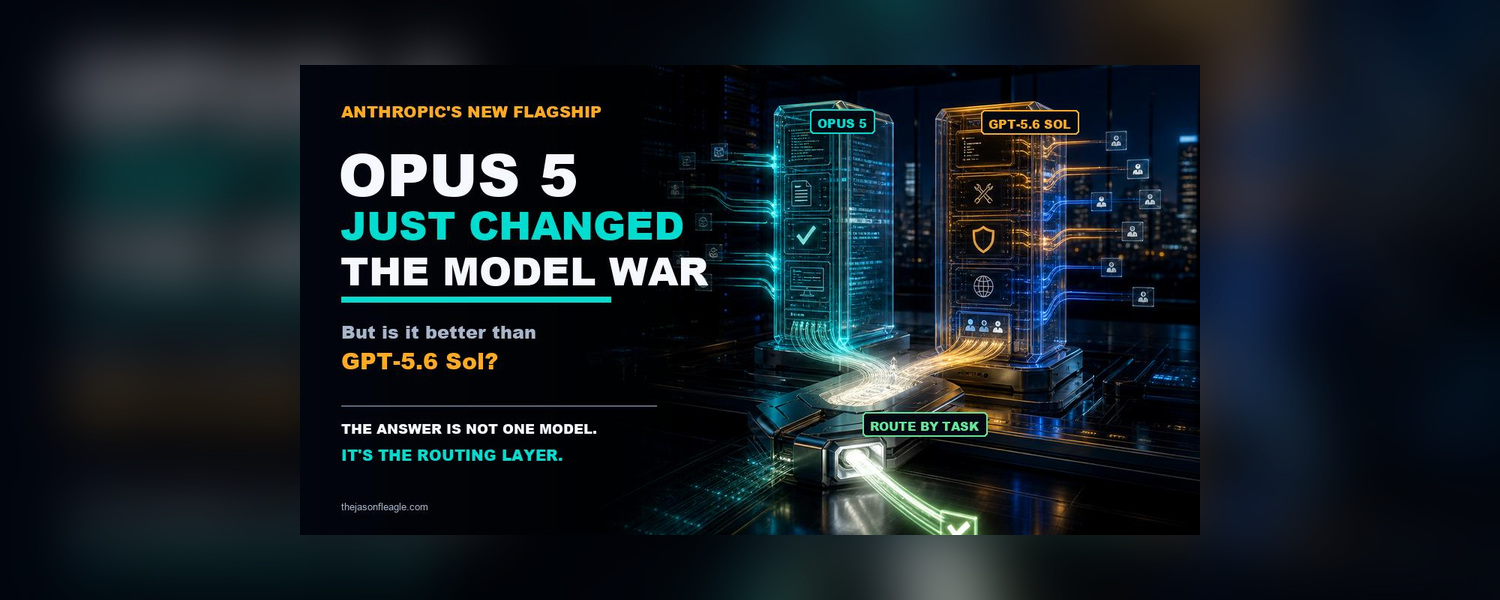
Anthropic Launches Opus 5, But Is It Better Than GPT-5.6 Sol?
Quick take: Claude Opus 5 has strong published signals in selected judgment-heavy coding, self-verification, computer-use, and very-long-context workloads. GPT-5.6 Sol remains compelling for terminal execution, broad tool orchestration, advanced cyber evaluations, and OpenAI-native workflows. These are not controlled equal-compute comparisons. The enterprise winner is a governed routing strategy—not one model everywhere.
Anthropic's new model wins important coding and computer-use tests. OpenAI's flagship still has meaningful advantages. The real answer depends on what you are asking the model to do.
Anthropic just made the frontier model race complicated again.
Anthropic released Claude Opus 5 on July 24, 2026. Anthropic reports substantial gains over Opus 4.8 at the same API price and positions the model for the long-running agentic work becoming a central enterprise AI battleground.
The immediate question is obvious: Is Opus 5 better than OpenAI's GPT-5.6 Sol?
The honest answer is yes and no.
Anthropic reports category-leading results on selected coding, computer-use, and professional-work evaluations, while Cognition's FrontierCode leaderboard provides a narrower third-party coding signal. Most of these results are not controlled, same-harness head-to-head tests.
OpenAI reports strong GPT-5.6 Sol results in terminal execution and advanced cybersecurity evaluations, alongside broad first-party tool support. Its practical advantage in multimodal and orchestration-heavy work remains workload- and harness-dependent.
That may sound like a hedge, but it is actually the more important signal.
The frontier is getting too capable, too configurable, and too dependent on the surrounding agent harness for one leaderboard to tell you which model is "best."
The new competitive question is not: Which model wins?
It is: Which model should receive this task, at this effort level, inside this workflow, with these tools, permissions, and success criteria?
That is a very different AI operating model.
What Anthropic Actually Released
Claude Opus 5 is now available across Claude, Claude Code, the Claude API, Amazon Bedrock, Google Cloud, and Microsoft Foundry.
It becomes the default model on Claude Max and the strongest model available on Claude Pro.
The API price remains:
$5 per million input tokens
$25 per million output tokens
That is the same base price as Opus 4.8 and lower than GPT-5.6 Sol's $30 output-token rate, but not by much, and it comes down to price/performance.
Opus 5 also includes:
- A 1-million-token context window
- Up to 128,000 output tokens
- Thinking enabled by default, with API effort defaulting to high
- Five effort levels: low, medium, high, xhigh, and max
- A Fast mode, available on the Claude Platform and through usage credits in Claude Code, that runs about 2.5 times faster at twice the base price
- Better multi-agent coordination
- Mid-conversation tool changes in beta
- Optional model fallbacks when a request triggers a safety classifier
Anthropic positions the model as close to Claude Fable 5 frontier intelligence at roughly half the price.
Fable 5 remains Anthropic's higher-capability widely released tier.
Opus 5 is designed to bring more frontier capability into everyday enterprise use at Opus pricing.
The Biggest Upgrade Is Not Raw Intelligence
The most important improvement in Opus 5 is not that it can produce a more impressive first answer.
It is that the model appears more willing to stay with a problem, question its own assumptions, verify the work, and keep iterating until it reaches a defensible result.
Anthropic says Opus 5 is much stronger at self-verification and root-cause analysis. In one test, the model found the underlying cause of an open-source package-manager bug and fixed an edge case missed by the community patch. In another, it built its own test harness when no live data feed was available to validate the system it had created.
That is the behavior you should care about.
A useful agent is not the model that writes the most confident answer.
It is the model that notices when the evidence is incomplete.
It knows when a patch only treats the symptom.
It checks whether the output works inside the real environment.
It challenges a flawed request instead of obediently building the wrong thing.
Anthropic's own Opus 5 prompting guidance makes the change unusually clear. The company tells developers to remove many legacy "double-check your work" instructions because Opus 5 already verifies itself. It also warns that the model delegates to subagents readily and may over-verify or over-narrate unless the workflow gives it clear limits.
That is a useful problem to have, but it is still a problem.
More intelligence does not remove the need for good orchestration.
It changes what the orchestration must control.
The Benchmark Fight Is Messier Than the Headlines
Anthropic says Opus 5 is state of the art on Frontier-Bench and GDPval-AA, more than doubles Opus 4.8's Frontier-Bench performance at a lower cost per task, and comes within 0.5% of Fable 5's peak CursorBench result at half the cost.
It also reports:
- Roughly 1.5x the next-best pass rate on Zapier AutomationBench at the same cost per task
- A score three times higher than the next-best model on ARC-AGI 3
- Better cost-adjusted results than every other tested model on OSWorld 2.0
- Significant gains over Opus 4.8 in organic chemistry and protein-function tasks
Those results are strong, but model-launch benchmarks need to be handled carefully.
Vendors choose the evaluations, agent harnesses, effort settings, token budgets, and comparison points used in launch materials. Anthropic also notes that its Frontier-Bench results are internal runs using a specific mini-SWE-agent harness, averaged over five attempts, with Opus 4.8 serving as a fallback when safety classifiers blocked Opus 5 or Fable 5.
OpenAI's GPT-5.6 launch data comes with the same category of caveat: impressive results, but produced using OpenAI's selected model configurations, tools, and reasoning modes.
That does not make the numbers useless.
It means they are directional evidence, not a universal verdict.
Opus 5 vs GPT-5.6 Sol: The Practical Comparison
Here is the comparison that matters for operators.
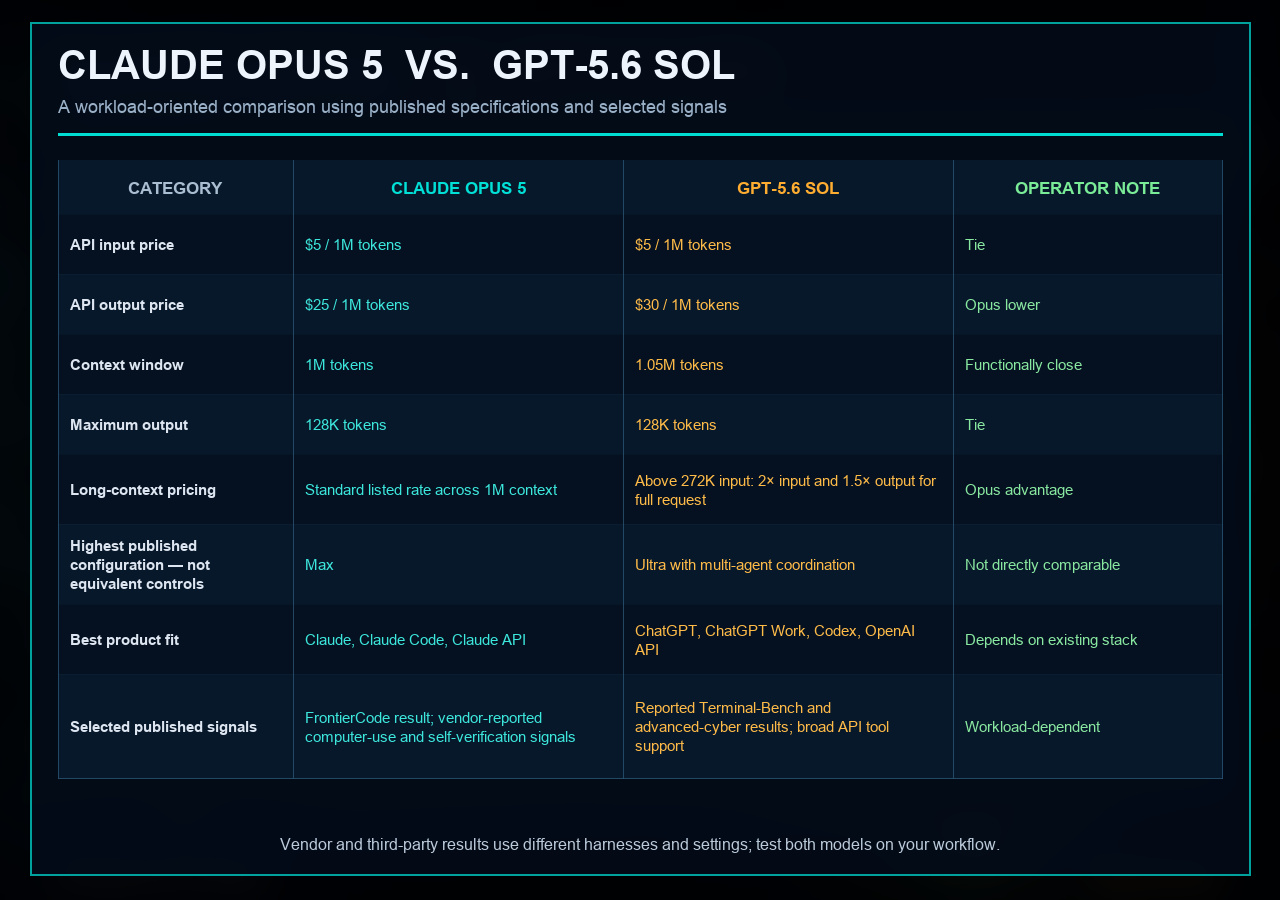
At the specification level, the models are close.
The biggest cost difference appears in output-heavy and very-long-context work.
In my own non-controlled testing, GPT-5.6 Sol has often delivered the best price-to-performance ratio.
Opus 5's output tokens are about 16.7% cheaper. OpenAI also charges a long-context premium once a Sol request exceeds 272,000 input tokens: input is billed at twice the standard rate and output at 1.5 times the standard rate for the full request.
That can materially change the economics of large code repositories, legal archives, due-diligence rooms, research corpora, and long-running agent sessions.
But token price is not the same thing as task price.
The better equation is: Cost per accepted outcome = model tokens + retries + tools + runtime + human correction + risk
If Sol finishes a workflow in fewer turns, it may still be cheaper.
If Opus produces a cleaner result that requires less review, its advantage may be much larger than the token price suggests.
Where Opus 5 Appears to Win
1. Judgment-heavy coding
A useful third-party head-to-head signal comes from Cognition's FrontierCode 1.1 benchmark, which asks whether maintainers would actually merge a model's code rather than merely whether the tests pass.
LLM Stats' July 24 transcription of Cognition's FrontierCode 1.1 leaderboard lists Opus 5 at 53.4% and Sol at 47.5%, with estimated rollout costs of $4.30 and $6.30, respectively. Leaderboard values may change.
That is a meaningful result.
It is also not perfectly apples to apples.
Opus ran at medium effort. Sol ran at max.
The result tells us that the published Opus configuration was more mergeable and less expensive in that test. It does not isolate the underlying model weights at an equal compute budget.
Still, if your workflow values tight diffs, scope discipline, root-cause debugging, code review, and fewer false positives, Opus 5 deserves the first test.
2. Computer use and business automation
Anthropic's launch comparison lists Opus 5 at 70.6% on OSWorld 2.0 and cites a 62.6% published result for Sol. Treat the gap as directional because these were not demonstrated here as controlled same-harness runs. Opus 5 also leads Anthropic's launch comparisons on AutomationBench and GDPval-AA.
That points toward strength in workflows where the model has to navigate software, interpret a business task, use several tools, and verify that the work is finished.
3. Self-correction and professional judgment
In testimonials included in Anthropic's launch post, early customers describe Opus 5 as better at challenging bad assumptions, identifying subtle hazards, and explaining why a decision is sound.
That is difficult to compress into one benchmark.
It may also be the most valuable difference for legal review, financial analysis, architecture decisions, scientific work, and executive research.
4. Large-context economics
Both models can accept roughly one million tokens.
But Opus 5's standard pricing across that window is simpler and potentially much cheaper than Sol once the prompt exceeds OpenAI's 272,000-token long-context threshold.
For teams feeding an agent very large working sets, that deserves attention.
Where GPT-5.6 Sol Appears to Win
1. Terminal-heavy execution
OpenAI reports strong Terminal-Bench results for GPT-5.6 Sol, but published figures use different benchmark versions and configurations. Its launch evidence also emphasizes persistent tool use, repeated testing, debugging, and multi-stage technical execution; exact percentages should only be compared after matching benchmark version, harness, and reasoning mode.
If the work is primarily:
- Inspect the system
- Run commands
- Read failures
- Modify files
- Test again
- Publish the finished artifact
Sol and the Codex harness make a strong combination.
2. Multi-agent orchestration
Sol's Ultra mode can coordinate concurrent subagents and synthesize their work in one request. OpenAI's Programmatic Tool Calling also allows the model to write and execute in-memory programs that coordinate tools and process intermediate results.
Opus 5 is also strong at multi-agent coordination, but Sol's model-plus-platform packaging is especially compelling for broad, execution-heavy workflows.
3. Cybersecurity
Anthropic says it intentionally avoided training Opus 5 on cyber tasks. It can find vulnerabilities, but it remains substantially behind Mythos 5 in exploit development.
OpenAI positions GPT-5.6 Sol as a frontier cybersecurity model and reports strong performance on SEC-Bench Pro, capture-the-flag tasks, ExploitBench, and ExploitGym, with additional access controls for higher-risk capabilities.
For advanced cyber tasks represented by OpenAI's reported evaluations—and where access controls permit them—Sol has the stronger public benchmark case. Defensive workflows still require task-specific testing.
4. OpenAI-native knowledge work
OpenAI says GPT-5.6 is available across ChatGPT, ChatGPT Work, Codex, and the API. In the Responses API, GPT-5.6 Sol supports web search, file search, image generation, Code Interpreter, hosted shell, computer use, MCP, and tool search; tool availability varies by product.
If your organization already operates inside that environment, switching the model may create more friction than the benchmark gain removes.
The harness still matters.
The Harness Is Still Part of the Model
When someone says "Opus 5 is better than Sol," ask what they actually tested.
Did they compare Claude with ChatGPT?
Claude Code with Codex?
The raw APIs?
The same tools and permissions?
The same effort level?
The same maximum token budget?
The same deadline?
The same human reviewer?
Those are not small details.
The deployed product is the model, context strategy, tool layer, memory, orchestration loop, safety policy, interface, and evaluation system working together.
A model can be stronger in isolation and still produce worse business outcomes inside a weaker harness.
That is why the next phase of the model war will look less like one winner taking everything and more like an intelligent routing layer.
The AI Pathfinder Verdict
Is Claude Opus 5 better than GPT-5.6 Sol?
For judgment-heavy coding, careful review, computer use, self-verification, and very-large-context economics: Opus 5 is the stronger first choice right now.
For terminal-heavy execution, multi-tool orchestration, advanced cyber evaluations, and OpenAI-native workflows: GPT-5.6 Sol is the stronger first model to test.
In my own tests with OpenClaw and Hermes, GPT-5.6 Sol has performed better on some large-context, coordination-heavy workflows. That is anecdotal and harness-specific, not a general model ranking.
For enterprise deployment, neither should become the default everywhere. Given the pace of model development, staying model-agnostic is important.
The mature architecture is:
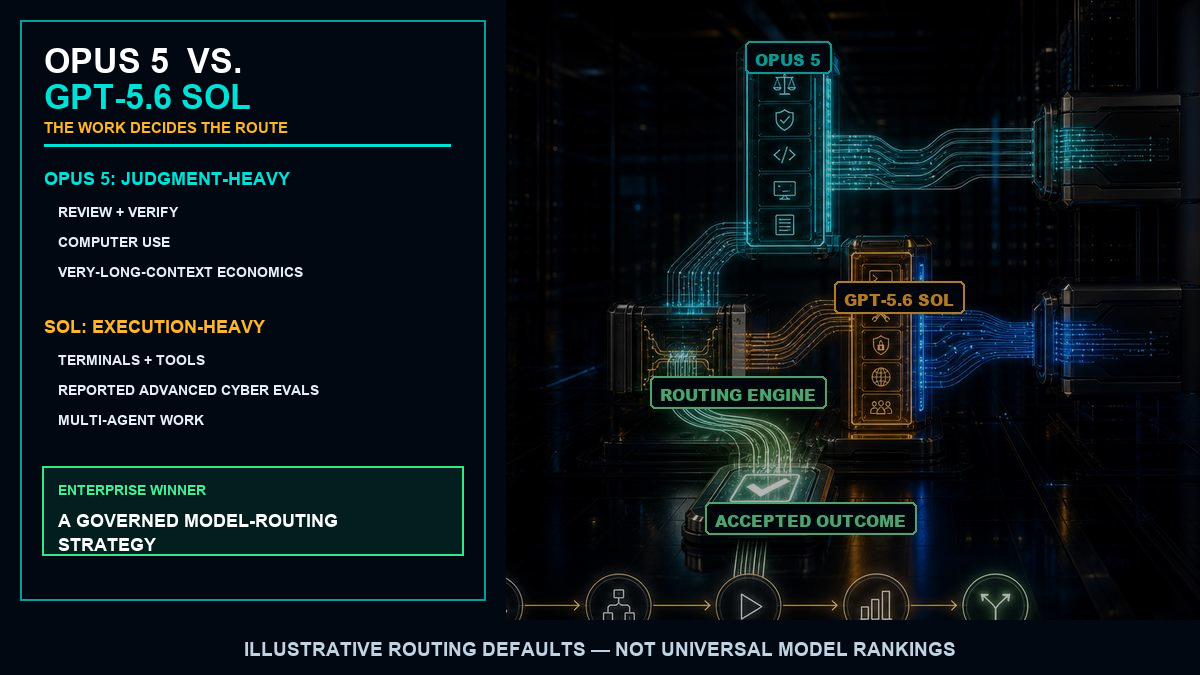
Route routine, high-volume work to the cheapest model that reliably passes your evaluation.
Escalate ambiguous, high-risk, or judgment-heavy work to Opus 5 or Sol.
Use a second model as reviewer when the cost of a wrong answer is high.
Measure accepted outcomes, not impressive drafts.
Keep the workflow, memory, evaluations, and institutional knowledge portable across model providers.
The last point is critical.
If your company has to rebuild its operating system every time a new model wins a benchmark, you do not own an AI capability.
You rent one.
Your AI Action Plan
Here is what I would do this week.
1. Build a 10-task private evaluation
Choose real work your team already performs:
- One complex code change
- One root-cause debugging task
- One code review
- One long-document analysis
- One spreadsheet or presentation deliverable
- One browser workflow
- One research task requiring citations
- One ambiguous strategy problem
- One security review
- One multi-tool operational workflow
Do not use toy prompts.
Use work that has a clear definition of done.
2. Match the test conditions
Give both models the same source files, tools, permissions, deadline, and success criteria.
Compare equivalent effort settings where possible.
Start each model in a clean session.
3. Score what remains
Track:
- Completion rate
- Human edits required
- Factual or technical errors
- Tool calls
- Retries
- Latency
- Total cost
- Policy refusals or fallbacks
- Whether a reviewer would accept the result
The winning model is not the one with the most polished explanation.
It is the one that leaves the least work behind.
4. Build a routing policy
Use the evaluation to decide which model handles:
- Default work
- Complex escalation
- Independent review
- Cybersecurity
- Long-context analysis
- High-volume automation
5. Re-evaluate the harness
Test the full product, not only the model.
Claude Code and Codex may produce different results even when the raw model intelligence is close. Your tools, approval gates, memory architecture, and evaluation loop can reverse the outcome.
Frequently Asked Questions
What is Claude Opus 5?
Claude Opus 5 is Anthropic's newest generally available Opus model, released on July 24, 2026. It is designed for complex agentic coding, enterprise knowledge work, computer use, and long-running tasks.
How much does Claude Opus 5 cost?
The Claude API price is $5 per million input tokens and $25 per million output tokens. Fast mode is a first-party API research preview and costs twice the base rate.
Is Opus 5 cheaper than GPT-5.6 Sol?
Input pricing is the same at $5 per million tokens. Opus 5 output is $25 per million tokens compared with $30 for Sol. Opus 5 also avoids Sol's long-context premium above 272,000 input tokens.
Which model is better for coding?
Opus 5 leads the cited published configuration on FrontierCode 1.1 and selected vendor-reported coding evaluations. These results do not establish a universal coding winner because harnesses, effort settings, and token budgets differ. Sol may still be the better fit for terminal-heavy work inside Codex; test both on your own repositories.
Which model is better for business work?
Opus 5 appears especially strong in judgment-heavy analysis, automation, and computer use. Sol is especially strong when the workflow depends on broad tool orchestration, browsing, artifact creation, and the ChatGPT Work ecosystem.
Which model is better for cybersecurity?
GPT-5.6 Sol has the stronger public case for advanced cybersecurity work. Anthropic intentionally kept Opus 5 behind Mythos 5 in offensive cyber capabilities.
Should an enterprise standardize on one model?
Probably not. A portfolio and routing strategy lets the organization balance quality, cost, latency, risk, and ecosystem fit while keeping its workflow intelligence portable.
Your Bottom Line
Anthropic did not end the model war with Opus 5.
It made the war harder to summarize.
Opus 5 appears to be the more careful operator.
GPT-5.6 Sol appears to be the more expansive execution engine.
But the real winner will not be chosen by a benchmark screenshot.
It will be chosen inside the workflow.
Give both models the same job.
Give them the same tools.
Give them the same finish line.
Then measure which one leaves less work behind.
That is the model worth deploying.
If your organization needs help evaluating frontier models, designing an AI routing strategy, or building secure agentic workflows that create measurable value, reach out to our team at Netsync.
About Jason Fleagle
Jason Fleagle is the Head of AI for Netsync and an AI and Growth Consultant working with global brands to help them adopt and govern AI successfully. He helps humanize data—so every growth decision an organization makes is rooted in clarity, not confusion. He has overseen the development and delivery of over $50M in digital solutions, driving significant revenue growth and operational efficiency for his clients.
Connect with Jason on LinkedIn to stay updated on the latest in AI, growth strategies, and enterprise technology.
Related Reading
- AI Readiness Scorecard
- AI Model Evaluation for Business
- AI Governance Checklist
- AI Agent Use Case Library
- Human-in-the-Loop AI Governance
- Prompt Injection Risk for Business Leaders
- Microsoft Copilot Governance
- Enterprise AI Roadmap Template
References
- 1. Anthropic: Introducing Claude Opus 5
- 2. Anthropic: Prompting Claude Opus 5
- 3. OpenAI: GPT-5.6 – Frontier intelligence that scales with your ambition
- 4. OpenAI: GPT-5.6 Sol model specifications
- 5. Cognition: FrontierCode Leaderboard
- 6. LLM Stats: Claude Opus 5 vs GPT-5.6 Sol Frontier Analysis
- 7. BenchLM: Claude Opus 5 vs GPT-5.6 Sol comparison
- 8. CNBC: Anthropic launches Claude Opus 5
- 9. Technology.org: Anthropic launches Claude Opus 5 at half the price
- 10. Lenny's Newsletter: Claude Opus 5 review
Originally published on LinkedIn.
About AI Pathfinder
AI Pathfinder is Jason Fleagle’s recurring field note on enterprise AI, agentic systems, AI governance, and the operating models leaders need as AI moves from experiments into real work.