
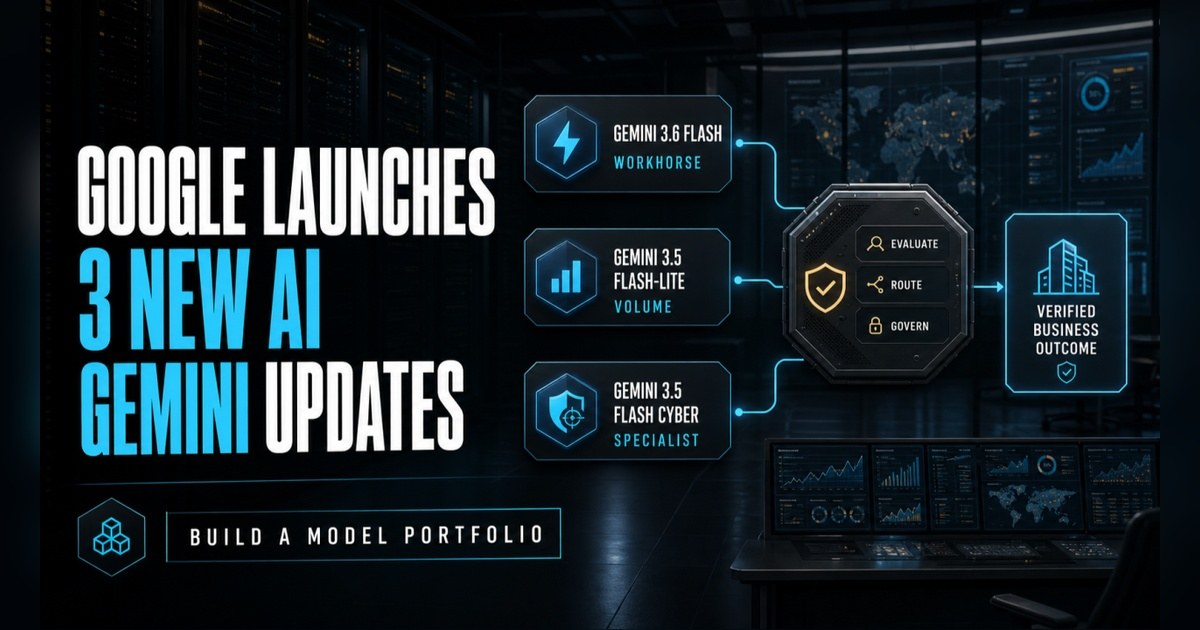
Google Launches 3 New AI Gemini Updates
What Google's new Gemini Flash lineup reveals about routing, agent economics, and governed specialization.
Quick take: Google’s new Gemini lineup points toward a model-portfolio strategy: route work by complexity, sensitivity, and cost per successful task instead of forcing one model onto every workflow.
Google released three Gemini models with three different jobs.
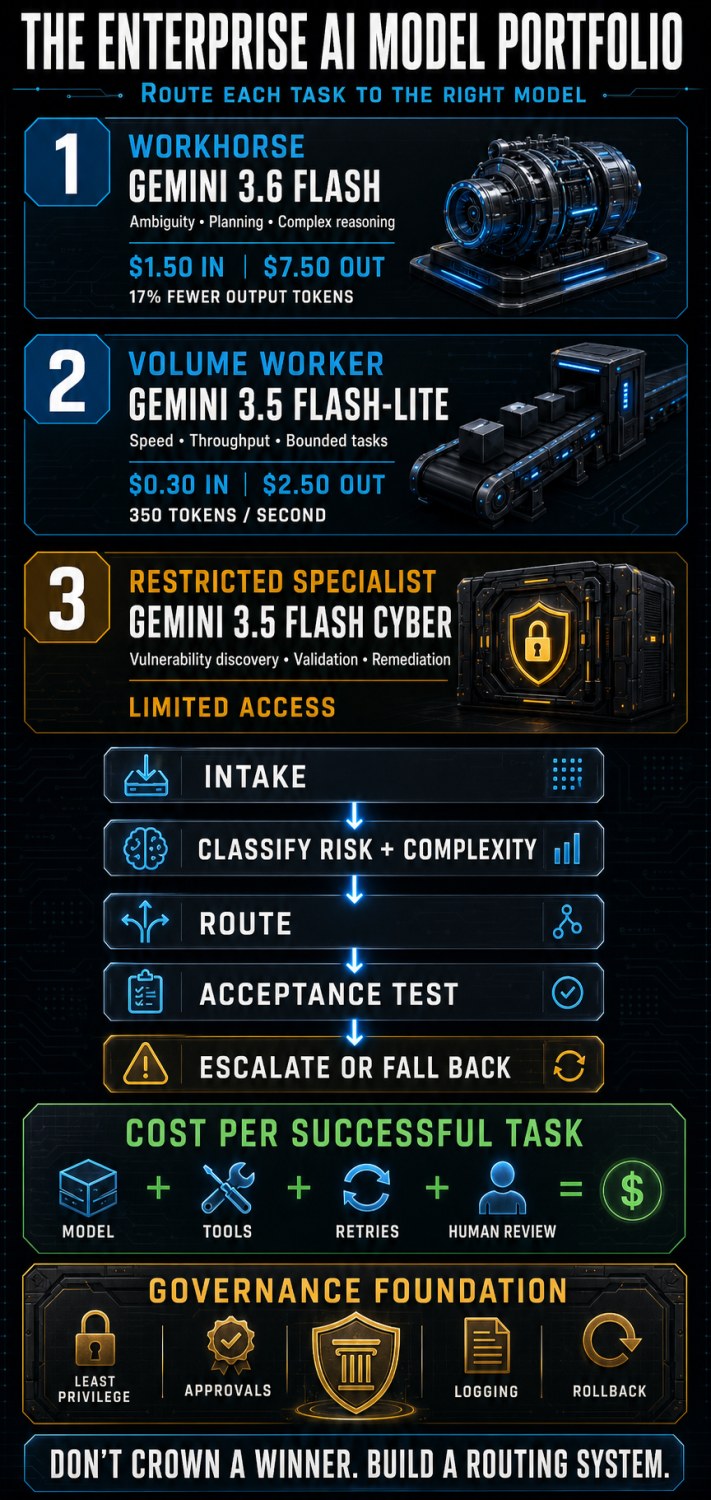
Gemini 3.6 Flash is the capable workhorse. Gemini 3.5 Flash-Lite is the fast, inexpensive worker. Gemini 3.5 Flash Cyber is a restricted specialist inside Google's CodeMender security system.
Most model coverage will focus on which benchmark each one won.
I think the more useful question is this: Where does each model lower the cost of completing acceptable work?
That is the question enterprise teams will have to answer as AI agents move from isolated pilots into real operations. Token price matters. So do retries, tool calls, latency, human correction, failed actions, and the cost of cleaning up a bad result.
The model portfolio is becoming part of the operating model.
Breaking Down Why the Gemini Model Update Matters
In its official announcement, Google positioned the lineup around production AI agents:
- Gemini 3.6 Flash targets coding, knowledge work, multimodal analysis, and multi-step workflows.
- Gemini 3.5 Flash-Lite targets low-latency, high-throughput work such as agentic search, document processing, and subagent execution.
- Gemini 3.5 Flash Cyber targets vulnerability discovery and remediation through CodeMender.
Google also says Gemini 3.5 Pro is testing with partners and that pre-training for Gemini 4 has begun.
The release does not prove that every enterprise needs the same three-layer architecture. It does show how quickly the one-model-for-everything assumption is breaking down.
What Google released
Gemini 3.6 Flash: the workhorse
Google reports that 3.6 Flash uses 17% fewer output tokens than 3.5 Flash on the Artificial Analysis Index. On DeepSWE, Google says output-token use can fall by as much as 65%. It also says the model takes fewer reasoning steps and tool calls to complete multi-step work.
Published pricing is $1.50 per million input tokens and $7.50 per million output tokens.
Google reports gains over 3.5 Flash on several evaluations:
- DeepSWE: 49% versus 37%
- MLE Bench: 63.9% versus 49.7%
- OSWorld-Verified: 83.0% versus 78.4%
- GDPval-AA v2: 1421 versus 1349
The company also describes stronger performance in document parsing, chart analysis, data analysis, and report drafting. The Gemini 3.6 Flash model card provides the accompanying technical and safety detail.
These numbers justify an evaluation. They do not establish that 3.6 Flash will outperform another model inside your data environment, tool stack, or agent harness.
Gemini 3.5 Flash-Lite: the volume worker
Google reports that Artificial Analysis measured Flash-Lite at 350 output tokens per second. Published pricing is $0.30 per million input tokens and $2.50 per million output tokens.
Google also reports substantial gains over 3.1 Flash-Lite:
- Terminal-Bench 2.1: 54% versus 31%
- GDM-MRCR v2: 72.2% versus 60.1%
- GDPval-AA v2: 1140 versus 642
It reportedly beats Gemini 3 Flash on SWE-Bench Pro and OSWorld-Verified as well. The Gemini 3.5 Flash-Lite model card contains more detail.
This may be the more consequential release for teams running agents at scale.
A large workflow contains plenty of jobs that do not need the strongest available model. Classify a request. Extract fields. Translate a receipt. Search a catalog. Inspect a browser state. Run one bounded coding task.
Those jobs may execute thousands of times. Paying workhorse rates for every step can be wasteful. Using a cheaper model that fails repeatedly can be even more expensive.
Gemini 3.5 Flash Cyber: the restricted specialist
Google built Gemini 3.5 Flash Cyber on top of 3.5 Flash and fine-tuned it to find, validate, and patch critical software vulnerabilities at a lower price per token than larger models. Inside CodeMender, multiple Flash Cyber agents work together to produce one combined security report.
Google says the system reaches competitive frontier performance on CyberGym. Because vulnerability discovery and exploitation are dual-use capabilities, Google plans to offer the model only to governments and trusted partners through a limited-access pilot. It is not described as a generally available Gemini API model.
That restriction is worth noticing. The cyber model is not merely another benchmark entry. It shows that powerful specialist models need an agent system around them and, in sensitive domains, narrower access rather than broader autonomy.
Read Google's Flash Cyber overview and CodeMender introduction for the underlying system design.
Cost per successful task beats token price
Imagine two models processing a contract workflow.
Model A costs less per token but misses key clauses, retries tools, and sends half the documents to a human for repair. Model B costs more per token but finishes correctly on the first pass. Model B may be cheaper.
Now reverse the task. If the job is extracting dates from standardized forms, using the strongest model available may add cost without improving the accepted result.
This is why agent economics cannot stop at an API price sheet.
The useful metric is cost per successful task. That calculation should include:
- model and infrastructure usage
- tool calls
- latency
- retries and failed runs
- human review and correction
- security and compliance overhead
- downstream impact from an incorrect action
Google's claim of fewer output tokens for 3.6 Flash is promising. Its claim of fewer reasoning steps and tool calls may matter more. Neither settles the economics until the model runs inside a real workflow.
Ask three questions: Did the task finish correctly? How long did it take? How much human work remained?
My interpretation of the Google Gemini lineup
I read Google's release as a useful model-portfolio pattern, not a universal architecture declaration.
A capable workhorse handles ambiguity, planning, complex reasoning, and the points where mistakes are expensive.
Fast workers handle clear, bounded tasks at scale. They can execute in parallel and escalate uncertain cases.
Restricted specialists operate in narrow, sensitive domains with stronger evidence and access controls.
Google even demonstrates 3.6 Flash acting as a master agent while Flash-Lite produces multiple design concepts underneath it. CodeMender provides the specialist version: several cyber-focused agents coordinated inside a larger security system.
The practical design question is no longer, "Which model should our company use?"
It is, "Which model should handle this step, under these permissions, with this acceptance test and at a particular cost?"
Computer use raises the stakes
Both 3.6 Flash and Flash-Lite include computer use through supported Google platforms.
That moves them beyond generating text. They can interact with interfaces, applications, files, and enterprise systems.
An OSWorld score tells you whether a model can operate a computer in an evaluation. It does not tell you whether the model should approve an invoice, update a customer record, change production code, or send an external message.
A permission model, audit trail, and rollback path are what make computer use deployable.
Before granting access, define:
- which applications and data the agent may use
- where it may write
- which actions require human approval
- how sessions and credentials are isolated
- what gets logged
- when the agent must stop
- how a failed action is reversed
Capability without authority design is how an impressive demo becomes an operating incident.
AI Pathfinder Action Plan
Use this Google Gemini release to test your AI model architecture rather than chase another leaderboard.
- Select three production-shaped workflows: one complex, one high-volume, and one sensitive.
- Break each workflow into planning, execution, review, and escalation steps.
- Compare candidate models using the same data, tools, permissions, and acceptance criteria.
- Measure successful completion, human correction, latency, retries, tool errors, unsafe actions, and total cost.
- Route simple work to faster models, but escalate uncertainty and consequential decisions.
- Put computer use behind least-privilege access, explicit approvals, logging, and rollback.
- Keep a fallback model and provider path so routing reduces lock-in instead of multiplying it.
Two weeks of controlled workflow testing will teach you more than another quarter of benchmark debate.
Frequently Asked Questions
Is Gemini 3.6 Flash Google's most capable model?
Google calls it the workhorse of the Flash lineup, not a universal replacement for every larger model. Gemini 3.5 Pro is still testing with partners.
Why use Flash-Lite if 3.6 Flash is stronger?
Flash-Lite is faster and less expensive. It may be the better option for high-volume, bounded work. The decision depends on the cost and quality of the completed task.
Are Google's benchmark gains enough to justify switching?
No. They justify testing. Public scores do not reproduce your data, tools, prompts, permissions, integrations, or acceptance criteria.
Your Bottom Line
Google's new Flash lineup gives enterprise teams a practical way to think about model roles.
Use a capable model where ambiguity and failure are expensive. Use faster models for bounded volume. Put sensitive specialists inside tighter systems. Then measure the accepted outcome, not just the tokens consumed.
The organizations that get this right will not spend their time arguing over one permanent model winner. They will build the routing, evaluation, and control layers needed to use several models well.
Where would a model portfolio make the biggest difference in your organization: software delivery, document operations, customer workflows, or cybersecurity?
Sources and further reading
- Google's Gemini 3.6 Flash, 3.5 Flash-Lite, and 3.5 Flash Cyber announcement
- Gemini 3.6 Flash model card
- Gemini 3.5 Flash-Lite model card
- Google DeepMind's Flash Cyber overview
- Google DeepMind's CodeMender introduction
About Jason Fleagle
Jason J. Fleagle helps business and public-sector leaders turn AI uncertainty into practical strategy, governance, architecture, and measurable operating outcomes. He is the Head of AI at Netsync Network Solutions and writes AI Pathfinder for leaders trying to adopt AI without losing control of risk, cost, or execution.
Learn more at thejasonfleagle.com and Netsync.
Related reading
- AI Model Evaluation for Business
- AI Governance Checklist
- AI Agent Use Case Library
- Enterprise AI Roadmap Template
Originally published on LinkedIn.
About AI Pathfinder
AI Pathfinder is Jason Fleagle’s field note on enterprise AI, agentic systems, governance, and the operating models leaders need as AI moves from experiments into real work.