
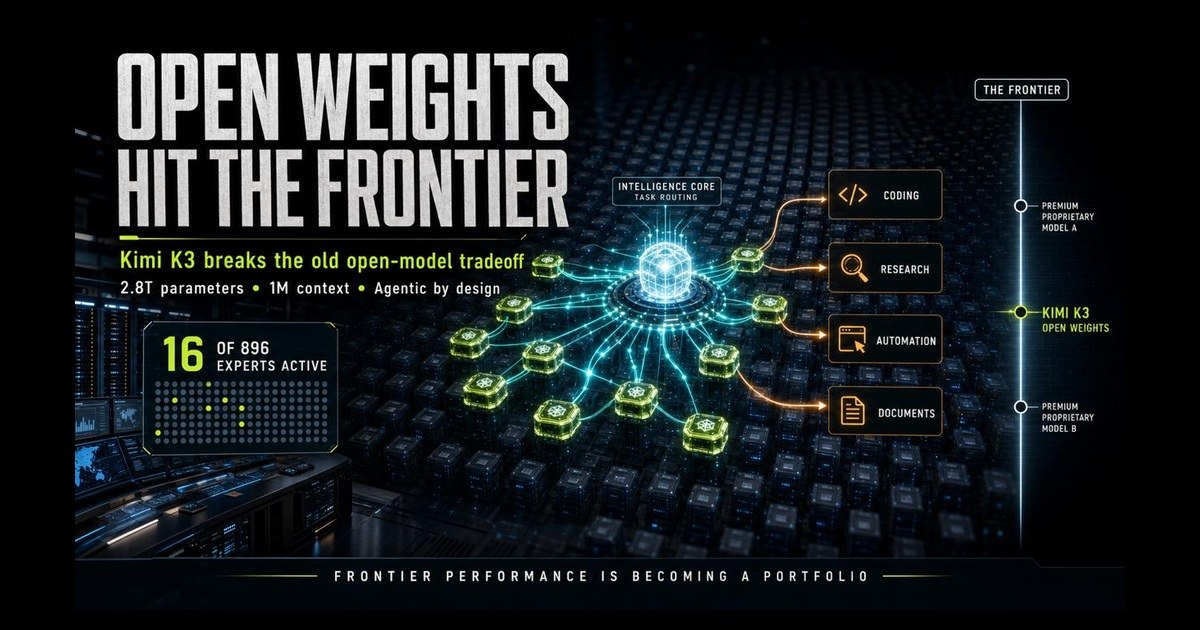
Kimi K3 Just Broke the Open-Model Tradeoff
Quick take: Kimi K3 is an announced open-weight, 2.8-trillion-parameter model that now leads several frontier-model benchmarks in coding, browsing, automation, spreadsheets, and document work. It does not win every evaluation, and its weights are not yet available. Enterprise leaders should test it as part of a governed model portfolio—not treat one leaderboard as a migration plan.
Open models used to come with an understood tradeoff.
You gained control. You gained flexibility. You gained more deployment options.
But you accepted a capability gap.
Kimi K3 is making that assumption much harder to defend.
On July 16, 2026, Beijing-based Moonshot AI released Kimi K3, a 2.8-trillion-parameter reasoning model built for long-horizon coding, research, browser work, knowledge work, and multimodal creation [1].
Moonshot's own release is unusually direct about where K3 stands.
It does not claim the model beats Claude Fable 5 or GPT-5.6 Sol overall.
It says K3 still trails those systems in total performance and user experience.
But K3 finishes ahead of leading proprietary models on several benchmarks involving software engineering, browsing, automation, spreadsheets, and visual documents.
It also debuted at the top of Arena's front-end coding leaderboard, ahead of Fable 5 and Sol, according to Axios [2]. Independent testing from Artificial Analysis places it among the most capable models currently available [3].
That is a strong signal.
The market is no longer divided cleanly between powerful proprietary models and compromised open alternatives.
The frontier is becoming a portfolio and orchestration problem.
The Key Takeaways of Kimi K3
Kimi K3 is Moonshot AI's new flagship reasoning model.
According to Moonshot, it combines:
- 2.8 trillion total parameters
- A sparse mixture-of-experts architecture
- 896 experts, with 16 activated for a given pass
- Kimi Delta Attention
- Attention Residuals
- Native image understanding
- A one-million-token context window
- Always-on reasoning
- Structured outputs and custom tool calling
- Long-running coordination across code, terminals, browsers, and other tools
The model is available through Kimi, Kimi Work, Kimi Code, and the Kimi API.
There is one important qualifier.
Moonshot says the full weights will be released by July 27, 2026 [1].
As of this article, those weights are not yet available for independent inspection or self-hosting.
So K3 is an announced open-weight model with a live managed endpoint, not yet a fully verifiable open deployment.
That distinction matters.
Where Kimi K3 Wins
Moonshot's release compares K3 with Claude Fable 5, GPT-5.6 Sol, Claude Opus 4.8, GPT-5.5, and GLM-5.2.
Several results stand out:
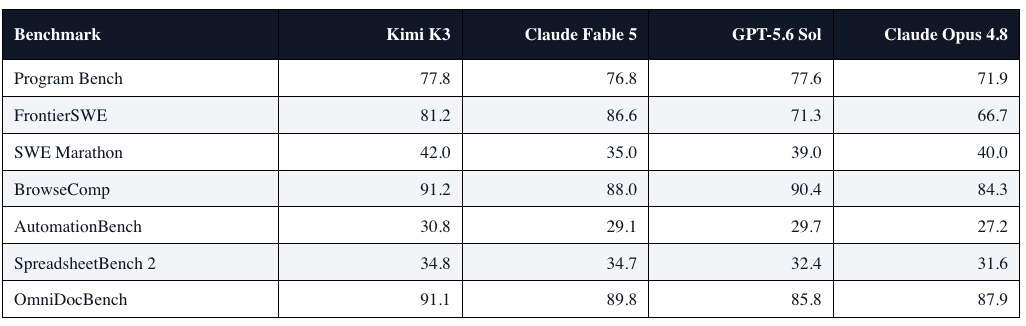
Those are meaningful results.
They are also task-specific, and most come from Moonshot's evaluation package.
K3 looks particularly strong when a task requires sustained tool use, code execution, browsing, automation, spreadsheets, or visual-document understanding.
But it does not win every row.
Moonshot reports weaker results than the leaders on DeepSWE, Humanity's Last Exam, Toolathlon, and several multimodal reasoning evaluations.
That is why the accurate news headline is not: Kimi K3 is the best model in the world.
The accurate headline is: An open-weight model is now winning important frontier-model workloads.
The Independent Signal
Vendor benchmark tables are useful, but they are not enough.
Independent signals provide a more balanced picture.
Axios reported that K3 reached the top of Arena's front-end coding leaderboard, beating leading U.S. models in blind output comparisons [2]. Participants evaluate the result without seeing the model name, which reduces brand bias.
That still does not make the ranking universal.
Front-end coding rewards visual ambition, interaction quality, and aesthetic choices. Those preferences do not prove superiority in security analysis, financial reasoning, regulated decisions, factual research, or production software maintenance.
Artificial Analysis gives K3 an Intelligence Index score of 57, placing it near the top of its tested field. It also measured output around 62 tokens per second and found K3 considerably more verbose than the median reasoning model [3].
That last point matters.
More tokens can mean richer reasoning.
They can also mean more latency and a larger bill.
Enterprise value is not intelligence per token. It is reliable task completion per dollar, per minute, and per unit of human rework.
The Architecture: Massive, but Extremely Sparse
A 2.8-trillion-parameter model sounds almost absurdly large.
But total parameter count is not the same as active computation.
K3 uses a sparse mixture-of-experts architecture. Moonshot says the model contains 896 experts but activates only 16 during a given pass [1].
Think of it less like asking an entire 896-person organization to solve every problem and more like routing each problem to a specialized 16-person team.
That does not make K3 small.
It makes the scale more computationally selective.
Moonshot also introduced two important architectural changes:
Kimi Delta Attention (KDA)
KDA is a hybrid linear-attention mechanism designed to handle long sequences more efficiently. That becomes essential when a model needs to reason across enormous repositories, long research histories, or one-million-token sessions.
Attention Residuals
Attention Residuals are designed to improve how information moves through a very deep network. Instead of accumulating all prior representations uniformly, the system can retrieve information across depth more selectively.
Moonshot says the architecture and training changes deliver roughly 2.5 times better scaling efficiency than Kimi K2 [1].
That is a vendor-reported claim, but it explains the larger design strategy.
K3 is not optimized to be a better chatbot.
It is optimized to be an agent engine.
The Model Is Only Half the Benchmark
There is a caveat inside Moonshot's own footnotes that enterprise buyers should not ignore.
Different models were evaluated through different agent harnesses.
K3 sometimes ran through Kimi Code.
Anthropic models sometimes ran through Claude Code.
OpenAI models sometimes ran through Codex.
In some cases, models were tested through the same harness. In others, each received the environment designed around its strengths.
That makes a perfectly clean comparison impossible.
The harness controls:
- Which tools are available
- How context is compressed
- How failures are retried
- How reasoning history is preserved
- How code is executed and validated
- How the agent plans and delegates work
- When a human is asked to intervene
These are not details around the benchmark. They are part of the system being benchmarked.
Moonshot explicitly warns that K3 is sensitive to its thinking history. If a harness does not return the complete prior assistant message, or if a user switches to K3 in the middle of another model's session, quality may become unstable [1].
That is a critical enterprise lesson.
You are not buying a model score. You are operating a model, harness, toolchain, permission structure, and workflow together.
The Long-Horizon Agent Test
Moonshot's case studies show where the company believes K3 is headed.
The most ambitious examples are not one-turn prompts, but multi-hour agent runs.
Moonshot says K3:
- Built a compact Triton-like GPU compiler
- Designed and verified a small AI chip during a 48-hour autonomous run
- Recreated a computational-astrophysics workflow in about two hours
- Generated an interactive report using thousands of searches, data pulls, filings, and source documents
- Coordinated subagents for scientific and financial research
- Edited video through multiple rounds of visual feedback
These are vendor demonstrations, not independently reproduced production outcomes.
But the direction is important.
The unit of AI work is shifting from an answer to a deliverable.
The model is expected to research, plan, call tools, write code, inspect the result, find defects, revise, and keep going. That makes agent workflow design part of the evaluation.
That is a different category of software.
It is also why K3's known limitation around excessive proactiveness matters so much.
Moonshot says the model may make unexpected decisions when intent is ambiguous because it was trained to keep difficult, long-running tasks moving [1].
That behavior may be useful in a sandbox.
It can become dangerous in production.
Open Does Not Mean Easy
If the weights arrive as scheduled, K3 will create new options for customization, private deployment, research, and sovereign AI.
It will not turn a 2.8-trillion-parameter model into a laptop download.
Moonshot recommends supernode configurations with 64 or more accelerators for K3 deployment [1]. The architecture uses quantization-aware training with MXFP4 weights and MXFP8 activations, extreme expert parallelism, and high-bandwidth communication between accelerators.
In plain English:
K3 may be open, but serving it well is an enterprise infrastructure project.
Most organizations will choose among four practical paths:
- Moonshot's managed API
- A hosted endpoint from another provider
- Private inference through a specialized infrastructure partner
- Self-hosting for organizations with the scale, talent, security requirements, and economics to justify it
That is why leaders should be precise with the word "open."
Open weights do not automatically mean:
- Cheap to operate
- Easy to reproduce
- Fully open training data
- Fully transparent safety work
- Available on commodity hardware
- Ready for regulated production
Openness creates control options.
Infrastructure determines whether those options are practical for a given organization.
The Price Is Not the Cost
Moonshot's official API pricing is [1]:
- $0.30 per million cache-hit input tokens
- $3 per million cache-miss input tokens
- $15 per million output tokens
Artificial Analysis describes that as somewhat expensive relative to the median of comparable reasoning models [3].
That may surprise anyone expecting another ultra-cheap Chinese model.
But token price is only one layer of the economics.
The real calculation is: Model cost + tool cost + runtime + retries + latency + human review + failed-task recovery
A premium model that completes a four-hour task correctly on the first run may be cheaper than a bargain model that requires three retries and a senior engineer to repair the output.
The reverse can also be true.
This is why enterprise evaluation must measure cost per accepted deliverable, not cost per million tokens.
Why This Is Bigger Than Kimi
K3 is part of a broader shift in the global AI market.
Chinese labs are challenging two assumptions at once:
- The strongest models will remain closed.
- Frontier capability will continue to support frontier pricing.
More credible model suppliers create leverage for customers.
They increase pricing pressure.
They reduce dependence on one provider.
They create more options for sovereign deployment, private inference, and architecture portability.
They also create new governance questions.
Enterprises need to evaluate model provenance, license terms, hosting jurisdiction, support commitments, data processing, security controls, update policies, and supply-chain risk.
An open-weight model can reduce one kind of dependency while creating another around accelerators, inference software, or specialized operators.
The geopolitical headline is U.S. versus China.
The enterprise reality is more practical: The model market is becoming competitive enough that lock-in is now a choice.
What Enterprise Leaders Should Notice
Model Selection Is Becoming Task-Level Routing
The idea of one company-wide "best model" is aging quickly.
K3 may be compelling for long-context research, coding agents, browsing, document analysis, spreadsheets, or visually grounded development.
Another model may be stronger for executive writing, low-latency customer support, tightly regulated decisions, or a specific enterprise ecosystem.
Build evaluations around the work.
Do not outsource model selection to a public leaderboard.
Open-Model Strategy Is an Architecture Decision
Leaders must distinguish among open weights, self-hosted deployment, managed open-model endpoints, private cloud inference, and sovereign deployment.
Those options have different security boundaries, staffing needs, economics, and operational risks.
One Million Tokens Create a New Data Boundary
A one-million-token window can hold an enormous repository, document collection, research history, or agent trajectory.
It can also hold an enormous amount of sensitive information.
Long-context deployment requires explicit controls for identity, data classification, retrieval, retention, prompt history, tool access, and observability.
Bigger context should not become permission to dump the company into a prompt.
Proactive Agents Need Narrow Authority
K3's own documentation warns about unexpected decisions under ambiguity.
Teams need to define:
- What tools the model can access
- Which data it may retrieve
- Where it may write
- Which actions require human approval
- When it must stop and escalate
- How its actions are logged
- How failed or abnormal runs are reviewed
Frontier capability increases the need for operating discipline. A practical AI governance workshop can define the permission, review, and escalation boundaries before deployment.
The AI Pathfinder Operating Model
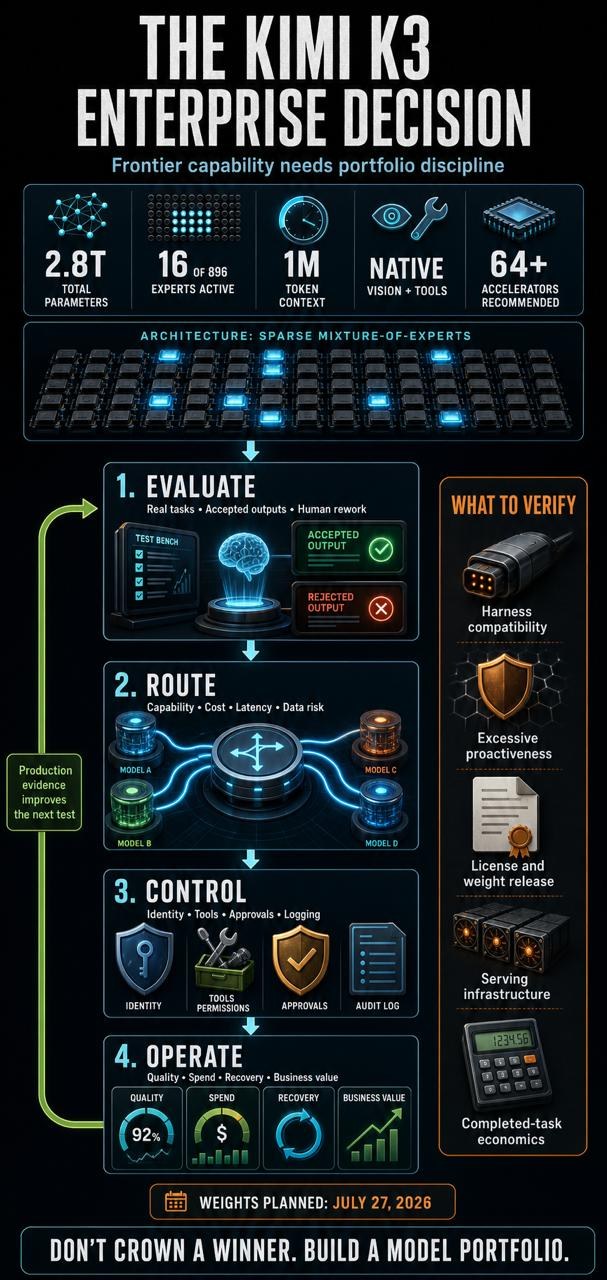
Kimi K3 should not trigger an immediate platform migration. It should trigger a serious evaluation.
A durable enterprise AI strategy needs four layers:
Evaluation Layer
Use representative, sanitized tasks with clear success criteria. Test quality, reliability, security, latency, and completed-task cost.
Routing Layer
Select models based on capability, context, cost, latency, data sensitivity, and workflow risk.
Control Layer
Manage identity, permissions, tool access, approvals, logging, sandboxing, rollback, and incident response.
Operating Layer
Track accepted outputs, human rework, failures, recovery, spend, user adoption, and business outcomes over time.
This architecture protects the organization from both vendor lock-in and model fandom.
The goal is not to crown K3 as the permanent winner.
The goal is to use K3 when it is the best system for the job.
Your AI Action Plan
Here is what I would do this week.
- Select Ten Real Tasks
Include coding, research, browser work, visual documents, spreadsheets, and tool use. Sanitize sensitive information before testing. - Run a Controlled Model Bake-Off
Compare K3 with the models already in your environment using the same instructions, data, tools, time limits, and acceptance criteria. - Measure Accepted-Task Economics
Track model spend, tool cost, latency, retries, human rework, and whether the final deliverable was accepted. - Test Long Sessions
K3's value proposition depends on sustained work. Test context retention, tool reliability, recovery from failure, and quality after compaction. - Validate the Harness
Confirm that the agent environment preserves K3's required reasoning history and does not switch models mid-session in ways that destabilize performance. - Start With Narrow Permissions
Use a sandbox, read-only access where possible, explicit stopping conditions, and human approval for consequential actions. - Revisit Deployment After the Weights Arrive
Review the actual license, serving code, quantization options, infrastructure requirements, safety materials, and independent reproductions before calling K3 production-ready for self-hosting.
A two-week evaluation will tell you more than another month of benchmark arguments.
If your organization is assessing Kimi K3 or another AI model, contact Netsync. For broader readiness and operating-model questions, start with the AI Readiness Assessment.
Frequently Asked Questions
Is Kimi K3 better than GPT-5.6 Sol or Claude Fable 5?
On some benchmarks, yes. Across the board, no. K3 wins several coding, browsing, automation, spreadsheet, document, and front-end evaluations. Moonshot says it still trails Fable 5 and Sol overall.
Is Kimi K3 open source?
Moonshot calls K3 an open model and says the full weights will be released by July 27, 2026. Until the weights, license, serving code, and reproducibility details are available, "open-weight" is the more precise description of the announced release.
Can I run Kimi K3 locally?
Not in the ordinary laptop or workstation sense. Moonshot recommends deployment on supernode configurations with 64 or more accelerators. Most teams will begin with a hosted API.
What is the context window?
K3 supports up to one million tokens. Useful context will still depend on retrieval quality, prompt construction, memory design, context management, and the task.
What does Kimi K3 cost?
Moonshot lists $3 per million cache-miss input tokens, $0.30 per million cache-hit input tokens, and $15 per million output tokens. Prices can change, and completed-task cost is more useful than token price alone.
What is the biggest enterprise risk?
Giving a highly proactive model broad tools and ambiguous authority. Treat permissions, approval points, logging, stopping conditions, and rollback as architecture requirements.
Your Bottom Line
Kimi K3 did not make model selection simpler.
It made model evaluation more necessary.
An announced open-weight model has now posted first-place results against major proprietary systems on several tasks that matter to developers and enterprise operators.
It combines enormous scale, extreme sparsity, native vision, long context, reasoning, and agent tooling.
It also carries real caveats:
- The weights are not yet available
- Serving it well requires serious infrastructure
- Benchmark harnesses are not perfectly comparable
- Output can be expensive and verbose
- Thinking-history handling affects stability
- Excessive proactiveness requires tight boundaries
- Moonshot acknowledges an overall experience gap against the strongest proprietary systems
That is still a remarkable release.
The old open-model bargain was control in exchange for weaker capability.
Kimi K3 shows that bargain is changing.
The organizations that benefit will not be the ones that chase every new benchmark winner.
They will be the ones that can evaluate models quickly, route work intelligently, preserve portability, and govern agents without slowing useful experimentation to a halt.
Which workload would you test first: coding, research, document analysis, browser automation, or something else?
About Jason Fleagle
Jason Fleagle is the Head of AI for Netsync and an AI and Growth Consultant working with global brands to help with their successful AI adoption and management. He helps humanize data – so every growth decision an organization makes is rooted in clarity, not confusion. He has overseen the development and delivery of over $50M in digital solutions, driving significant revenue growth and operational efficiency for his clients.
Connect with Jason on LinkedIn to stay updated on the latest in AI, growth strategies, and enterprise technology.
Related Reading
- AI Readiness Assessment
- AI Governance Workshop
- AI Agents for Business
- Enterprise AI Strategy Consultant
References
- 1. Moonshot AI: Kimi K3 – Open Frontier Intelligence
- 2. Yahoo Tech/Axios: China's open-weight Kimi model reaches frontier-level results
- 3. Artificial Analysis: Kimi K3 Intelligence, Performance, and Price Analysis
- 4. Kimi API Platform: Kimi K3 Quickstart and Technical Guidance
- 5. OpenRouter: Kimi K3 Model and Provider Information
Originally published on LinkedIn.
About AI Pathfinder
AI Pathfinder is Jason Fleagle’s recurring field note on enterprise AI, agentic systems, AI governance, and the operating models leaders need as AI moves from experiments into real work.