GPT-5.6 Turns ChatGPT From a Chatbot Into a True Operating Layer
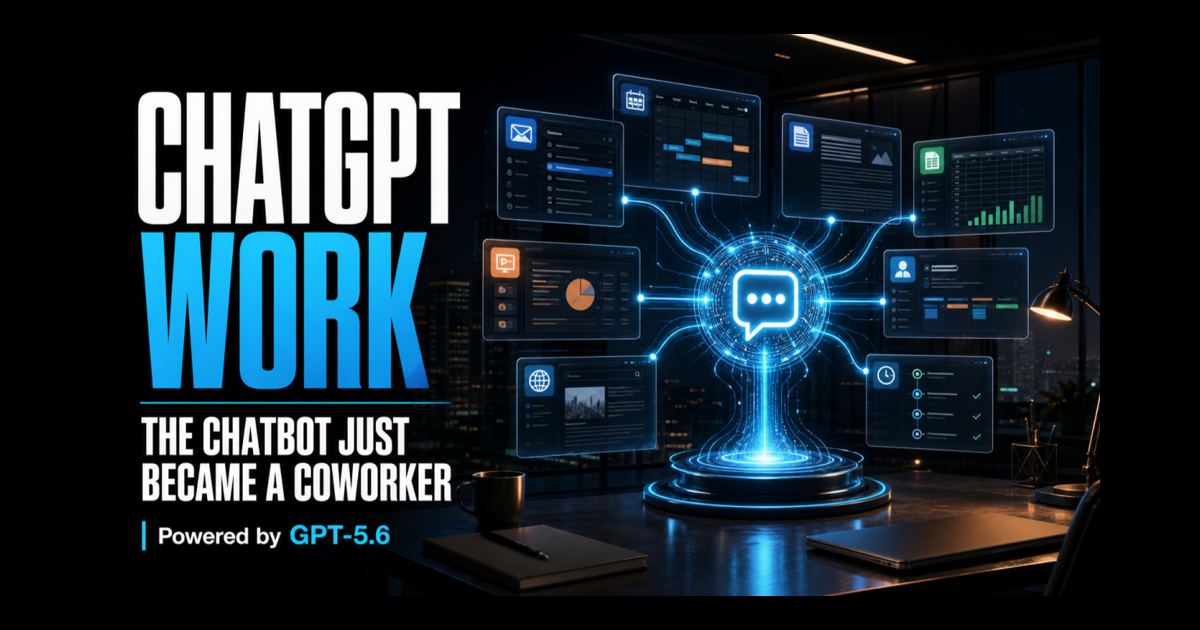
Quick take: GPT-5.6 is the model release, but ChatGPT Work is the strategic shift. OpenAI is moving ChatGPT beyond answers toward connected workflows that can gather context, execute across tools, create finished artifacts, and continue on a schedule.
- For employees: less copying between chat, files, email, browsers, and business systems.
- For leaders: the unit of value becomes finished work rather than prompts or isolated outputs.
- For technology teams: identity, permissions, evaluation, approval boundaries, and auditability become part of the product.
OpenAI did not just release a more capable model, but actually changed what ChatGPT is for.
For the last several years, the basic AI workflow has been familiar:
Open a chatbot.
Ask a question.
Get an answer.
Take that answer into the systems where the real work happens.
ChatGPT Work is designed to collapse that gap.
Launched on July 9, 2026, ChatGPT Work combines ChatGPT with Codex technology so it can gather context from connected apps, break a project into steps, work across files and websites, and turn a goal into finished documents, spreadsheets, presentations, dashboards, and web apps.
GPT-5.6 is the intelligence underneath that new experience.
The model family includes Sol, Terra, and Luna, giving organizations three different ways to balance capability, speed, and cost. But the bigger story is not the benchmark table.
The bigger story is that OpenAI is turning ChatGPT into a work layer.
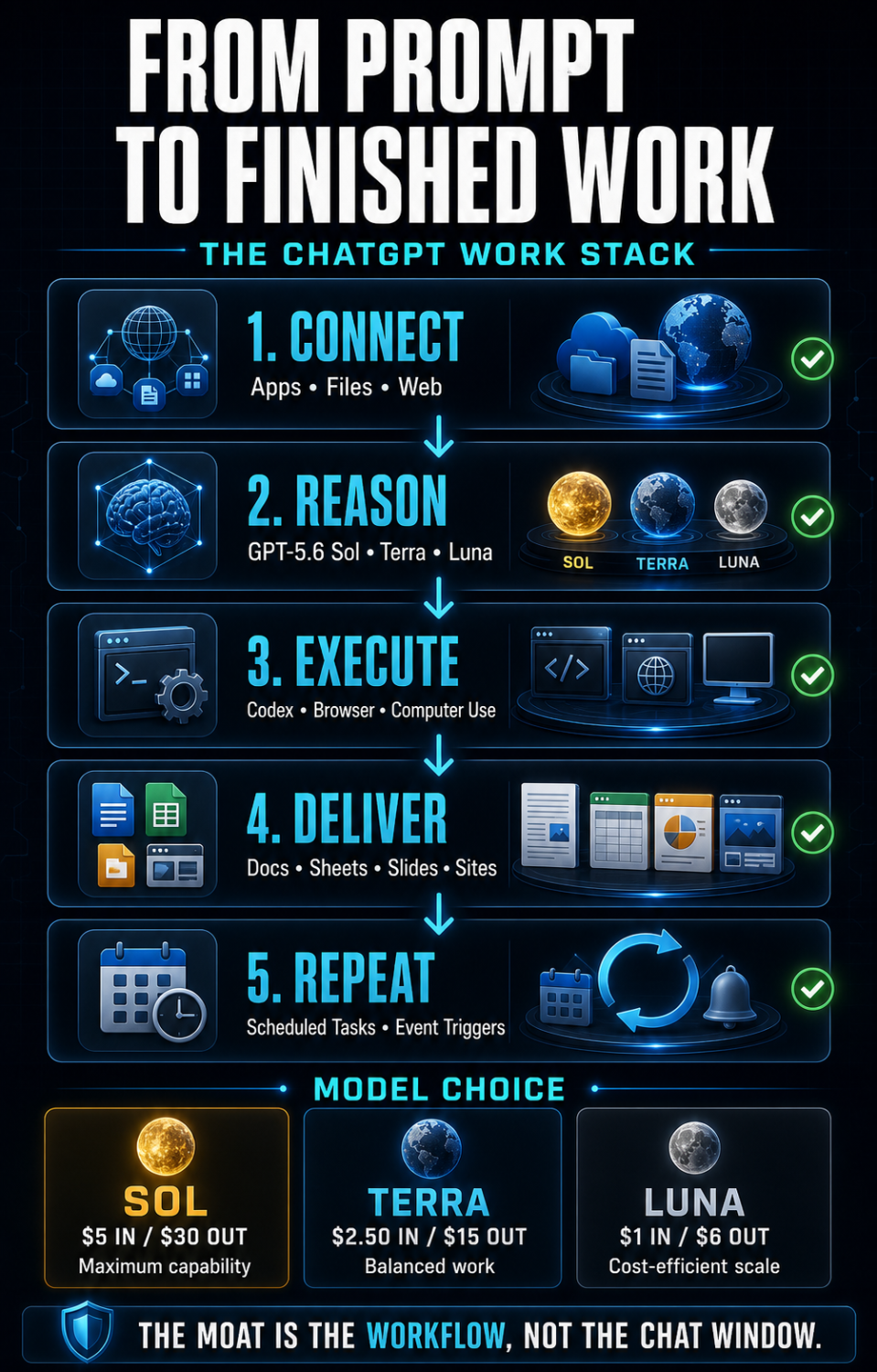
It can connect to the systems where work already lives.
It can reason across messy context.
It can execute with Codex, a browser, and computer use.
It can deliver editable artifacts.
And with Scheduled Tasks, it can keep working after the user leaves.
That is a much bigger change than a smarter chat window.
The Chatbot Era Was Only the Interface
Chatbots made AI accessible.
They taught millions of people how to prompt, iterate, summarize, and create.
But chat has always had a structural limitation: the user remains the integration layer.
The chatbot writes the email, but the human sends it.
The chatbot analyzes the spreadsheet, but the human finds the file and updates the forecast.
The chatbot drafts the presentation, but the human rebuilds it inside the company template.
The chatbot suggests a follow-up, but the human checks the CRM, calendar, and Slack thread.
That is useful assistance, but not completed work.
ChatGPT Work is OpenAI's attempt to cross that boundary. It can connect to systems such as Slack, Microsoft Teams, Google Drive, SharePoint, email, calendars, CRMs, and project trackers through a unified plugins directory. It can pull relevant context into a project, create the artifact, and continue refining it in the background.
On desktop, the stack goes further. A built-in browser can work across websites and web applications, while computer use can click, type, and move files across local apps and tools.
The user is no longer responsible for carrying every output from one system to the next.
The agent can carry the context.
That is the shift.
GPT-5.6 Is a Model Family Built for Work
OpenAI is launching GPT-5.6 as three models instead of one:
| Model | Best fit | API pricing per 1M tokens |
|---|---|---|
| GPT-5.6 Sol | Complex coding, professional work, cybersecurity, science, design, and long-running agentic tasks | $5 input / $30 output |
| GPT-5.6 Terra | Balanced everyday knowledge work where capability, speed, and cost all matter | $2.50 input / $15 output |
| GPT-5.6 Luna | High-volume classification, formatting, and cost-sensitive workflow steps | $1 input / $6 output |
That tiering matters because enterprise AI is moving beyond the question, “Which model is smartest?”
The better question is: “What level of intelligence does this step of the workflow actually require?”
A high-stakes financial analysis may need Sol.
A recurring account summary may run well on Terra.
A classification or formatting step may belong on Luna.
The winning architecture will not route every task to the biggest model. It will use the right amount of intelligence at each stage, then reserve expensive reasoning for the moments where it changes the outcome.
OpenAI is also introducing higher-effort modes for difficult work. The new ultra setting coordinates multiple agents across parallel workstreams. In the API, developers can build similar experiences with multi-agent capabilities in the Responses API.
The model is no longer only generating an answer.
It can write small programs, coordinate tools, process intermediate results, inspect progress, and decide what to do next.
That is closer to an operator than an oracle.
Finished Work Is Now the New Benchmark
Model benchmarks still matter.
GPT-5.6 Sol posted strong results across coding, browsing, computer use, cybersecurity, and professional knowledge work. OpenAI reports a 92.2% score on BrowseComp with its multi-agent ultra configuration and 62.6% on OSWorld 2.0. It also reports stronger design judgment, better template following, and more accurate spreadsheet and document generation than GPT-5.5.
But the most important benchmark may be much simpler: Can a normal employee give the system a business goal and receive something ready to use?
OpenAI says early users applied ChatGPT Work to:
– Turn fragmented CRM and email activity into a recurring executive sales dashboard.
– Compare an airline's customer experience with competitors and compress weeks of analysis into hours.
– Review release plans and project tasks, identify missing ownership, and produce source-backed reports.
– Reconcile finance data, update forecasts, create slides, and reduce month-end work from days to hours.
These are not isolated content-generation tasks, but workflows.
Each one requires context gathering, judgment, tool use, artifact creation, and verification.
That is why this launch is a direct response to Anthropic's Claude Cowork and a broader signal about where enterprise AI is going. The major AI platforms are racing to own the layer between employee intent and finished work.
Scheduled Tasks Turn AI Into an Operating Rhythm
The quietest announcement may become the most important.
Scheduled Tasks allow ChatGPT Work to run once, repeat on a schedule, respond to an event, or monitor for changes over time.
That means an agent can:
- Review new Slack messages and refresh a weekly meeting agenda.
- Monitor dashboards and websites, then send a summary of what changed.
- Turn incoming customer feedback into prioritized product themes.
- Update a presentation when new information arrives by email.
This moves AI from a reactive tool to a persistent operating capability.
The old pattern was: Ask → answer → copy → act.
The new pattern is: Connect → delegate → monitor → approve → improve.
That creates leverage, but it also changes the risk model.
When AI can read company systems, move files, update artifacts, and trigger actions, prompt quality is no longer the only control that matters.
Identity matters. Permissions matter. Data boundaries matter. Approval points matter. Auditability matters. Evaluation matters.
The more useful the agent becomes, the more important the AI Assurance layer becomes around it.
The Government Preview Is a New Frontier-AI Precedent
GPT-5.6 also arrived through an unusual release process.
OpenAI initially provided the model to a limited group of trusted organizations whose participation was shared with the U.S. government. Reporting from Axios, The Washington Post, and the Associated Press said the Trump administration requested the staggered rollout while officials evaluated security risks, particularly advanced cyber capabilities.
The broad release followed roughly two weeks later.
OpenAI said it did not believe a government-mediated access process should become the long-term default. Still, the episode offers a preview of what frontier-model launches may look like going forward:
Release is becoming a policy event.
Advanced capability is becoming a national-security concern.
Access may increasingly depend on identity, trust, use case, and jurisdiction.
For enterprise leaders, this adds another variable to model strategy. The most capable system may not always be universally available, available on the same timeline, or available under the same controls.
That is another reason to avoid building an operating model around a single model endpoint.
The Real Product Is the Work Graph
Here is the strategic takeaway.
OpenAI is not only competing to provide the best model, but to own the work graph around the model.
The plugins provide organizational context.
GPT-5.6 provides reasoning.
Codex provides execution.
The browser and computer-use layer provide reach.
Sites, documents, spreadsheets, and presentations provide deliverables.
Scheduled Tasks provide persistence.
Governance controls determine what the system can access and which actions require approval.
Once those pieces are connected, switching costs move beyond token pricing.
The organization starts building workflows, policies, templates, memories, evaluations, and employee habits around the system.
That is where platform power compounds.
The moat is the workflow, not the chat window.
Your AI Action Plan
Here is what I would do this week.
1. Pick One Complete Workflow
Do not start with a generic “use AI more” initiative.
Choose one recurring workflow with a clear beginning, a clear deliverable, and measurable friction. Good candidates include account planning, meeting preparation, weekly reporting, budget variance analysis, customer-feedback synthesis, or launch readiness.
2. Map the Context and Actions
List the systems the workflow needs to read from, the artifacts it must create, and the actions it may take.
Separate read access from write access.
Do not give an agent broad permissions simply because it makes the demo easier.
3. Route Work by Value
Test Sol, Terra, and Luna against your own use cases. Measure outcome quality, latency, human review time, and total workflow cost.
The cheapest token is not always the cheapest workflow. A lower-cost model that creates more rework may cost more operationally.
4. Define Approval Boundaries
Decide what the agent can do independently, what it can prepare for review, and what always requires explicit human approval.
External communication, financial commitments, permission changes, sensitive data movement, and production-system actions deserve clear controls.
5. Build Private Evaluations
Do not rely only on public benchmarks.
Create a small set of real company tasks with known standards. Score factual accuracy, source quality, completeness, brand alignment, policy compliance, and the amount of human correction required.
6. Measure Finished Work
Track cycle time, rework, error rate, throughput, and business outcome.
Do not measure success by the number of prompts.
Measure whether the workflow produced better work, faster, with an acceptable level of risk.
Frequently Asked Questions
What is ChatGPT Work?
ChatGPT Work is an agent inside ChatGPT that can gather context across connected apps and files, break complex goals into steps, use tools, and create finished materials such as documents, spreadsheets, presentations, dashboards, and web apps.
How is ChatGPT Work different from normal ChatGPT?
Traditional chat primarily returns an answer. ChatGPT Work is designed for longer projects that require context gathering, tool use, multi-step execution, artifact creation, and continued work in the background.
What are GPT-5.6 Sol, Terra, and Luna?
They are three models in the GPT-5.6 family. Sol targets maximum capability, Terra balances capability and cost, and Luna targets cost-efficient, high-volume work.
What are Scheduled Tasks?
Scheduled Tasks allow ChatGPT Work to run a workflow once, on a recurring schedule, in response to an event, or while monitoring for changes.
Is ChatGPT Work available to everyone?
OpenAI began rolling it out on web and mobile to Pro, Enterprise, and Edu users, with Plus and Business following. The updated desktop app includes Chat, Work, and Codex modes across plans, including Free, though available models and usage limits vary by plan.
What should enterprise teams test first?
Start with one repeatable, reviewable workflow where the source systems and final deliverable are clear. Measure the entire workflow, including review and rework, rather than model output alone.
The Bottom Line
GPT-5.6 is a strong model release.
ChatGPT Work is the more important announcement.
It shows where the market is heading:
From answers to outcomes.
From prompts to projects.
From isolated chat to connected work.
From one-time assistance to persistent operations.
The next phase of enterprise AI will not be won by the company with the most impressive chatbot, but by the companies that can connect intelligence to context, execution, governance, and measurable business value.
ChatGPT just moved much closer to that future.
About Jason Fleagle
Jason Fleagle is the Head of AI for Netsync and an AI and Growth Consultant working with global brands to help with their successful AI adoption and management. He helps humanize data — so every growth decision an organization makes is rooted in clarity, not confusion. He has overseen the development and delivery of over $50M in digital solutions, driving significant revenue growth and operational efficiency for his clients.
Connect with Jason on LinkedIn to stay updated on the latest in AI, growth strategies, and enterprise technology.
Related Reading
- AI Readiness Scorecard
- AI Model Evaluation for Business
- AI Governance Checklist
- AI Agent Use Case Library
- Human-in-the-Loop AI Governance
- Prompt Injection Risk for Business Leaders
- Microsoft Copilot Governance
- Enterprise AI Roadmap Template
References
- OpenAI: ChatGPT is now a partner for your most ambitious work
- OpenAI: GPT-5.6 — Frontier intelligence that scales with your ambition
- OpenAI Deployment Safety Hub: GPT-5.6 Preview System Card
- Axios: Trump administration lifts restrictions on OpenAI’s GPT-5.6
- Associated Press: OpenAI and Anthropic limit new AI models during cybersecurity review
Originally published on LinkedIn.
About AI Pathfinder
AI Pathfinder is Jason Fleagle’s recurring field note on enterprise AI, agentic systems, AI governance, and the operating models leaders need as AI moves from experiments into real work.