Cisco Live 2026 made one thing clear.
Cisco is no longer positioning AI as a feature inside infrastructure.
It is building an agentic operating model for running and defending critical IT systems.
That is the real story.
Not another dashboard. Not another assistant. Not another alert summary tool.
Cisco is trying to turn networking, security, observability, support, and operations into one governed human-plus-agent workspace.
The headline is Cisco Cloud Control. But the bigger shift is AgenticOps.
For years, IT teams have been buried under telemetry — alerts, tickets, topology changes, security events, compliance pressure, user complaints, vulnerability disclosures, and infrastructure lifecycle risk. The problem is not that teams lack data. The problem is that the data arrives faster than humans can correlate, prioritize, validate, and act.
Cisco’s answer is to move from signal to action. With humans still in control.
The Big Announcement: Cisco Cloud Control
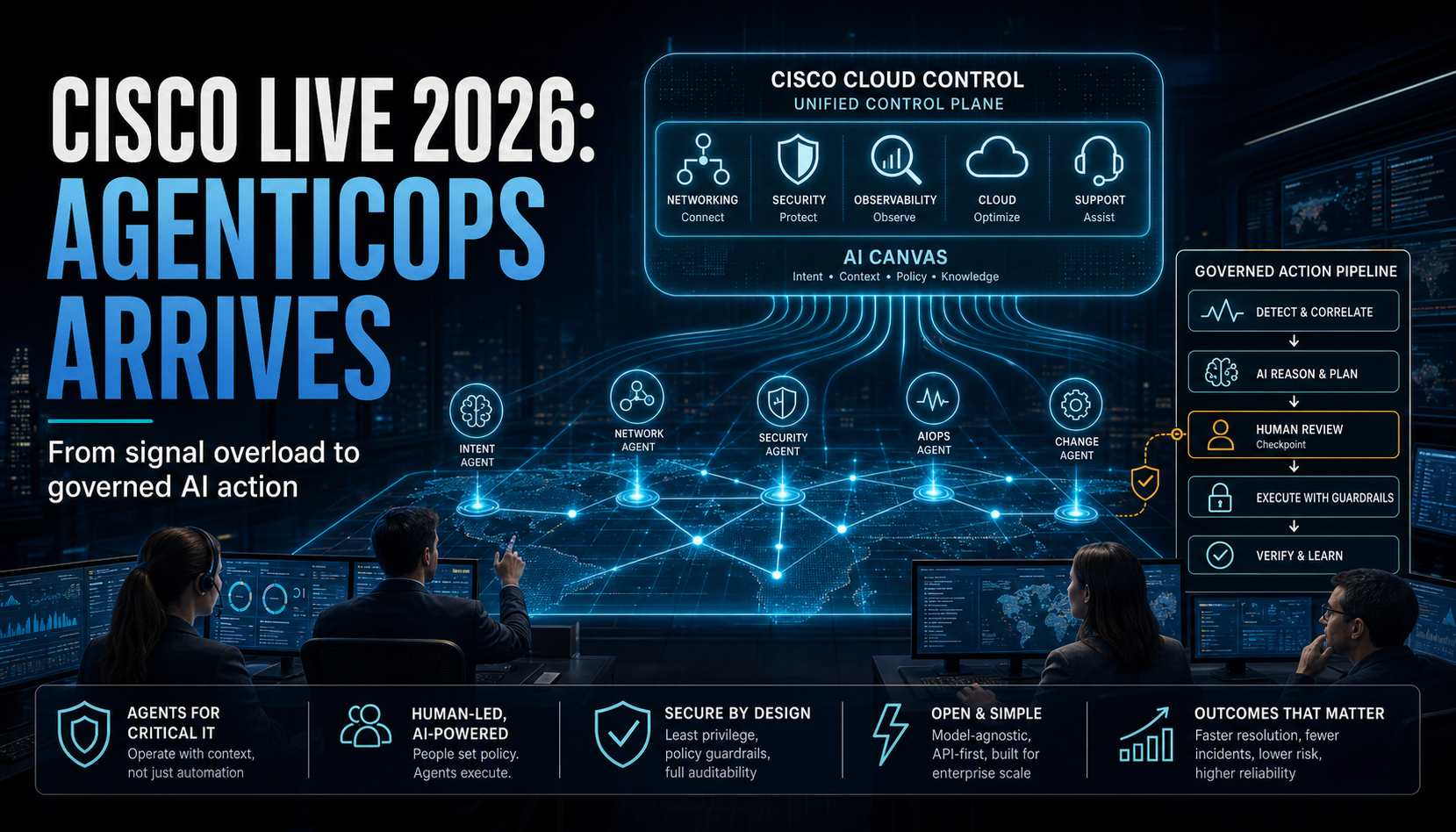
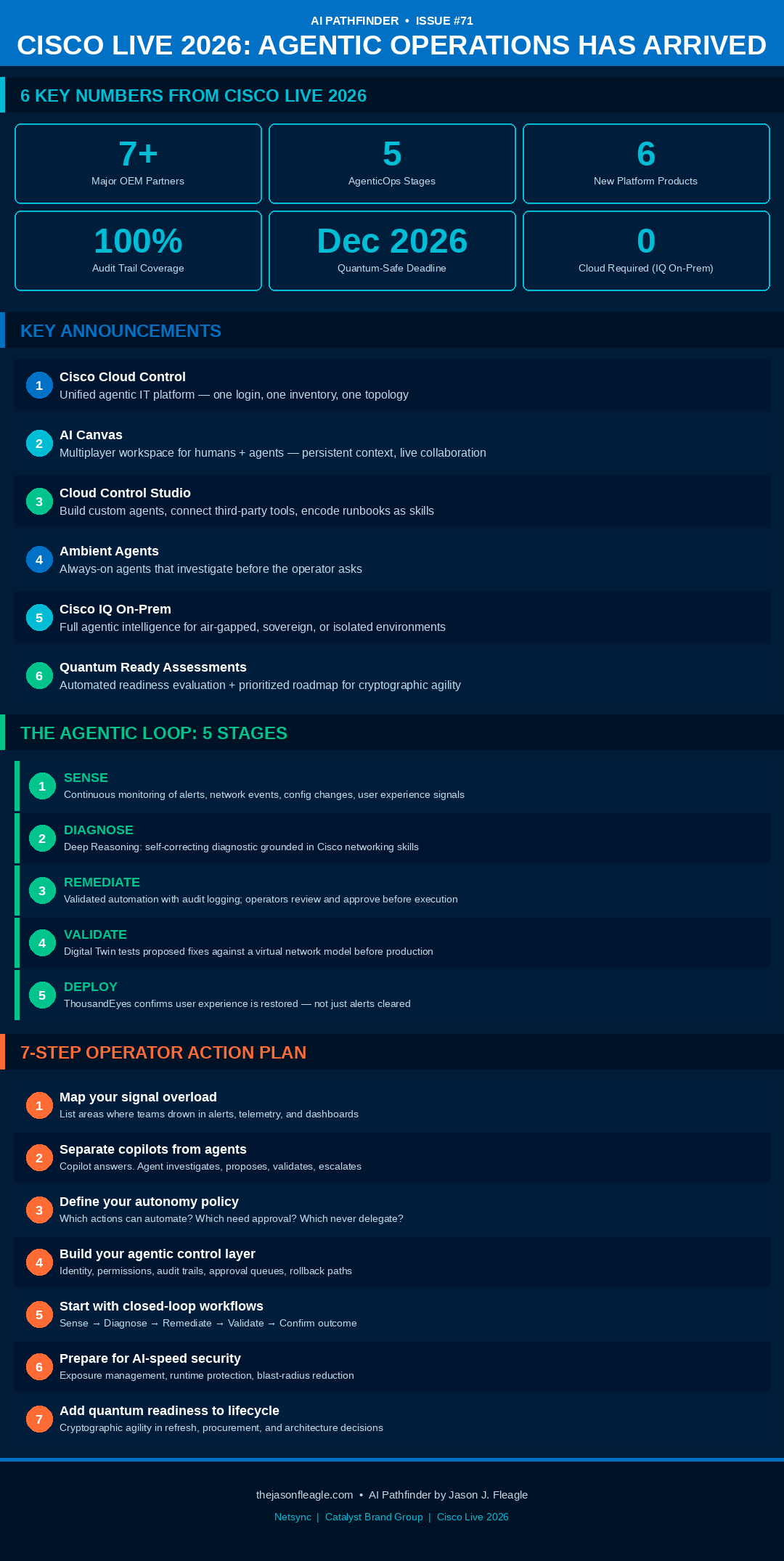
Cisco Cloud Control is the new unified platform for agentic IT. Cisco describes it as one operational environment across the Cisco portfolio, built for the way IT works in the agentic era.
The idea is simple: one login, one inventory, one topology, one shared operational surface.
Instead of jumping between tools to understand assets, health signals, risks, vulnerabilities, dependencies, topology, and compliance posture, Cisco wants Cloud Control to become the command center. That matters because agentic operations need shared context. Agents cannot help much if they are trapped inside disconnected tools. They need telemetry, topology, identity, policy, risk signals, user experience data, and operational history — and they need that context before they recommend or execute anything.
That is why Cloud Control is the foundation of Cisco’s AgenticOps strategy.
AI Canvas: The Multiplayer Workspace for Humans and Agents
The most interesting product experience is Cisco AI Canvas.
AI Canvas is not just a chat window. It is a persistent workspace where operators and agents investigate, correlate, and resolve issues together. That distinction matters. Chat is temporary. Operations are continuous. A real incident may span teams, shifts, tools, domains, and escalation paths. AI Canvas is designed to preserve context so teams do not restart the investigation every time someone new joins.
Cisco’s framing is strong: ask anything, let agents do the work, visualize insights, collaborate live, never lose context.
Agents can investigate, correlate signals, run diagnostics, and prepare remediation plans. But the operator stays in control. Agents surface findings and proposed next steps. The team reviews and approves before execution. That is the right model for critical infrastructure — not black-box autonomy, but governed autonomy.
Cloud Control Studio: Build Your Own Agents
Cisco also announced Cloud Control Studio, the customization layer for AgenticOps.
This is where the strategy gets more interesting. Cloud Control Studio lets organizations build custom agents, connect third-party tools, encode runbooks and SOPs as reusable skills, and deploy agents into AI Canvas or as ambient background agents.
That is important because no enterprise runs on one vendor stack. Cisco knows that. So Cloud Control Studio supports third-party integrations and open MCP connectivity, with ecosystem support across tools like ServiceNow, Slack, Microsoft, Google, Wiz, PagerDuty, AWS, Qualys, Okta, Atlassian, Snowflake, and Tenable.
This is Cisco saying: your agents should know your environment, your tools, your policies, your workflows, your runbooks, your operational reality. That is the difference between generic AI assistance and enterprise-grade agentic operations.
The Agentic Loop
The strongest concept from Cisco Live is the Agentic Loop.
Cisco breaks agentic network operations into five stages: Sense, Diagnose, Remediate, Validate, and Deploy.
That sounds simple. But it is the missing structure most agent conversations need. Agents should not just “take action.” They should move through a governed workflow. And after deployment, the system verifies whether the user experience actually recovered — because the goal is not to clear an alert, it is to restore the experience. That is a very different operating principle.
Ambient Agents: Agents That Do Not Wait for a Prompt
Cisco also introduced ambient agents for networking.
These agents are always-on and purpose-built to monitor signals, investigate anomalies, reason over telemetry and topology, and recommend or execute actions through governed workflows. This is the move from reactive AI to proactive AI. Instead of waiting for an operator to ask what went wrong, ambient agents can start investigating when the signal appears — clustering related events, filtering noise, identifying likely causes, preparing recommended actions, and escalating when human approval is needed.
This is where AgenticOps starts to look like an agentic workforce. Not one assistant. A team of specialized agents working across the network.
Agentic Actions: Where Autonomy Gets Governed
If agents are going to touch production infrastructure, governance becomes the product.
Cisco Agentic Actions is the control surface for that. It gives operators a place to see what an agent observed, what it inferred, what evidence supports the recommendation, what action it proposes, whether approval is required, what action was taken, and what outcome was verified.
That is the right level of accountability. Every decision includes reasoning. Every action is captured in an audit trail. Every recommendation that needs oversight appears in an approval queue. This is how autonomy becomes usable in enterprise infrastructure — not all-or-nothing, not “let the agent do whatever it wants,” but autonomy by action type, domain, change window, risk level, and policy.
Deep Reasoning and Digital Twin Validation
Cisco is also pushing a more serious approach to agent reasoning.
Deep Reasoning is designed for the problems that simple playbooks cannot solve. Instead of giving a shallow summary, the agent plans, gathers evidence, tests hypotheses, and refines its diagnosis using Cisco-authored networking skills across wired, wireless, WAN, and security domains. That grounding matters. A confident wrong answer in production infrastructure is not acceptable. Cisco’s point is that the agent should reason, but the network should confirm.
For higher-risk changes, Cisco validates proposed fixes against a Digital Twin before they touch production. That allows teams to model behavior, assess blast radius, and identify unintended consequences before deploying. This is the AI Assurance layer showing up inside NetOps — not just faster action, but safer action.
Security for the Mythos Era
Cisco tied its announcements directly to the new security reality created by frontier cyber models. AI-enabled attacks have compressed the exploit window from weeks to minutes. That changes the old patch cycle.
Cisco’s security and resilience moves include:
- Resilient Infrastructure Services — A three-step service model covering exposure assessment, infrastructure modernization, and defense resiliency.
- Live Protect expansion — Runtime protections for newly discovered vulnerabilities without reboots, upgrades, or maintenance windows.
- Hybrid Mesh Firewall — Unified protection across networks, applications, and Cisco plus third-party firewalls to limit blast radius.
- On-prem Cisco IQ — Agentic support intelligence for environments with data sovereignty or isolation requirements.
- Quantum Readiness — Assessments and roadmaps to prepare for the “Harvest Now, Decrypt Later” threat before the December 2026 compliance deadlines.
The Bottom Line for IT Leaders
Cisco Live 2026 was not about adding chatbots to routers.
It was about composing a new platform for agent-first operations.
The next IT platform will be a governed agent layer across networking, security, observability, support, and cloud operations. The winners in this era will not be the teams with the most data. The winners will be the teams that can move from signal to action the fastest, with the highest confidence.
Frequently Asked Questions (FAQ)
What is Cisco Cloud Control?
Cisco Cloud Control is a unified platform for agentic IT that provides one login, one inventory, and one topology across the Cisco portfolio, serving as the command center for AgenticOps.
How does Cisco AI Canvas work?
AI Canvas is a persistent multiplayer workspace where human operators and AI agents investigate, correlate, and resolve issues together without losing context across shifts or teams.
What are the 5 stages of the Agentic Loop?
The Agentic Loop consists of five stages: Sense, Diagnose, Remediate, Validate, and Deploy. This structure ensures agents move through a governed workflow rather than taking unchecked actions.
What is the difference between ambient agents and standard AI assistants?
Standard AI assistants wait for a human prompt. Ambient agents are always-on, proactively monitoring signals, investigating anomalies, and preparing recommended actions before an operator even asks.
How does Cisco govern AI agent actions?
Cisco Agentic Actions provides a control surface where operators can see an agent’s observations, reasoning, proposed actions, and audit trails. High-risk actions require human approval and can be validated against a Digital Twin before deployment.
References
- Cisco: What we’re announcing at Cisco Live and why it couldn’t wait
- TechRepublic: Microsoft Project Solara Brings AI Agents to Enterprise Devices
- Read the original post on LinkedIn
About the Author
Jason J. Fleagle is an AI architect, operator, and the founder of Catalyst Brand Group. He also serves as the Chief AI Officer at Netsync, helping enterprise leaders turn data into growth and build secure, high-ROI AI workflows. You can follow his insights on LinkedIn.