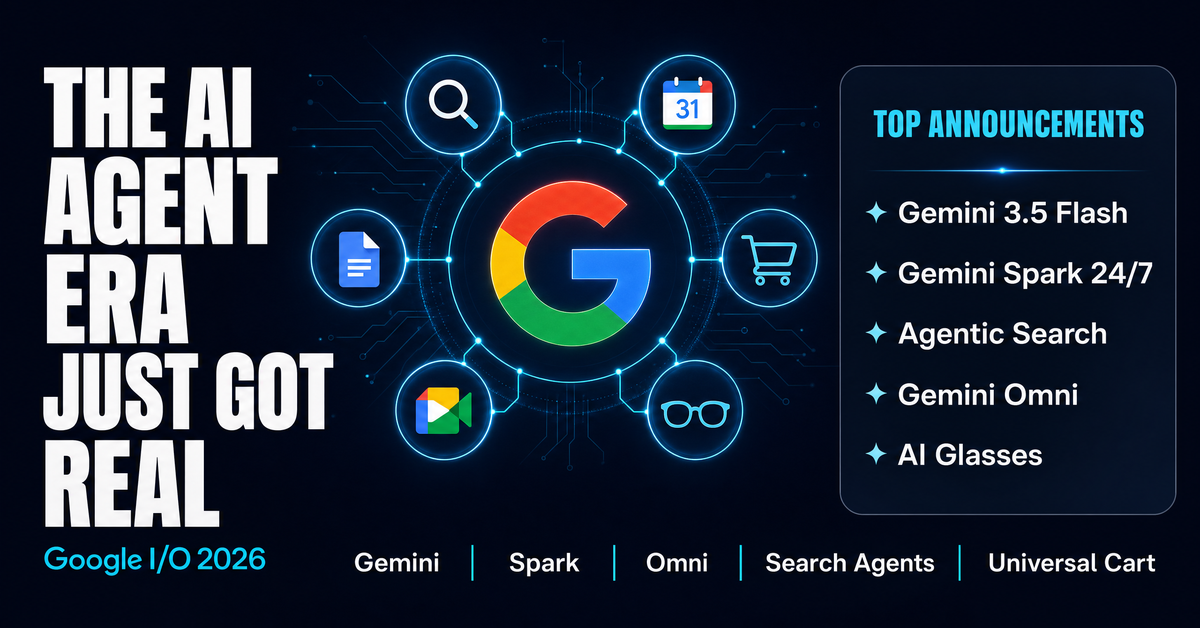
Google I/O 2026 made one thing clear: Google is no longer positioning AI as a chatbot layer. It is building an agentic operating system across Search, Workspace, Gemini, Chrome, Android, shopping, creative tools, and wearables.
The headline is not just “better models.” The real story is that AI is moving from answering questions to completing work.
Here are the top updates worth paying attention to.
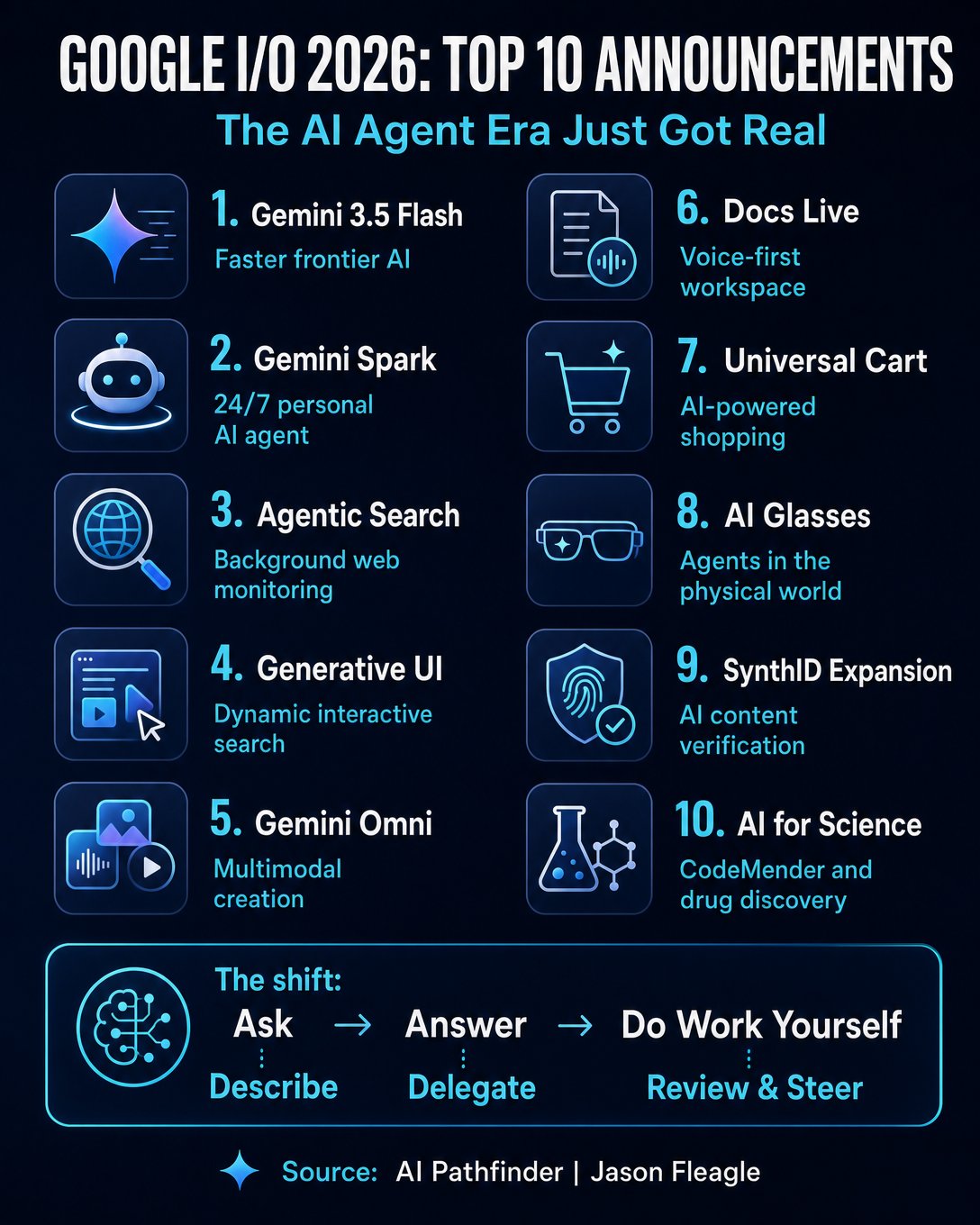
1. Gemini 3.5 Flash: Faster Frontier AI
Google introduced Gemini 3.5 Flash, a new model designed to combine frontier-level intelligence with speed. Google claims it is stronger than Gemini 3.1 Pro across most benchmarks, with major gains in coding and real-world economically valuable tasks.
The key point: speed matters. If agents are going to run in browsers, apps, workflows, and background tasks, latency becomes a product feature.
2. Gemini Spark: A Personal AI Agent That Works 24/7
Gemini Spark may be one of the most important announcements. It is Google’s personal AI agent that runs on dedicated Google Cloud virtual machines and can continue working even after you close your laptop.
In the demo, Spark handled multiple requests at once: updating calendar events, drafting a neighbor invitation, and creating a family school-year checklist. Google says Spark will start with its own tools, then expand to third-party tools through MCP.
This is the future of AI assistants: persistent, delegated, multi-step work.
3. Search Becomes Agentic
Google announced the biggest upgrade to its search box in over 25 years. The new AI search experience accepts text, images, files, and videos, then reasons across them.
More importantly, Google is introducing search agents that can monitor the web for you. Apartment hunting, sneaker drops, price changes, research updates: instead of searching repeatedly, users can assign background agents to keep watch.
Search is becoming less of a query box and more of an always-on research assistant.
4. Generative UI Comes to Search
One of the most interesting demos showed Search generating custom interactive experiences on the fly.
Ask about black holes, and Search can create an interactive spacetime visualization. Ask a follow-up about binary black holes and gravitational waves, and it generates a new interactive visual tailored to the question.
This is a major shift. Instead of serving static links or summaries, Search can now create the interface that best explains the answer.
5. Gemini Omni: Multimodal Creation and Editing
Gemini Omni combines Gemini’s reasoning with Google’s media models for image, video, and simulation generation. It can take text, images, or video as input and generate or edit rich media outputs.
The biggest leap is conversational video editing. Users can change style, camera angle, environment, objects, and characters while preserving important parts of the original scene.
For creators, this points toward a world where editing becomes less about operating software and more about directing outcomes.
6. Workspace Gets Voice-First AI
Docs Live lets users verbally brain dump ideas and have Gemini turn them into structured drafts. In the demo, Gemini pulled context from Drive and Gmail, created a document, reformatted sections into tables, and adjusted emphasis based on voice instructions.
Google also said similar voice capabilities are coming to Gmail and Keep.
The productivity implication is simple: the blank page is disappearing. Work starts with natural language, context retrieval, and live editing.
7. Universal Cart Brings AI to Shopping
Google introduced Universal Cart, an intelligent shopping cart that works across Search, Gemini, YouTube, and Gmail.
Once a product is added, the cart can track deals, monitor price drops, surface price history, and alert users when items are back in stock.
This turns shopping from a transaction into an agent-managed workflow.
8. AI Glasses Are Coming This Fall
Google announced its first audio glasses, designed for private, hands-free help from Gemini. They pair with both Android and iOS.
The demo showed glasses navigating to a remembered location, ordering coffee through DoorDash, checking messages, adding calendar events, and generating an edited image from a photo.
This matters because it brings agents into the physical world. The interface is no longer just a screen. It is voice, context, camera, apps, and location working together.
9. AI Content Verification Expands
Google is expanding SynthID and content credentials verification across Search and Chrome. Users will be able to circle or right-click content and ask whether it was AI-generated.
Google also announced that OpenAI, Kakao, and ElevenLabs are adopting SynthID.
As synthetic media gets better, provenance becomes infrastructure.
10. AI for Science and Security
Google closed with broader research and safety announcements, including CodeMender for automatically finding and fixing software vulnerabilities, Gemini for Science, AlphaEarth Foundations, and Isomorphic Labs’ work on drug discovery.
This was Google’s reminder that agentic AI is not just about productivity apps. It is also being aimed at cybersecurity, climate modeling, medicine, and scientific discovery.
The AI Pathfinder Takeaway
Google I/O 2026 was about one central idea: AI is becoming an action layer.
The old AI pattern was:
- Ask a question.
- Get an answer.
- Do the work yourself.
The new pattern is:
- Describe an outcome.
- Delegate the work.
- Review, steer, and approve.
That shift will affect every knowledge worker, creator, developer, researcher, and business leader. The winners will not be the people who simply “use AI.” The winners will be the people who learn how to manage AI agents, design better workflows, and decide where human judgment still matters most.
The AI era is quickly becoming the agent era.
Frequently Asked Questions
What is Gemini 3.5 Flash?
Gemini 3.5 Flash is Google’s new AI model designed to combine frontier-level intelligence with high speed. It is significantly faster than previous models and is optimized for agentic tasks, coding, and real-world applications.
What is Gemini Spark?
Gemini Spark is a personal AI agent that runs 24/7 on dedicated Google Cloud virtual machines. It can handle multiple, long-running tasks in the background, even when your devices are turned off, and integrates with Google Workspace and third-party tools.
How is Google Search changing?
Google Search is becoming more agentic. It now accepts multimodal inputs (text, images, video) and features “information agents” that can monitor the web in the background for specific updates, like price drops or news. It also includes Generative UI, which creates custom interactive visuals on the fly.
What is Gemini Omni?
Gemini Omni is a new family of models that combines Gemini’s reasoning with generative media capabilities. It allows for multimodal creation and conversational editing of images, video, and simulations.
When will these features be available?
Many features, like Gemini 3.5 Flash, are rolling out immediately. Others, like Gemini Spark and the new Search agents, will be available to trusted testers and subscribers in the coming weeks and months. The new AI glasses are expected this fall.
References & Sources
- YouTube: Google I/O 2026 Keynote in 35 Minutes — The Verge
- The Verge: The 13 biggest announcements at Google I/O 2026
- Google Blog: Gemini 3.5 — frontier intelligence with action
About Jason Fleagle
Jason Fleagle is the Head of AI for Netsync and an AI and Growth Consultant working with global brands to help with their successful AI adoption and management. He helps humanize data — so every growth decision an organization makes is rooted in clarity, not confusion. He has overseen the development and delivery of over 500 AI projects and tools, and frequently conducts training workshops to help companies understand and adopt AI.
If you need a team of AI experts to help your organization deploy secure AI workflows at scale, let’s talk with our team at Netsync. Connect with Jason on LinkedIn or learn more about his work at NetSync.
Read the original post on LinkedIn: Google I/O 2026: Top Announcements & Key Takeaways