AI Pathfinder, Issue #36

For the last two years, the biggest bottleneck in artificial intelligence hasn’t been algorithms or data. It’s been concrete, steel, and the electrical grid.
Training frontier models requires gigawatt-scale power. Data centers face multi-year build delays, grid connection queues, and local zoning battles. The physical infrastructure of Earth is struggling to keep up with the compute demands of machine intelligence.
So the market is looking up. Literally.
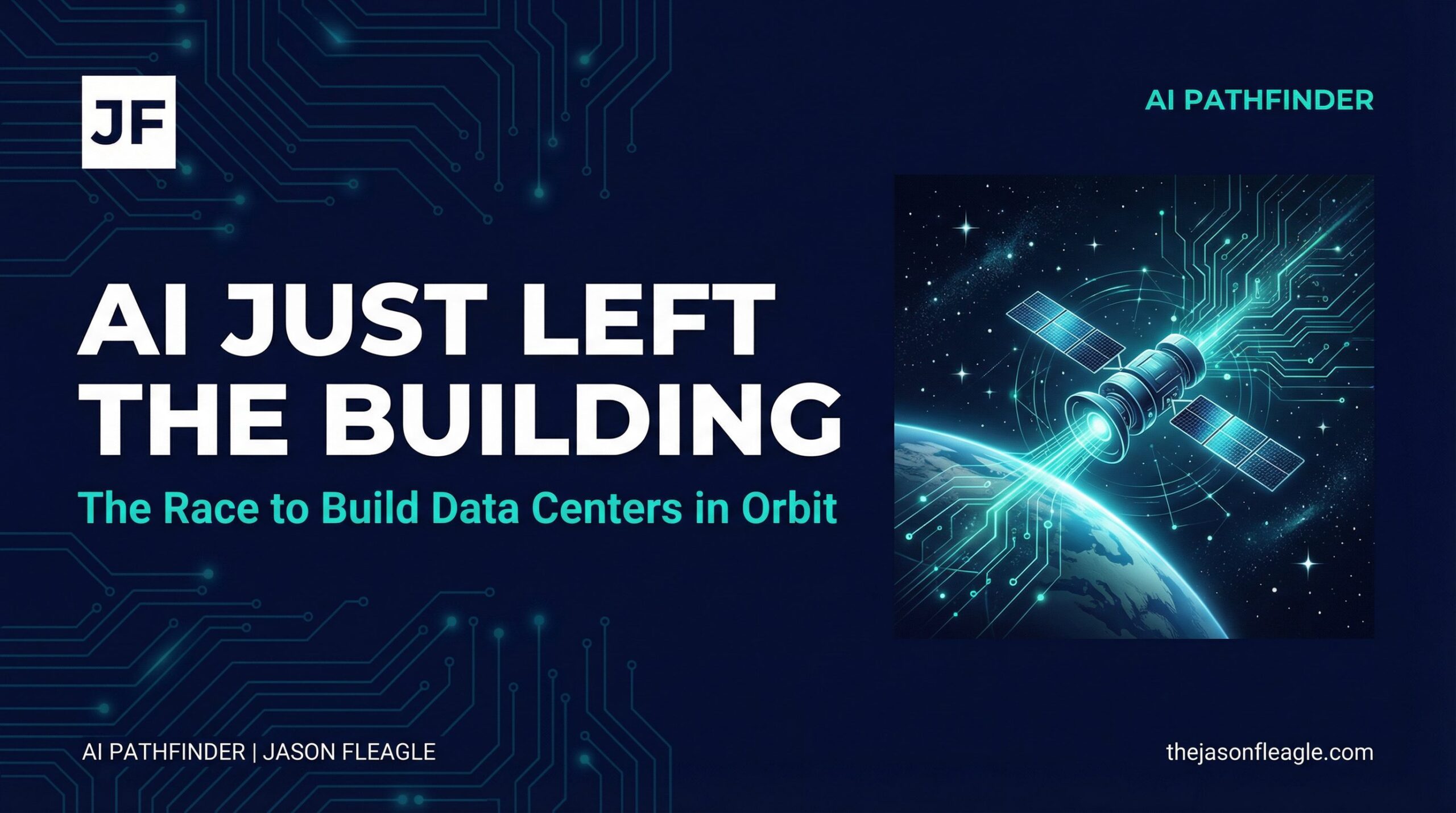
Starcloud, an orbital compute infrastructure startup, just raised $170 million at a $1.1 billion valuation, just 17 months after graduating from Y Combinator. Their mission? To build an 88,000-satellite constellation of AI data centers in space, powered by continuous, unfiltered solar energy.
This isn’t science fiction. It’s a capital-backed infrastructure play that aligns perfectly with Elon Musk’s recent thesis: the cheapest place to run AI will soon be in orbit.
Here is why the constraint is shifting from power availability to launch cadence, and what it means for the future of enterprise AI.
The Earthbound Energy Crisis
To understand why investors are pouring hundreds of millions into space-based compute, you have to look at the math on the ground.
According to recent industry reports, nearly one in five data center campuses is expected to exceed gigawatt scale by 2030. Developers are already forecasting severe power constraints by 2027 or 2028 due to underinvestment in terrestrial grids and supply chain disruptions.
You can build the fastest GPU in the world, but if you can’t plug it into a reliable, massive power source, it’s just expensive silicon.
Space solves the power problem. In orbit, solar energy is abundant, continuous, and doesn’t require fighting local municipalities for grid access. The vacuum of space also provides a natural heat sink, addressing the massive cooling requirements of modern AI clusters.
Starcloud’s First Mover Advantage
Starcloud isn’t just pitching the concept, they are already executing on the vision.
In November 2025, the company launched Starcloud-1, a 130-pound satellite carrying an NVIDIA H100 chip. This marked an industry first: demonstrating AI training and inference in orbit.
The company is now moving aggressively toward commercialization:
- Next Launch: Scheduled for October 2026, featuring Amazon Web Services’ AWS Outposts offering.
- Partnerships: Actively working with NVIDIA, AWS, and Google Cloud.
- Funding: Total capital raised now sits at $200 million, with backing from Benchmark, EQT Ventures, Andreessen Horowitz, and In-Q-Tel (the CIA’s venture capital arm) .
“The main customer contracts that are committed are for other spacecraft, particularly Earth Observation and DOW satellites,” said Starcloud co-founder and CEO Philip Johnston. “We are also working on some binding energy offtake agreements with the hyperscalers to be announced in the coming months”.
The SpaceX Factor
Starcloud isn’t the only player looking to the stars.
In February 2026, Elon Musk’s SpaceX acquired his AI startup, xAI, and revealed plans for a million-satellite orbital data center network. This follows Musk’s comments at Davos earlier in the year, where he stated unequivocally that the cheapest place to run AI will be space in the next 2–3 years.
When the company that controls the world’s most reliable and frequent launch cadence (SpaceX) decides to enter the orbital compute market, the economics change overnight.
The primary hurdle for space-based data centers has always been launch costs. However, Starcloud expects these costs to fall significantly, projecting that space-based data centers will be cost-competitive with Earth facilities by 2028 or 2029.
Your 3-Step Action Plan
The shift to orbital compute won’t happen tomorrow, but the capital and engineering momentum is undeniable. Here is how operators and leaders should be thinking about this transition:
1. Re-evaluate Long-Term Compute Strategy
If your enterprise is planning massive, multi-year investments in on-premise data centers or long-term terrestrial cloud contracts, factor in the potential for orbital compute to disrupt pricing and availability by the end of the decade. The constraints of the terrestrial grid may make off-planet compute not just an option, but a necessity for frontier workloads.
2. Monitor the Hyperscalers
Watch AWS, Google Cloud, and Microsoft Azure closely. Starcloud’s partnerships with these giants indicate that orbital compute will likely be offered as an extension of existing cloud services (like AWS Outposts). You won’t need to launch your own satellite, but you may be able to select an “Orbital Region” in your cloud console.
3. Prepare for Edge AI in Space
The immediate commercial use case for orbital compute is processing data where it’s generated — in space. If your business relies on Earth observation, satellite imagery, or global logistics tracking, the ability to run inference directly on the satellite (rather than downlinking raw data) will drastically reduce latency and bandwidth costs.
The takeaway: Capital is now backing off-planet compute as a real, viable path. If this trend continues, AI infrastructure will follow energy — and that direction increasingly leads into orbit.
Ready to Build Your AI Workforce?
If you’re ready to move from AI experiments to building a true AI-powered workforce, let’s talk. We help organizations design and implement the strategies and systems needed to thrive in the agentic era.
Work with me on AI consulting →
Subscribe to my YouTube channel →
Learn AI marketing fundamentals →
About Jason Fleagle
Jason Fleagle is a Chief AI Officer and Growth Consultant working with global brands to help with their successful AI adoption and management. He helps humanize data—so every growth decision an organization makes is rooted in clarity and confidence. Jason has helped lead the development and delivery of over 500 AI projects & tools, and frequently conducts training workshops to help companies understand and adopt AI. With a strong background in digital marketing, content strategy, and technology, he combines technical expertise with business acumen to create scalable solutions.
References
[1] Reuters: Starcloud reaches $1.1 billion valuation as AI space race heats up
[2] LinkedIn (Alvin Fsc): Elon Musk says space will be the lowest cost activity