
Google just launched “vibe coding” in AI Studio, and it’s a game-changer. Describe your app idea in plain language—”Create a magic mirror that transforms my photo into something fantastical”—and AI Studio, powered by Gemini, builds it for you. No API keys. No SDK integration. No juggling services. Just idea to working app in minutes.
This isn’t just a feature update. It’s Google’s declaration that the era of technical barriers to AI app development is over.
What Is Vibe Coding?
Traditionally, building an AI-powered app meant mastering a gauntlet of technical complexity. You needed to understand which APIs to call, how to authenticate with different services, how to wire models together, and how to handle the inevitable integration headaches. Even experienced developers found it tedious. For non-developers, it was a wall.
Vibe coding removes that wall entirely.
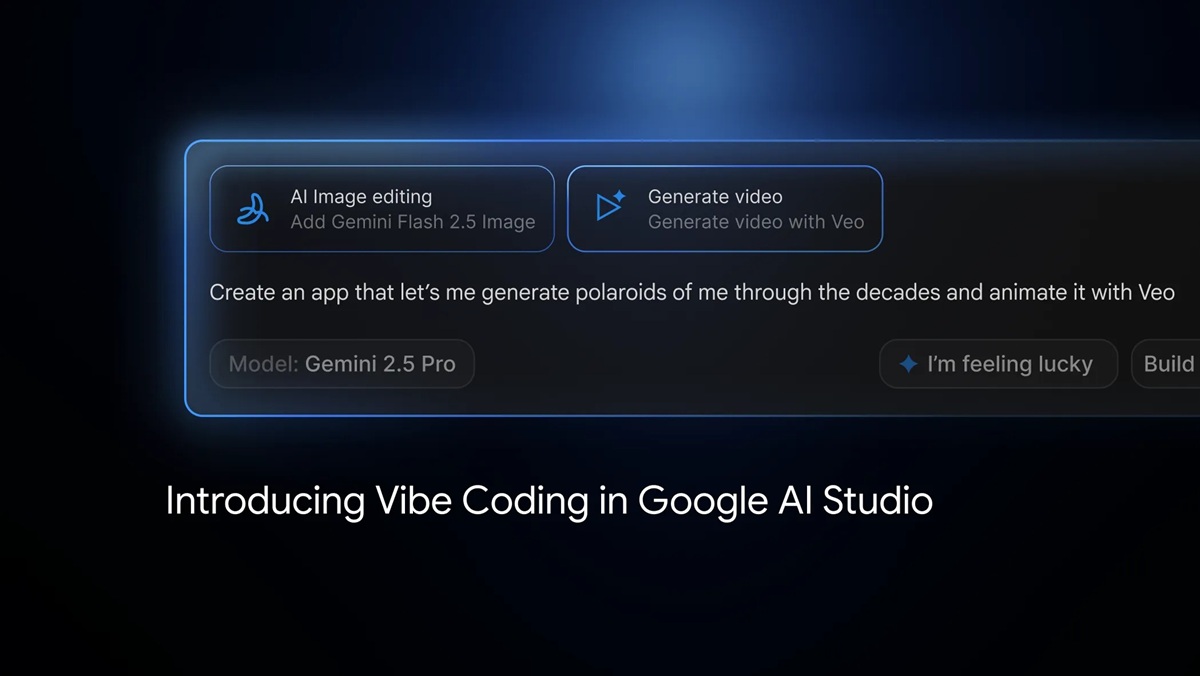
Here’s how it works: You describe what you want to build in natural language. AI Studio, powered by Google’s latest Gemini models, understands the capabilities you need and automatically wires up the right models and APIs. Want to generate videos from a script using Veo? Build an image editor with Gemini Flash? Create a writing assistant that fact-checks using Google Search? Just describe it. AI Studio handles the rest.
And if you’re stuck for ideas, hit the “I’m Feeling Lucky” button and Gemini will suggest a project to get you started.
What You Can Build Right Now
The possibilities are genuinely impressive. Here are real examples from Google’s announcement:
🎥 Video Generation Apps
“Generate videos from a script with Veo”—the kind of app that would have required deep knowledge of video APIs, encoding, and model orchestration. Now it’s a single prompt.
🖼️ Image Editing Tools
“Build powerful image editing tools with a command using Nano Banana”—complex image manipulation that used to require specialized libraries and careful API management.
✍️ AI-Powered Writing Assistants
“Create the ultimate writing app that can check your sources using Google Search”—combining language models with search APIs in a way that would have taken days to wire up manually.
🪞 Creative Transformation Apps
“Make a magic mirror app that takes your photo and transforms it into something fantastical”—multi-modal processing that seamlessly combines image input, AI transformation, and visual output.
The common thread? These are all apps that used to require significant technical expertise. Now they’re accessible to anyone who can describe what they want.
The Features That Make It Work
Google didn’t just add a prompt box and call it a day. They redesigned the entire experience around removing friction:
1. Annotation Mode
Instead of describing changes in text or digging through code, you can now highlight a part of your app and tell Gemini what to modify.
“Make this button blue.”
“Change the style of these cards.”
“Animate the image in here from the left.”
It’s a visual dialogue that keeps you in creative flow instead of forcing you back into technical mode.
2. Revamped App Gallery
A rich, visual library of what’s possible with Gemini. Explore project ideas, preview them instantly, learn from the starter code, and remix apps into your own creations. It’s inspiration meets education meets rapid prototyping.
3. Brainstorming Loading Screen
While your app builds, AI Studio cycles through context-aware project ideas generated by Gemini. It turns wait time into a source of new possibilities—a clever way to keep the creative momentum going.
4. Uninterrupted Development
If you exhaust the free quota, you can add your own API key and keep building. AI Studio automatically switches you back to the free tier once it renews. No friction, no interruption.
Why This Bites
This is more than a productivity boost. It’s a fundamental shift in who can build with AI.
For Experienced Developers:
Vibe coding collapses the time from idea to prototype. Instead of spending hours (or days) wiring together APIs, configuring authentication, and debugging integration issues, you describe what you want and iterate on the result. It’s not about replacing your skills—it’s about letting you focus on the creative and strategic parts of development instead of the plumbing.
For Non-Developers:
This is the moment AI app development becomes accessible. You don’t need to learn Python, understand REST APIs, or figure out OAuth flows. If you can describe what you want, you can build it. That’s a massive democratization of capability.
For Organizations:
This accelerates experimentation and lowers the cost of failure. Your team can test 10 AI app ideas in the time it used to take to build one. That means faster learning, more innovation, and better alignment between what you build and what actually works.
The Strategic Implications
Google’s move here is deliberate and aggressive. By making AI app development this accessible, they’re doing three things:
1. Expanding the Developer Ecosystem
Every person who can now build an AI app with vibe coding is a potential user of Google’s AI infrastructure. The more people who build on Gemini, the more entrenched Google becomes in the AI stack.
2. Putting Pressure on Competitors
OpenAI, Anthropic, Microsoft—they all have developer platforms. But none of them have made it this easy to go from idea to working app. Google just raised the bar. Competitors will need to respond or risk losing developers to a platform that removes friction.
3. Accelerating AI Adoption
The faster people can experiment with AI, the faster they’ll find use cases that work. Google isn’t just making it easier to build—they’re making it easier to discover what’s worth building. That accelerates the entire AI adoption curve.
The Governance Questions You Can’t Ignore
But here’s what the announcement doesn’t talk about—and what every leader needs to consider:
Data Security and Privacy
When your team uses vibe coding to build apps, where does the data go? If you’re prototyping with customer data, internal documents, or proprietary information, what guarantees do you have about how Google handles it? What’s logged? What’s used for training? What’s retained?
Vendor Lock-In
The easier Google makes it to build on their platform, the harder it becomes to leave. If your team builds a dozen AI apps using vibe coding, migrating them to another platform means rewriting everything from scratch. That’s not a technical barrier—it’s a strategic dependency.
Skill Development vs. Skill Atrophy
If your team can build AI apps without understanding APIs, authentication, or model orchestration, what happens when something breaks? Or when you need to customize beyond what vibe coding supports? There’s a balance between democratization and dependency that organizations need to navigate carefully.
Quality Control and Testing
When AI generates the code, how do you ensure it’s secure, performant, and maintainable? Vibe coding makes it easy to build fast—but fast doesn’t always mean good. You need processes to review, test, and validate what gets deployed.
What to Do Next
If you’re an individual developer or creator:
- Go to Google AI Studio and try vibe coding
- Start with a simple idea—a playlist generator, a photo editor, a writing assistant
- Experiment with Annotation Mode to see how intuitive visual editing feels
- Explore the App Gallery for inspiration and remix existing projects
- Document what works, what doesn’t, and where you hit limitations
If you’re leading a team:
- Test vibe coding yourself before rolling it out to your team
- Identify 2-3 internal use cases where rapid prototyping would add value
- Assess data sensitivity—what can safely be prototyped in AI Studio vs. what needs to stay internal
- Build guidelines for when to use vibe coding (rapid experimentation) vs. traditional development (production systems)
- Consider how this fits into your broader AI governance framework
If you’re a business leader:
- Understand that the barrier to AI app development just dropped significantly
- Expect your team to start experimenting—decide whether you want to enable it or control it
- Evaluate whether Google’s AI infrastructure aligns with your long-term strategy
- Consider the competitive implications—if your competitors can prototype AI apps in minutes, how does that change your timeline?
The Bottom Line
Google AI Studio’s vibe coding is a paradigm shift in AI app development. It removes technical barriers, accelerates experimentation, and democratizes access to AI capabilities. For developers, it’s a productivity multiplier. For non-developers, it’s an unlock. For organizations, it’s both an opportunity and a strategic decision.
The question isn’t whether vibe coding will change how AI apps get built—it will. The question is whether you’ll shape that change intentionally or let it happen by default.
If you’re thinking about AI adoption, developer productivity, or how your team experiments with AI, this is the moment to get ahead of it. Because once your team discovers they can turn ideas into working apps in minutes, there’s no going back.
About OnStak
OnStak specializes in comprehensive AI implementation across four core expertise areas: AI/Data for intelligent knowledge management, AI/Edge for distributed operational intelligence, AI/Performance for optimized system efficiency, and AI/Migrations for seamless technology integration. Our proven methodology helps manufacturing leaders achieve operational transformation while maximizing return on investment.
Here’s a few recent AI projects we’ve delivered:
•Case Study: Cricket Sports Team Uses AI to Gain An Advantage
•Case Study: Transforming Mental Healthcare With AI
•Case Study: ARI AI Chatbot Helps Military Veterans Community
•Case Study: AI Helps Healthcare Professionals Roleplay Patient Care
•Case Study: AI Document Processing for Real Estate Investment
About Jason Fleagle
Jason Fleagle is the Chief AI Architect at OnStak, and is also a writer, entrepreneur, and consultant specializing in tech, AI, and growth. He helps humanize data—so every growth decision an organization makes is rooted in clarity and confidence. Jason has helped lead the development and delivery of over 150 AI applications, and frequently conducts training workshops to help companies understand and adopt AI. With a strong background in digital marketing, content strategy, and technology, he combines technical expertise with business acumen to create scalable solutions. He is also a content creator, producing videos, workshops, and thought leadership on AI, entrepreneurship, and growth. He continues to explore ways to leverage AI for good and improve human-to-human connections while balancing family, business, and creative pursuits.
Looking for AI Growth?
Let’s Talk About Your AI Goals!
What would you do if you could determine the top AI use cases or opportunities for you and your team?
We can help you go from surviving to thriving – with done-for-you business growth implementations.
•You can learn more about Jason on his website here.
•You can learn more about OnStak here.
•You can learn more about our top AI case studies here on our website.
•Learn more about my AI resources here on my youtube channel.
•And check out my AI online course.
Table of content
- 🎥 Video Generation Apps
- 🖼️ Image Editing Tools
- ✍️ AI-Powered Writing Assistants
- 🪞 Creative Transformation Apps
- 1. Annotation Mode
- 2. Revamped App Gallery
- 3. Brainstorming Loading Screen
- 4. Uninterrupted Development
- For Experienced Developers:
- For Non-Developers:
- For Organizations:
- 1. Expanding the Developer Ecosystem
- 2. Putting Pressure on Competitors
- 3. Accelerating AI Adoption
- Data Security and Privacy
- Vendor Lock-In
- Skill Development vs. Skill Atrophy
- Quality Control and Testing
- If you’re an individual developer or creator:
- If you’re leading a team:
- If you’re a business leader: