
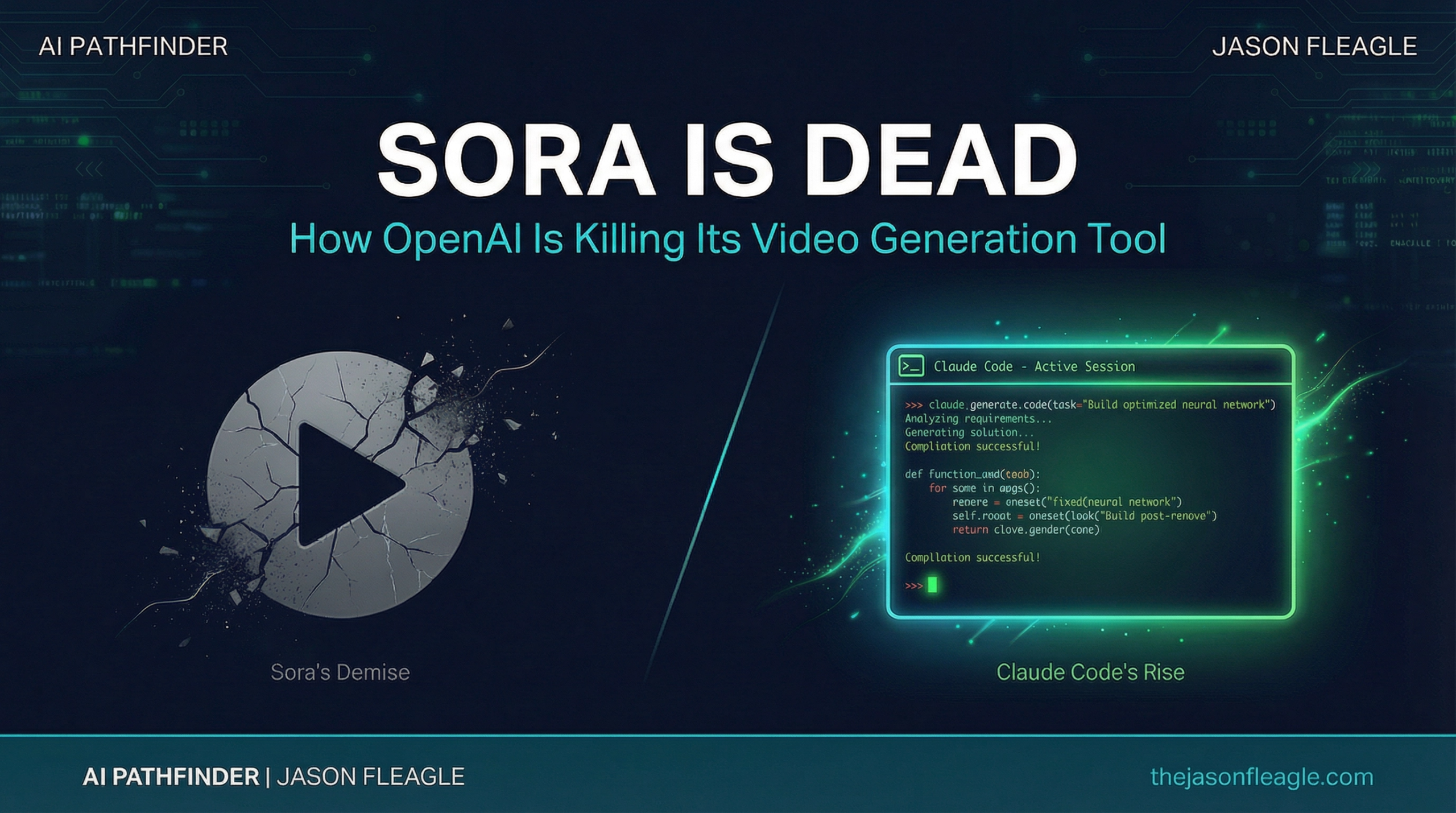
AI Pathfinder, Issue #32
In September 2025, OpenAI launched Sora to the world with a TikTok-style interface, a billion-dollar Disney partnership, and the kind of press coverage that money can’t buy.
It hit number one in the Apple App Store.
Then it flatlined.
By late March 2026, OpenAI had quietly pulled Sora from the API, removed it from ChatGPT, and walked away from the Disney deal entirely.
No fanfare. No post-mortem. Just a product that burned bright and disappeared.
The tech press called it a failed experiment. A product that couldn’t find its audience.
That’s the wrong read.
Sora’s death isn’t a product failure. It’s a strategic autopsy. And if you know where to look, it tells you everything about who is winning the AI race — and who is about to get lapped.
The Side Quest Problem
In a company-wide meeting earlier this month, OpenAI’s CEO of Applications, Fidji Simo, stood in front of her team and said something that should have been obvious two years ago:
“We cannot miss this moment because we are distracted by side quests.”
— Fidji Simo, CEO of Applications, OpenAI
Side quests. That’s how OpenAI’s own leadership now describes the strategy that defined the company’s last eighteen months.
Think about what OpenAI shipped in that window. Not just Sora. They built an AI-powered web browser called Atlas. They launched Operator, a web-browsing agent. Then ChatGPT Agent — another web-browsing agent, apparently because one wasn’t enough. They shipped ChatGPT Search, ChatGPT Pulse (an AI news aggregator), ChatGPT Health, Prism (a workspace for scientists), DALL-E updates, Whisper, and a hardware device with Jony Ive that hasn’t shipped yet.
Twelve-plus products in eighteen months. Each one announced with a press release. Each one competing for the same finite pool of compute, engineering talent, and executive attention.
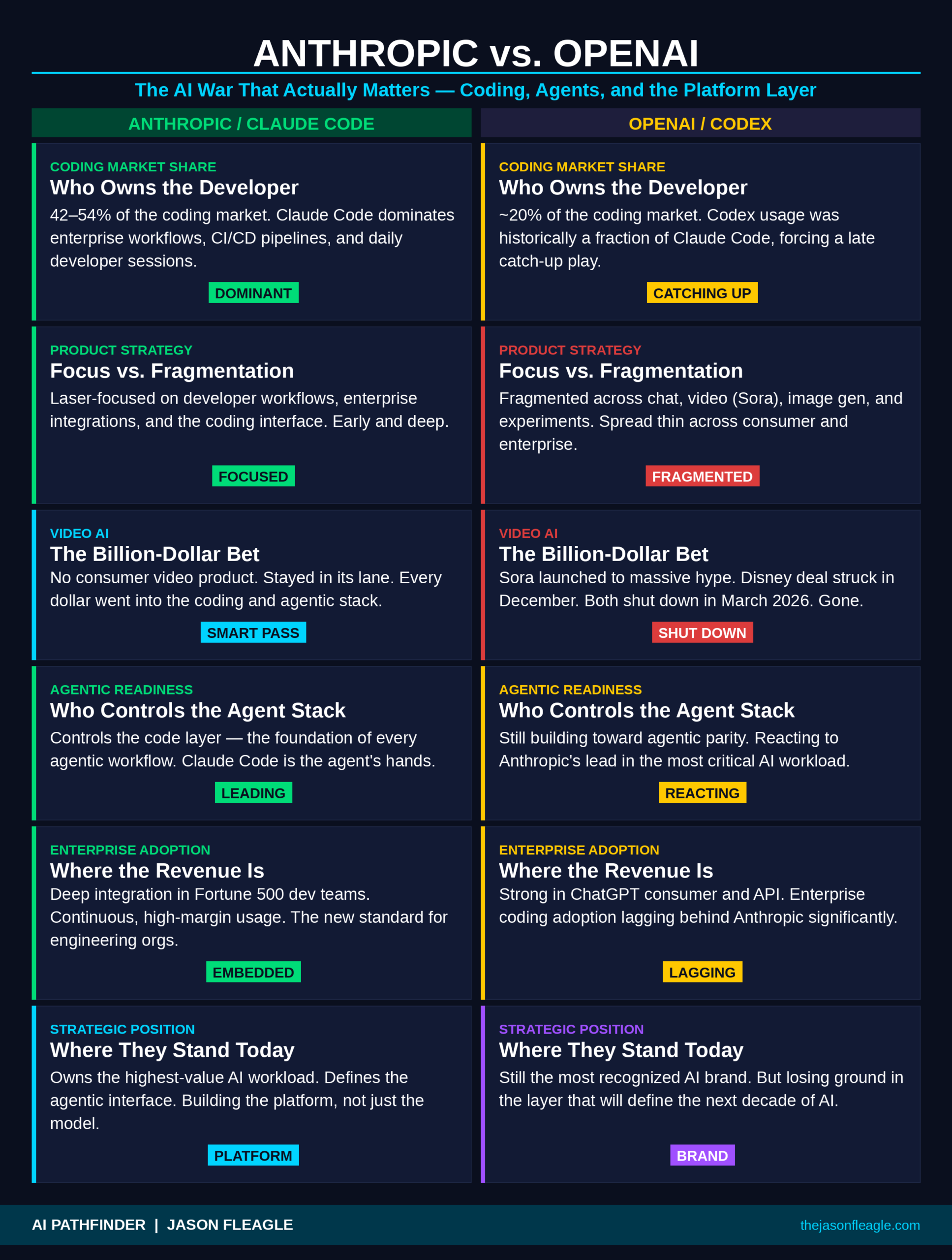
Meanwhile, Anthropic shipped two things: Claude Code. And Claude Cowork.
That’s it. Two products. Both of them boring. Both of them exactly what enterprise teams needed. And both of them now dominating the single most valuable workload in the AI economy.
The Numbers That Should Keep Sam Altman Up at Night
Let’s be direct about what the data says.
Claude Code now commands an estimated 42–54% of the developer market . OpenAI’s Codex sits at roughly 20%. That’s a BIG structural divide. And it’s widening.
A Google engineer recently went public with a story that became a rallying cry in developer communities: Claude Code built in one hour what her team had spent an entire year trying to accomplish. That’s a case study in leverage if I ever saw one.
The developer community noticed. Claude has now overtaken ChatGPT in the Apple App Store rankings — not just because of a viral moment, but because developers who use Claude Code every day are telling their teams, and those teams are telling their companies.
And here’s the part that matters most: coding is not a feature. It is the engine of the entire digital economy. Every agentic AI workflow that will exist in the next decade runs on code.
Agents read code. Agents write code. Agents debug, test, and deploy code.
The company that owns the developer’s terminal owns the infrastructure layer of the AI economy.
Anthropic understood that early. OpenAI is only now admitting it.
Go where the builders are building.
The Anatomy of a Pivot
When a company announces a “superapp,” it means the sprawl strategy failed.
That’s exactly what OpenAI is doing. According to the Wall Street Journal, the company is now planning to merge ChatGPT, Codex, and Atlas into a single desktop application — a direct response to Anthropic’s unified desktop experience, which already bundles Claude, Claude Code, and Claude Cowork into one cohesive product .
OpenAI president Greg Brockman is temporarily leading the overhaul. Fidji Simo will handle distribution. The Sora team — which was inexplicably placed under the research department despite shipping a consumer product — is being reorganized. And Sora itself, rather than getting its own standalone future, will be folded into the main ChatGPT app as a feature.
That’s the tell. When a flagship product becomes a feature, it means the flagship strategy failed.
Simo described Anthropic’s rise to employees as a “wake-up call.” The company is, in her words, “very much acting as if it’s a code red”.
That’s not the language of a company that’s confidently executing. That’s the language of a company that looked up and realized it was losing the war it thought it was winning.
Why the Agentic Stack Runs on Code
Here’s the strategic argument that most people are still missing.
The next decade of AI isn’t about chatbots. It’s about agents — autonomous systems that can take actions, make decisions, and complete complex multi-step tasks without a human in the loop for every step.
And the agentic stack is built on code. Not video. Not images. Not search.
Agents need to read and write code to interact with digital systems. They need to understand APIs to connect to the outside world. They need to debug, test, and deploy software to perform any meaningful work. The entire infrastructure of autonomous AI — every tool call, every workflow, every integration — is fundamentally a software engineering problem.
He who controls the code, controls the agent.
Anthropic didn’t stumble into this position. They made a deliberate bet that the highest-value AI workload was the one that developers touch every single day. Not the one that goes viral on X. Not the one that gets a Disney partnership. The one that becomes so embedded in how engineers work that removing it would break their entire workflow.
That’s what Claude Code is now. And OpenAI is only beginning to understand what it means to compete with a product that people can’t live without.
OpenAI spread themselves too thin trying to do too many things.
The Bottom Line
Sora’s shutdown is a headline. The real story is the strategic confession buried inside it.
OpenAI bet on breadth. Anthropic bet on depth. And in the market that matters most — the one where AI becomes infrastructure, not a feature — depth won.
The companies that will define the next decade of AI aren’t the ones with the longest product list. They’re the ones that became indispensable to the people who build everything else.
Right now, that’s Anthropic. OpenAI is reorganizing, consolidating, and playing catch-up in the market it should have owned.
Don’t count OpenAI out. Time will tell how quickly they can rebound.
The question isn’t whether OpenAI can recover. They have the brand, the capital, and the talent to mount a serious comeback. The question is whether the window is already closing — and whether the developers who’ve built their entire workflow around Claude Code will ever switch back.
History says they won’t.
Your 3-Step Action Plan
1. Audit your AI stack by workload, not by brand.
The “use one model for everything” era is over. If your team is using a general-purpose model for specialized development tasks, you’re leaving performance on the table. Run a structured benchmark: put Claude Code, Codex, and your current setup against the same real-world engineering task. Let the output decide.
2. Prioritize depth over breadth in your own AI deployments.
The lesson from Anthropic’s win isn’t just about coding tools. It’s about focus. If you’re building AI into your business, resist the temptation to deploy everywhere at once. Pick the two or three workflows where AI creates the most leverage, go deep, and make those integrations indispensable. That’s how you build infrastructure, not experiments.
3. Watch the agentic layer, not the chatbot layer.
The next wave of AI value creation isn’t in chat interfaces. It’s in autonomous agents that can take actions, connect to systems, and complete complex tasks. The companies building that infrastructure now — and the platforms that developers trust to build it on — will define the next decade. Position yourself accordingly.
Ready to build your own agentic AI strategy?
I’ve helped over 500 companies — from early-stage startups to Fortune 500 enterprises — build and deploy AI systems that drive real, measurable revenue. If you’re ready to move beyond the hype and build a structural advantage, reach out to my team.
Want to see more real-world AI case studies?
- Browse my full library of AI case studies
- Subscribe to my YouTube channel for AI breakdowns
- Take our AI Marketing Course to learn how to apply these strategies
About the Author
Jason Fleagle is a global AI Consultant with over 500 AI projects and integrations delivered, Jason has generated over $70M in ROI for clients by designing and implementing marketing and tech agentic systems that drive measurable growth.