

Anthropic’s new release raises the ceiling for difficult technical work. The evidence still argues for choosing by workload, not switching everything to the newest model.
Anthropic has a new model that can coordinate large engineering projects, perform better on difficult coding tests, and help researchers tackle problems that were previously impractical.
Its recommendation for most users? Start with Opus 5.5.
That is worth paying attention to. The November 9 launch of Claude Fable 5.2 and Claude Mythos 5.2 is a substantial technical release, but Anthropic is positioning it above the daily-driver tier. The question for a business is which difficult work now deserves another attempt, and whether the new model finishes it well enough to justify the cost.
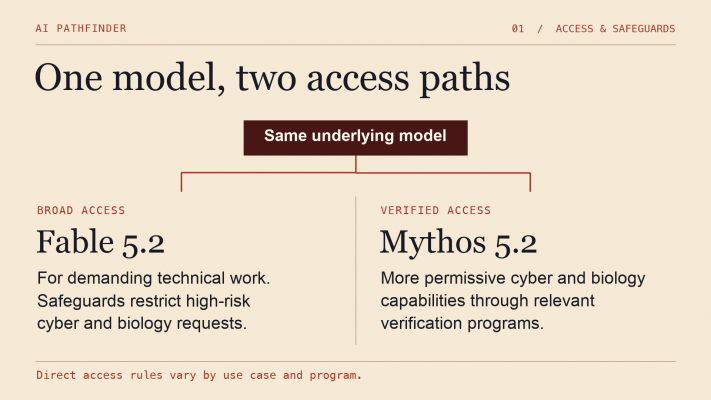
There is also an important naming distinction: Fable and Mythos are two configurations of the same underlying model. Their safeguards and access rules differ. Buying access to one does not automatically give you the capabilities or permissions associated with the other.
Why this matters
Fable 5.2 is a strong candidate for demanding coding, long-running research, and complex technical projects. Mythos 5.2 opens more permissive cybersecurity and biology capabilities through verified-access programs. Independent evaluations support meaningful progress, but the new release does not win every comparison. Before upgrading a production workflow, test the effort setting, fallback behavior, data-retention terms, and cost of an accepted result.
What Anthropic actually launched
In its Fable 5.2 and Mythos 5.2 announcement, Anthropic describes improvements in coding, reasoning, vision, and engineering judgment. It reports token generation up to 30% faster than the 5.1 versions, with lower standard API prices.
The current Fable 5.2 documentation lists:
- Standard API pricing: $8 per million input tokens and $40 per million output tokens.
- Optional fast mode: $16 per million input tokens and $80 per million output tokens, with Anthropic advertising up to 2.5 times faster token generation.
- Context and output: a one-million-token context window and up to 128,000 output tokens.
- Input and output formats: text and images in; text out.
- Reasoning: adaptive thinking is always on, with an effort setting controlling depth.
These are token prices and generation-speed claims, not promises about the cost or duration of a complete project. A long research task can still spend substantial time thinking, calling tools, testing, and correcting its work. Testing and validation is required to understand the total cost of ownership (TCO) for using these models in production.
Fable is broadly available through Claude and supported cloud platforms. Mythos direct access requires approval through the relevant verification program. Fast-mode availability is narrower than the overall model rollout, so confirm support on your chosen platform rather than assuming every endpoint behaves identically.
The gains are real enough to test
The strongest reason to evaluate Fable 5.2 is that several different kinds of evidence point toward better performance on hard work. They also reveal where the limits remain.
Independent testing supports a higher capability ceiling
At the time of this review, Artificial Analysis’s Intelligence Index v5.0.1 lists Fable 5.2 at Max effort, with Default Fallback, at 65, the highest score on that index. Its High and Xhigh configurations both score 62.
That is an independent composite across nine evaluations, not a percentage of business tasks the model will successfully complete. The configuration label matters: this is a Fable result with fallback enabled, not an independent Mythos score.
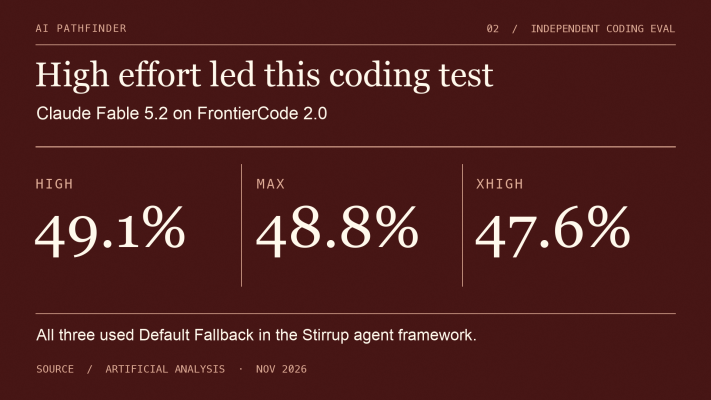
Coding results are particularly encouraging. On Artificial Analysis’s FrontierCode 2.0 evaluation, Fable 5.2 scores 49.1% at High effort, 48.8% at Max, and 47.6% at Xhigh, all labeled Default Fallback. The evaluation uses 132 private coding tasks, with tests and grading rules that assess the resulting patches.
Anthropic’s launch chart also shows a 49.1% FrontierCode score, but at Xhigh, from a different evaluation run. Artificial Analysis uses its Stirrup agent framework; the Cognition evaluation described in Anthropic’s system card runs Claude through Claude Code and uses a different attempt count.
Those results should stay attached to their respective testing setups. Combining the score from one with the cost from another would produce a misleading comparison.
For an engineering team, the practical lesson is straightforward: test both the model and the software surrounding it. More reasoning effort is not automatically better, and a model running inside one coding agent may behave differently inside another.
Finished work matters more than an impressive answer
Anthropic’s system card reports that Scale AI evaluated Fable 5.2 on the Remote Labor Index, a collection of 240 freelance projects with human-produced reference deliverables. Human evaluators judged Fable’s output at least as good as the professional reference on 41.3% of projects, compared with 21.3% for Opus 5.5.
That is a useful signal for work that has to end in an artifact: software, analysis, a design, or another finished deliverable. It does not mean 41.3% of jobs can be eliminated. A selected project benchmark does not capture an employee’s full responsibilities, relationships, accountability, or operating context.
I would use that result to revisit a difficult, well-bounded backlog item. A stalled migration with a clear test suite is a better starting point than a vague instruction to automate a department.
It does not win every business-work comparison
Anthropic’s own launch table puts Fable 5.2 at 51.4% on AutomationBench, behind Gemini 4 Carbon at 53.9%. That benchmark tests multi-step business workflows, not just conversational answers.
The knowledge-work results also resist a simple ranking. The system card reports Artificial Analysis’s AA-Briefcase v1.1 evaluation with Fable ahead of Opus on rubric scoring, 66.1% versus 61.2%, but behind on the separate Elo rating, 1785 versus 1800. Rubric completion and comparative judgments of work quality are different measures. The narrow Elo ordering alone does not establish a meaningful advantage.
These are good reasons to keep your existing model in the comparison. A broad capability gain can coexist with a better fit elsewhere for a particular workflow.
Mythos is a verified-access configuration, not a premium toggle
Fable’s additional safeguards restrict high-risk cybersecurity work and much research biology. Mythos makes more of those dual-use capabilities available under the relevant verification program. Neither configuration makes malicious activity acceptable.
The Cyber Verification Program distinguishes Defense Access, Red Team Access, and Specialized Access. Individuals can apply for Defense Access; the broader tiers are for organizations and carry additional requirements. Approval, account assignment, platform provisioning, and permitted use are separate steps.
A detail that matters for consultants and service providers: internal approval does not automatically authorize work for customers. Anthropic requires separate approval for external services or products using program access.
There is also a product-access distinction. Anthropic says Claude Enterprise customers can use Claude Security, now powered in part by Mythos 5.2, without being members of the Cyber Verification Program. That is access to a defined security product, not unrestricted direct access to Mythos.
If your team is evaluating vulnerability research, incident response, or scientific work, establish the permitted workflow and access path before building the business case around a benchmark result.
The engineering demonstrations are ambitious, but read the setup
Anthropic reports that a team of 1,000 agents using an earlier Fable 5.2 snapshot formalized Fermat’s Last Theorem in 30 hours. The system card explains that the effort built on definitions and smaller proven results from an earlier formalization.
This was translating an existing mathematical result into a computer-checkable proof, not discovering Fermat’s theorem from scratch. It was also a coordinated research setup, not one ordinary chat response.
The launch includes other ambitious demonstrations: a prototype operating system built over eight days, electronic devices designed with a manufacturing partner, and work on open theoretical-physics problems. These are Anthropic-reported examples; they should not be presented as independently replicated outcomes or general guarantees about autonomous research.
The opportunity is still interesting. More capable agents may make some complex projects worth attempting again. But a large agent team needs a way to divide work, reconcile changes, run tests, and recognize failure. The model does not remove those engineering requirements.
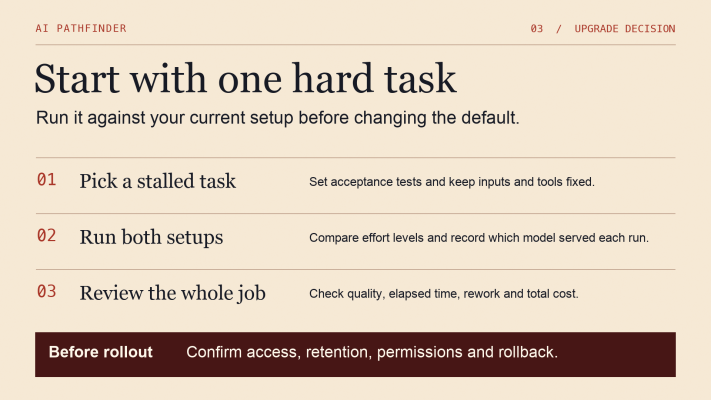
For most organizations, I would start with one hard project and explicit acceptance tests rather than imitate the largest agent count in the launch announcement.
A safety detail worth more attention: which model answers?
The system card contains a finding that complicates any claim that Fable 5.2 is simply safer across the board.
In its adversarial coding prompt-injection evaluation, Anthropic reports that Fable frequently fell back to Opus 4.8. The resulting system had a higher attack-success rate than some earlier models, even though requests answered by Fable itself were more robust in that test.
This is a controlled adversarial evaluation, not a real-world breach rate. It nevertheless exposes a practical deployment issue: you need to evaluate the full response path, including fallback models.
A model selector can say Fable while a particular request is handled elsewhere. The behavior of that fallback, its permissions, and the controls around it matter to the application you are actually running.
Anthropic also reports improvements in several alignment and sandbox-related evaluations while acknowledging regressions and uncertainty in others. A stronger benchmark score does not justify broader production permissions. Keep external content untrusted, limit tool access, require approval for consequential changes, and test how the system behaves when asked to work outside its scope.
Check privacy and migration details before sending real data
Fable 5.2’s documentation specifies 30-day data retention unless Anthropic expressly authorizes zero data retention. The launch describes Enterprise Frontier Safeguards as being in private beta, with eligible arrangements that support zero data retention.
Do not assume a previous contract, cloud deployment, or enterprise subscription automatically establishes the right retention arrangement for this model. Confirm the applicable provider, account, and terms before submitting sensitive information.
Developers should also review integration assumptions. The API defaults to High effort, while the launch says Claude apps and Claude Code default to Medium. Adaptive thinking cannot be disabled, and certain older sampling and forced-tool settings are not accepted. Changing only the model ID may be insufficient.
For paid subscribers, the launch offer gives Pro users and standard Team seats included Fable usage, capped at 50% of weekly usage limits, through November 16, 2026 at 11:59 p.m. Pacific. That is a temporary evaluation opportunity, not permanent unlimited access. Reset eligibility has separate conditions.
Your AI Pathfinder Action Plan
My recommendation is a selective upgrade test, with your current model retained as the baseline.
- Choose work that has been genuinely difficult. Use a stubborn engineering task, a source-heavy research question, or a complex deliverable with a clear definition of acceptable output. Avoid judging the release on an easy prompt every model already handles.
- Compare realistic settings. Test your current configuration against Fable at more than one effort level. Keep the tools, inputs, time limits, and acceptance criteria consistent. Record the actual model that served requests, including fallbacks.
- Measure the whole job. Track quality, elapsed time, tool failures, total consumption, and human correction. Faster generation only matters if it improves the workflow you care about.
- Verify access and data conditions. Confirm Mythos eligibility where relevant, internal versus customer-facing use, provider support, retention terms, and the permissions the workflow needs.
- Promote only the proven improvement. Route the difficult work to Fable when the results justify it. Keep simpler work on a less costly model, and retain human review and rollback for consequential actions.
A hypothetical migration is a useful example. Let the existing model handle routine changes. Have Fable investigate the failing tests or an architectural decision that has resisted simpler approaches. Compare the reviewed patch and total effort before handing it the entire repository.
Frequently Asked Questions
Are Fable 5.2 and Mythos 5.2 different underlying models?
Anthropic says they share the same underlying model. Their safeguards and access conditions differ, particularly for cybersecurity and biology. Those differences can affect which model ultimately handles a request.
Should I replace Opus 5.5 with Fable 5.2?
Not by default. Anthropic still recommends Opus 5.5 for most coding and knowledge work, with Fable or Mythos for more demanding tasks. Let your own workload evaluation determine where escalation helps.
Does the release prove autonomous engineering is ready without supervision?
No. It provides promising benchmark results and ambitious demonstrations. Production readiness still depends on the surrounding tools, tests, permissions, monitoring, and people responsible for accepting the result.
The Bottom Line
Fable 5.2 gives technical teams a credible reason to retry work that previous models handled poorly. Mythos 5.2 expands what verified teams can attempt in sensitive domains.
The best first move is to select a difficult task you can evaluate properly. Keep the current approach as a baseline, test the new configuration, and upgrade where the finished result earns it.
Related reading: Gemini 4 Carbon vs. Claude and GPT: where Google wins and where it doesn’t.
About Jason Fleagle
Jason Fleagle is the Head of AI at Netsync and writes AI Pathfinder about practical AI adoption, business value, and secure operations. His work connects AI strategy with the architecture and operating discipline needed to put it into practice. Explore more at thejasonfleagle.com and Netsync’s AI and automation services.