
The Next AI Gap Will Be Delegation, Not Access
Quick take: OpenAI Codex research shows AI work is shifting from quick chatbot answers to delegated agent tasks. The next productivity gap is delegation.
OpenAI just handed enterprise leaders a useful preview of where AI work is heading.
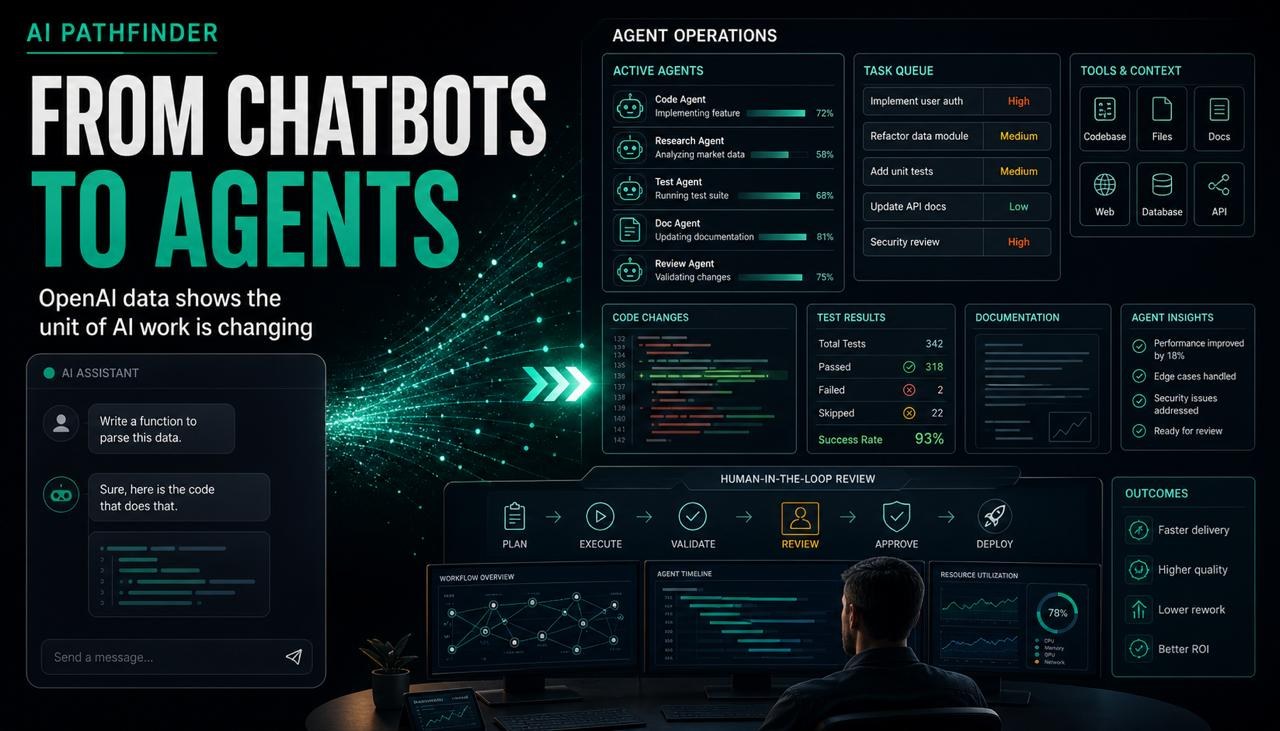
The company published new research on Codex usage, and the signal is pretty hard to miss: people are moving from quick chatbot exchanges into longer blocks of delegated work. They are asking AI to do more than answer questions. They are giving it jobs.
That sounds like a product story at first. Codex grew. ChatGPT usage shifted. Developers adopted a new workflow.
The more interesting read is operational. Once AI can use tools, run for longer stretches, and return something a human can review, the shape of work starts to change.
A chatbot asks you to stay in the loop every few seconds.
An agent asks you to define the job, set the boundaries, and check the work when it comes back.
That is a very different management problem.
What changed
The old AI workflow was simple enough:
- ask a question
- get an answer
- copy the useful part
- do the rest yourself
That helped with emails, summaries, outlines, first drafts, and research cleanups. It still does.
The agent workflow feels different in practice:
- describe the outcome
- provide the context
- set constraints
- let the agent work
- review what it did
- approve, revise, or send it back
- save the workflow if it worked
The interface changed because the job changed. People are starting to hand AI larger blocks of work instead of treating it like a smarter search box.
That shift is easy to miss if you only track logins or token volume. A team can have high AI usage and still be using it mostly as a writing assistant. Another team may use fewer prompts but delegate actual work blocks that clear backlog, create artifacts, or move decisions forward.
Those two teams are not in the same place.
The Codex signal
Related AI Pathfinder reading
- AI Agent Use Case Library
- Human-in-the-Loop AI Governance
- AI Governance Checklist
- AI Readiness Scorecard
- Enterprise AI Roadmap Template
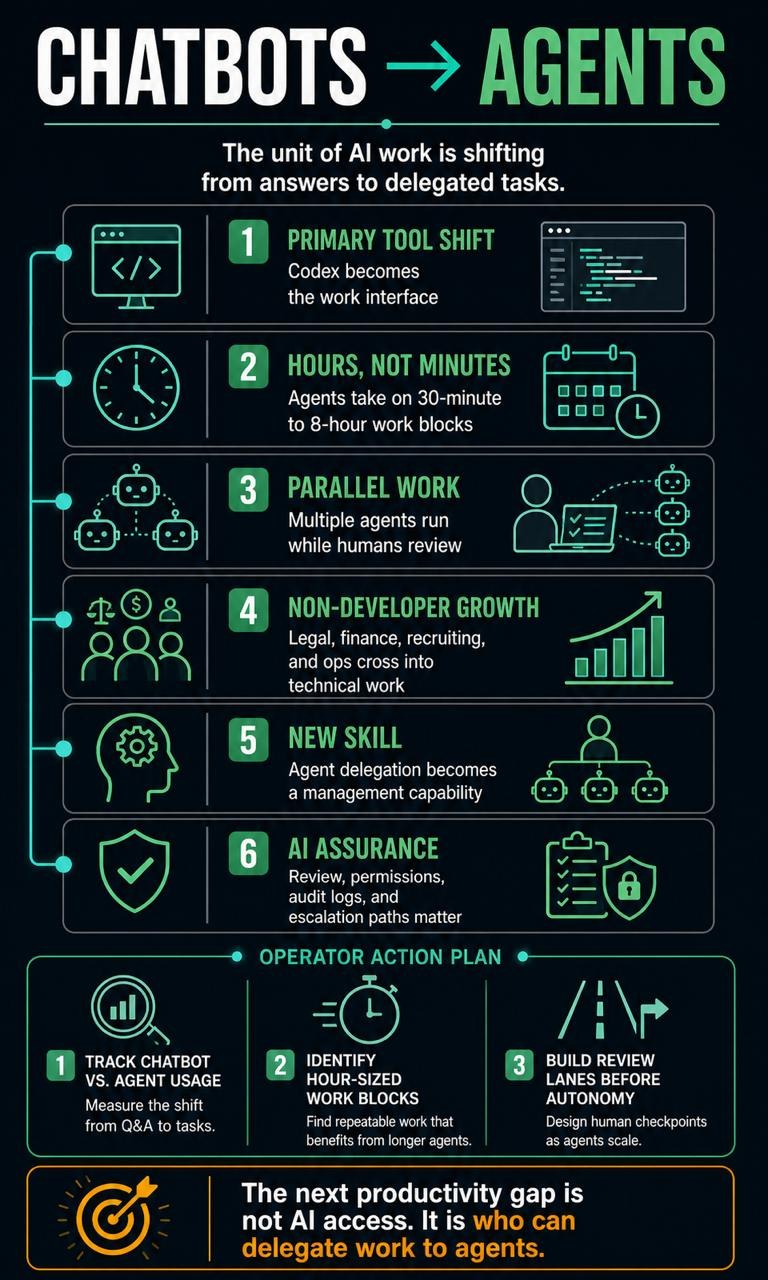
OpenAI’s research says Codex has become the primary AI work tool inside the company. Engineering moved first, which makes sense. Then usage spread into legal, finance, recruiting, and other business functions.
That second part is the real tell.
Codex started with code, but the pattern is now showing up in business work. Legal teams can structure document reviews. Finance teams can build lightweight workflows. Recruiters can automate pieces of process cleanup. Operators can create internal tools without waiting for every request to enter an engineering queue.
No one should oversell that. A finance team using an agent does not suddenly become an engineering team. The human still needs judgment, review standards, and a way to catch mistakes.
But the boundary moves.
A business user can get further before asking for technical help. An engineer can spend less time on first-pass scaffolding. A manager can turn a vague operational pain into a draft workflow, a script, a checklist, or a dashboard concept before the next meeting.
That matters because most companies run on queues.
The sales ops queue. The data queue. The analytics queue. The engineering queue. The legal review queue. The “someone should really clean this up someday” queue.
Agents will not erase those queues. They can take some of the first-pass work off them.
The work unit is getting bigger
The first wave of AI productivity was measured in minutes.
Draft the email. Summarize the meeting. Clean up the paragraph. Explain the PDF.
Useful, but limited.
Agents move the unit of work closer to 30 minutes, one hour, four hours, sometimes more. That is where the operating model gets interesting.
A person saving five minutes gets a slightly easier afternoon.
A person delegating a four-hour research brief, test plan, workflow map, or data cleanup gets a different week.
The OpenAI data points in that direction. Sampled Codex users had delegated tasks estimated at more than 30 minutes of human work, more than an hour, and in some cases more than a full workday. The exact numbers will vary outside OpenAI, but the pattern is the useful part. People are learning to hand AI bigger chunks of work.
That creates capacity. It also creates mess.
Longer-running agents can make more progress. They can also drift further, touch more systems, and produce a much more convincing wrong answer. A bad chatbot response is annoying. A bad agent run can create broken code, a misleading analysis, or a workflow that looks done until someone actually uses it.
The review lane becomes part of the product.
The bottleneck moves to management
For years, the AI adoption question sounded like access.
Who has the tool? Who has permission? Who knows how to prompt it? Who is using it every week?
Those questions still matter. They no longer tell the whole story.
The harder questions are managerial:
- Can the employee describe the outcome clearly?
- Can they provide the right context?
- Can they set boundaries before the agent starts?
- Can they tell whether the work is good?
- Can they decide what needs human approval?
- Can they turn a good run into a repeatable process?
Prompting is the surface layer. Delegation is the actual skill.
Good delegation has always been hard. Managers struggle with it when the worker is human. They either under-specify the work, over-control every step, or fail to define what “done” means.
Agents make that weakness visible fast.
A vague request produces a vague result. A missing source creates a guess. A missing review standard creates false confidence. A weak process becomes a faster weak process.
That is why the agent conversation belongs with operations leaders as much as IT and innovation teams.
What this means for non-technical teams
The most important enterprise use cases may come from people who do not identify as technical.
That will make some leaders uncomfortable. It should.
A recruiter building an automation, a marketer analyzing structured data, or a legal team creating document workflows introduces real governance questions. Who owns the output? What data did the agent use? What systems did it touch? How was the result checked?
Those questions are manageable. Ignoring them is the risky move.
If companies block non-technical teams from experimenting, shadow AI usage will fill the gap. If they open everything without controls, they get speed without trust.
The healthier path sits in the middle: give business teams safe places to delegate work, then wrap those workflows with review, permissions, logs, and escalation paths.
Agent fluency should become a business skill, the same way spreadsheet fluency did. Not everyone needs to become a developer. More people need to understand how to define work clearly enough that an agent can take a useful first pass.
Where leaders should start
Start with the backlog, not the tool catalog.
Ask each team to identify work that has three traits:
- it happens often
- it takes 30 minutes to eight hours
- it produces something a human can review
That filter keeps the first wave practical.
Good candidates include customer research briefs, meeting-to-action summaries, CRM cleanup, proposal first drafts, support ticket clustering, policy analysis, test generation, data cleanup, and internal documentation updates.
Avoid the temptation to start with high-stakes autonomy. Most organizations are not ready for that. Start with tasks where the agent can create a first pass and a human can review the result without risking a customer, a contract, or a production system.
Then define the review lane before expanding the workflow.
For each agentic task, write down:
- the human owner
- the data the agent can access
- the tools the agent can use
- the output format
- the validation step
- the approval step
- the escalation path when the work looks wrong
This is the part companies tend to skip because it feels less exciting than the demo.
It is also the part that makes the demo safe enough to become real work.
Measure output instead of activity
AI dashboards can become vanity dashboards quickly.
Logins are easy to count. Prompts are easy to count. Token volume is easy to count.
None of those prove that the work improved.
A useful agent program should track things closer to the business:
- cycle time reduced
- backlog cleared
- documents or workflows created
- decisions improved
- rework lowered
- quality maintained
- customer response time shortened
- manual steps removed
Usage is a signal. Output is the scoreboard.
The best internal AI teams will probably look less like tool evangelists and more like workflow editors. They will find messy work, turn it into a clear delegation pattern, test it, document it, and teach others to repeat it.
This work rarely looks as flashy as a launch video, but it is where the value starts to show up.
The assurance layer is the enterprise story
As agents get more useful, assurance becomes more important.
Every serious workflow needs basic answers:
- Who requested the work?
- What did the agent access?
- What did it change?
- Which output did a human approve?
- What failed?
- What got escalated?
- What should be reusable next time?
This is where agent adoption will separate mature organizations from chaotic ones.
The companies that move fastest will not be the ones that let agents do anything. They will be the ones that give agents enough room to be useful while keeping ownership, review, and auditability clear.
That means permissions. Logs. Human review. Data boundaries. Approved tools. Clear escalation.
Boring words, maybe. Important ones.
Your AI Pathfinder action plan
Here is the practical move for this week.
- Pick one team and separate chatbot use from agent use.
Do not put summaries, drafting, workflow automation, and delegated agent tasks into the same adoption bucket. - Find five hour-sized work blocks.
Look for repeatable tasks that take 30 minutes to eight hours and produce reviewable artifacts. - Choose one low-risk workflow.
Start with research, cleanup, documentation, internal analysis, or a first-pass briefing. - Write the delegation pattern.
Define the outcome, context, allowed sources, constraints, output format, and review standard. - Run it with a human owner.
The owner reviews the result, notes what failed, and decides whether the workflow deserves a second run. - Save the repeatable version.
If it works twice, turn it into a playbook.
That is how agent adoption becomes an operating habit instead of a collection of experiments.
Bottom line
The next AI gap will show up in the quality of delegation.
Some teams will keep using AI as a chat window. Others will learn to hand agents meaningful work, review the output, and convert the best runs into repeatable workflows.
That difference will compound.
The practical starting point is small: one team, one hour-sized task, one reviewable output, one clear owner.
Run it. Review it. Improve it.
Then do it again.
About Jason Fleagle
Jason Fleagle is the Head of AI for Netsync and an AI and Growth Consultant who helps organizations move from AI interest to practical adoption. He helps leaders turn scattered data, unclear workflows, and emerging technology into business decisions rooted in clarity.
Connect with Jason on LinkedIn for practical guidance on AI adoption, agentic workflows, growth strategy, and enterprise technology.
References
- OpenAI: How agents are transforming work
- OpenAI / arXiv: The Shift to Agentic AI: Evidence from Codex
- The Deep View: Data: US workers are rapidly embracing AI agents
Additional internal reading
- AI Agent Use Case Library
- Human-in-the-Loop AI Governance
- AI Governance Checklist
- AI Readiness Scorecard
- Enterprise AI Roadmap Template
- AI Model Evaluation for Business
Originally published on LinkedIn.