
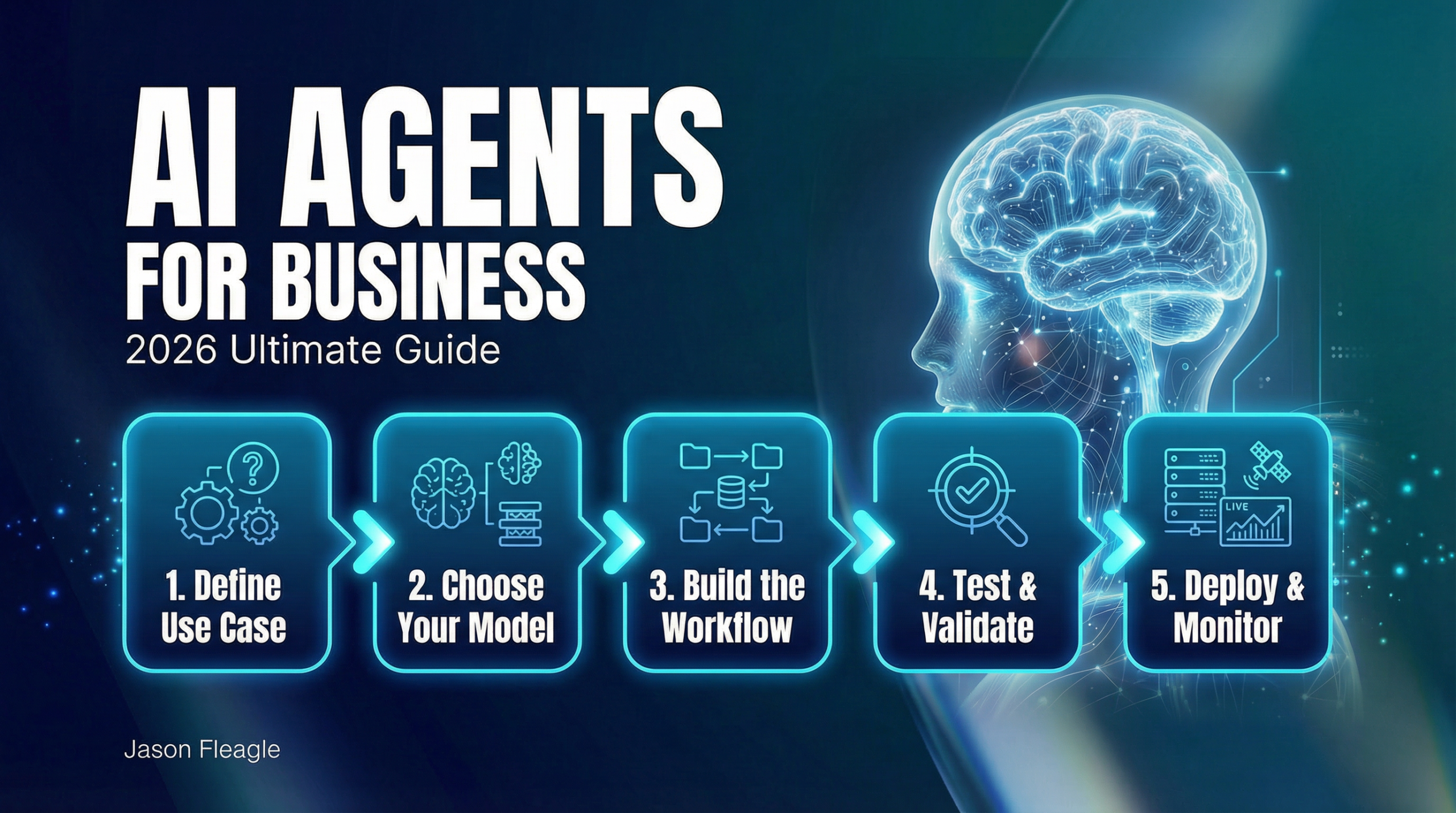
AI Agents for Business
Design AI agents around accountable work, not novelty demos.
Jason helps teams identify where agentic workflows can create value, what controls are required, and how to keep humans in the loop where judgment matters.
No AI theater. No tool-first chaos. Just executive clarity, governed adoption, agentic workflow design, and a practical path from interest to operating value.
AI Strategy • Readiness • Governance • Agents & Workflows • Executive Speaking

Built for leaders who need useful AI, not more noise
Practical AI strategy for leaders who need clarity, governance, and measurable business outcomes.
Executive questions
The right AI conversation starts before the tool decision.
The strongest executive AI guidance moves beyond keywords and hype. It addresses the decisions leaders are carrying: where to invest, how to govern risk, and what teams should do next.
The AI Operating Advantage Framework
A practical path from AI pressure to governed operating value.
Choose the right AI path
One brand system. Multiple executive buying motions.
Designed for executives and operators who need a practical AI decision path: clear business priorities, readiness assessment, governance, workflow design, human review, implementation sequencing, and measurable next steps.AI Agents for Business: practical answers for serious AI decisions
AI Agents for Business: Direct Answer and FAQ
Direct answer: AI agents for business are systems that can use tools, follow goals, retrieve information, draft or execute work, and report results. Useful business agents need workflow boundaries, evidence, human review, permissions, and clear accountability.
When should a business use AI agents?
Use agents when a workflow requires repeated research, drafting, triage, monitoring, coordination, or tool use that can be bounded and reviewed.
What should not be automated with agents?
Avoid agent automation where decisions are high-risk, poorly defined, compliance-sensitive, or lacking clear human ownership.
What makes agents safe enough for business?
Useful agents need scoped permissions, logging, review gates, test cases, rollback paths, and clear standards for when a human must decide.