We are living in two different AI realities right now.
On one hand, general AI adoption is moving faster than the personal computer revolution. On the other hand, the deployment of autonomous enterprise AI agents is shaping up to be a slow, multi-decade grind.
This week, we got two massive data drops that perfectly illustrate this paradox: the February 2026 Federal Reserve data on GenAI usage, and a new economic forecast from Goldman Sachs on the future of AI agents.
Here is what the data tells us about where we are, and where the bottlenecks are hiding.
The 16-Year Compression (The Fed Data)
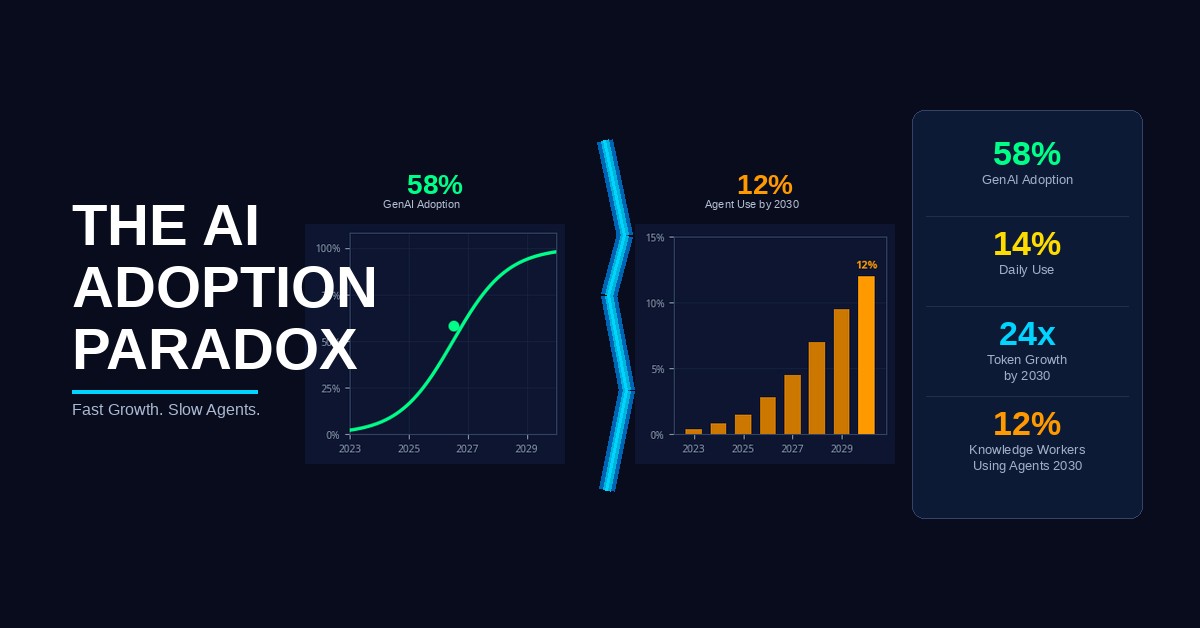
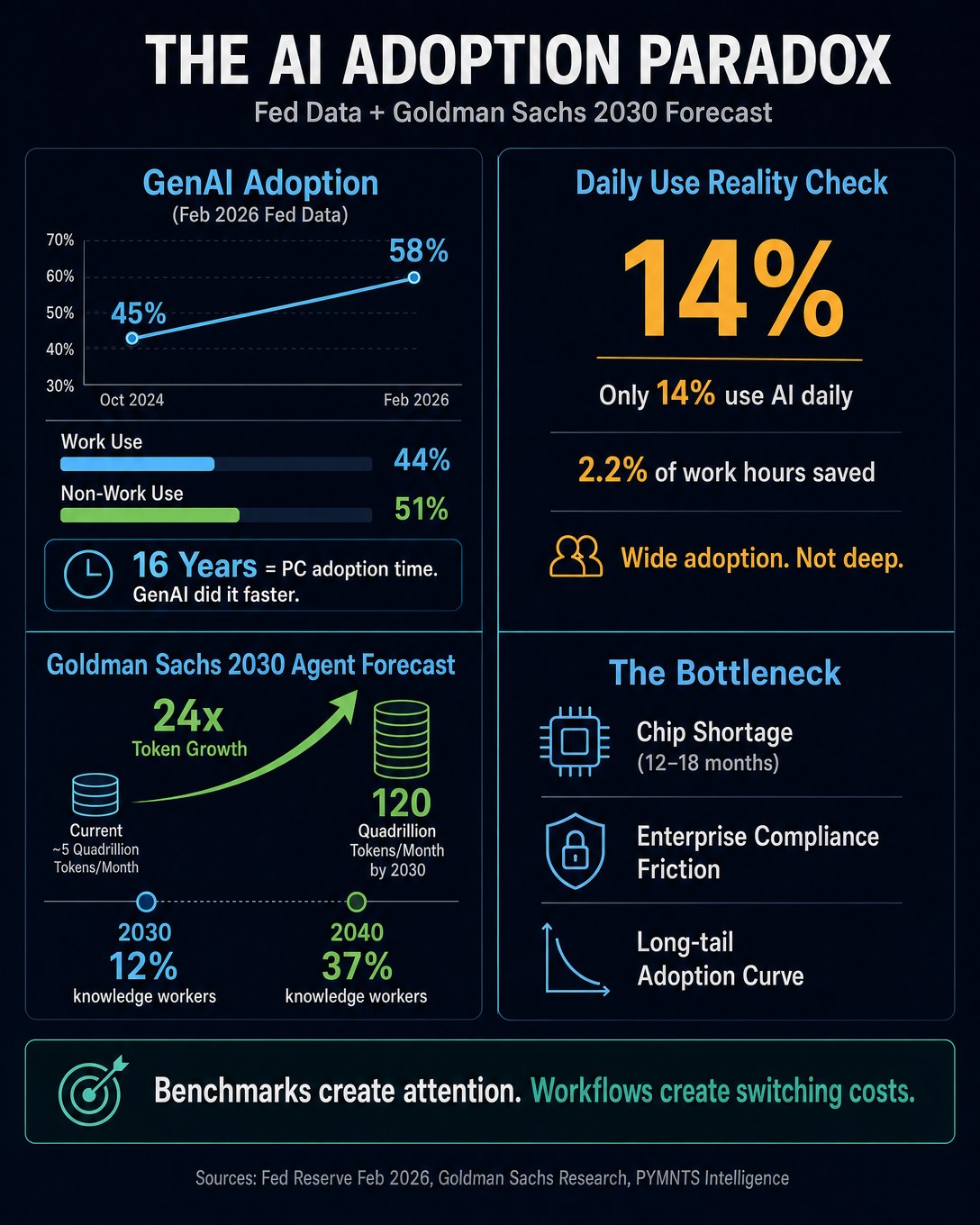
According to the latest Fed data (highlighted by Sequoia partner Alfred Lin), GenAI use among U.S. working-age adults rose from roughly 45% in October 2024 to 58% in February 2026 [1].
The breakdown shows growth across the board:
- Work use: Climbed from ~33% to 44%.
- Non-work use: Climbed from ~36% to 51%.
The most staggering statistic? It took personal computers 16 years to reach the penetration level that GenAI hit in just a few years [1].
But there is a catch. While adoption is wide, it is not yet deep. Daily use has remained relatively flat, hovering near 14%. Furthermore, the Fed estimates that GenAI adoption is currently only saving about 2.2% of total work hours [1].
As Lin noted: “Inside the tech industry, AI is all anyone can talk about. Outside, we are still incredibly early in adoption. Even the divide between those using AI at all vs using it daily is stark.”
The 120 Quadrillion Token Future (Goldman Sachs)
While basic GenAI usage flattens out, the infrastructure side of the industry is preparing for a massive shift: the move from turn-based chatbots to “always-on” background agents.
A new report from Goldman Sachs predicts that the adoption of autonomous AI agents will drive a 24-fold increase in global token consumption by 2030, reaching a staggering 120 quadrillion tokens processed per month [2].
This shift changes the economics of the tech industry. Jim Schneider, senior equity analyst at Goldman Sachs Research, notes that as computing costs decrease, AI players are poised for a period of “margin inflection.” As higher gross margins lead to higher operating cash flow, hyperscalers gain the headroom they need to sustain massive capital expenditures [2].
The Enterprise Bottleneck
If agents are the future, why isn’t everyone using them yet? The answer lies in both hardware and software bottlenecks — and in something more fundamental: the operating model required to make AI useful inside real enterprise workflows.
On the hardware side, a shortage of high-end semiconductors is expected to last for the next 12 to 18 months as manufacturers build new plants. On the software side, enterprise adoption is inherently slow due to complex requirements around integration, testing, and compliance [2].
The real bottleneck is not just the model. It is people, processes, data, integration, security, compliance, and governance. That is why the next phase of AI adoption will not be won by the companies with the most licenses. It will be won by the companies that can turn occasional usage into daily workflow transformation.
Because of this friction, Goldman Sachs forecasts a very long-tail adoption curve for agents:
| Year | Knowledge Workers Using Agentic AI |
|---|---|
| 2026 (current) | <5% (estimated) |
| 2030 | 12% |
| 2040 | 37% |
The Operator Action Plan
The data presents a clear mandate for business leaders. Stop measuring AI adoption by who has access. Start measuring it by who has changed how work gets done — with real ROI and success metrics. Here is what you need to do this week:
1. Drive daily use, not just adoption.
58% of people have tried AI, but only 14% use it daily. If you are leading a team, your goal is no longer getting people to log in; it is building workflows that force daily interaction. The 2.2% time savings will only grow when AI becomes a daily habit.
2. Prepare for the token explosion.
If Goldman Sachs is right, token consumption is about to 24x. If your infrastructure and budget are not prepared for “always-on” background agents, you will be priced out or throttled. Start modeling your API costs for agentic workflows now.
3. Move out of the sandbox.
According to PYMNTS Intelligence, the number of Chief Product Officers who were just “considering” or “exploring” agentic AI dropped from 52% in August to 30% recently, while those actively piloting or using it in production jumped from 3% to nearly 25% [2]. If you are still window-shopping, your competitors are already building.
If you are looking for help doing AI the right way, reach out to the team at Netsync to schedule a discovery session. We can help you determine the right action plan to get you where you need to go.
Frequently Asked Questions
How fast is GenAI adoption growing?
According to February 2026 Fed data, GenAI use among U.S. working-age adults reached 58%, up from 45% in October 2024. It achieved in a few years what took personal computers 16 years to accomplish.
How much time is AI actually saving workers?
Currently, the Fed estimates that GenAI adoption is saving about 2.2% of total work hours, largely because daily use remains low (around 14%). Early adopters and systems-thinkers who have built AI into their daily workflows are seeing significantly better results.
What is the Goldman Sachs prediction for AI agents?
Goldman Sachs predicts that autonomous AI agents will drive a 24-fold increase in global token consumption by 2030, reaching 120 quadrillion tokens per month. However, only 12% of knowledge workers are forecast to be using agentic AI by 2030.
Why is enterprise agent adoption so slow?
Enterprise adoption is slowed by a combination of hardware constraints (semiconductor shortages), and software complexity around integration, testing, security, compliance, and governance. The deeper challenge is building the operating model — people, processes, and data — required to make AI useful inside real enterprise workflows.
What is causing the AI chip shortage?
The rapid evolution of AI use cases has outpaced supply. A shortage of high-end semiconductors is expected to last 12 to 18 months while manufacturers build new fabrication plants. Goldman Sachs analyst Jim Schneider predicts it could take two full years for supply to catch up with evolving use cases.
How should companies measure AI adoption success?
Stop measuring AI adoption by who has access. Start measuring it by who has changed how work gets done — with real ROI and success metrics. The goal is not getting people to log in; it is building workflows that force daily interaction and deliver measurable business outcomes.
References & Sources
[1] Alfred Lin on X: February 2026 GenAI usage data
[2] PYMNTS: Goldman Sachs Predicts AI Agents Will Increase Tech Cash Flow
About Jason Fleagle
Jason Fleagle is the Head of AI for Netsync and an AI and Growth Consultant working with global brands to help with their successful AI adoption and management. He helps humanize data — so every growth decision an organization makes is rooted in clarity, not confusion. He has overseen the development and delivery of over $50M in digital solutions, driving significant revenue growth and operational efficiency for his clients.
Jason is also the Founder of Catalyst Brand Group, where he blends AI software development, digital marketing, and automation to deliver revenue-first, real-world deployments. He is the creator of Growth OS and Personify, focusing on measurable ROI and clear deliverables.
Connect with Jason on LinkedIn to stay updated on the latest in AI, growth strategies, and enterprise technology.
Read the original post on LinkedIn: The AI Adoption Paradox: Fast Growth, Slow Agents