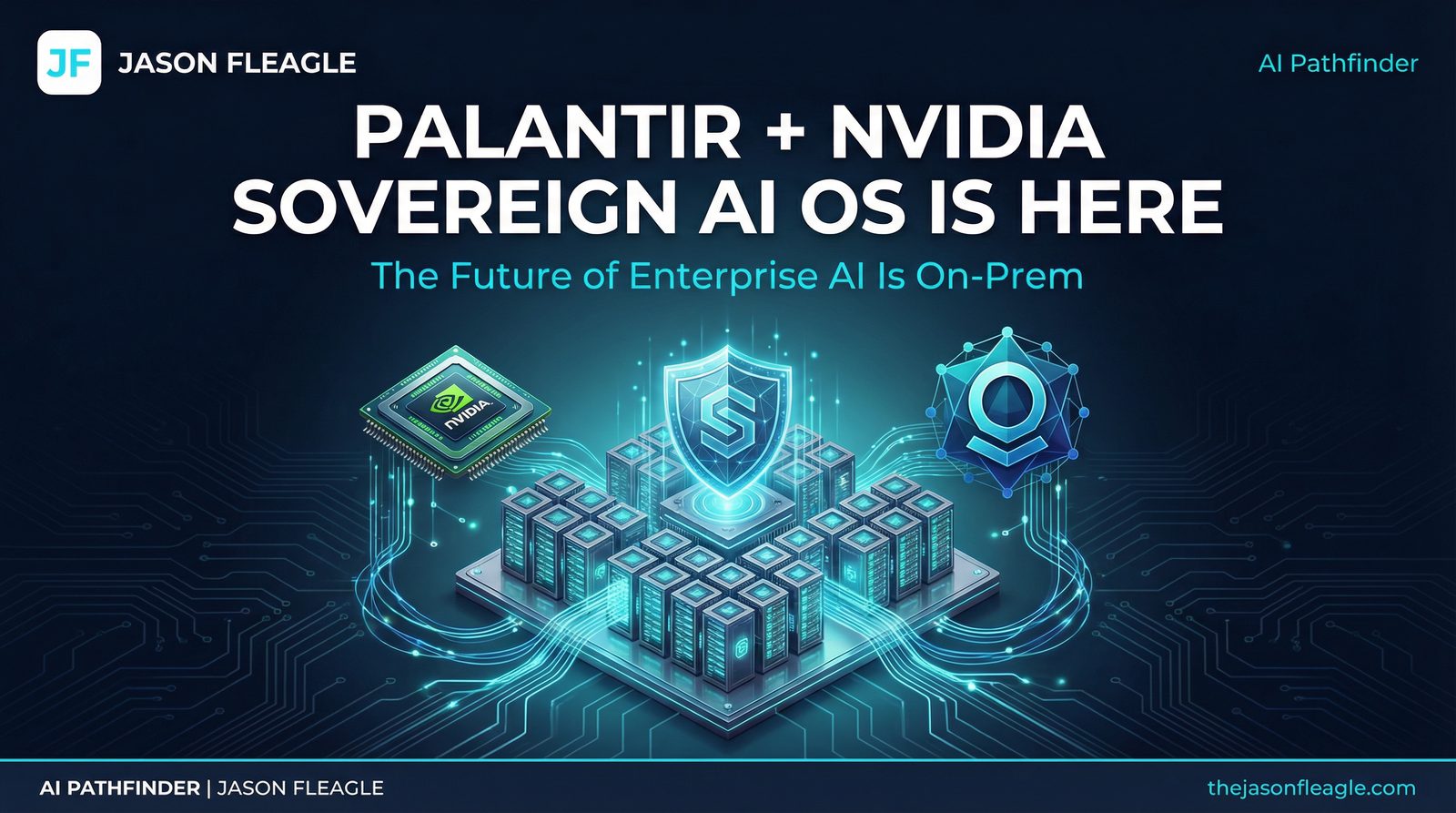
TLDR: Palantir and NVIDIA dropped a Sovereign AI Operating System. It’s a full-stack, on-prem AI data center in a box. This isn’t a niche product but a direction of enterprises moving from the public cloud to a future of enterprise AI leveraging on-prem AI to be more about data sovereignty, control, and performance.
What Happened
Palantir and NVIDIA announced a joint Sovereign AI Operating System reference architecture. This is a complete, production-ready AI infrastructure solution designed to be deployed in a company’s own data centers. The partnership combines Palantir’s entire software suite (AIP, Foundry, Apollo) with NVIDIA’s latest hardware (Blackwell Ultra GPUs, Spectrum-X networking) and software (NVIDIA AI Enterprise).
In short, they’ve created a turnkey AI data center. The goal is to give enterprises and nations the full power of a state-of-the-art AI stack without forcing them to send their most sensitive data to the public cloud.
Why It Matters (The Board-Level View)
This move is a direct response to a massive, unspoken trend in the enterprise: the great AI repatriation. A recent survey found that 93% of enterprises are already moving AI workloads off the public cloud, driven by concerns over cost, performance, and data sovereignty.
Palantir and NVIDIA are betting the farm that this trend will only accelerate. They’re not just selling a product, but offering a strategic alternative to the public cloud oligopoly. This is about giving customers complete ownership and control over their AI destiny. And in some cases, the hybrid approach is becoming the clear winner for AI infrastructure.
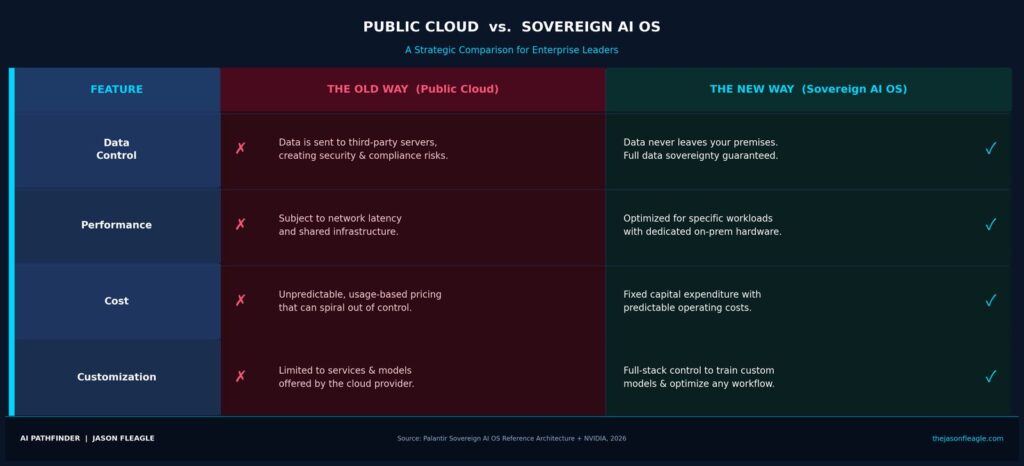
Here’s how this changes the game:
Most companies are running mission-critical AI on infrastructure they don’t own or control. This comparison shows why that’s becoming a liability — and why the smartest enterprises are moving toward sovereign, on-prem AI deployments where data never leaves their walls and costs are predictable from day one. It is becoming cheaper to do so, but also offer the best value, safety, and security.
3 Strategic Imperatives for Leaders
1. Recalculate Your On-Prem vs. Cloud Break-Even Point. The math has changed. With turnkey solutions like this, the cost and complexity of deploying on-prem AI have dropped significantly. It’s time to re-run the numbers and determine the break-even point for repatriating your most critical AI workloads. The public cloud is no longer serving as the default answer. A reassessment is a good idea to compare hybrid or on-prem total cost of ownership (TCO).
2. Audit Your AI Workloads for Sovereignty & Latency Risks. Identify the AI applications in your portfolio that handle sensitive data (customer PII, financial records, IP) or require real-time performance (industrial automation, fraud detection). These are your prime candidates for a sovereign, on-prem deployment. The risk of not owning these workloads is now a major liability. And as AI agents and AI employees become more integrated and used, those cloud costs can add up, so on-prem 24/7 workloads become more cost-effective in terms of ROI.
3. Invest in “Forward Deployed” Talent. The Palantir/NVIDIA model relies on a new breed of engineer: the Forward Deployed Engineer (FDE). These are not just coders, but full-stack problem solvers who can work across infrastructure, data, and business logic. You need to start hiring or training people with this hybrid skillset. Your ability to execute your AI strategy will depend on it. This is one of the new areas of value I like to play in because it requires balancing the business, technical, and people components effectively for organizations. It’s a rare skill today, but a crucial one for companies as they try to effectively navigate AI.
The Bottom Line
The Palantir-NVIDIA partnership is a declaration of AI independence for the enterprise. It signals a major shift in the AI landscape, from a centralized, cloud-dominated model to a decentralized, sovereign one. Leaders who understand this shift and act on it will build a durable competitive advantage. Those who don’t will find themselves building their future on rented land. When the decision-makers behind leading the charge of AI adoption are saying this, it’s usually good to pay attention.
What are your thoughts? Yay or nay? What are you seeing in your experience? Let me know in the comments below, and if you got value from this article be sure to repost.
Ready to Build Your Sovereign AI Strategy?
- Work with me on AI consulting → scalingmillions.com/ai-consultant
- See more case studies → thejasonfleagle.com/category/case-studies/
- Subscribe to my YouTube channel → youtube.com/@jjfleagle
- Learn AI marketing fundamentals → theaimarketingcourse.com
About Jason Fleagle
Jason Fleagle is an AI architect and Chief AI Officer who helps enterprise organizations turn data into growth. He’s delivered over $70M in revenue impact through AI-powered marketing, automation, advertising, and strategic consulting. His work focuses on practical, ROI-driven AI implementations that deliver measurable results in time savings, cost reduction, and workforce transformation.
References
- Palantir. “Palantir and NVIDIA Team to Deliver Sovereign AI Operating System Reference Architecture.” March 12, 2026. investors.palantir.com
- Palantir. “Palantir Sovereign AI OS Reference Architecture with NVIDIA.” palantir.com/sovereignaios
- Fryer, Bradley. “Enterprise survey finds 93% are repatriating AI workloads from public cloud.” LinkedIn. March 9, 2026. linkedin.com