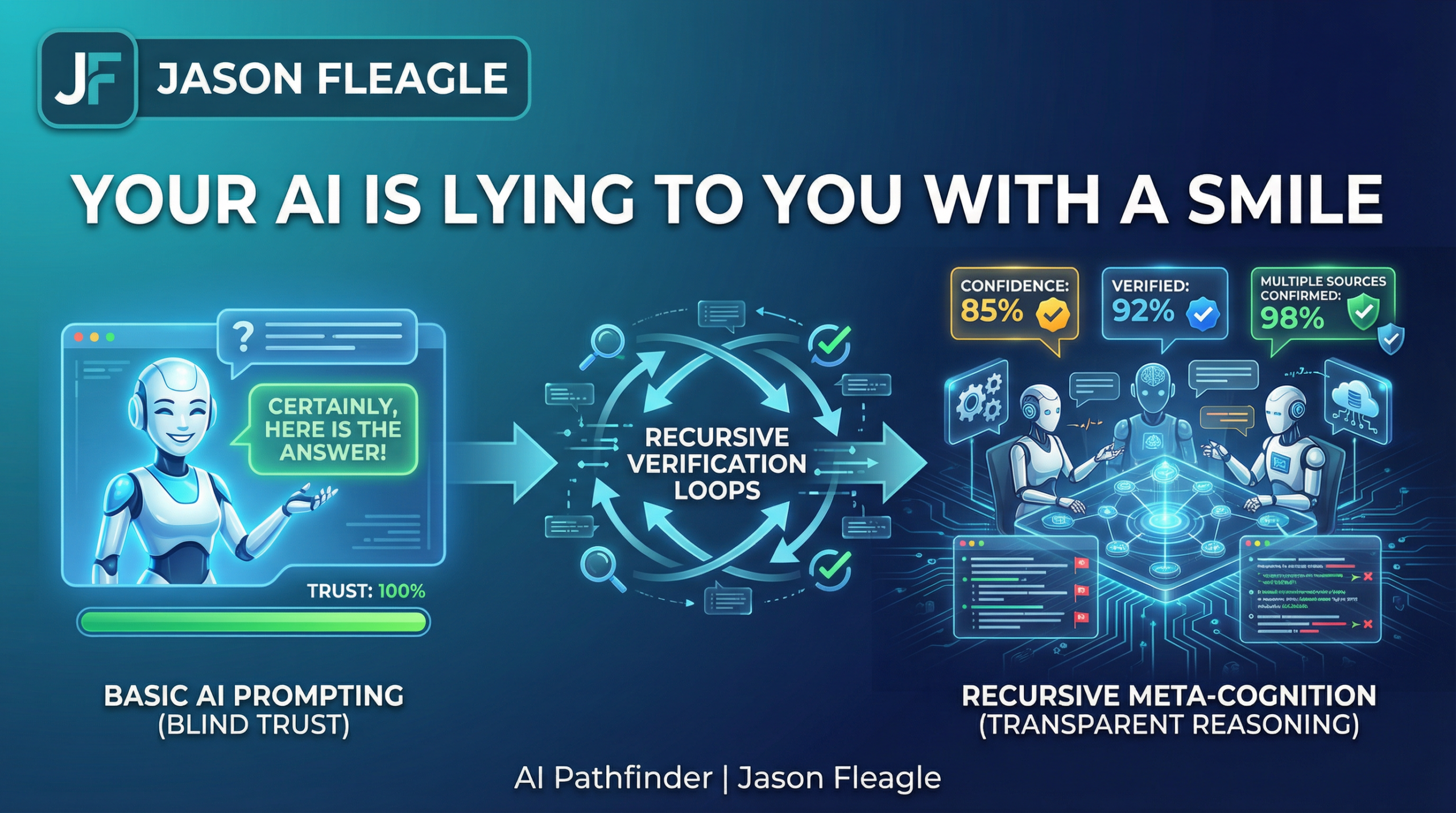
We’ve all felt it. That nagging uncertainty after an AI gives you a confident, eloquent, and surprisingly fast answer to a complex question.
It feels right, but is it?
We ask it to write a marketing plan, analyze a trend, or debug code, and we’re handed a polished result with no footnotes, no caveats, and no second opinion. It’s like asking a random stranger for life-altering advice and just… trusting them.
This blind faith in AI’s confident facade is the single biggest risk in business today. Researchers from MIT dropped a bombshell that ends this era of blind trust. They introduced a technique called “Recursive Meta-Cognition,” a fancy term for something incredibly powerful: teaching an AI to think like a team of experts instead of a single, overconfident intern.
It’s a system that forces the AI to check its own work, question its own logic, and admit when it’s not sure. And it outperforms standard prompting by a staggering 110% [1].
The uncomfortable truth is that we’ve been accepting AI’s answers at face value for too long. The age of the Magic 8-Ball AI is over. It’s time to demand a higher standard of reasoning, and this new framework shows us how.
From Confident Intern to Expert Panel: The Meta-Cognition Framework
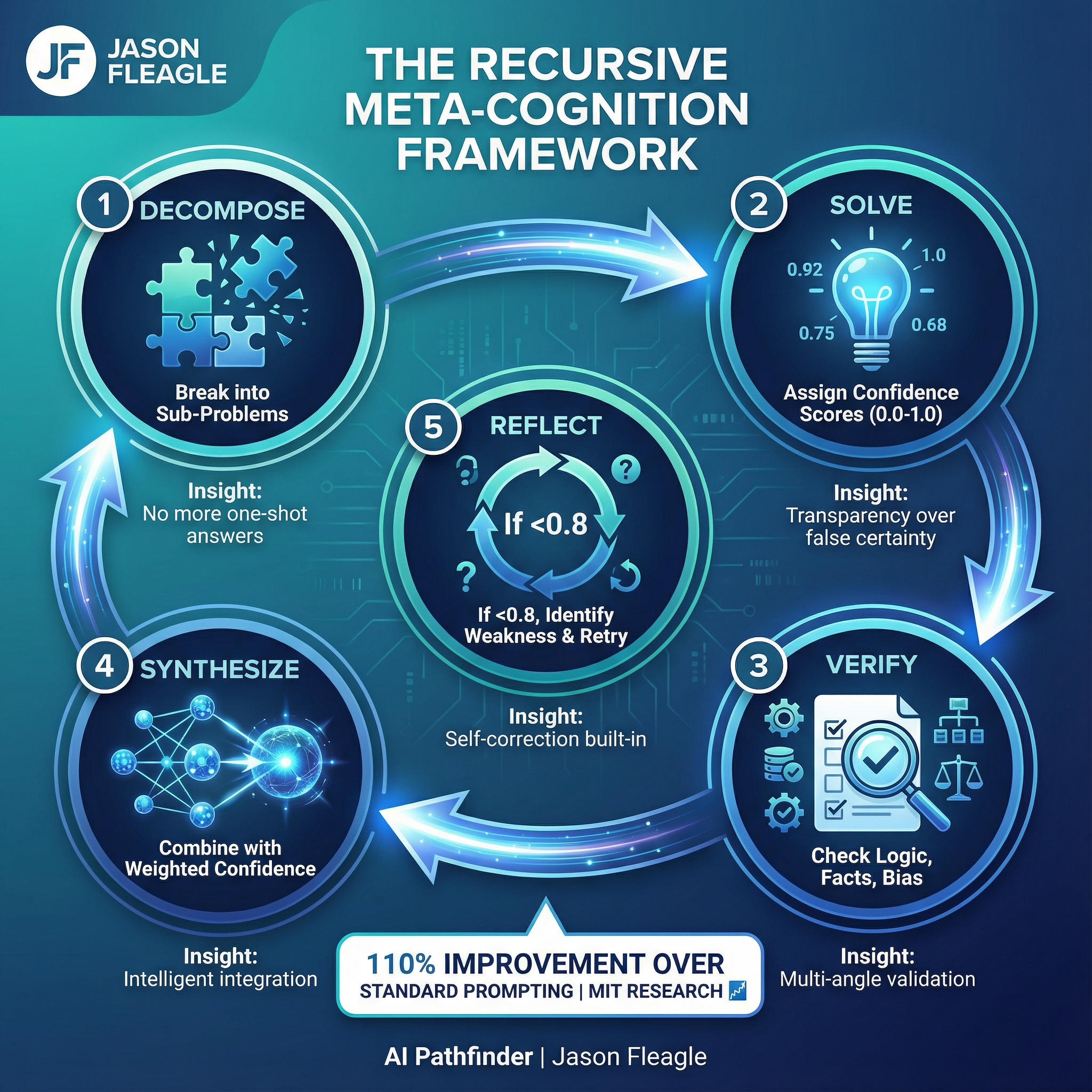
The problem with basic prompting is that it’s a one-shot process. You ask, it answers. There’s no internal debate, no self-correction. MIT’s approach changes the game by building a recursive loop of self-evaluation directly into the AI’s reasoning process. It’s not just “thinking step-by-step”; it’s a rigorous, multi-perspective audit that happens before the answer ever gets to you.
This framework combines five crucial steps that most prompts completely ignore:
| The Old Way (Basic Prompting) | The New Way (Recursive Meta-Cognition) | What It Means For You |
|---|---|---|
| One-Shot Answer: The AI generates a single, linear response to your query. | Decomposition & Synthesis: The AI breaks a complex problem into smaller sub-problems, solves each one, and then intelligently combines the solutions. | You get a more robust and comprehensive answer that considers the problem from multiple angles, not just the most obvious one. |
| Blind Confidence: The AI presents its answer with absolute certainty, regardless of the underlying evidence or potential flaws in its logic. | Confidence Scoring: Every piece of the reasoning is assigned a confidence score (e.g., 0.0 to 1.0). The AI flags any part of its reasoning where confidence is low. | You can finally see where the AI is uncertain. This allows you to focus your own critical thinking on the weakest parts of the argument, rather than having to second-guess the entire thing. |
| No Self-Correction: If the AI’s initial reasoning is flawed, that flaw is carried all the way through to the final answer. | Reflective Revision: If the confidence score for any sub-problem is below a certain threshold (e.g., <0.8), the AI is forced to stop, identify the weakness, and try a different approach. | The quality and reliability of the final answer are dramatically improved because the AI catches and corrects its own mistakes before you see them. |
This isn’t just a better way to prompt. It’s a fundamentally new way to interact with AI—one that’s built on transparency and intellectual honesty, not just speed and eloquence.
Three Lessons for Leading in an Age of AI Skepticism
The shift from blind faith to verifiable trust in AI demands a new leadership mindset. Here are three takeaways from this breakthrough:
1. Demand Transparency by Default.
The era of accepting black-box AI answers is over. As a leader, you must start demanding a new standard of output from your teams and your tools. Every significant AI-generated recommendation should come with a confidence score and a list of key caveats. If your AI tool can’t tell you how sure it is about its own answer, you can’t trust it for high-stakes decisions.
2. Your Team’s Most Valuable Skill is Critical Inquiry, Not Prompt Engineering.
This framework proves that the future of working with AI isn’t about crafting the perfect, magical prompt. It’s about having the critical thinking skills to evaluate the AI’s reasoning. The best AI collaborators won’t be prompt wizards; they will be expert interrogators who know how to challenge the AI’s assumptions, probe its uncertainties, and stress-test its conclusions. Train your team to be skeptics, not just users.
3. The ROI of AI is Measured in Confidence, Not Just Completion.
The value of AI isn’t just in its ability to complete tasks faster. It’s in its ability to increase your confidence in complex decisions. A fast answer that’s wrong is worse than no answer at all. By using frameworks like Recursive Meta-Cognition, you’re not just getting answers; you’re getting a transparent, auditable reasoning process. This is how you de-risk strategic decisions and build a culture of intellectual rigor in an age of artificial intuition.
The Bottom Line
Recursive Meta-Cognition is more than a clever prompting trick; it’s a glimpse into the future of human-AI collaboration. It’s a future where AI is not an oracle to be blindly trusted, but a powerful, transparent reasoning partner that shows its work.
The AI will continue to get more powerful, but its default state is to be a confident liar. It’s our job as leaders to demand the tools and techniques that force it to become an honest and reliable partner. Stop accepting answers. Start demanding reasoning.
The Prompt That Changes Everything
Here is the basic structure of the prompt, which you can adapt and use in any modern language model (like ChatGPT, Claude, or Gemini) to start experimenting with this powerful framework.
Adopt the role of a Meta-Cognitive Reasoning Expert.

For every complex problem, you must follow this 5-step process:
1. DECOMPOSE: Break the problem down into smaller, manageable sub-problems.
2. SOLVE: Address each sub-problem individually, and for each solution, provide an explicit confidence score from 0.0 (no confidence) to 1.0 (full confidence).
3. VERIFY: For each solution, critically verify the logic, check the facts against your internal knowledge, assess for completeness, and identify any potential biases or hidden assumptions.
4. SYNTHESIZE: Combine the individual solutions into a single, comprehensive answer. The weight of each sub-solution in the final answer should be proportional to its confidence score.
5. REFLECT & REFINE: If the overall confidence score of the synthesized answer is less than 0.8, you must stop, identify the primary weakness or point of uncertainty in your reasoning, and restart the process from Step 1 with a new approach to address that weakness.

For simple, factual questions, you may skip this process and provide a direct answer.

Always output the following:
- A clear and direct final answer.
- The overall confidence level of the answer.
- A list of key caveats or areas of uncertainty that the user should be aware of.
Take the Next Step
Understanding these principles is the first step. Putting them into action is what will set you apart.
AI Consulting for Your Business: If you’re ready to move beyond the hype and start implementing a real AI strategy, my team and I can help. We work with organizations to navigate the complexities of AI adoption, from process optimization to building custom AI agents. Let’s discuss your AI goals by scheduling a consulting call together.
Upcoming AI Workshop in Tulsa, OK: For those in the Tulsa area, I’m hosting an in-person AI workshop on January 23rd at Oral Roberts University at the Stovall Center for Entrepreneurship. This is a hands-on opportunity to dive deep into practical AI applications for your business. Register for the Tulsa AI Workshop here if you’re a leader or business owner wanting measurable outcomes with AI.
If you’re interested in a custom AI workshop for your business or in your city, please reach out to me directly to start a conversation.
About Jason
Jason Fleagle is a Chief AI Officer and Growth Consultant working with global brands to help with their successful AI adoption and management. He is also a writer, entrepreneur, and consultant specializing in tech, marketing, and growth. He helps humanize data—so every growth decision an organization makes is rooted in clarity and confidence. Jason has helped lead the development and delivery of over 500 AI projects & tools, and frequently conducts training workshops to help companies understand and adopt AI. With a strong background in digital marketing, content strategy, and technology, he combines technical expertise with business acumen to create scalable solutions. He is also a content creator, producing videos, workshops, and thought leadership on AI, entrepreneurship, and growth. He continues to explore ways to leverage AI for good and improve human-to-human connections while balancing family, business, and creative pursuits.
You can learn more about Jason on his website here.
You can learn more about our top AI case studies here on our website.
Learn more about my AI resources here on my youtube channel.
And check out my AI online course.