
The Ultimate Guide to AI Agents for Business (2026)
If you are still treating AI as a glorified search engine or a chatbot, you are already behind. The era of conversational AI is over. We have entered the era of AI agents—autonomous systems that don’t just answer questions, but execute complex, multi-step workflows on your behalf. They book meetings, qualify leads, write and send emails, analyze data, and update your CRM. All without a human in the loop.
This guide is the definitive resource for business leaders, founders, and enterprise executives who want to move beyond the hype and deploy AI agents that drive measurable ROI. Whether you are looking to automate sales, streamline operations, reduce overhead, or build a competitive moat, this guide will show you exactly how to do it.
What is an AI Agent? (The Plain-English Definition)
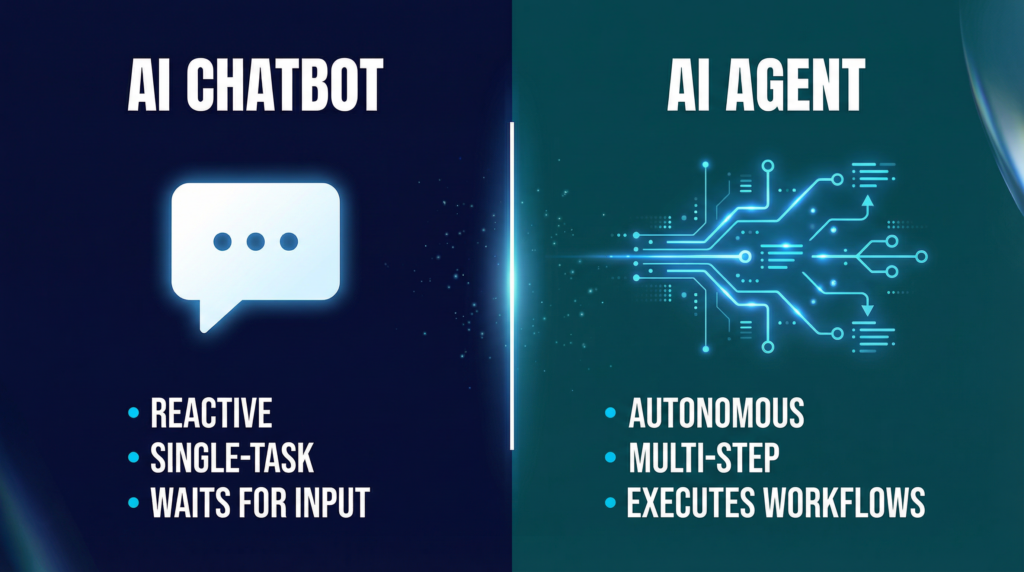
An AI agent is a software program powered by a Large Language Model (LLM) that can perceive its environment, make decisions, and take actions to achieve a specific goal—without requiring a human to guide every step. Unlike a standard chatbot that requires constant prompting, an AI agent can be given a high-level objective and figure out the steps required to complete it.
Think of it this way: A chatbot is like a calculator. You punch in the numbers, and it gives you the answer. An AI agent is like an accountant. You hand them a box of receipts, and they figure out your tax liability, fill out the forms, and file them. You set the goal. The agent handles the execution.
The technical definition involves four core capabilities: perception (reading inputs from the world), reasoning (deciding what to do next), action (executing tasks via tools and APIs), and memory (retaining context across interactions). When these four elements work together, you have a system that can operate with genuine autonomy.
The Evolution: From Chatbots to AI Coworkers
The shift from chatbots to agents is the most significant technological leap since the introduction of the smartphone. We are seeing this play out in real-time with platforms like Anthropic’s Claude Cowork and OpenAI Frontier, which are explicitly designed to function as digital employees rather than just tools. Cisco’s AI Summit 2026 was built almost entirely around the concept of AI coworkers operating alongside human teams.
As I noted in my analysis of GPT-5.4, these systems are no longer just generating text. They are executing code, navigating browsers, querying databases, and interacting with your existing software stack. The line between “AI tool” and “AI employee” is dissolving fast.
Why Your Business Needs AI Agents Now (Not Next Year)
The AI infrastructure race is heating up, and the companies that deploy agents first will capture disproportionate market share. Google spent $32 billion acquiring Wiz AI. OpenAI and Meta have acquired the agent layer. VCs poured over $1 billion into robotics in a single quarter. This is not a technology trend. This is a fundamental restructuring of how businesses operate.
Here is the business case in plain terms:
1. Infinite Scalability Without Linear Headcount Growth
AI agents don’t sleep, take vacations, or get burned out. You can scale your operations instantly without proportional headcount growth. A single AI agent can handle 500 customer inquiries simultaneously. Hiring 500 customer service reps to do the same thing is not a realistic alternative for most businesses.
2. Dramatically Reduced Operational Costs
The break-even math for AI has changed. Deploying an agent to handle tier-1 customer support, lead qualification, or appointment scheduling costs a fraction of a human salary—and the cost is dropping every quarter. Businesses that delay adoption are paying a compounding opportunity cost.
3. Speed-to-Lead Advantage
Studies consistently show that the first business to respond to a lead wins the deal in the majority of cases. An AI agent can respond to an inbound inquiry in under 30 seconds, 24 hours a day, 7 days a week. That speed advantage alone can transform your close rate. We saw this firsthand in our plumbing company case study, where instant AI-powered lead response generated over $10,000 in new sales in the first month.
4. Increased Accuracy and Consistency
While early AI struggled with hallucinations and inconsistency, modern agentic workflows use self-reflection loops, tool-use, and retrieval-augmented generation (RAG) to verify their work. If you are still struggling with AI accuracy, read my guide on how to make your AI more accurate and trustworthy. The techniques are practical and implementable today.
Real-World Case Studies: AI Agents Driving Revenue
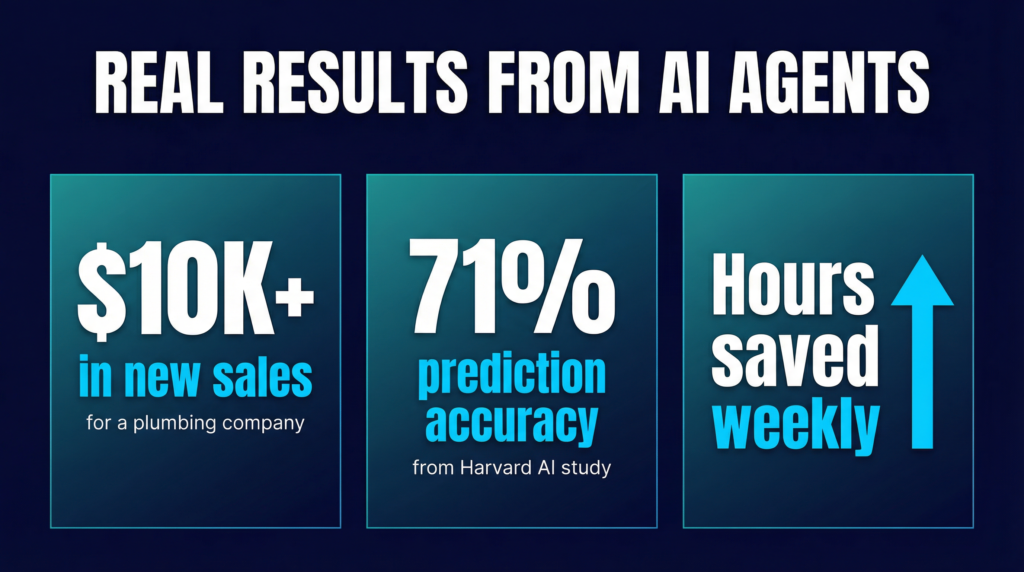
Theory is great, but execution is what matters. Here are real-world examples of how businesses across different industries are using AI agents to drive revenue and efficiency right now.
Case Study 1: $10k+ in Sales for a Plumbing Company
One of the most immediate ROI opportunities for AI agents is in lead response and qualification. In a recent deployment, we built a custom AI agent for a local plumbing company. The agent instantly responded to inbound leads via SMS and web chat, qualified the prospect by asking the right diagnostic questions, and booked the appointment directly into the technician’s calendar.
The result was unambiguous. The agent generated over $10,000 in new sales in its first month by capturing leads that would have otherwise gone to competitors due to slow response times. The owner’s comment: “It’s like having a salesperson who never sleeps and never misses a call.”
Case Study 2: AI Chatbot for Military Veterans
Not every AI agent use case is about sales. We built ARI, an AI chatbot for a military veterans community, designed to provide 24/7 support, resource navigation, and peer connection. The agent reduced the burden on human counselors by handling routine inquiries and triaging urgent cases to the appropriate human support staff.
Case Study 3: AI Document Processing for Real Estate
Real estate investment involves an enormous volume of documents—leases, inspection reports, financial statements, and legal filings. We deployed an AI document processing agent for a real estate investment firm that could ingest, analyze, and summarize hundreds of documents in minutes, flagging key risks and opportunities for the investment team. What previously took a junior analyst two days now takes the agent under 10 minutes.
Case Study 4: Transforming Nonprofit Operations
AI isn’t just for tech startups and enterprise corporations. Mission-driven organizations are using agents to multiply their impact without multiplying their budget. We worked with CTCF and GHF to deploy AI systems that streamlined their grant writing, donor communication, and program reporting. Read the full case study on how nonprofits are transforming services with AI to see how resource-constrained teams can leverage agentic workflows.
Case Study 5: Voice AI for Healthcare Training
AI agents are exceptionally effective at roleplay and simulation. We developed a Voice AI Healthcare Roleplay App that allows medical professionals to practice difficult patient conversations in a safe, simulated environment. The same technology is being used to build AI sales trainers that help reps practice their pitches against realistic, dynamic AI personas before they ever get on a real call.
Case Study 6: AI Governance in Healthcare
Deploying AI agents in regulated industries requires a governance framework before you deploy a single line of code. We worked with a large healthcare customer to build a comprehensive AI Governance Framework that addressed data privacy, model bias, audit trails, and compliance with HIPAA. This case study is required reading for any enterprise leader in a regulated industry.
How to Build and Deploy AI Agents: A Practical Framework
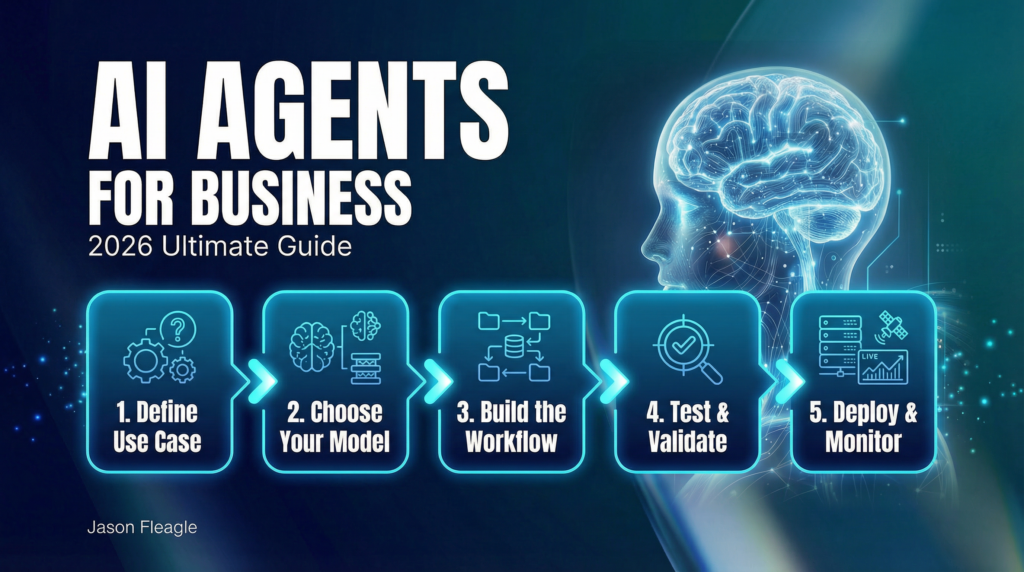
Building an AI agent requires a shift in how you think about software development. You are no longer writing deterministic code (if X, then Y). You are designing systems that can reason, adapt, and make decisions in real time. Here is the framework I use with every client.
The Four Core Components of Any AI Agent
- The Brain (LLM): The underlying model that provides reasoning capabilities. Your choice of model matters. Claude Sonnet 4.6 is currently the best balance of speed, cost, and intelligence for most business applications. GPT-5.4 is the right choice for complex reasoning tasks.
- Memory: The ability to remember past interactions, user preferences, and business context. Without memory, every conversation starts from zero. With it, your agent gets smarter with every interaction.
- Tools (Function Calling): The APIs and integrations that allow the agent to take action—sending emails, querying your CRM, booking calendar appointments, updating databases. This is where agents go from “interesting” to “indispensable.”
- Planning and Routing: The framework the agent uses to break down a complex goal into manageable steps. This is what separates a simple chatbot from a true autonomous agent.
The Enterprise AI Implementation Roadmap
If you are an enterprise leader, you cannot just hand your team ChatGPT accounts and call it an AI strategy. You need a structured approach. I outline this fully in my 8-Step Roadmap to Enterprise AI Success, but the core phases are as follows.
- Phase 1: Audit and Ideation. Identify the high-friction, low-value tasks that are draining your team’s time and your company’s money. The best starting point is always the processes that are repetitive, rule-based, and time-consuming. See how Mississippi College used an AI Ideation Workshop to identify their highest-impact use cases before writing a single line of code.
- Phase 2: The Proof of Concept. Build a tightly scoped agent to solve one specific problem. Prove the ROI before scaling. The goal is not to build the perfect system; it is to build a working system that demonstrates value within 30 days.
- Phase 3: Governance and Security. Establish guardrails before you scale. As I discussed in my AI Governance Framework Case Study, you must protect your data, ensure compliance, and define the boundaries of what your agents are allowed to do. Also read my analysis of the AI security crisis that nobody is talking about.
- Phase 4: Production and Scale. Integrate the agent into your core workflows, connect it to your existing tech stack, and train your team on how to manage and improve their new digital coworkers. This is where the real ROI compounds.
Choosing the Right AI Model for Your Agent
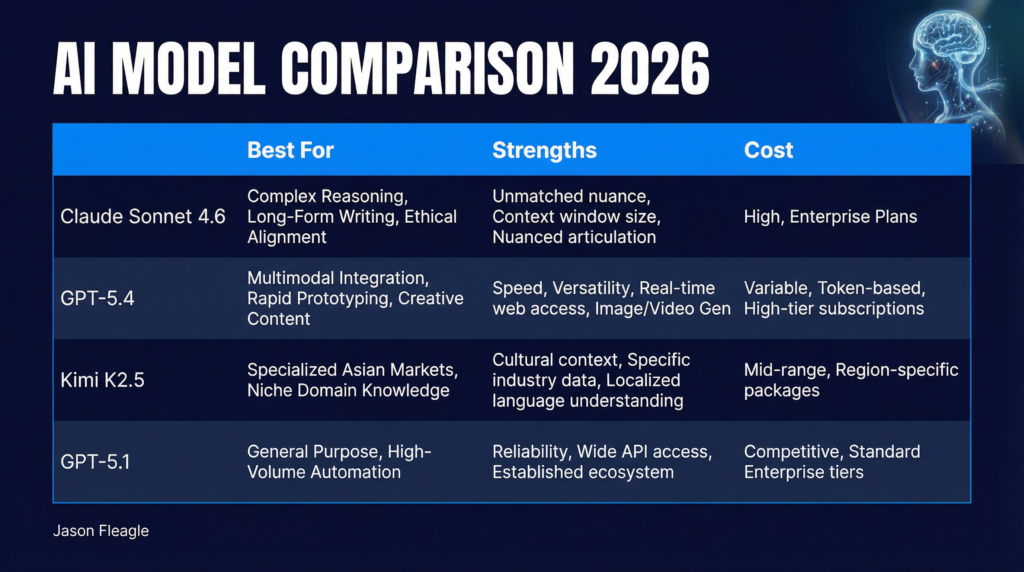
Not all LLMs are created equal, and the model you choose will significantly impact your agent’s performance, cost, and reliability. Here is a practical comparison for business use cases.
| Model | Best For | Cost | Speed |
|---|---|---|---|
| Claude Sonnet 4.6 | Most business agents, customer service, document analysis | Medium | Fast |
| GPT-5.4 | Complex reasoning, code generation, research agents | High | Medium |
| Kimi K2.5 | Multi-agent swarms, open-source deployments | Low | Fast |
| GPT-5.1 | Personalized interactions, long-term memory tasks | Medium | Fast |
The key principle: use the smallest, cheapest model that can reliably complete the task. Over-engineering your model selection is one of the most common and expensive mistakes in AI deployment.
The Future of AI Agents: Swarms, Edge AI, and What’s Next
We are rapidly moving from single-agent systems to Multi-Agent Swarms. Instead of one AI trying to do everything, you will have specialized agents working in concert. A Researcher Agent gathers data and passes it to an Analyst Agent for synthesis, who then hands it to a Writer Agent to draft the deliverable, which is then reviewed by a Quality Control Agent before delivery. Each agent is optimized for its specific function, and the whole is greater than the sum of its parts.
We are already seeing open-source models like Kimi K2.5 utilizing agent swarms to outperform much larger, more expensive proprietary models on complex benchmarks. The democratization of agentic AI is accelerating.
Meanwhile, advancements in Edge AI mean that agents will increasingly run locally on devices and on-premises infrastructure rather than relying entirely on cloud APIs. This reduces latency, improves privacy, and eliminates the dependency on third-party uptime. The break-even math for on-premises AI has shifted dramatically, making local deployment viable for mid-market companies for the first time.
AI agents are also expanding into entirely new domains. ChatGPT Health is entering the clinical environment. OpenAI and PayPal are integrating commerce directly into AI interfaces. OpenAI’s Aardvark is an autonomous security research agent. The scope of what agents can do is expanding every month.
Common Mistakes to Avoid When Deploying AI Agents
After deploying AI agents across dozens of businesses, I have seen the same mistakes repeated. Here are the ones that will cost you the most time and money.
Mistake 1: Starting Too Big
The most common failure mode is trying to automate everything at once. Start with a single, well-defined use case. Prove the ROI. Then scale. The plumbing company did not start by automating their entire business—they started with lead response. That one workflow generated $10,000 in the first month and funded the next phase of deployment.
Mistake 2: Skipping the Governance Step
Deploying an AI agent without a governance framework is like hiring an employee without a job description, an employment contract, or any HR policies. The three AI challenges every leader must solve include governance, and skipping it will eventually create a compliance, security, or reputational problem.
Mistake 3: Trusting the Agent Blindly
AI agents can and do make mistakes. They can hallucinate facts, misinterpret instructions, and take unintended actions. Build human-in-the-loop checkpoints for high-stakes decisions. Review agent outputs regularly. And read my guide on how to make your AI more accurate to understand the specific failure modes and how to mitigate them.
Mistake 4: Ignoring Security
AI agents that have access to your systems, data, and customer information are a significant security surface. Prompt injection attacks, data exfiltration, and unauthorized actions are real risks. Read my analysis of the AI security crisis no one is talking about before you give an agent access to anything sensitive.
Getting Started: Your Next Steps
The biggest mistake leaders make with AI is waiting for the technology to “settle down.” It will not. Every quarter you wait is a quarter your competitors are deploying, learning, and compounding their advantage. The challenges of AI adoption are real, but the cost of inaction is greater.
Here is your action plan:
- Identify your highest-friction workflow. What is the most repetitive, time-consuming task your team does every week? That is your first agent use case.
- Choose your model and framework. For most businesses, start with Claude Sonnet 4.6 or GPT-5.4 via API, integrated with your existing CRM or communication tools.
- Build a scoped proof of concept. Give yourself 30 days to build and test a working agent on your target use case. If it doesn’t show clear ROI in 30 days, pivot.
- Establish governance before scaling. Define what the agent can and cannot do, who owns it, and how you will monitor its performance.
- Scale what works. Once you have a proven agent, expand its scope, connect it to more systems, and start building your second agent.
Ready to Build Your First AI Agent?
Stop experimenting with prompts and start building systems that drive revenue. I help businesses design, build, and deploy custom AI agents that deliver measurable ROI — from lead automation to enterprise-scale deployments.
Additional Resources
This guide is part of an ongoing series on AI strategy and implementation. Explore these related resources to go deeper on specific topics:
- 8-Step Roadmap to Enterprise AI Success: From Pilot to Production
- AI Governance Framework Case Study (Large Healthcare Customer)
- Case Study: How AI Agents Generated $10k+ in Sales for a Plumbing Company
- Case Study: Voice AI Healthcare Roleplay App
- Case Study: ARI AI Chatbot for Military Veterans Community
- Case Study: AI Document Processing for Real Estate Investment
- Your AI Is Lying to You — How to Make It More Accurate
- The AI Security Crisis No One’s Talking About
- On-Premises AI vs. Cloud AI: The Break-Even Math Has Changed
- 3 AI Challenges Every Leader Must Solve