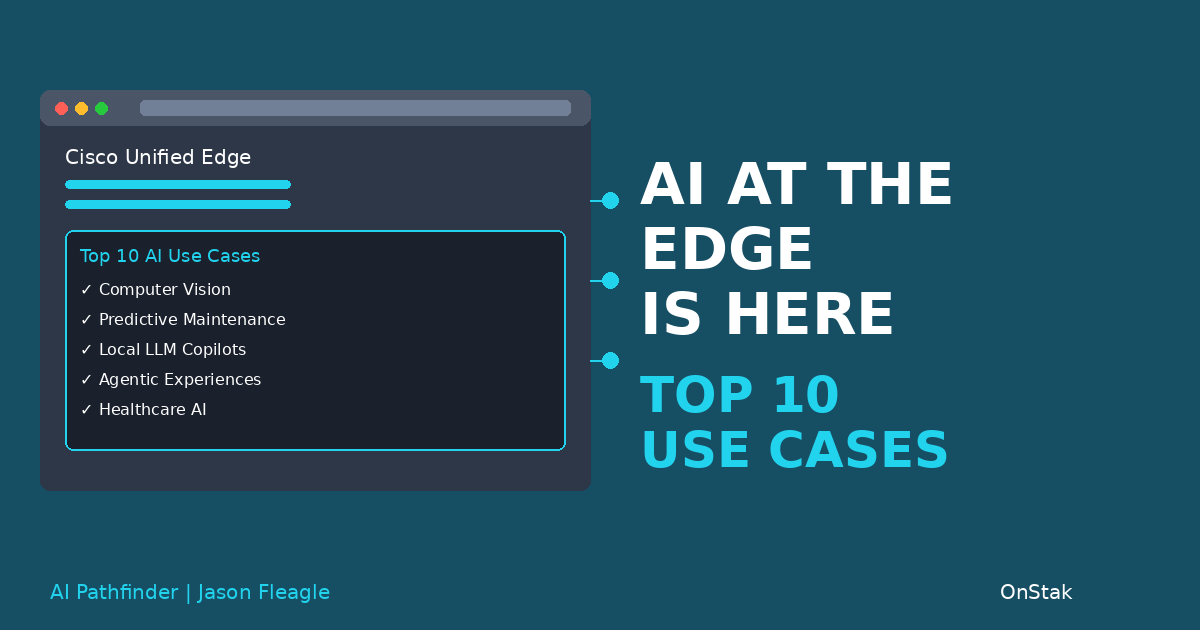
TLDR – Cisco just launched Unified Edge, a modular, AI-ready platform that brings data center power to the edge. Think of it as a “mini AI POD” for every store, factory, or branch office. This article breaks down the top 10 potential AI use cases that can run on this new device, from real-time computer vision to local LLM copilots.
What is Cisco Unified Edge?
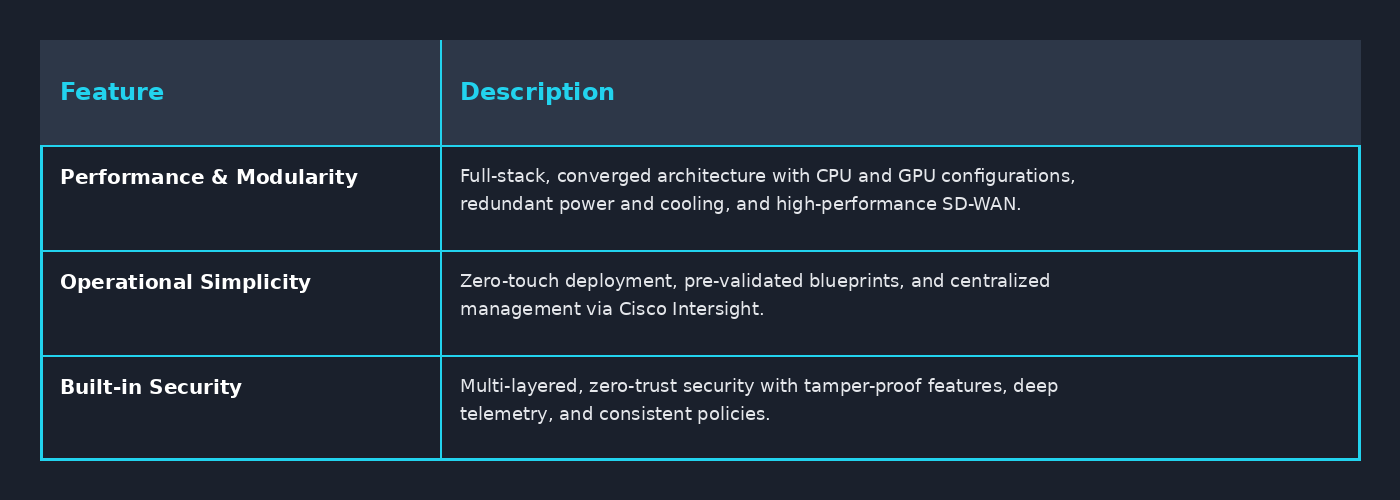
At its Partner Summit in San Diego, Cisco announced the launch of Unified Edge, an integrated computing platform designed for distributed AI workloads [1]. This isn’t just another server; it’s a full-stack, converged architecture that unifies compute, storage, networking, and security into a single, modular system. The goal is to bring the power of the data center to where business actually happens—the edge.
“Today’s infrastructure can’t meet the demands of powering AI at scale. As AI agents and experiences proliferate, they will naturally emerge closer to where customers interact and decisions are made – the branch office, retail store, factory floor, stadium, and more. That’s where compute needs to live. With our Unified Edge we’re making it easier to power AI in the real world with flexible, secure systems that are simple to deploy, operate, and scale as demand grows.”
— Jeetu Patel, President and Chief Product Officer at Cisco [1]
Key Features of Unified Edge
Why This Matters: The Edge is the New AI Frontier
More than half of today’s AI pilots are stalling due to infrastructure constraints. With 75% of enterprise data expected to be created and processed at the edge this year, the need for a new decentralized network architecture is urgent. AI workloads are shifting from centralized model training to real-time inference, and agentic AI queries can generate up to 25 times more network traffic than a chatbot. Traditional data centers struggle to keep up.
Unified Edge is Cisco’s answer to this challenge. It’s a platform designed to grow and adapt without rip-and-replace upgrades, protecting AI investments and powering the next generation of edge-native applications.
Top 10 AI Use Cases for Cisco Unified Edge
Here are the top 10 AI use case patterns that are a perfect fit for the Cisco Unified Edge device:
1. Real-time Computer Vision at the Edge
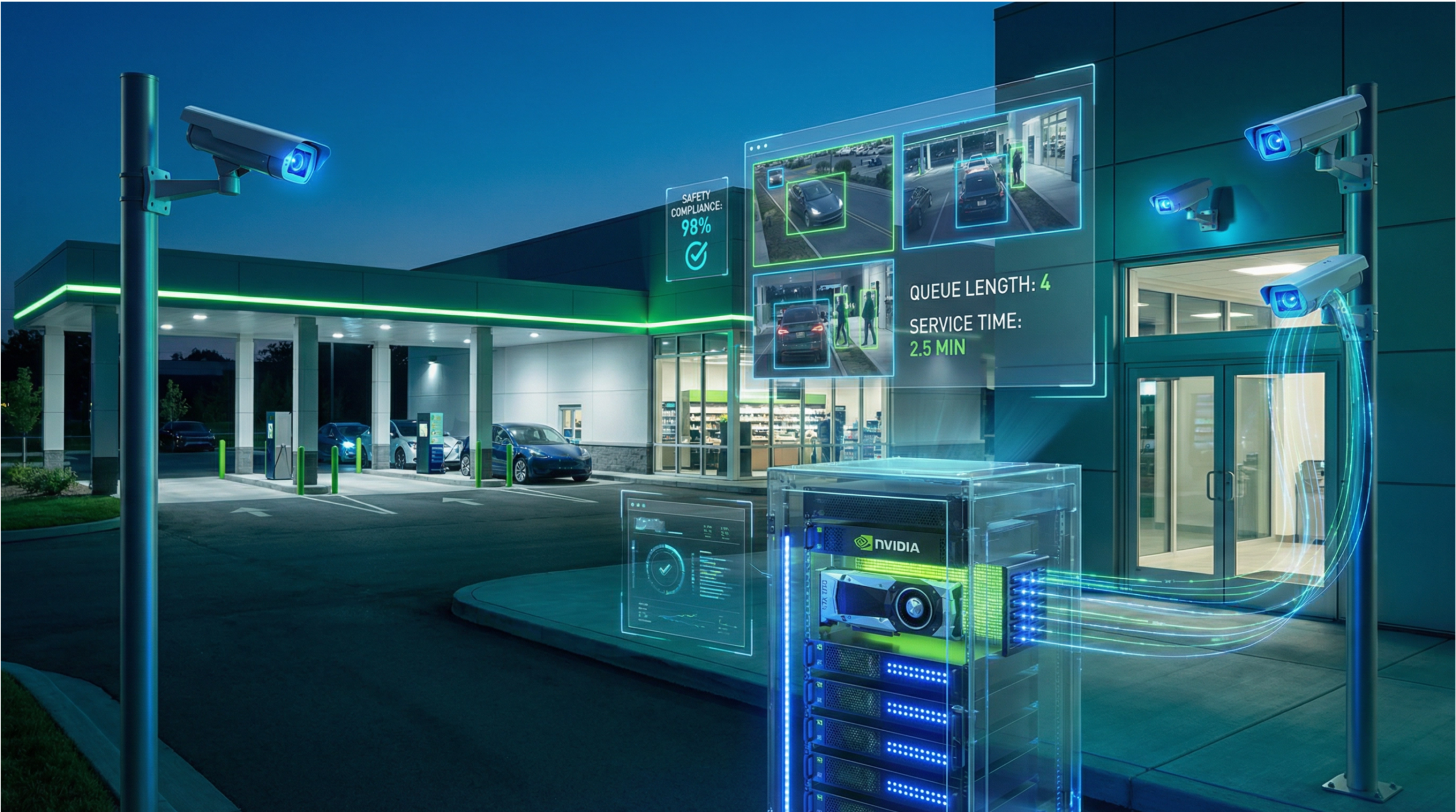
From queue analytics in retail to PPE compliance in manufacturing, running computer vision models locally on Unified Edge keeps raw video data private and reduces bandwidth costs.
2. Predictive Maintenance & Industrial IoT Analytics
In manufacturing and logistics, Unified Edge can run anomaly detection models on sensor data to predict equipment failures and optimize production lines in real time.
3. Local LLM Copilots & RAG for Frontline Workers
Deploying fine-tuned LLMs and Retrieval-Augmented Generation (RAG) systems on Unified Edge provides frontline workers in stores, clinics, and field operations with instant access to SOPs, service manuals, and local data, even with poor WAN connectivity.
4. Agentic Customer-Facing Experiences
From drive-thru ordering agents to in-store concierge kiosks, Unified Edge can power low-latency, conversational AI experiences that pull from local inventory and pricing data without sending sensitive information to the cloud.
5. Healthcare: Bedside & Clinic AI
In hospitals and clinics, Unified Edge can power real-time patient monitoring, fall risk detection, and privacy-preserving clinical scribes, keeping all protected health information (PHI) within the facility.
6. Financial Services: Branch & ATM Intelligence
For banks and credit unions, Unified Edge can run local fraud detection models, analyze ATM and lobby video for suspicious behavior, and track branch service levels to optimize staffing.
7. Smart Building, Stadium, & Campus Optimization
Unified Edge can act as the brain for smart buildings, optimizing HVAC and lighting based on occupancy, managing crowd flow in stadiums, and optimizing cleaning schedules based on actual usage.
8. AI-Assisted Network, Security & Observability
Unified Edge can run local models to classify traffic, tune QoS, detect anomalous flows, and summarize logs and metrics before sending high-value signals to centralized management tools like Splunk or ThousandEyes.
9. Robotics, AMRs, and OT Agent Orchestration
With its ability to run Kubernetes and hypervisors, Unified Edge can host multi-agent orchestrators for autonomous mobile robots (AMRs) in warehouses, robotic picking and packing systems, and port and yard operations.
10. Cross-Site Fleet Intelligence with Local Autonomy
The true power of Unified Edge is the ability to have per-site brains with global control. Models can be trained centrally, deployed to thousands of edge clusters, and continuously tuned with anonymized data collected from each device.
The Governance Questions You Can’t Ignore
As with any powerful new technology, the deployment of agentic AI at the edge raises critical governance questions:
- Data & Access Control: How do you ensure that local AI agents only have access to the data they need to perform their tasks?
- Accuracy & Trust: How do you validate the accuracy of AI-driven decisions and build trust with the frontline workers who rely on them?
- Patch Integrity & Security: How do you securely patch and update models and agents across a distributed fleet of devices?
- Training Data & Confidentiality: How do you ensure that confidential data used for local model training or RAG is not inadvertently exposed?
What to Do Next
For organizations looking to leverage the power of AI at the edge, the path forward involves a three-step process:
- Discover: Identify the highest-value use cases for your specific industry and business context.
- Prove: Start with a small-scale pilot to prove the technical feasibility and business value of your chosen use case.
- Scale: Once you have a proven model, use a platform like Cisco Unified Edge and a management tool like Cisco Intersight to scale your solution across your entire fleet of edge locations.
The Bottom Line
The launch of Cisco Unified Edge marks a significant milestone in the evolution of enterprise AI. By bringing data center power to the edge, Cisco is enabling a new class of real-time, agentic AI applications that will transform industries from retail and manufacturing to healthcare and financial services. For business and IT leaders, the time to start exploring the possibilities of AI at the edge is now.
We are currently working on a large AI project where the Cisco Unified Edge device is powering an AI workload for a large telecom company.
We also can partner with any Cisco partner and company to implement Unified Edge solutions and power the digital transformations enterprise organizations are looking for today.
We’d love to have a conversation with you to learn more about how we can help you.
About OnStak
OnStak specializes in comprehensive AI implementation across four core expertise areas: AI/Data for intelligent knowledge management, AI/Edge for distributed operational intelligence, AI/Performance for optimized system efficiency, and AI/Migrations for seamless technology integration. Our proven methodology helps manufacturing leaders achieve operational transformation while maximizing return on investment.
Here’s a few recent AI projects we’ve delivered:
Case Study: Cricket Sports Team Uses AI to Gain An Advantage
Case Study: Transforming Mental Healthcare With AI
Case Study: ARI AI Chatbot Helps Military Veterans Community
Case Study: AI Helps Healthcare Professionals Roleplay Patient Care
Case Study: AI Document Processing for Real Estate Investment
About Jason Fleagle
Jason Fleagle is the Chief AI Architect at OnStak, and is also a writer, entrepreneur, and consultant specializing in tech, AI, and growth. He helps humanize data—so every growth decision an organization makes is rooted in clarity and confidence. Jason has helped lead the development and delivery of over 150 AI applications, and frequently conducts training workshops to help companies understand and adopt AI. With a strong background in digital marketing, content strategy, and technology, he combines technical expertise with business acumen to create scalable solutions. He is also a content creator, producing videos, workshops, and thought leadership on AI, entrepreneurship, and growth. He continues to explore ways to leverage AI for good and improve human-to-human connections while balancing family, business, and creative pursuits.
Looking for AI Growth?
Let’s Talk About Your AI Goals!
What would you do if you could determine the top AI use cases or opportunities for you and your team?
We can help you go from surviving to thriving – with done-for-you business growth implementations.
You can learn more about Jason on his website here.
You can learn more about OnStak here.
You can learn more about our top AI case studies here on our website.
Learn more about my AI resources here on my youtube channel.
And check out my AI online course.