TLDR:
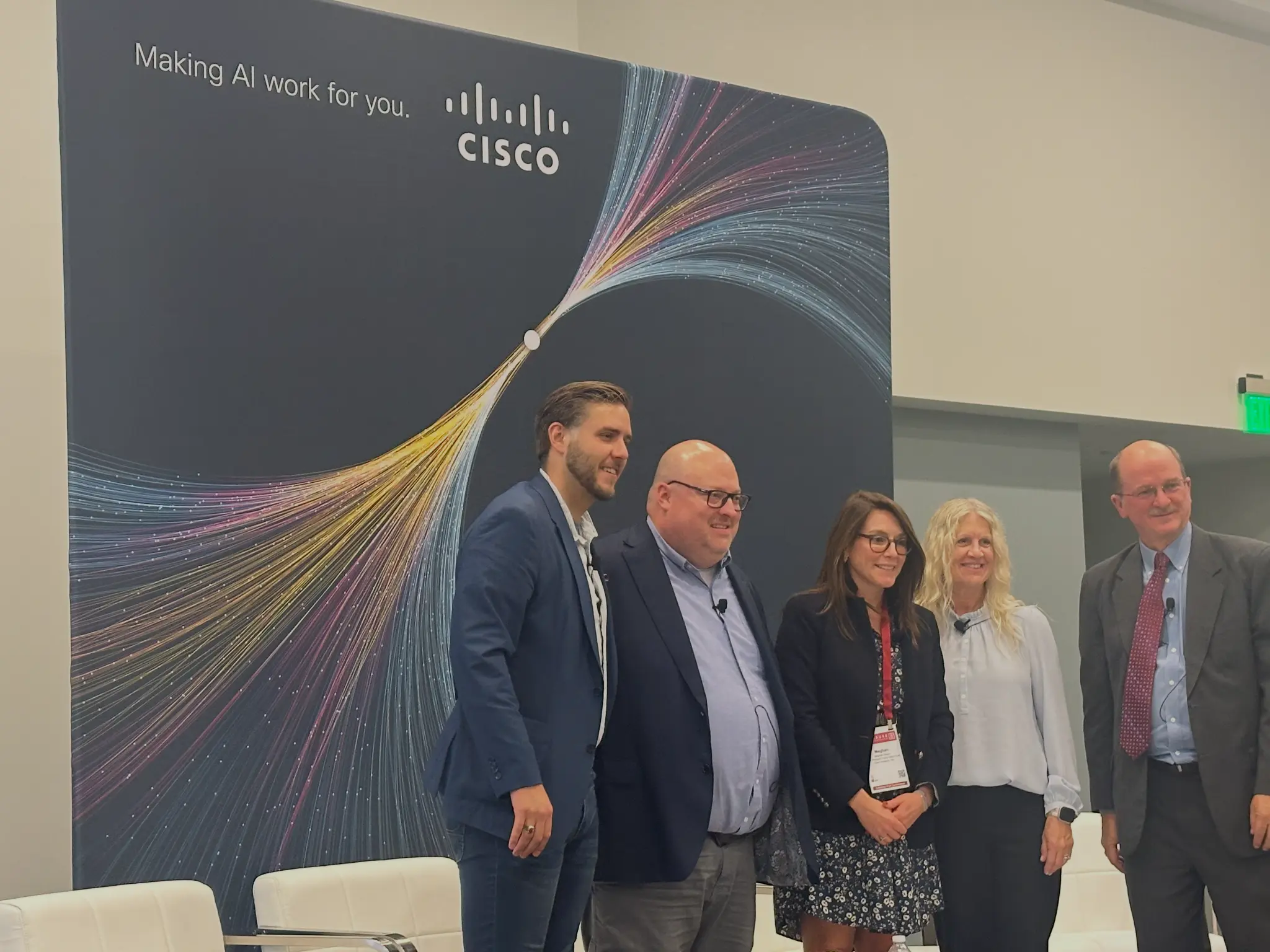
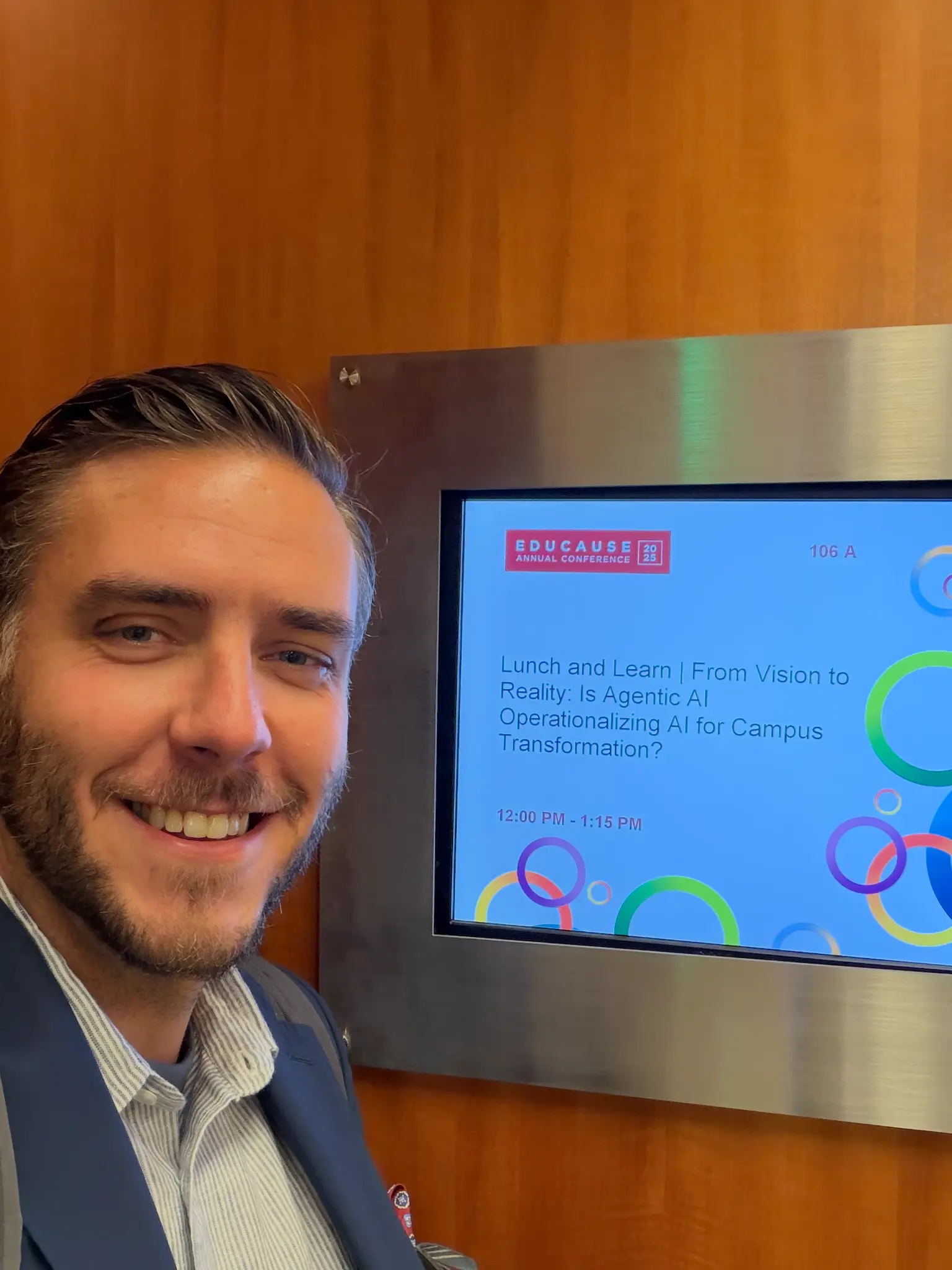
This week at the EDUCAUSE Annual Conference, I had the privilege of speaking on a panel hosted by Cisco about the shift from AI vision to operational reality in higher education. The core message was clear: Agentic AI is not a chatbot story, but more of a governed automation story. While many institutions are still in the “cool demo” phase, the campuses winning right now are shipping small, measurable AI agents on secure infrastructure and then scaling what works. This isn’t about replacing roles, it’s about creating an ‘assistant for every role’ that can reason over institutional data, take actions through approved tools, and verify outcome, safely and audibly by design.
What is Agentic AI (And Why Does It Matter in Higher Ed)?
Agentic AI represents a fundamental shift from passive, conversational AI to proactive, goal-seeking systems. Instead of just answering questions, these agents can plan, call tools and APIs, and take constrained actions to achieve a specific goal. Think of it as a closed-loop system for getting work done.
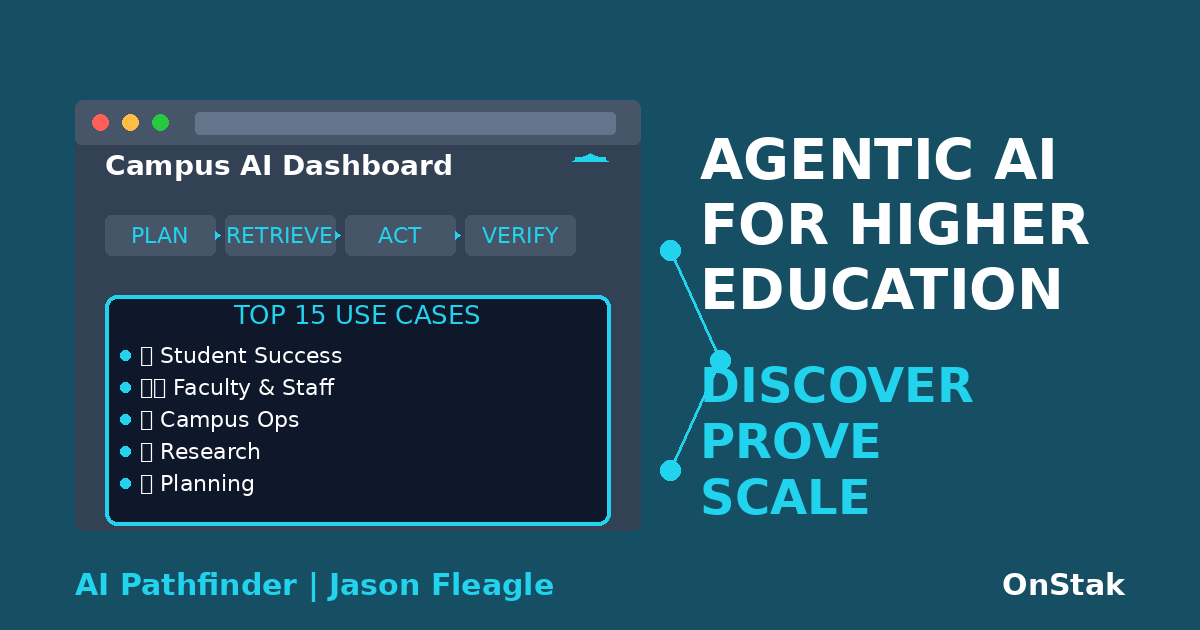
The Core Loop: Plan → Retrieve → Act → Verify → Log
This matters because it moves AI beyond simple Q&A and into the realm of tangible, operational outcomes. It allows universities to scale the capacity of their scarce staff, ensure policy is executed consistently every time, and maintain a complete audit trail for every action taken.
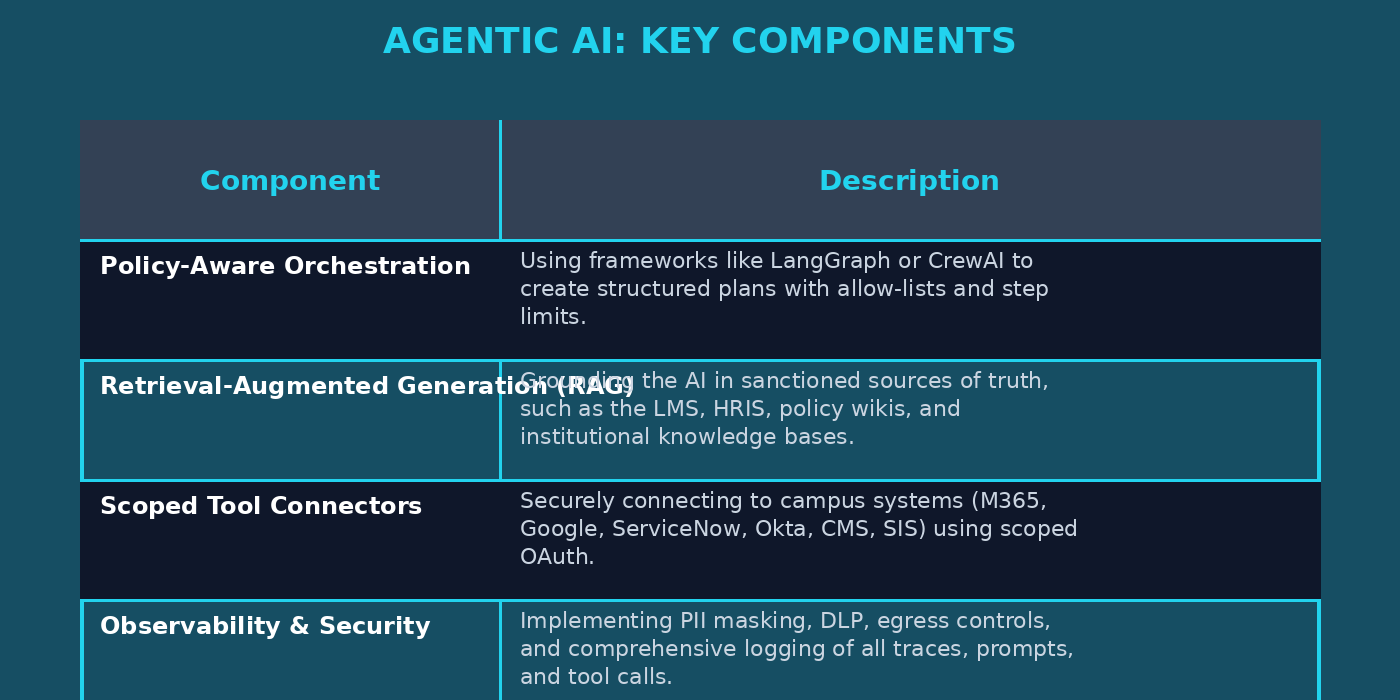
The Key Ingredients for Agentic AI
Building effective agentic AI requires a robust architecture. Here are the essential components we typically implement at OnStak:
From Use Case to Reality: The Discover → Prove → Scale Methodology
How do you move from a list of potential AI use cases to a production-ready agent? I’ve developed a simple process going from idea to production and now have operationalized it at OnStak. We follow a simple, three-step rhythm designed to de-risk investment and deliver measurable value quickly.
1. Discover (Business + Data + Risk)
First, we identify high-friction workflows with clear, measurable outcomes. We look for metrics like ticket handle time, error rates, compliance defects, or time-to-publish. We assess data readiness—identifying the systems of record—and define the risk posture, determining where human-in-the-loop approvals are required.
2. Prove (2–3 Weeks of Hands-On Work)
Next, we build a “thin slice” of the agent, focusing on one role, one dataset, and two or three tools. We create evaluation harnesses to test for accuracy and hallucinations and run the agent side-by-side with the existing manual process. The goal is to prove we can move the needle on a key metric.
3. Scale (Production & Operations)
Once the value is proven, we scale. This involves moving to policy-driven agents for entire departments, onboarding more tools and datasets, and standing up the necessary observability and governance infrastructure. We also optimize for cost and performance, choosing the right models and infrastructure (on-prem, cloud, or hybrid) for each specific workflow.
Rule of thumb: If a task has a repeatable policy, known systems of record, and measurable outcomes, it’s AI agent-ready.
The Top 15 AI Use Cases for Higher Education
Based on our work with universities, here are the most impactful AI use cases we’re seeing today, grouped into key transformation areas.
🎓 Student Experience & Academic Success
- Predictive Analytics for Enrollment & Retention: Analyze application trends and student behavior to predict and improve retention rates.
- AI Student Assistant: A conversational AI to help students manage coursework, schedule advising, and navigate campus services.
- Mental Health Companion: Provide HIPAA-compliant mental health check-ins and triage students to the appropriate services.
- Voice AI Role-play & Coaching: Allow students to practice interviews or clinical simulations with automated scoring and feedback.
- Course Content & Accessibility: Automate the creation of syllabi and course materials while ensuring ADA/508 compliance.
🧑🏫 Faculty & Staff Enablement
- Onboarding/Offboarding Agents: Automate account management, system access, and compliance tracking for new and departing employees.
- Faculty Privilege Management: Dynamically adjust access to research databases and internal platforms based on role changes.
- HR Lifecycle Agents: Automate routine HR tasks like profile updates, scheduling, and logging to reduce manual overhead.
🛡️ Campus Operations & Security
- Cybersecurity Threat Prediction: Use AI to analyze logs and behavior to detect and respond to threats in real-time.
- Campus Safety with Vision + Agents: Leverage existing cameras to detect anomalies, manage events, and trigger automated responses. This is one of our strongest areas of expertise, check out our case study at OnStak here.
- IT Help Desk Automation: Triage tickets, execute runbooks for common issues, and escalate complex problems with full context.
- Predictive Maintenance: Use IoT and AI to monitor campus equipment and predict failures before they happen.
🧪 Research & Innovation
- Research Compliance Agents: Assist with grant applications, export control checks, and PII/PHI detection in datasets.
- AI Copilots for Research: Accelerate research productivity with support for literature reviews, code generation, and data analysis.
🧠 Infrastructure & Strategic Planning
- AI-Driven Institutional Planning: Model enrollment scenarios, course demand, and staffing projections to optimize resource allocation.
Agentic AI in Action: OnStak Project Prototype Snapshots
- University in Central USA: We developed an HR AI agent prototype that automates the entire staff offboarding process. It pulls the official HR record, deactivates email and SSO, removes the user from all groups, updates the staff web profile, and opens closure tasks in ServiceNow—all with approvals and logs for every step.
- University in the South: We built AI assistant pilot for Student Services and the IT Help Desk. Agents are grounded in policy handbooks and the LMS to file tickets, summarize interactions, and generate communications, resulting in a measurable reduction in manual triage time.
- Public Healthcare University: We implemented a Voice AI role-playing system prototype that allows students & professionals to practice patient interactions. The system provides real-time feedback, scores performance against a rubric, and pushes the results directly into a private database.
The Governance Questions You Can’t Ignore
Agentic AI is powerful, but it requires a foundation of trust and governance. Here are the critical questions every institution must answer:
- Data & Identity: Are you using identity-first agents with least-privilege access? Are you grounding them only in sanctioned sources of truth?
- Accuracy & Evaluation: How do you protect against hallucinations? Are you using red-teaming, golden-set testing, and regression checks on every change?
- Auditability: Are all prompts, tool calls, and results immutable and queryable? Can you prove an agent followed policy?
- Infrastructure: Does your data classification policy drive your infrastructure choices? Are you using on-prem/hybrid inference for sensitive FERPA/PII data?
The Bottom Line
Agentic AI is ready to move from pilots to production. The campuses that will lead in this next chapter are not the ones building the biggest, most complex models. They are the ones that are methodically identifying high-value workflows, proving value with small-scale agents, and scaling what works on a secure, governed, and right-sized infrastructure.
The era of the AI-powered campus is here. It’s not about replacing people; it’s about augmenting them with tireless, policy-driven assistants that free them to focus on their core mission: education and research.
What is the #1 operational bottleneck at your institution that could be solved with a governed AI agent?
About OnStak
OnStak specializes in comprehensive AI implementation across four core expertise areas: AI/Data for intelligent knowledge management, AI/Edge for distributed operational intelligence, AI/Performance for optimized system efficiency, and AI/Migrations for seamless technology integration. Our proven methodology helps manufacturing leaders achieve operational transformation while maximizing return on investment.
Here’s a few recent AI projects we’ve delivered:
Case Study: Cricket Sports Team Uses AI to Gain An Advantage
Case Study: Transforming Mental Healthcare With AI
Case Study: ARI AI Chatbot Helps Military Veterans Community
Case Study: AI Helps Healthcare Professionals Roleplay Patient Care
Case Study: AI Document Processing for Real Estate Investment
About Jason Fleagle
Jason Fleagle is the Chief AI Architect at OnStak, and is also a writer, entrepreneur, and consultant specializing in tech, AI, and growth. He helps humanize data—so every growth decision an organization makes is rooted in clarity and confidence. Jason has helped lead the development and delivery of over 150 AI applications, and frequently conducts training workshops to help companies understand and adopt AI. With a strong background in digital marketing, content strategy, and technology, he combines technical expertise with business acumen to create scalable solutions. He is also a content creator, producing videos, workshops, and thought leadership on AI, entrepreneurship, and growth. He continues to explore ways to leverage AI for good and improve human-to-human connections while balancing family, business, and creative pursuits.
Looking for AI Growth?
Let’s Talk About Your AI Goals!
What would you do if you could determine the top AI use cases or opportunities for you and your team?
We can help you go from surviving to thriving – with done-for-you business growth implementations.
- You can learn more about Jason on his website here.
- You can learn more about OnStak here.
- You can learn more about our top AI case studies here on our website.
- Learn more about my AI resources here on my youtube channel.
- And check out my AI online course.