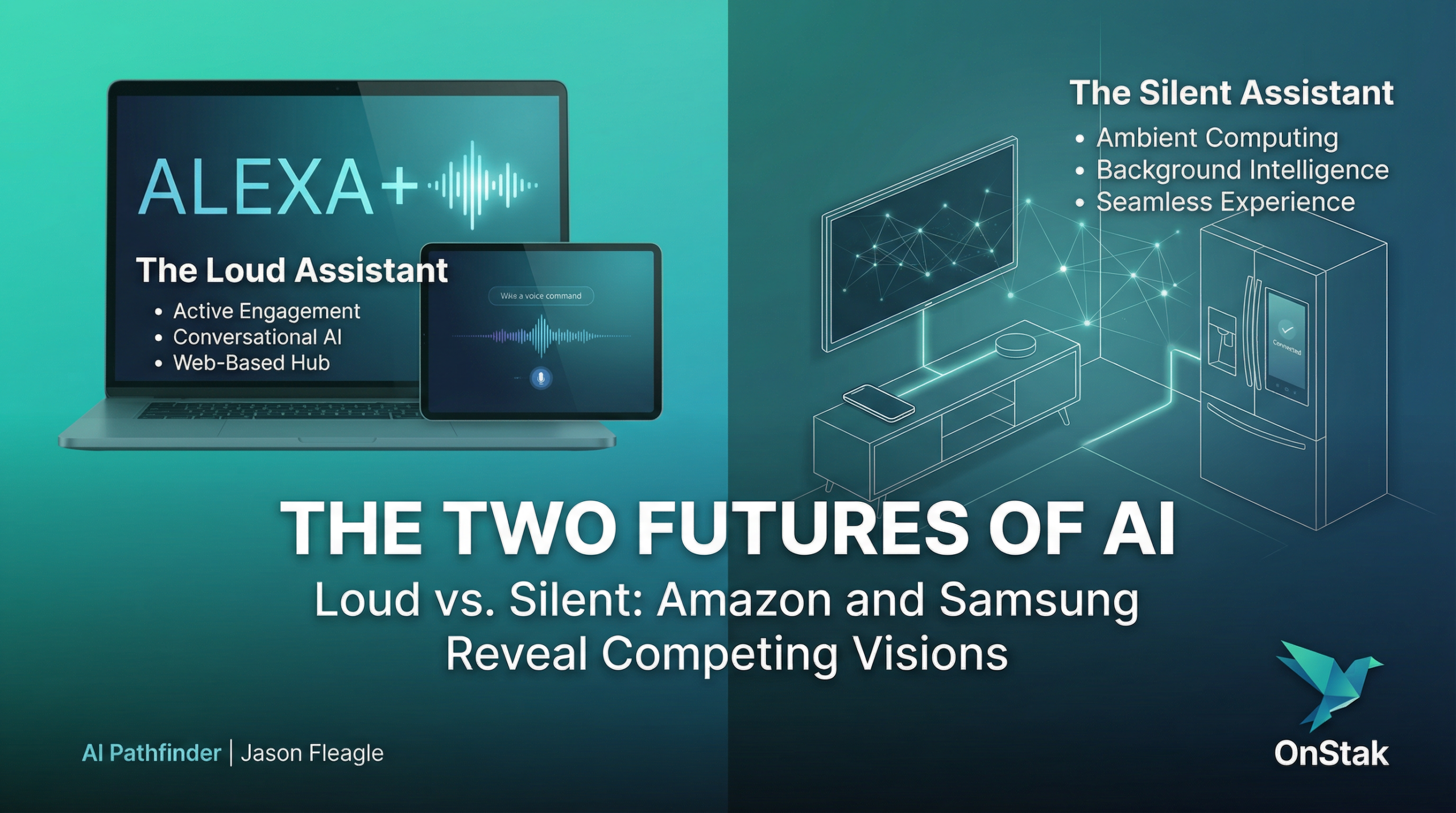
For the past year, the AI race has been deafening. Louder models, bigger announcements, and a constant battle for our attention. But as the dust settles from CES 2026, a fascinating divide is emerging, revealing two fundamentally different futures for how we will interact with artificial intelligence.
On one side, Amazon is making Alexa louder. It’s bringing its AI to the web, making it more conversational, and asking for more of your data to become a central organizational hub. On the other side, Samsung is making its AI silent. It’s embedding intelligence into the background of your home, aiming for an experience that’s so seamless it feels like electricity—always on, but rarely noticed.
These aren’t just different product strategies; they are competing philosophies for the future of human-AI interaction. For enterprise leaders, understanding this loud vs. silent dichotomy is critical to making the right bets on your own AI-powered future.
Let’s break down these two paths and what they mean for you.
Path 1: The “Loud” Assistant – Amazon Makes Alexa a Web-Based Brain
Amazon’s big move at CES was launching a web-based version of Alexa+ for early users [1]. This is a direct shot at ChatGPT and Gemini, transforming Alexa from a voice assistant on your speaker to a general-purpose AI you can interact with on your computer. The goal is to make Alexa the central hub for your life, capable of planning itineraries, generating content, and managing your smart home.
To achieve this, Amazon is asking for access to your personal documents, emails, and schedules. It wants to be the brain that organizes your household, compensating for its lack of a native productivity suite like Google or Microsoft. Early metrics are promising, with 2-3x more conversations than the original Alexa, but it comes with a significant trade-off: trust. Can Amazon convince users to hand over their most sensitive data to an AI assistant that has a history of misfires?
This “loud” approach is about active engagement. It requires you to prompt, converse, and consciously “use AI” to get things done.
Path 2: The “Silent” Assistant – Samsung Makes the Home the AI
Samsung took the exact opposite approach. Instead of a flashy chatbot, it showcased a vision where AI disappears into the fabric of your home [2]. Your TV, fridge, phone, and appliances work as a single, context-aware system. The AI learns your routines and makes decisions in the background—adjusting energy use, tracking health metrics, and managing home comfort without a single prompt.
This is the smart home experience Amazon promised with Alexa but never quite delivered. Samsung isn’t trying to make its AI smarter in isolation; it’s making it calmer, more distributed, and useful to everyone without a learning curve. The goal isn’t for you to use AI, but for your environment to be enhanced by it.
This “silent” approach is about ambient computing. The AI is a utility that works for you, not a personality you have to manage.
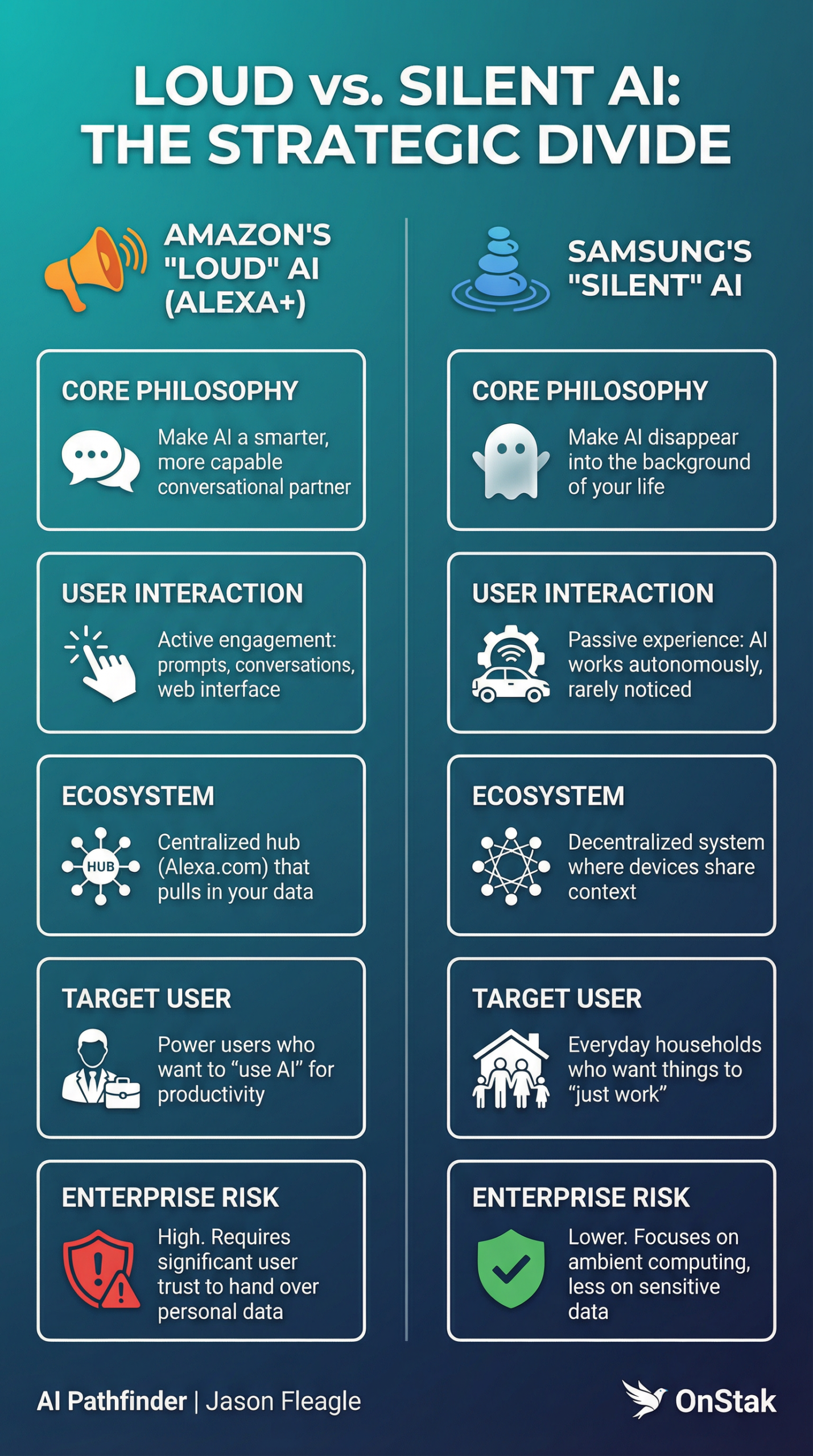
The Strategic Divide: Loud vs. Silent AI
For enterprise leaders, this isn’t just about smart speakers. It’s a framework for thinking about your own AI strategy. Do your customers want a powerful tool they can actively command, or an intelligent environment that anticipates their needs?
What This Means for Your Business
The loud vs. silent framework should guide your product development and customer experience strategy.
- If you are building tools for expert users (e.g., financial analysis, coding assistants, research tools), a “loud” AI that offers powerful, direct control is likely the right path.
- If you are building products for everyday consumers (e.g., smart home devices, wellness apps, e-commerce platforms), a “silent” AI that reduces friction and works in the background will create a more magical and sticky experience.
The most important question to ask is: Does our AI serve the user, or does it demand the user serve the AI?
In Other News: The AI World Keeps Spinning
Beyond the loud vs. silent debate, several other key developments caught my eye:
- The Rise of AI-Generated Misinformation: A viral Reddit post claiming to expose exploitation at a food delivery company was flagged by multiple AI detectors as machine-generated [1]. The post, complete with a fake AI-generated employee badge, shows how easily AI can be used to weaponize real-world problems and spread believable misinformation at scale. For brands, this means the threat of AI-driven reputation attacks is now very real.
- GEO is the New SEO: Brands are beginning to shift from Search Engine Optimization (SEO) to Generative Engine Optimization (GEO) [2]. As AI platforms like Perplexity and ChatGPT become the new starting point for discovery, optimizing your content to be found and synthesized by these models is becoming a critical marketing strategy for 2026.
- The Reality of Home Robots: A viral video of a robot that can tidy up a room is impressive, but it’s still a controlled demo [2]. The reality is that home robots are still far from being able to handle the chaotic, unpredictable nature of a real home. They are impressive assistants, but not yet autonomous household staples.
The Bottom Line
The future of AI isn’t a single path. It’s a spectrum, with the “loud” and “silent” approaches of Amazon and Samsung defining the two extremes. As you build your own AI strategy, the most important decision you’ll make is where on that spectrum your business needs to be.
Will you build an AI that your customers talk to, or one they never have to think about at all?
Please feel free to drop a comment or DM me if you have a question or if you’re interested in working with a team of AI experts to help you along your AI adoption journey.
And remember to keep moving forward!
About Jason
Jason Fleagle is the Chief AI Architect at OnStak, and is also a writer, entrepreneur, and consultant specializing in tech, AI, and growth. He helps humanize data—so every growth decision an organization makes is rooted in clarity and confidence. Jason has helped lead the development and delivery of over 500 AI projects & tools, and frequently conducts training workshops to help companies understand and adopt AI. With a strong background in digital marketing, content strategy, and technology, he combines technical expertise with business acumen to create scalable solutions. He is also a content creator, producing videos, workshops, and thought leadership on AI, entrepreneurship, and growth. He continues to explore ways to leverage AI for good and improve human-to-human connections while balancing family, business, and creative pursuits.
Looking for AI Growth?
Let’s Talk About Your AI Goals!
What would you do if you could determine the top AI use cases or opportunities for you and your team?
We can help you go from surviving to thriving – with done-for-you business growth implementations.
You can learn more about Jason on his website here.
You can learn more about OnStak here.
You can learn more about our top AI case studies here on our website.
Learn more about my AI resources here on my youtube channel.
And check out my AI online course.